StudentRND’s pitch deck is a straightforward, mission-driven presentation that prioritizes social impact and community building over traditional SaaS metrics. The organization seeks $350,000 in sponsorships to scale two primary products: CodeDay, a national hackathon series, and the StudentRND Incubator, an 8-week summer program. The deck relies heavily on a single high-profile success story—Tapin.TV, a Y Combinator-backed startup—to validate its incubator model. While the expansion plan is ambitious, projecting growth from 5 to 50 cities in three years, the deck lacks detailed financial proj…
Key takeaways
- The organization identifies a psychological barrier where students view successful young creators as 'prodigies' rather than peers (Slide 2).
- The business model relies on two pillars: 'Super Fun Events' and an 'Intensive Summer Program' (Slide 3).
- The StudentRND Incubator is an 8-week commitment for students to build apps, games, and robotics (Slide 4).
- Validation is provided through Tapin.TV, an alumnus project that secured Y Combinator funding (Slide 5).
- CodeDay is the primary vehicle for national expansion, with a pilot event noted for Portland (Slide 6).
- The expansion plan targets 50 cities for CodeDay and 60 teams for the Incubator by 2015 (Slide 7).
- The total funding ask is $350,000 in sponsorships to facilitate national growth (Slide 8).
- A specific 'Supporting Sponsor' tier is priced at $10,000, offering recruiting access and branding (Slide 9).
Deck Overview
The StudentRND pitch deck is a 17-slide presentation (9 slides provided for this teardown) that outlines a mission to bridge the gap between student interest in technology and actual creation. The deck is structured as a sponsorship proposal rather than a venture capital pitch, focusing on the social and educational impact of their programs. The aesthetic is minimal, utilizing high-contrast text on black backgrounds and full-bleed imagery to convey the energy of their events.
Slide 1: Title and Team
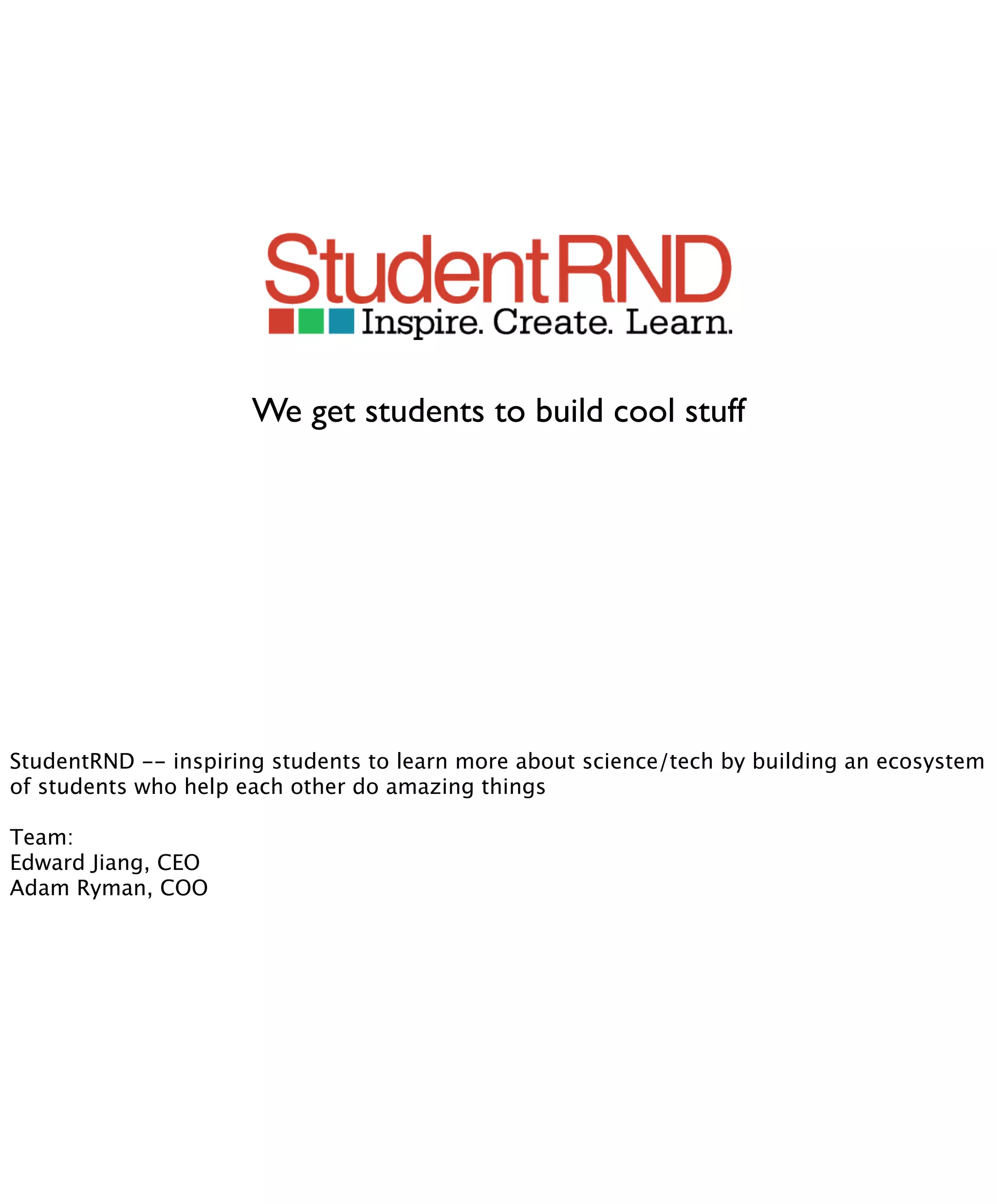
The cover slide introduces the brand with the tagline: "We get students to build cool stuff." It defines the mission as building an ecosystem where students help each other. The team is listed as Edward Jiang, CEO and Adam Ryman, COO . Notably, this slide lacks any biographical information or credentials, which is a significant omission for a program predicated on educational leadership and organizational scaling.
Slide 2: The Problem
The problem slide addresses a psychological barrier rather than a market inefficiency. It states, "Students don’t realize they can do amazing things." The notes explain that students often view successful peers as "prodigies" and don't see a path for themselves. It identifies two segments: talented students who lack the connection to their own potential, and motivated students who "don’t even know where to start." This slide effectively sets the emotional stage but lacks data on the number of students affected or the economic cost of this untapped potential.
Slide 3: The Solution
The solution is presented as a two-pronged approach: "Super Fun Events + Intensive Summer Program." The background image features the Seattle skyline, establishing the organization's current base of operations. This slide is high-level and serves as a transition into the specific product offerings.
Slide 4: The StudentRND Incubator
This slide details the "StudentRND Incubator," described as an 8-week summer commitment where teams build apps, games, robotics, or electronics. The goal is to "Redefine how society sees students." The notes mention that even students who are not accepted into the formal program can participate in the community by "hanging out at the space, or participating in our meetups." This suggests a physical location is central to their current model, though the deck does not detail the costs associated with maintaining such a space.
Slide 5: Proof of Concept (Tapin.TV)
To validate the incubator, the deck highlights Tapin.TV . The notes state that the team started with an unrelated project during the summer and later created a video-sharing service. The key metric here is external validation: "They’re now a YCombinator-funded startup, and are currently raising their seed round." Using a YC-backed company as a case study is a strong move, as it provides immediate credibility to the quality of students StudentRND attracts and nurtures.
Slide 6: CodeDay Expansion
The deck introduces "CodeDay" as the primary vehicle for national reach. The slide shows a map of the United States with arrows pointing from Seattle to various regions. The notes specify they are "Testing an event in Portland next month" and aim to make CodeDay "THE best event for students to build apps and games." It explicitly contrasts CodeDay with other competitions where students merely "win awards for their resume," emphasizing a culture of 'doing' over 'winning.'
Slide 7: Expansion Plan
This slide provides a clear, albeit aggressive, growth roadmap. For CodeDay , the targets are:
The jump from 5 to 50 cities in two years is a massive operational undertaking. The deck omits how they plan to staff these cities or maintain the 'community' feel at that scale.
Slide 8: The Ask
The financial requirement is stated as: "We’re raising a total of $350,000 in sponsorships to launch CodeDays across the country, and expand the Incubator." The funds are earmarked for National/Regional Partnerships, Event Space, Public Relations, and Sponsoring StudentRND. The use of the word "sponsorships" confirms this is likely a non-profit fundraising effort rather than an equity round. There is no breakdown of how the $350,000 is allocated between these four categories.
Slide 9: Sponsor Tiers
The final provided slide details the "Supporting Sponsor" level at $10,000 . It targets companies in Seattle, San Francisco, Portland, New York, and Boston. The benefits include a "Presentation slot, 5 mins during opening," and "Recruiting information from students." This slide clearly identifies the business model: selling access to high-potential technical talent to corporate recruiters. It is a pragmatic way to fund a non-profit, but the deck does not provide data on previous sponsor retention or the success rate of student placements.
What Works Well
Clear Product Distinction: The deck does a good job of separating the top-of-funnel 'fun' events (CodeDay) from the deep-funnel 'intensive' program (Incubator). This shows a clear understanding of the student journey from curiosity to creation.
High-Value Validation: Citing a Y Combinator-backed alumnus is the strongest possible validation for a tech-focused educational program. It proves that the 'cool stuff' students build has real-world market value.
Specific Call to Action: Slide 9 is very tactical. By pricing a sponsorship tier at $10,000 and listing specific benefits, the founders make it easy for a corporate social responsibility (CSR) or recruiting lead to say 'yes' without lengthy negotiations.
What Is Missing
Operational Logistics: Expanding to 50 cities requires more than just money; it requires a playbook, local leads, and quality control. The deck does not mention if these events are run by volunteers, student ambassadors, or full-time staff.
Budget Breakdown: A $350,000 ask for a 50-city expansion seems lean. Without a slide showing the cost per city or the cost per student, it is difficult to assess if the organization is asking for enough—or too much—to achieve its goals.
Sustainability Beyond Sponsorship: The deck relies entirely on sponsorships. There is no mention of registration fees, licensing of their 'CodeDay' model, or long-term endowments. This makes the organization vulnerable to fluctuations in corporate marketing budgets.
Detailed Team Backgrounds: While the founders are named, their ability to execute a national rollout is not supported by any listed experience. In a mission-driven pitch, the 'why us' is just as important as the 'what.'
Founder Takeaways
Use Case Studies Wisely: If you have one 'star' outcome, lead with it. StudentRND uses Tapin.TV to bridge the gap between 'students building toys' and 'students building companies.' This is a powerful narrative tool.
Define Your Tiers: If you are raising sponsorships or selling a service, don't be vague. The $10,000 Supporting Sponsor slide is a great example of how to package a value proposition for a specific buyer (in this case, tech recruiters).
Address the 'Prodigy' Myth: The insight on Slide 2 regarding how students perceive their own potential is a strong psychological hook. Founders should always look for these non-obvious barriers to entry in their market and explain how their solution removes them.
Frequently asked questions
- Is StudentRND a non-profit or a for-profit startup?
- The deck does not explicitly state the legal structure, but the language used—specifically 'sponsorships' rather than 'equity' or 'investment' on Slide 8—strongly suggests a non-profit or community-interest model. The focus is on educational outcomes and ecosystem building rather than revenue multiples or exit strategies.
- How does StudentRND measure success?
- Success is measured through two primary metrics: geographic reach and student output. Slide 7 tracks the number of cities for CodeDay (aiming for 50 by 2015) and the number of teams in the Incubator (aiming for 60 by 2015). The deck also uses the success of individual projects, like Tapin.TV, as a qualitative KPI.
- What is the primary value proposition for sponsors?
- According to Slide 9, the value proposition for a $10,000 sponsor includes 'Recruiting information from students,' branding on events, and a 5-minute presentation slot. It positions the sponsorship as a way for companies to develop a pipeline of 'talented, passionate, and motivated entrepreneurial people' vital to the sponsor's long-term success.
- What is missing from the team slide?
- Slide 1 lists Edward Jiang as CEO and Adam Ryman as COO. However, it lacks any professional background, prior achievements, or technical credentials for either founder. There is no mention of an advisory board, mentors, or the staff required to manage a 50-city expansion.
- What are the biggest risks in the expansion plan?
- The plan (Slide 7) requires a 10x increase in CodeDay cities (5 to 50) and a 4x increase in Incubator teams (15 to 60) within two years. The deck does not explain how they will maintain quality control, manage local logistics in 50 different markets, or if the $350,000 ask is sufficient to cover the overhead of such a rapid scale-up.