Studnt is a personalized AI tutor platform designed to provide immediate, course-specific academic support. The deck highlights a significant post-COVID gap in student performance, noting that 50% of students started 2022 below grade level (Slide 2). Unlike generalized competitors like Chegg or CourseHero, Studnt differentiates itself by using specific class content to train its models, aiming for higher reliability and lower costs (Slide 3). The product features a 'Choose Class' interface that allows students to select specific university courses, such as those at Concordia University (Slide…
Key takeaways
- The platform addresses a 100% increase in tutorial session demand in Quebec classrooms since 2019 (Slide 2).
- Studnt positions itself as a cheaper and more reliable alternative to incumbents like Chegg, CourseHero, and Studocu (Slide 3).
- Technical reliability is attributed to the use of GPT-4, which the deck states uses 45 gigabytes of training data and 100 trillion parameters (Slide 3).
- The 'Choose Class' feature allows for curriculum-aligned assistance rather than generalized answers (Slide 5).
- Market adoption relies heavily on social media (TikTok/Facebook) and organic search traffic (Slide 6).
- The company identifies its primary competitive advantages as being niche-focused, easy to use, and reliable (Slide 7).
- A user testimonial from a Concordia University student validates the 'one-on-one tutor' experience for elective classes (Slide 8).
- The deck lacks essential fundraising components including a team slide, financial projections, and a specific investment ask.
The Studnt Pitch Deck: A Deep Dive into Hyper-Local EdTech
Studnt enters the crowded EdTech market with a specific thesis: generalized AI is not enough for the modern university student. By focusing on course-specific data, they aim to solve the accuracy problems that plague broader platforms. This teardown examines the eight provided slides of their 24-slide deck to see how they build their case for a 'Personalized AI Tutor Platform.'
Slide 1: Title and Vision
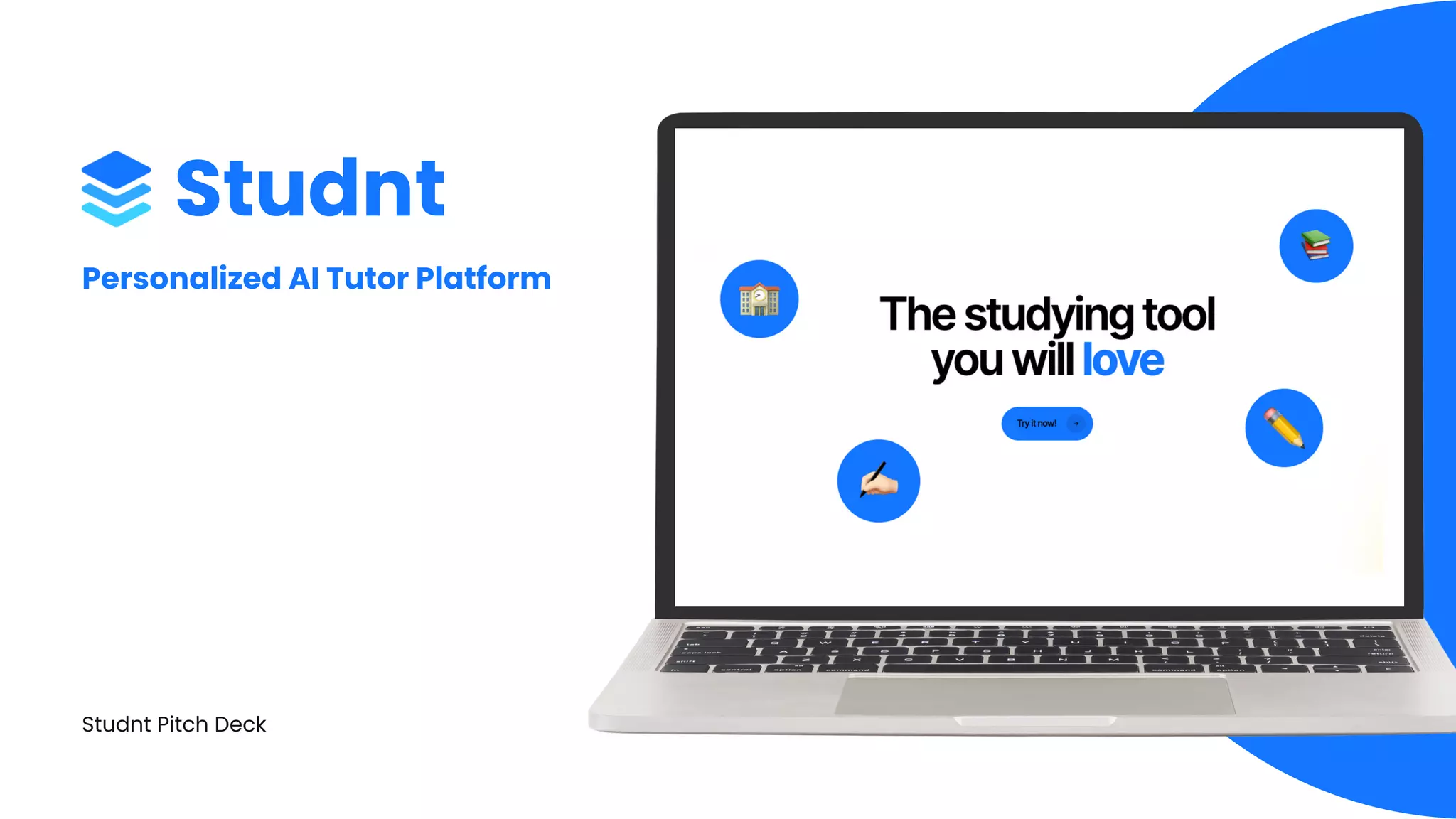
The cover slide is minimalist, featuring the brand name 'Studnt' and the tagline 'Personalized AI Tutor Platform.' It uses a clean, tech-forward aesthetic with a laptop mockup displaying the phrase 'The studying tool you will love.' This slide establishes the brand identity—blue, professional, and student-centric—but does not offer a unique value proposition beyond the 'personalized' label.
Slide 2: Defining the Problem Post-COVID
Slide 2 attempts to quantify the pain point. It cites three specific data points: a 100% increase in tutorial sessions in Quebec since 2019, a federal survey stating 50% of students started 2022 below grade level due to COVID, and a consumer expectation stat that 71% of 16-24 year-olds value quick responses. By grounding the problem in Quebec-specific data and post-pandemic recovery, Studnt creates a sense of urgency. The focus on 'quick responses' sets the stage for an AI-driven solution that operates 24/7.
Slide 3: The Competitive Comparison
This is a critical slide where Studnt directly names its enemies: Chegg, CourseHero, and Studocu. They claim four advantages: affordability, reliability (citing GPT-4's 100 trillion parameters), specificity (class-specific tutoring), and availability (24/7 immediate responses). The mention of GPT-4's training data (45 gigabytes) is an attempt to use technical authority to justify why their 'tutor' is better than a human or a legacy search-based platform. However, it does not explain how they make GPT-4 more reliable than a student simply using ChatGPT directly.
Slide 4: The Solution Statement
Slide 4 is a transition slide. It defines Studnt as a 'cutting-edge AI-powered tutoring platform' that provides 'personalized learning experiences tailored to each student's needs.' While the imagery of students collaborating around a table is standard for EdTech, the text reinforces the 'revolutionizing' narrative without adding new technical details.
Slide 5: Product Interface - The 'Choose Class' Feature
This slide provides the first look at the actual product. The 'Choose Class' feature is the core of their differentiation. The mockup shows a dropdown menu for 'Concordia University' with specific course codes like BIOL203 and CHEM205. This is a powerful visual because it proves the 'niche' strategy mentioned earlier. It suggests the AI isn't just guessing; it is tuned to the specific curriculum of a specific school. This is a 'moat' strategy—if they have the data for every course at a university, they are harder to displace.
Slide 6: Market Adoption Strategy
Studnt outlines a standard but logical GTM (Go-To-Market) strategy. They plan to use TikTok and Facebook for top-of-funnel awareness, Google SEO for intent-based traffic, and university partnerships for institutional credibility. The inclusion of 'targeted Facebook groups' shows an understanding of how students actually communicate and share resources today.
Slide 7: Competitive Advantage Summary
This slide reiterates the 'Niche, Easy, Reliable' pillars. The 'Niche' section is the most important, stating they provide 'personalized learning support for specific classes and subjects.' This slide serves as a summary of the pitch's logic: by being specific, they become more reliable, and by being reliable, they become the preferred tool for students who are tired of generalized AI hallucinations.
Slide 8: Social Proof
The final provided slide is a user testimonial from 'Lea S.' at Concordia University. The quote highlights that Studnt is 'on another level' compared to Chegg because it supports 'elective classes' and feels like a 'one-on-one tutor.' This validates the product's ability to handle less common subjects that broader platforms might ignore. The request for 'more classes' in the testimonial subtly signals high demand and a need for scaling.
What Works in the Studnt Deck
Specific Targeting: By naming Concordia University and specific course codes, the deck moves from a vague 'AI for education' pitch to a tangible 'tutor for your specific biology class' pitch. This makes the product feel much more real to an investor.
Direct Competitor Comparison: Naming Chegg and CourseHero is a bold move that helps investors immediately place Studnt in a market category. It defines the 'old way' (expensive, generalized, slow) versus the 'new way' (affordable, specific, instant).
Data-Driven Problem: Using the 100% increase in tutorial demand in Quebec provides a localized proof of concept. It suggests that if the model works in one province, it can be replicated across other university hubs.
What is Missing from the Studnt Deck
The Team: There is no mention of who is building this. In early-stage EdTech, the pedigree of the founders (e.g., former educators, AI researchers) is often as important as the product itself. We don't know if the team has the technical capability to actually 'tune' GPT-4 as claimed.
Business Model and Unit Economics: The deck says they are 'more affordable' than Chegg, but it doesn't state the price. Is it a subscription? A per-query fee? Without a slide on revenue, it is impossible to judge the sustainability of the business.
The Ask: A pitch deck is a fundraising tool, yet these slides contain no information on how much capital is being raised, the valuation, or what the milestones for the next 18 months look like.
Technical Moat: While they mention GPT-4, they don't explain how they prevent a student from just using ChatGPT for free. The 'specific data from class content' is mentioned, but the process for acquiring and processing that data legally and at scale is a significant hurdle that isn't addressed.
What Founders Should Copy
The 'Niche' Framework: Founders should copy the way Studnt identifies a broad problem (general AI) and offers a narrow, high-value solution (class-specific AI). Investors love 'wedges'—small entry points into large markets.
Visualizing the UI: Slide 5 is a great example of showing, not just telling. By showing the dropdown menu with real course codes, they make the 'personalized' claim concrete.
Localized Proof Points: If you are starting in a specific city or university, use data from that specific area to prove the need. It makes the market opportunity feel less like a guess and more like an observation.
Frequently asked questions
- What is Studnt's primary differentiation from Chegg?
- According to Slide 3 and Slide 7, Studnt focuses on 'specific class tutoring' rather than generalized assistance. While Chegg provides broad answers, Studnt claims to use specific data from class content to ensure the AI's responses align exactly with a student's specific curriculum and university requirements.
- How does Studnt plan to acquire users?
- Slide 6 outlines a three-pillar strategy: TikTok and Facebook for engaging content and targeted ads, Google SEO to drive organic traffic through relevant keywords, and direct partnerships with universities to enhance credibility and access a larger student base.
- What technical foundation does the platform use?
- Slide 3 explicitly mentions the use of GPT-4. The deck cites technical specs for this model, including 45 gigabytes of training data and 100 trillion parameters, to support their claim of providing 'more reliable' and 'accurate' responses compared to competitors.
- Is there evidence of product-market fit in the deck?
- The deck provides qualitative evidence via a user testimonial on Slide 8. A student from Concordia University mentions that the platform provides instant support for elective classes that was previously missing, though the deck lacks quantitative user growth or retention metrics.
- What critical information is missing from this pitch?
- The provided slides omit the 'Ask' (how much money they are raising), the 'Team' (who is building this), and 'Business Model' (how they actually make money). Without unit economics or a roadmap, it functions more as a product vision than a complete investment proposal.