How education startups present the solution in a pitch deck: give each party (learner, teacher, parent, school) its own benefit.
Edtech Solution Slide: Real Pitch Deck Examples
Eight solution slides from education startups, shown in full, compare how each gives every party its own benefit, makes the format and time to result concrete, and backs the promise with an outcome.
TL;DR
An edtech solution slide should say what each party gets (learner, teacher, parent or school), describe the format and how long it takes, and show an outcome already achieved. BusRight gives the transportation director, the driver and the parent one benefit each, under a screen each uses. SoftUni states the format and the result together: "12–18 months online zero-to-career programs" and "97% of graduates finish with a tech job." Pathrise says how long it takes: "3-4 months on average" with "weekly live video sessions." The weaker STEM curriculum slide claims "no other curriculum on the market offers the same benefits" without saying what the benefits are.
Edtech solution slides from real pitch decks
Each example shows the exact stored slide above its analysis and links to the full teardown. Claims are as shown on the slides; we have not verified them.
BusRight solution slide — slide 6
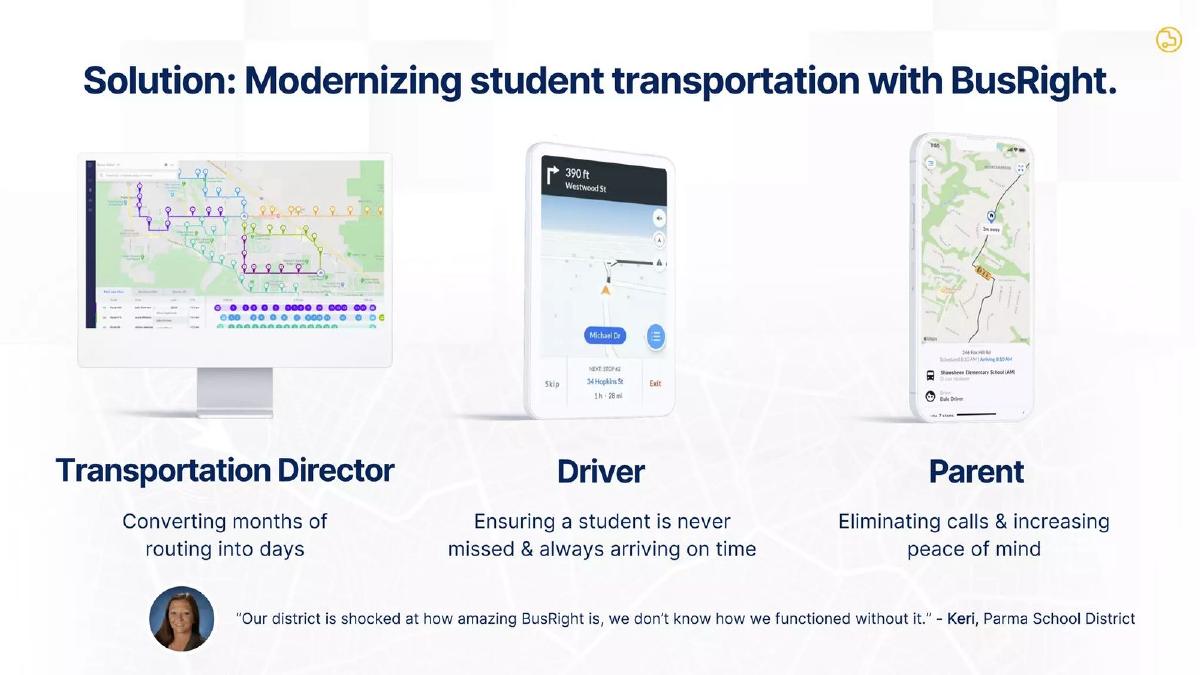
School bus routing and tracking software. Three screens, one per user, and a customer quote.
BusRight deck, slide 6. Exact stored slide matched to this analysis.
Our analysis: Three people, three screens, three benefits: the buyer (director) and two users each get their own line.
Evidence and limitation: A named district customer quote; the routing time claim (months to days) is not quantified further.
What a founder can adapt: Give every party a column with the screen they use and the one thing that improves for them.
Supporting analysis
What the deck claims: "Solution: Modernizing student transportation with BusRight." "Transportation Director: Converting months of routing into days." "Driver: Ensuring a student is never missed & always arriving on time." "Parent: Eliminating calls & increasing peace of mind." Quote: "Our district is shocked at how amazing BusRight is, we don't know how we functioned without it." – Keri, Parma School District.
Presentation choice: An investor sees who pays, who uses it daily and who is reassured, in one glance.
When it does not fit: Replace "months into days" with a measured example from one district.
Online software-career school. A bulleted list with format, price and results.
SoftUni deck, slide 6. Exact stored slide matched to this analysis.
Our analysis: It gives format, duration, price and outcome on one slide.
Evidence and limitation: Retention, student count, price and graduate job rate; no source or definition of "graduate".
What a founder can adapt: State how long it takes, what it costs the learner and what share reach the result.
Supporting analysis
What the deck claims: "Our hybrid approach fills the gap between existing solutions: 12-18 months online zero-to-career programs with high retention rate of 55%+; Scheduled learning with instructors, in groups, with high interaction; 24/7 live mentorship & support; Proven comprehensive from zero-to-career programs with 200,000+ students; Affordable – free starting course, then 99$/month; Practical skills, required by the industry." "Proven effective – 97% of graduates finish with a tech job."
Presentation choice: Duration plus price plus job rate lets an investor estimate the learner's payback.
When it does not fit: Define "graduate" next to the 97%: with 55% retention, the rate for everyone who starts is much lower.
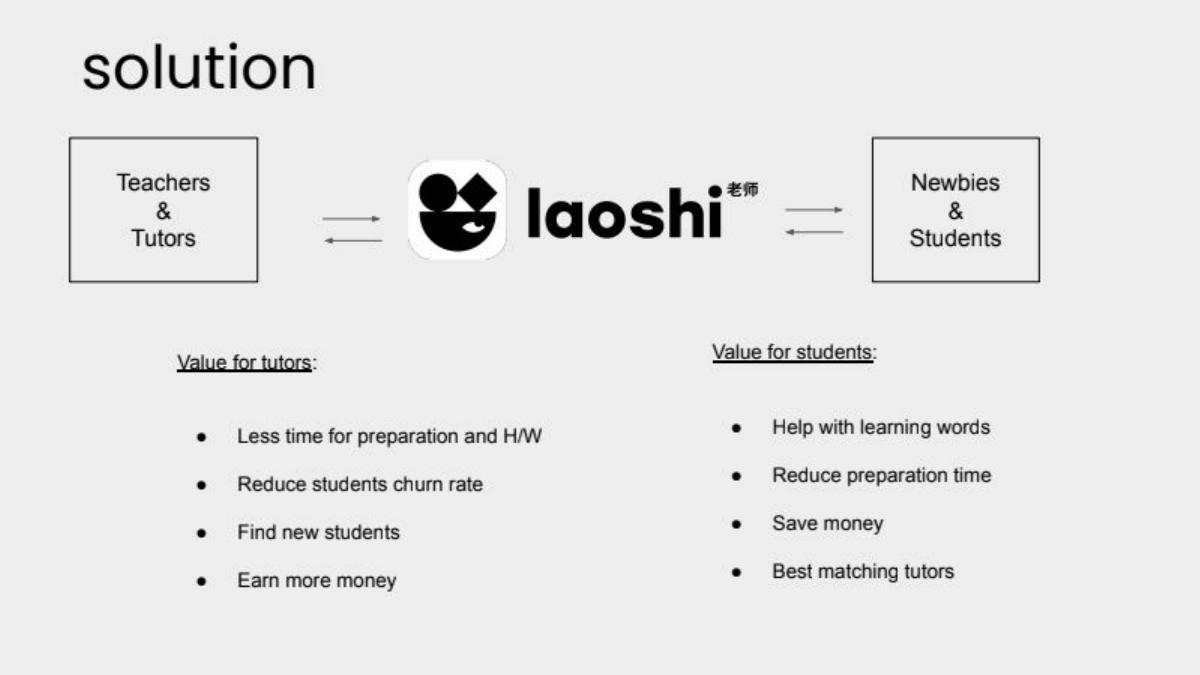
Mandarin vocabulary practice between lessons. A diagram with tutors on one side and students on the other.
Laoshi deck, slide 4. Exact stored slide matched to this analysis.
Our analysis: It answers its own problem slide (students don't learn words before lessons) and gives tutors a reason to push it.
Evidence and limitation: No figures.
What a founder can adapt: If teachers can bring students, list what the teacher gains, not only the learner.
Supporting analysis
What the deck claims: "Teachers & Tutors" ⇄ "laoshi" ⇄ "Newbies & Students." "Value for tutors: Less time for preparation and H/W; Reduce students churn rate; Find new students; Earn more money." "Value for students: Help with learning words; Reduce preparation time; Save money; Best matching tutors."
Presentation choice: Tutors who reduce churn by using it become a distribution channel.
When it does not fit: Put one number on a tutor benefit (hours saved per week, churn before and after), and show the app.
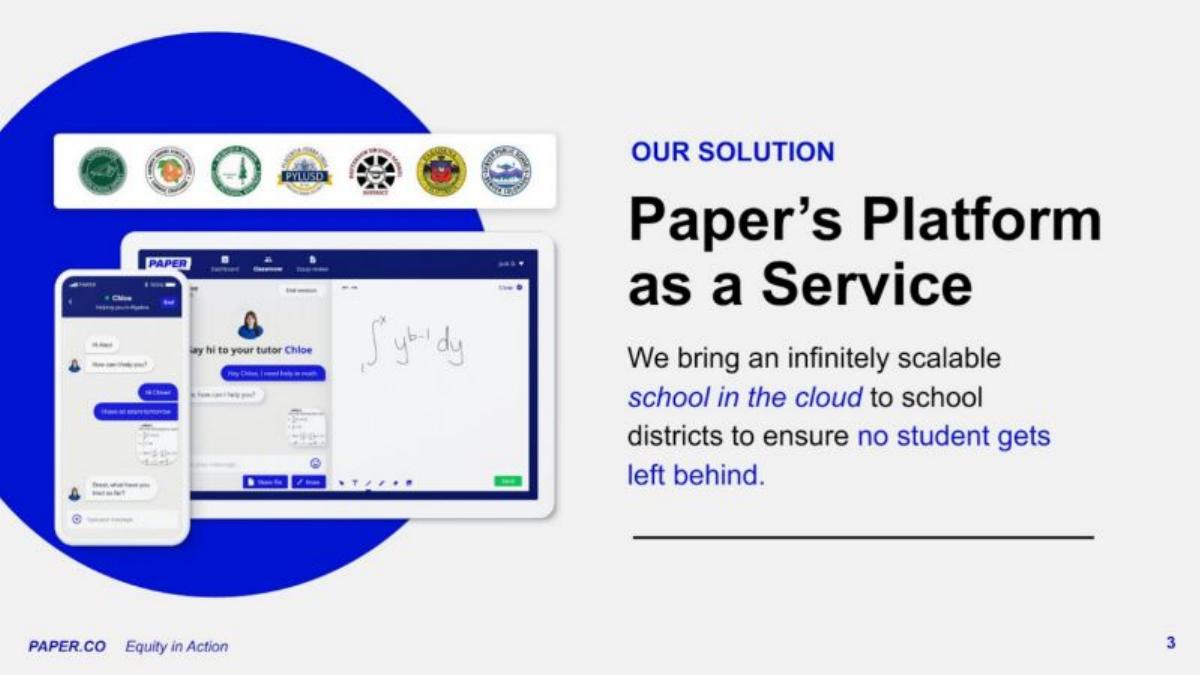
Online tutoring sold to school districts. A tutoring chat screen, district seals and one sentence.
Paper deck, slide 3. Exact stored slide matched to this analysis.
Our analysis: The buyer (school districts) is named in the sentence and shown by the seals.
Evidence and limitation: District seals; no counts or outcomes on the slide.
What a founder can adapt: Name the buyer in the solution sentence and show the learner's screen.
Supporting analysis
What the deck claims: "Our solution: Paper's Platform as a Service. We bring an infinitely scalable school in the cloud to school districts to ensure no student gets left behind." The screen shows a student chatting with a tutor and working a problem on a whiteboard; seven district seals run along the top.
Presentation choice: The tutoring screen shows what a student actually does: ask a tutor and work through a problem.
When it does not fit: Replace "infinitely scalable" and "no student gets left behind" with hours available per student or a result from one district.
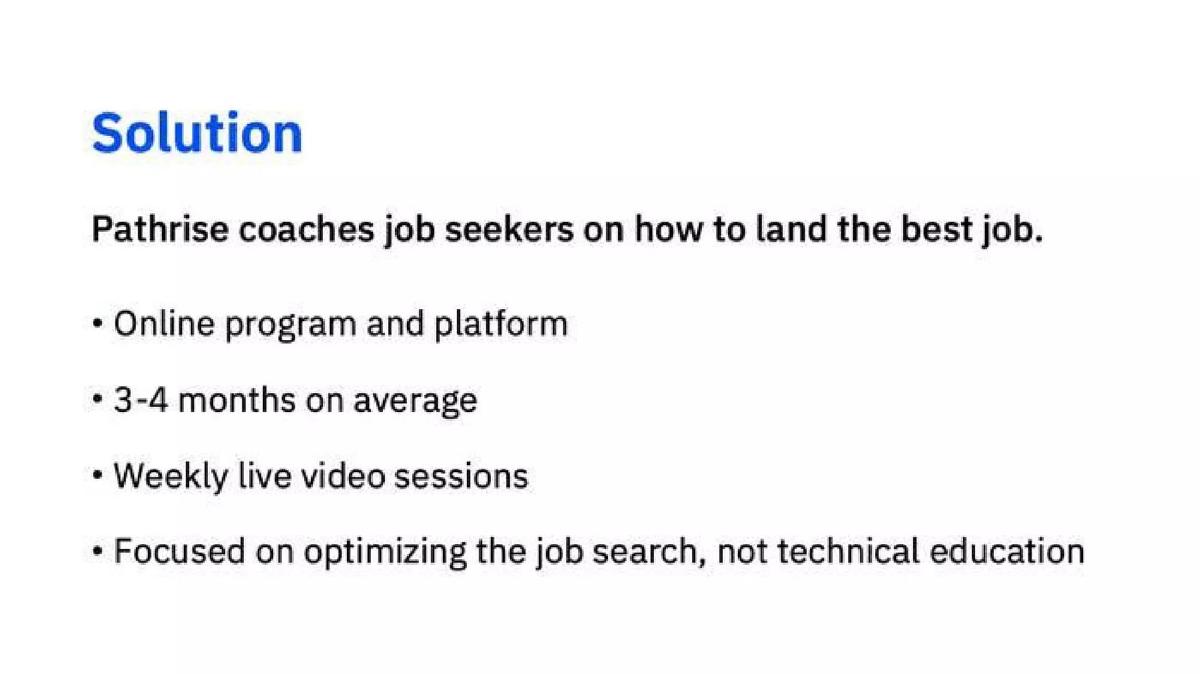
Job-search coaching. One sentence and four bullets.
Pathrise deck, slide 3. Exact stored slide matched to this analysis.
Our analysis: It states the format, time to result and what the programme is not.
Evidence and limitation: Duration and cadence; no outcome figures on this slide.
What a founder can adapt: Say what your product deliberately doesn't do, if it helps investors place you.
Supporting analysis
What the deck claims: "Pathrise coaches job seekers on how to land the best job." "Online program and platform; 3-4 months on average; Weekly live video sessions; Focused on optimizing the job search, not technical education."
Presentation choice: "Not technical education" separates it from bootcamps in six words.
When it does not fit: Add the outcome, such as placement rate or salary change, so the 3–4 months has a result attached.
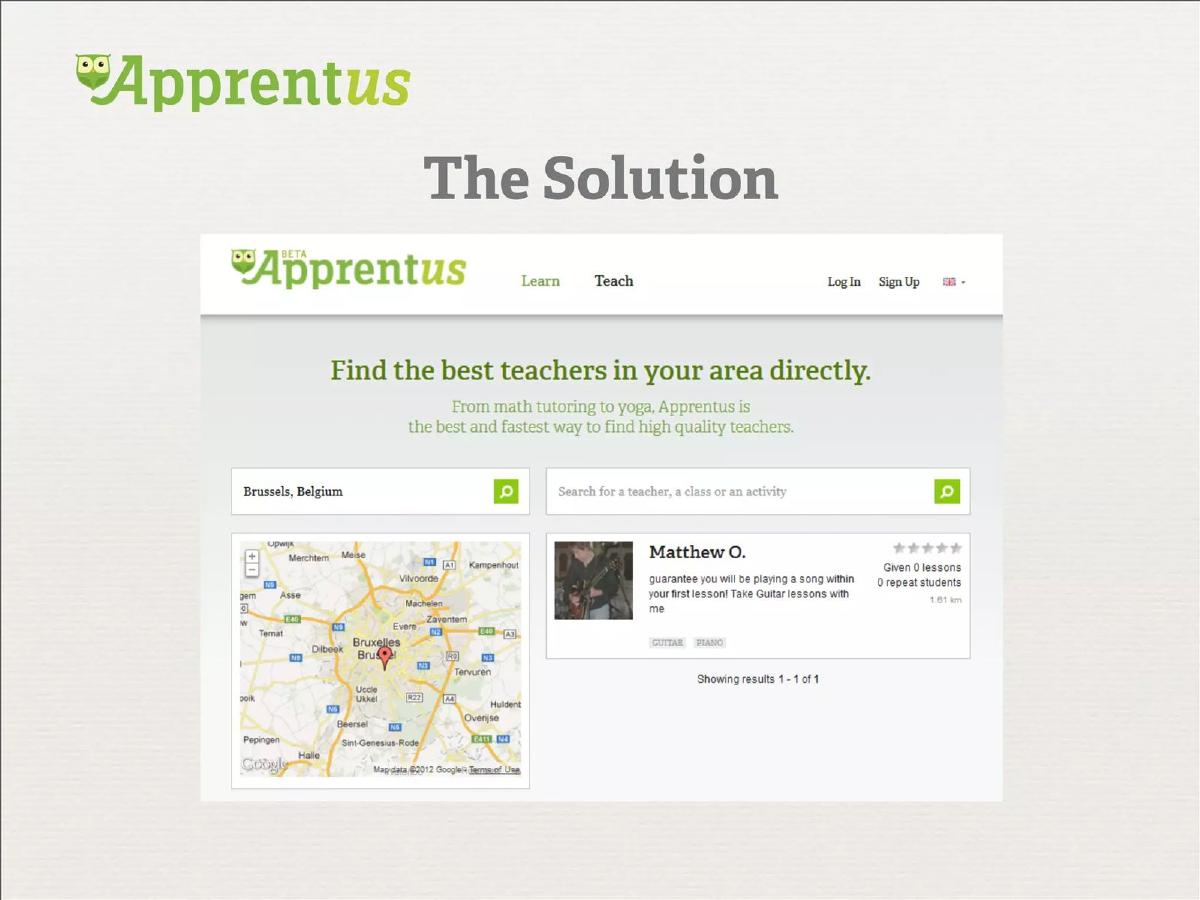
Finding local teachers. A full screenshot of the search page.
Apprentus deck, slide 4. Exact stored slide matched to this analysis.
Our analysis: The slide is the product: the investor sees the search a learner would run.
Evidence and limitation: A product screenshot; no usage figures.
What a founder can adapt: If your product is simple, let a screenshot carry the slide.
Supporting analysis
What the deck claims: "Find the best teachers in your area directly. From math tutoring to yoga, Apprentus is the best and fastest way to find high quality teachers." The screenshot shows a location field ("Brussels, Belgium"), a search box, a map and a teacher listing with reviews.
Presentation choice: A real screen is more convincing than a description of features.
When it does not fit: Crop to the part that matters (listing and reviews) so it is readable, and replace "best and fastest" with a time to book.
AI tutoring by class. One sentence and three icons.
Studnt deck, slide 6. Exact stored slide matched to this analysis.
Our analysis: "Class-specific" is the distinctive idea; the three icons are generic.
Evidence and limitation: No figures, price or screens.
What a founder can adapt: Lead with the differentiator (tutoring matched to a student's actual course) and show it.
Supporting analysis
What the deck claims: "A reliable web platform that delivers AI-powered, class-specific tutoring available around the clock, empowering students to elevate their learning experience at an affordable price." "Personalized Learning: Customized tutor support and practice to boost grades and academic success." "Extensive course data: Studnt uses comprehensive data for personalized insights and academic recommendations." "AI-Powered: Powered by advanced AI technology for innovative solutions and competitive advantage."
Presentation choice: It shows how a real differentiator gets lost among labels every edtech deck uses.
When it does not fit: Replace "affordable" with a price and "boost grades" with a before-and-after from a pilot.
A STEM curriculum for schools; the deck doesn't give a company name. A weaker example, included on purpose: four labels in small text on a dark background.
STEM curriculum startup deck, slide 4. Exact stored slide matched to this analysis.
Our analysis: It claims uniqueness without naming the benefits, and names teachers as the audience while the savings go to schools.
Evidence and limitation: No figures, examples or screens. The slide footer still reads "1/7/20XX" and "Pitch deck" from a template.
What a founder can adapt: Show one lesson, what a teacher does with it, and what a school saves in money.
Supporting analysis
What the deck claims: "Close the gap: Our curriculum makes learning STEM easier, and no other curriculum on the market offers the same benefits." "Target audience: Teachers and educators." "Cost savings: Reduce costs for schools to finance complex technology that they don't need." "Easy to use: A simple curriculum that gives students the information they need in order to succeed in college."
Presentation choice: It shows how an unsupported "no other product" claim invites the question it can't answer.
When it does not fit: Drop superlatives, remove template placeholders, and make the text readable at presentation size.
Whether each slide gives every party a benefit, states the format and time to result, and shows an outcome.
Example
Benefit for each party
Format and time
Outcome shown
BusRight
Yes (director, driver, parent)
Partly (months to days)
Partly (district quote)
SoftUni
No (learner only)
Yes (12–18 months, live groups, $99/month)
Yes (97% of graduates, undefined)
Laoshi
Yes (tutors, students)
No
No
Paper
Partly (districts named)
Partly (tutoring screen)
No
Pathrise
No (job seekers only)
Yes (3–4 months, weekly live)
No
Apprentus
No (learners only)
Partly (search screen)
No
Studnt
No
No
No
STEM curriculum startup
Partly (teachers, schools)
No
No
Key Takeaways
Give each party its own line: what the learner, teacher, parent or school gets.
State the format and time to result: live or self-paced, weeks or months.
Show one outcome already achieved, such as completion, grades or jobs, with its basis.
Show the screen each party uses, not only a logo.
Replace "personalized" and "AI-powered" with what the learner does differently.
Build your edtech solution slide
One line per party, then format, time and one result.
Parties. Who is involved (learner, teacher, parent, school, employer), and what does each get?
Format. How does learning happen: live, self-paced, in class, one to one?
Time. How long until the learner reaches the result?
Outcome. Which result have you already achieved, and for how many learners?
Copyable framework: [Learner] gets [benefit] through [format] in [time]. [Teacher or school] gets [benefit]. So far [outcome] for [number] learners.
Illustrative example 1 — written by us
Before: An AI-powered, personalized learning platform that empowers every student.
After: First-year nursing students practise anatomy terms in 15-minute daily sessions for eight weeks. Instructors see who is falling behind each Monday. In a pilot with 140 students, first-attempt pass rates rose from 41% to 63%.
What improved: Our illustrative rewrite; figures are invented for the example. It names the parties, format, time and an outcome with its sample.
What this guide adds
The general solution slide guide covers presenting a product in any business. In education the user, the payer and the person who judges the result are often different, and results take months to appear. This guide compares how edtech decks show who benefits, how the learning happens and what it has achieved.
It pairs with the edtech problem slide guide. Laoshi appears in both, so you can read its problem slide (slide 2) next to its solution slide (slide 4).
Three parts of an edtech solution
Each party: a benefit for every person involved (BusRight, Laoshi).
Format and time: how learning happens and how long it takes (SoftUni, Pathrise).
Outcome: a result already achieved (SoftUni, BusRight's district quote).
Strong slides cover all three. Most real slides cover one or two.
Common mistakes
Only the learner. If a teacher, parent or school is involved, give them a line.
No time to result. Say how long it takes to learn, pass or get the job.
Generic labels. "Personalized" and "AI-powered" say nothing on their own.
Unsupported uniqueness. "No other product offers this" needs the specific benefit.
Undefined outcomes. Say who counts in a completion or job rate.
Diagnostic checklist
Each party involved gets its own benefit.
The format and time to result are stated.
One outcome already achieved is shown, with its basis.
A screen, lesson or product shot shows how it works.
It answers the problem on your previous slide.
Frequently asked questions
How we chose these examples
Corpus: published pitch deck teardowns on StartupFundraising.com. Founder-uploaded private decks are excluded.
Selection (2026-09-25): we searched extracted text of slides 2–6 for slides beginning with "solution" in decks whose recorded sector is edtech, education or learning, or whose slide text mentions students, teachers, schools, learners, tutors or courses. About forty candidates were read; hiring, telehealth, insurance, incubator and non-education slides were set aside, as were duplicate copies of the same deck. The STEM curriculum slide is kept as a weaker contrast; its deck gives no company name.
Overlap check: none of these eight slides appears in another guide. Laoshi's problem slide (slide 2) is in the edtech problem guide; its slide 4 is used here. Female Invest and Careerist appear in other guides and were not reused.
Review: all eight stored slide images were inspected on 2026-09-25 and matched to company, deck and slide number (editorial model review). No person has yet completed an editorial review of this page.
Claims are as shown on the slides; we have not verified them. We make no claim that any slide caused a fundraising outcome.