Edtech Competition Slides: 12 Real Pitch Deck Examples
How edtech startups show competition in a pitch deck: name what learners, teachers or schools use today (paper, YouTube, a marketplace.
Edtech Competition Slide: Name What Learners and Schools Use Today
In education, the rival is often not another edtech startup. It is paper forms, free YouTube videos, a university lab, a big marketplace, or a school doing it itself. This guide compares five real edtech competition slides on two questions: did they name the alternative the buyer would really choose, and did the comparison give a reader any reason to believe it?
TL;DR
Name what your learner, teacher or school uses today and compare on what they care about. eProf names the two options a tutoring business really has (join a marketplace or build it yourself) and says what each costs them. GAMR puts free YouTube channels and university game labs next to Codecademy, and shows rivals winning some rows. SRS includes paper feedback forms alongside SurveyMonkey and Socrative. Handshake names Facebook and LinkedIn but never says what its own product does better, and TalentAccurate plots rivals on a chart with no scale or source. None of the five gives evidence such as usage, price or outcomes behind its comparison.
Edtech competition slides from real pitch decks
Each example shows the exact stored slide above its analysis and links to the full teardown. Slides that name the real alternative and compare fairly come first; weaker ones follow for contrast. Claims are as shown on the slides; comments are ours.
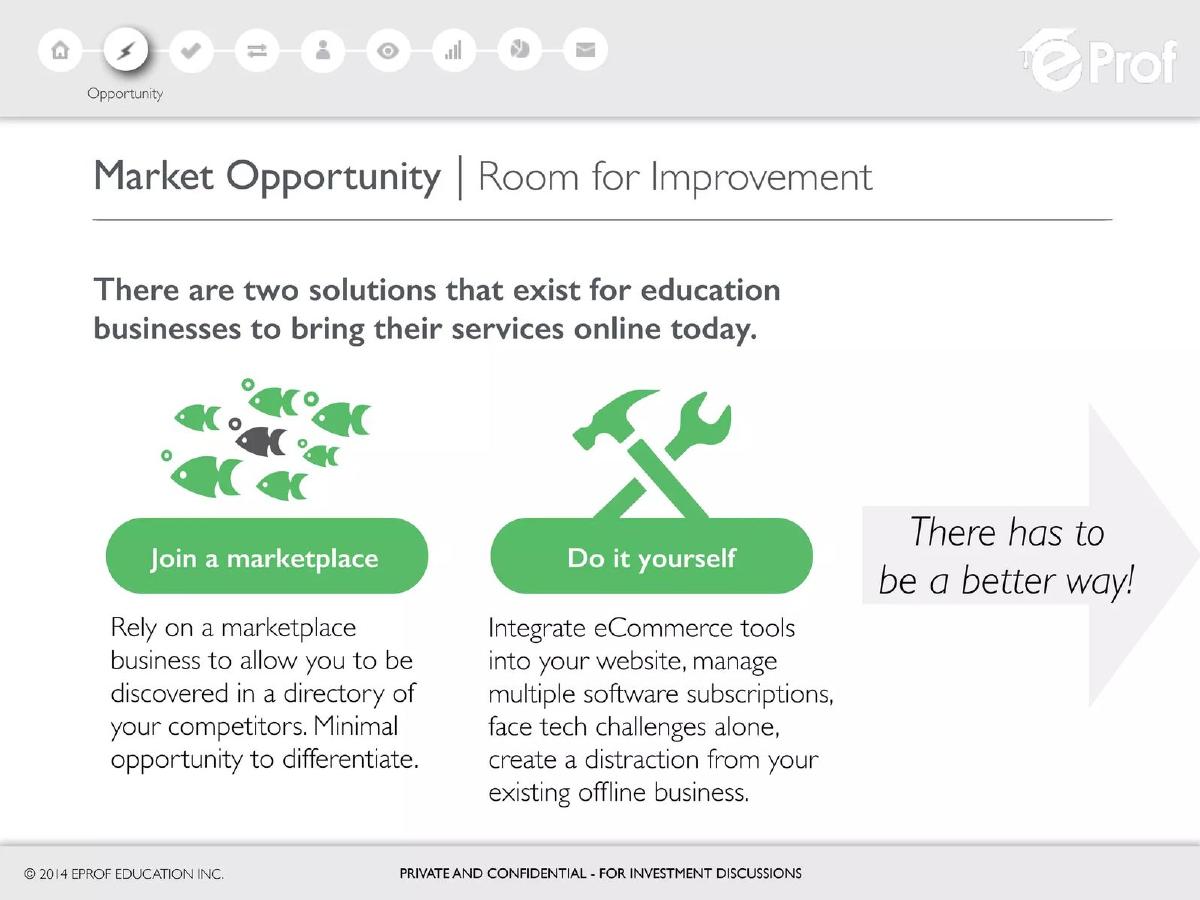
eProf competition slide — slide 6
Online platform for traditional education businesses such as tutoring centres, 2014 deck. The slide is titled "Market Opportunity | Room for Improvement" but works as the competition slide.
eProf deck, slide 6. Exact stored slide matched to this analysis.
Our analysis: It frames competition as the two choices the buyer actually has, and states the cost of each in the buyer's terms: being listed next to rivals, or running a tech project on the side.
Evidence and limitation: No marketplace is named and no cost, time or price is given for either option.
What a founder can adapt: Name the two or three options your buyer weighs today and give one number for each (fees, hours, subscriptions).
Supporting analysis
What the deck claims: "There are two solutions that exist for education businesses to bring their services online today." "Join a marketplace: Rely on a marketplace business to allow you to be discovered in a directory of your competitors. Minimal opportunity to differentiate." "Do it yourself: Integrate eCommerce tools into your website, manage multiple software subscriptions, face tech challenges alone, create a distraction from your existing offline business." "There has to be a better way!"
Presentation choice: For a small education business, "do it ourselves" and "list on a big site" are the real alternatives. Naming both answers the investor's first question.
When it does not fit: Name the marketplaces, and put a figure on the do-it-yourself cost so the comparison can be checked.
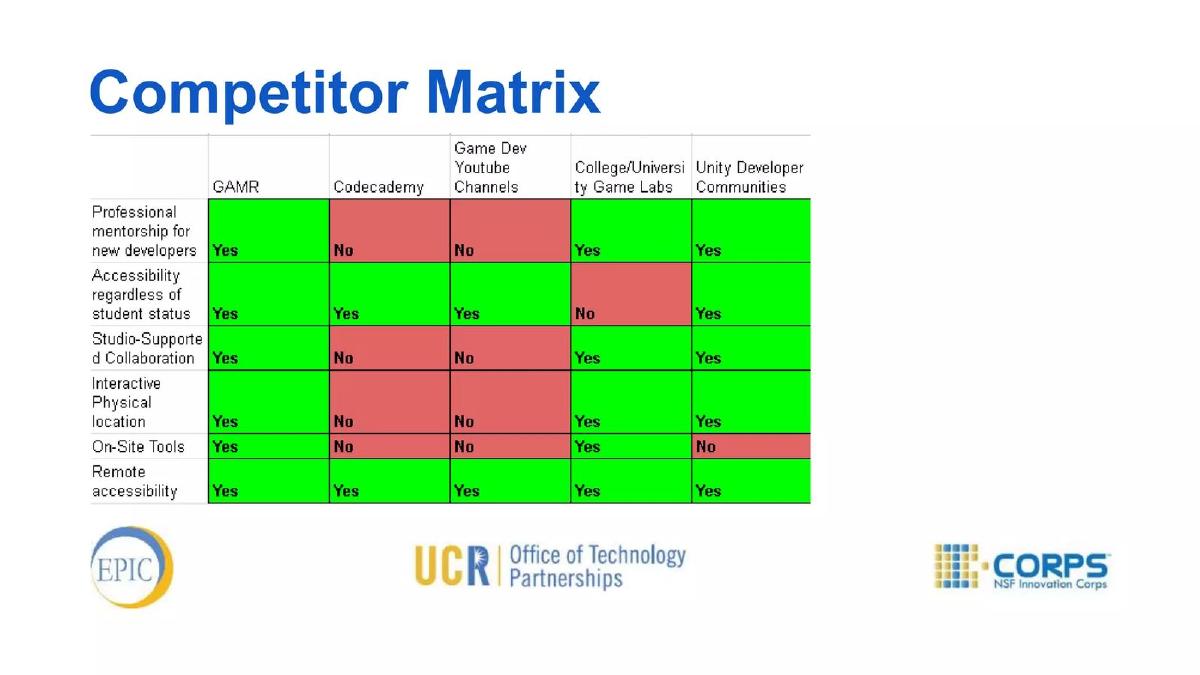
Game-development learning space with mentorship, linked to UC Riverside. Competitor matrix.
GAMR deck, slide 5. Exact stored slide matched to this analysis.
Our analysis: It names the free and institutional options a new game developer would actually use, and shows two of them matching GAMR on most rows.
Evidence and limitation: The Yes/No cells are the company's own judgement; no price, usage or learner outcome is shown.
What a founder can adapt: Include the free option and the institution your learner already has access to, and mark where they match you.
Supporting analysis
What the deck claims: Columns: GAMR, Codecademy, Game Dev YouTube Channels, College/University Game Labs, Unity Developer Communities. Rows: professional mentorship for new developers, accessibility regardless of student status, studio-supported collaboration, interactive physical location, on-site tools, remote accessibility. GAMR is "Yes" on all six; university labs are "Yes" on five ("No" on accessibility regardless of student status); Unity communities "Yes" on five ("No" on on-site tools).
Presentation choice: Putting YouTube and university labs on the slide shows the founders know the real defaults. Letting rivals score "Yes" makes the table more believable.
When it does not fit: If a rival matches you on five of six rows, say why that sixth row matters and add price, which is where YouTube and Codecademy likely win.
Classroom feedback tool (student response system) from a solo founder, deck dated 19 February 2015. Slide titled "Competition & Revenue".
SRS deck, slide 6. Exact stored slide matched to this analysis.
Our analysis: It includes paper feedback forms, the real default in many classrooms, and gives rivals credit where they have a feature.
Evidence and limitation: Ticks are the company's own; the slide says "Revenue" in its title but shows no pricing or revenue.
What a founder can adapt: Keep the default (paper, free forms) as a column and compare on the one or two things teachers need most.
Supporting analysis
What the deck claims: Columns: Paper FB, SurveyMonkey, Qualtrics, Socrative, Google, SRS. Rows: feedback, real-time, anonymous, reports, customizable, personalized, slide viewer. Socrative has real-time; SurveyMonkey and Qualtrics have reports; SRS has a tick in every row, and no rival has "personalized" or "slide viewer".
Presentation choice: A teacher's alternative is often paper or a free Google form, not another startup. Putting them in the table is the right instinct.
When it does not fit: The rows where only SRS scores are features it defined itself. Add the revenue the title promises, and a price comparison against free tools.
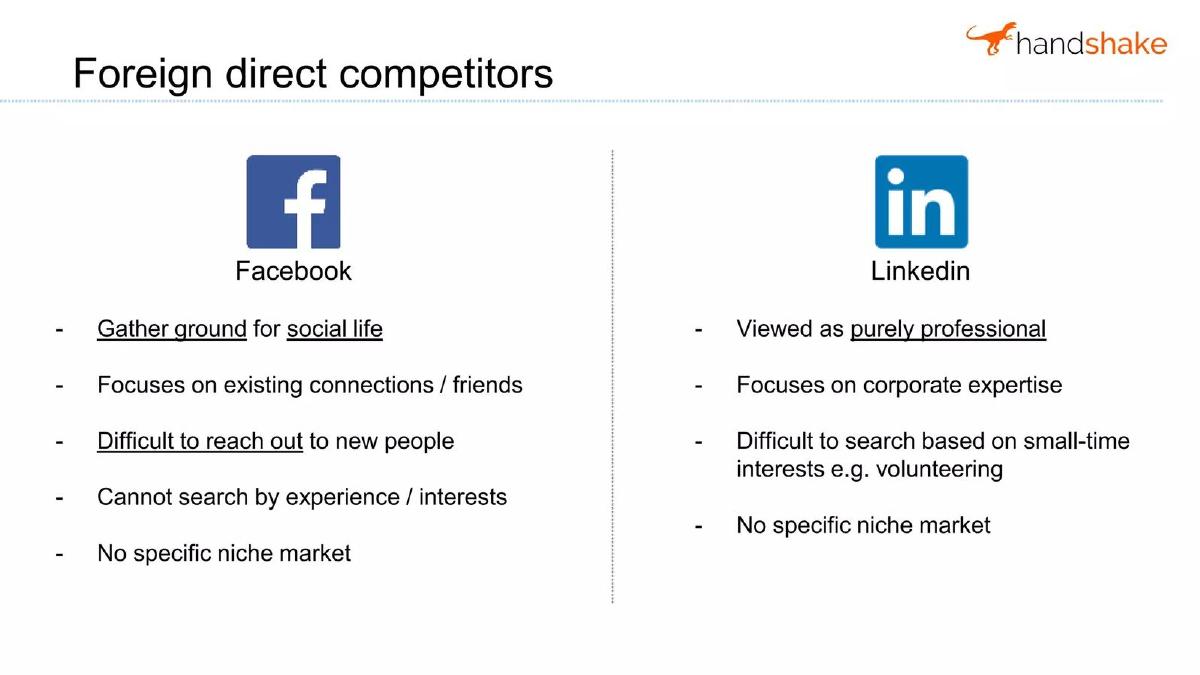
Hong Kong social network for secondary-school students to find others by experience and interests. Slide titled "Foreign direct competitors"; a separate slide covers local rivals.
Handshake deck, slide 5. Exact stored slide matched to this analysis.
Our analysis: It names where students already are, which is honest, but lists only rivals' gaps. A reader must infer Handshake's answer.
Evidence and limitation: No usage figures for students on either platform and no statement of what Handshake does instead.
What a founder can adapt: Add a Handshake column answering each gap (for example, search by interest) and one piece of evidence that students want it.
Supporting analysis
What the deck claims: Facebook: "Gather ground for social life", "Focuses on existing connections / friends", "Difficult to reach out to new people", "Cannot search by experience / interests", "No specific niche market". LinkedIn: "Viewed as purely professional", "Focuses on corporate expertise", "Difficult to search based on small-time interests e.g. volunteering", "No specific niche market".
Presentation choice: Shown for contrast: naming giant incumbents is fine, but without your own column the slide doesn't say why students would switch.
When it does not fit: "No specific niche market" is not a weakness to a student already using Facebook. Compare on what the student needs.
Coding skills assessment for hiring, 2018 deck. Two-axis chart.
TalentAccurate deck, slide 5. Exact stored slide matched to this analysis.
Our analysis: Rivals are named, but the placement rests only on the company's say-so.
Evidence and limitation: Neither axis has a scale, and "accuracy" is not defined or sourced.
What a founder can adapt: If you use a chart, define each axis and say how positions were decided (a test, a customer survey, published data).
Supporting analysis
What the deck claims: "Competitive Landscape". Axes: "Accuracy" (vertical) and "Algorithm vs Realtime Assignments" (horizontal). Plotted: HackerRank, HackerEarth, CodeChef, Code Forces, LeetCode, Hired, TripleBytes, and TalentAccurate alone at top right.
Presentation choice: Shown as the weakest: a two-axis chart where you sit alone in the corner is easy to draw and hard to believe without a measure behind it.
When it does not fit: Undefined axes that happen to put you top right.
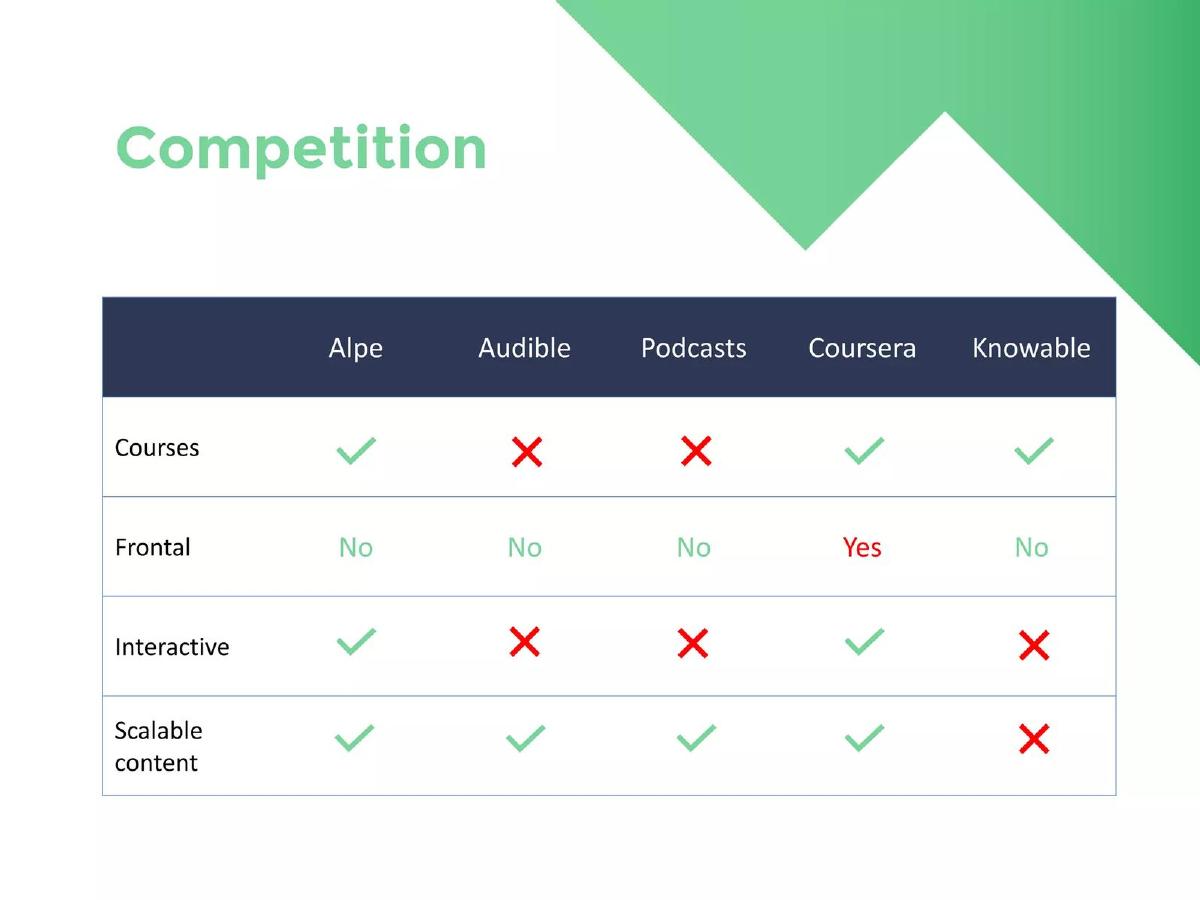
Audio learning courses. Stage and year not stated.
Alpe deck, slide 13. Exact stored slide matched to this analysis.
Our analysis: It names the audio products a listener actually uses, including free podcasts.
Evidence and limitation: Coursera matches Alpe on three of four rows; the grid doesn't explain why the one difference (frontal teaching) matters.
What a founder can adapt: Add price and a usage figure; that is where Audible and podcasts are likely to win.
Supporting analysis
What the deck claims: Competition grid: Alpe, Audible, Podcasts, Coursera, Knowable. Rows: Courses (yes, no, no, yes, yes); Frontal (No, No, No, Yes, No; Coursera's "Yes" in red); Interactive (yes, no, no, yes, no); Scalable content (yes, yes, yes, yes, no).
Presentation choice: It names the audio products a listener actually uses, including free podcasts.
When it does not fit: Coursera matches Alpe on three of four rows; the grid doesn't explain why the one difference (frontal teaching) matters.
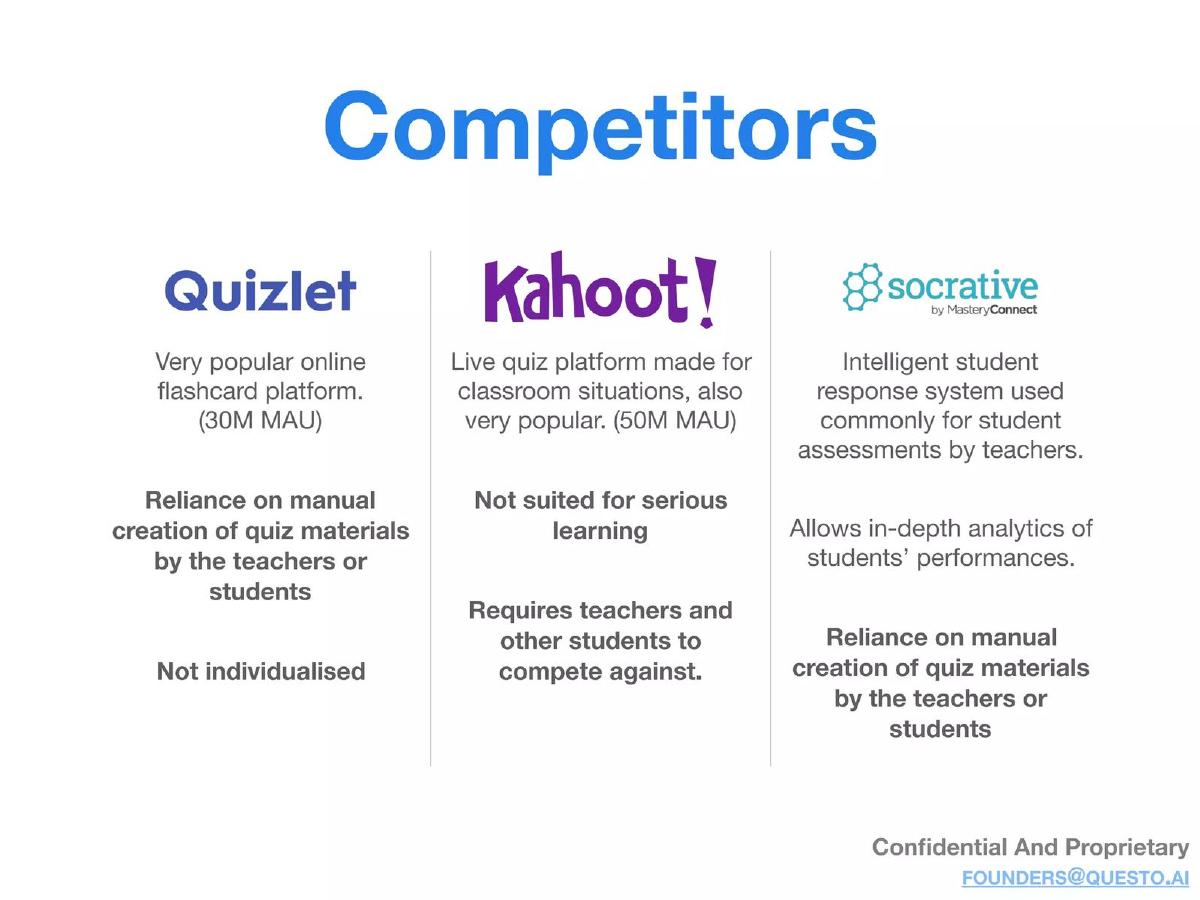
AI-generated quizzes for students. Slide marked "Confidential And Proprietary".
Questo AI deck, slide 15. Exact stored slide matched to this analysis.
Our analysis: It names the tools teachers already use, gives their scale, and credits Socrative's strength.
Evidence and limitation: Rival MAU figures are undated and unsourced; there is no Questo column.
What a founder can adapt: Date and source each rival's user figure, and add your own line per column.
Supporting analysis
What the deck claims: Competitors: Quizlet ("Very popular online flashcard platform. (30M MAU)"; "Reliance on manual creation of quiz materials by the teachers or students"; "Not individualised"). Kahoot! ("Live quiz platform made for classroom situations, also very popular. (50M MAU)"; "Not suited for serious learning"; "Requires teachers and other students to compete against"). Socrative by MasteryConnect ("Allows in-depth analytics of students' performances"; "Reliance on manual creation of quiz materials").
Presentation choice: It names the tools teachers already use, gives their scale, and credits Socrative's strength.
When it does not fit: Rival MAU figures are undated and unsourced; there is no Questo column.
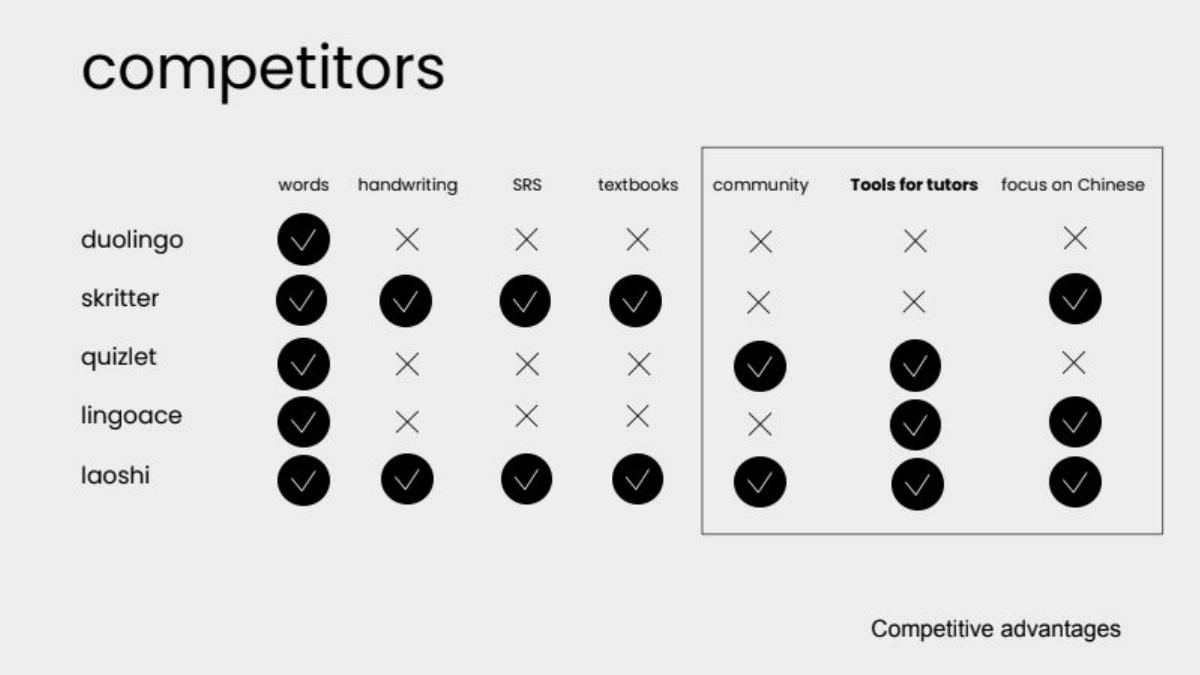
Chinese learning app for tutors and students. Other edtech guides use slides 2, 3, 4 and 10 from this deck.
Laoshi deck, slide 5. Exact stored slide matched to this analysis.
Our analysis: The box shows which columns matter, and a strong rival (Skritter) is shown matching most of them.
Evidence and limitation: Only Laoshi ticks every column; add price or users to make it checkable.
What a founder can adapt: Mark the two or three columns that decide the purchase, as Laoshi does.
Supporting analysis
What the deck claims: competitors grid: duolingo, skritter, quizlet, lingoace, laoshi against words, handwriting, SRS, textbooks, community, Tools for tutors, focus on Chinese. Last three boxed as "Competitive advantages". Laoshi ticks all seven; Skritter ticks five.
Presentation choice: The box shows which columns matter, and a strong rival (Skritter) is shown matching most of them.
When it does not fit: Only Laoshi ticks every column; add price or users to make it checkable.
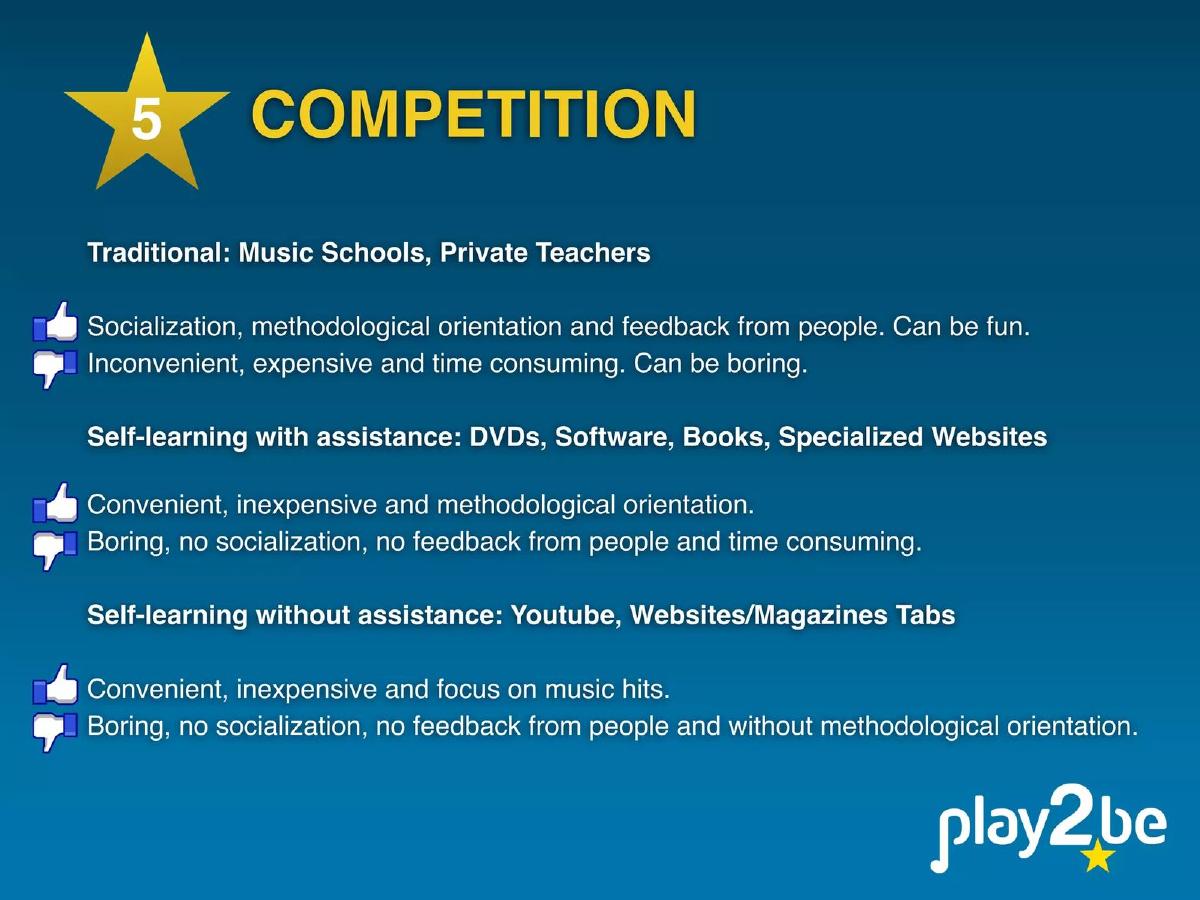
Music learning game. The music solution guide uses slide 4 from this deck.
Play2be deck, slide 8. Exact stored slide matched to this analysis.
Our analysis: It names the real defaults, including free YouTube, and admits what each does well.
Evidence and limitation: No company is named, and Play2be's own answer isn't on the slide.
What a founder can adapt: Add how Play2be scores on the same pros and cons, and one price.
Supporting analysis
What the deck claims: "Competition." Traditional: Music Schools, Private Teachers (up: "Socialization, methodological orientation and feedback from people. Can be fun."; down: "Inconvenient, expensive and time consuming. Can be boring."). Self-learning with assistance: DVDs, Software, Books, Specialized Websites. Self-learning without assistance: Youtube, Websites/Magazines Tabs (up: "Convenient, inexpensive and focus on music hits."; down: "Boring, no socialization, no feedback from people and without methodological orientation.").
Presentation choice: It names the real defaults, including free YouTube, and admits what each does well.
When it does not fit: No company is named, and Play2be's own answer isn't on the slide.
Whether each slide names the alternative the buyer really uses, compares fairly, and gives a basis for the comparison.
Example
Real alternative named
Rivals win any row
Evidence or source
eProf
Yes (marketplace, do it yourself)
n/a (no table)
No
GAMR
Yes (YouTube, university labs)
Yes
No
SRS
Yes (paper, free forms)
Yes
No
Handshake
Yes (Facebook, LinkedIn)
No own column
No
TalentAccurate
Partly (startups only)
No
No (undefined axes)
Coursmos table
Yes (Udemy, Coursera, Udacity)
Yes
Yes (dated, three sources)
Coursmos ratio
Yes (incl. YouTube)
No
Our check: arithmetic correct
Alpe
Yes (Audible, podcasts)
No
No
Questo AI
Yes (Quizlet, Kahoot!, Socrative)
No own column
Rival MAU, unsourced
Laoshi
Yes (Duolingo, Quizlet)
Matches (Skritter)
No
Play2be
Yes (schools, YouTube)
Yes (pros listed)
No
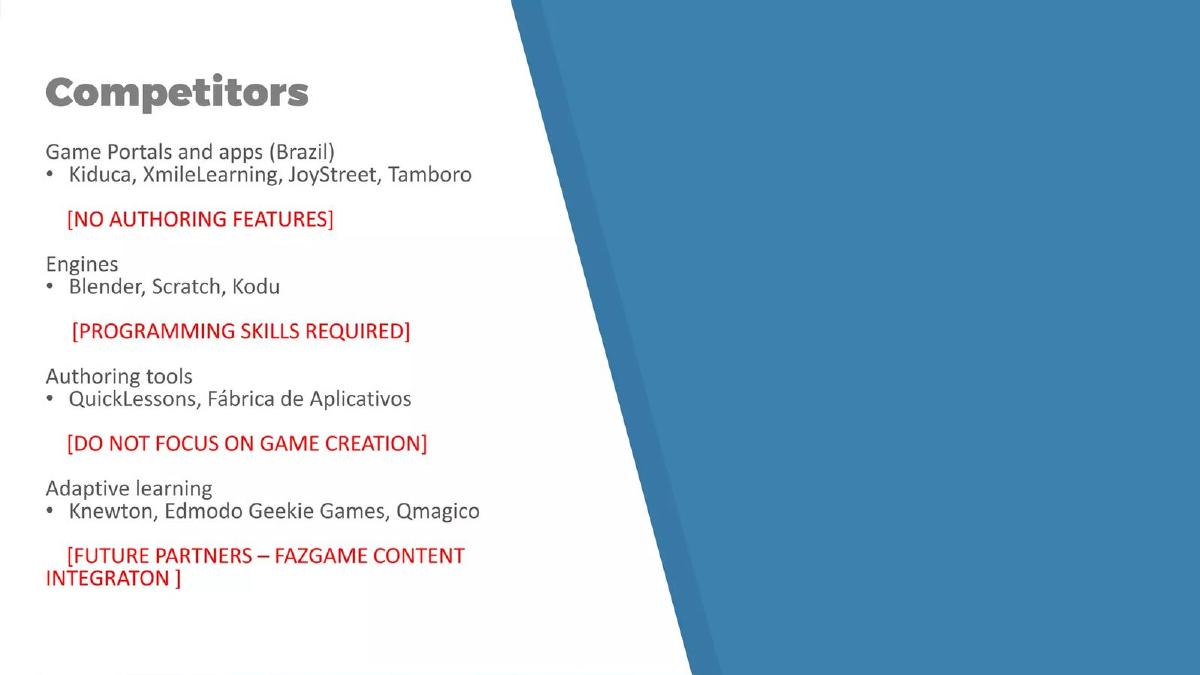
Teczelt Fazgame
Yes (Scratch, portals)
No
No
Key Takeaways
Name the default: paper, free video, the school's current tool, or doing it yourself.
Compare on what the buyer is judged on (time saved, cost, learning results, placement).
Let rivals win some rows; a table where you win everything reads as selective.
Say what your product does, not only what rivals lack.
Give each comparison a basis: price, usage, a pilot result or a source.
Build your edtech competition slide
Start from what your learner or school does today.
Buyer. Who decides: learner, parent, teacher, school, university or employer?
Today's default. What do they use now: paper, free videos, the school's current system, a marketplace, doing it themselves?
What matters. Which one or two things is the buyer judged on (learning results, teacher time, cost, placement)?
Proof. What price, usage or pilot result shows you beat the default on that?
Fairness. Where does the default win (usually price or familiarity), and why switch anyway?
Copyable framework: Today [buyer] uses [default], which [shortfall, with number]. [Product] [result, with number] ([basis]). [Default] is free/familiar; we win because [reason].
Illustrative example 1 — written by us
Before: Competitors lack personalization and real-time features. We have everything.
After: Most teachers collect feedback on paper or a free Google form and see results days later. SRS shows answers live during the lesson; in our 3-class pilot, teachers reviewed feedback in class instead of after. Google Forms is free; we charge $4 per teacher a month.
What improved: Our illustrative rewrite; figures are invented for the example. It names the default, compares on what teachers need, admits where the free option wins and points to evidence.
What this guide adds
The general competition slide guide covers any business. Edtech has its own pattern: many buyers (a teacher, a parent, a school, an employer) and a strong free default. Free content and familiar tools mean the question is usually "why not keep using what we have?" rather than "why you over another startup?"
The edtech problem, solution and product guides cover other slides in similar decks. Here we look only at how each deck handles rivals and alternatives.
How we read each slide
We quote the text on the stored slide images. We have not checked the companies' claims about themselves or their rivals, and none of the five slides cites a source.
Dated, sourced tables: the strongest edtech format
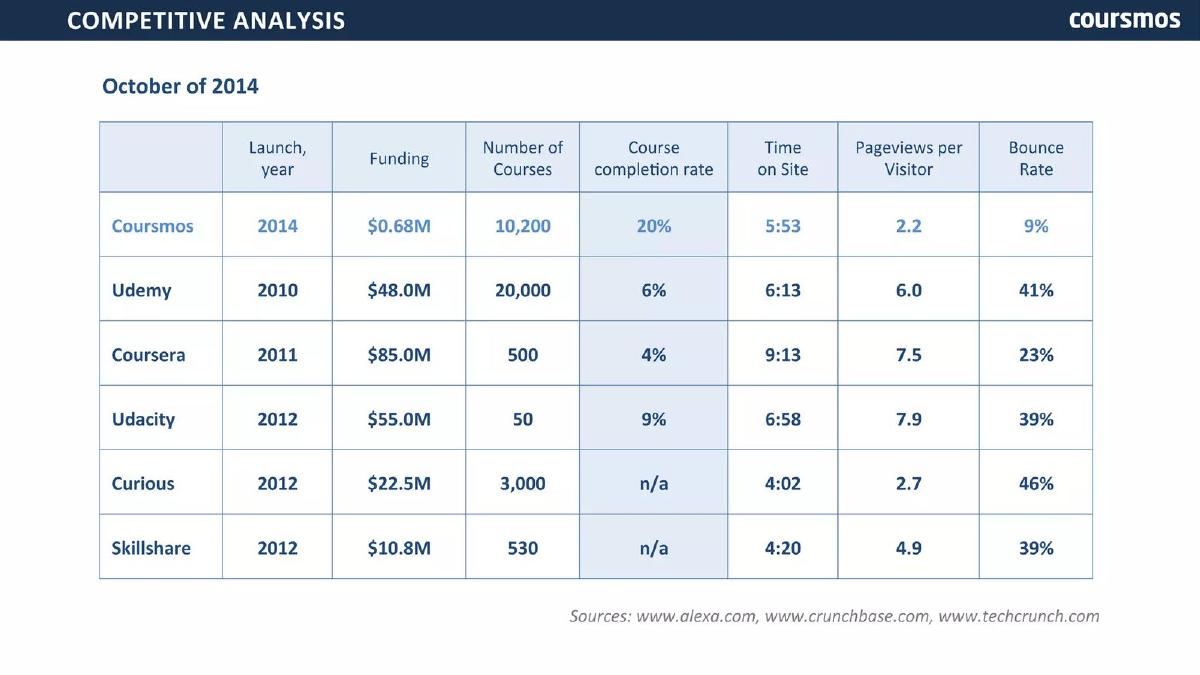
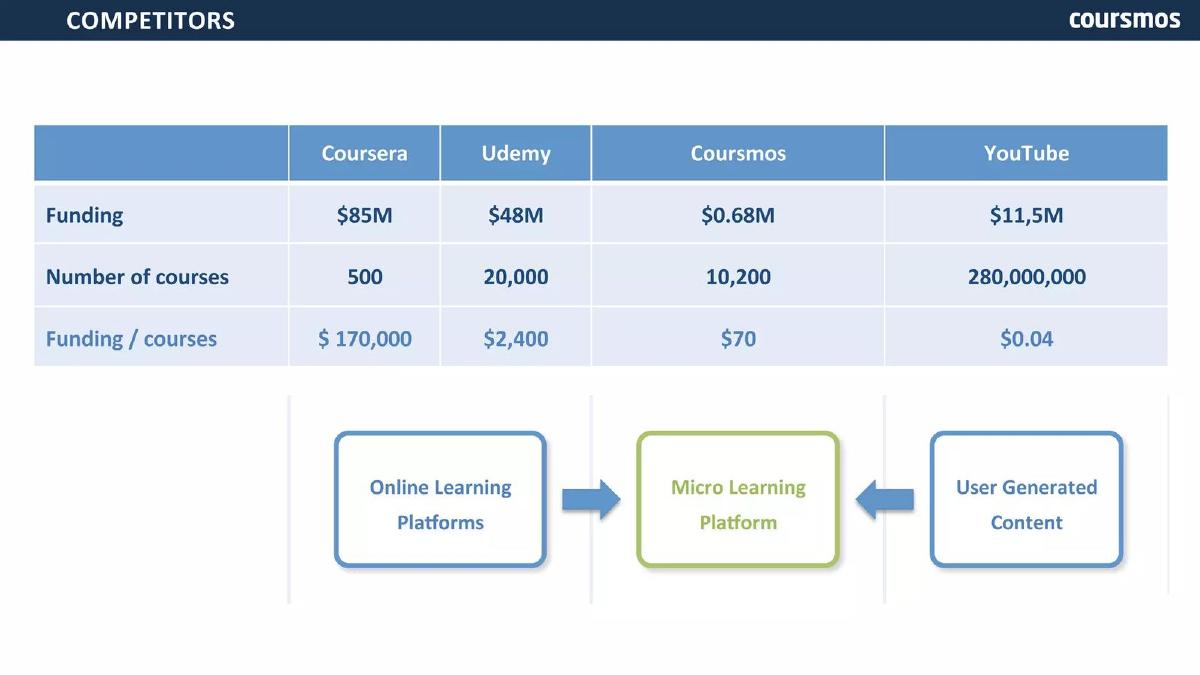
Coursmos's "Competitive Analysis" is headed "October of 2014" and compares six online-course companies on launch year, funding, number of courses, course completion rate, time on site, pageviews per visitor and bounce rate, with "Sources: www.alexa.com, www.crunchbase.com, www.techcrunch.com". Coursmos shows $0.68M funding and 10,200 courses against Udemy's $48.0M and 20,000, and a 20% completion rate against 4% to 9% for Coursera, Udemy and Udacity.
A date and named sources let an investor check most of the table. The figure that matters most, completion rate, is the one those sources are least likely to cover: Coursmos's own 20% is the company's claim, and the slide doesn't say how completion was measured for each rival. Completing a five-minute micro-course and a twelve-week course are not the same thing.
Ratios that flatter
Coursmos's next slide divides funding by number of courses: Coursera $170,000 per course, Udemy $2,400, Coursmos $70, YouTube $0.04. Our check: the arithmetic is right ($0.68M divided by 10,200 is about $67, shown as $70). But the ratio measures money raised per item listed, not learning quality or cost to produce, and it treats 280,000,000 YouTube videos as courses. A ratio you invent will almost always put you in a good light; say what it does and doesn't show, or compare on a measure buyers already use.
Feature grids, rival profiles and categories
Alpe and Laoshi use checkmark grids. Alpe ticks every row against Audible, podcasts, Coursera and Knowable; Laoshi boxes its three "competitive advantages" (community, tools for tutors, focus on Chinese) against Duolingo, Skritter, Quizlet and LingoAce. Laoshi's grid is more honest: Skritter matches it on five of seven columns, and the box tells the reader which columns matter.
Questo AI profiles three tools teachers already use: Quizlet ("30M MAU"), Kahoot! ("50M MAU") and Socrative, with each rival's weakness ("Reliance on manual creation of quiz materials"). Quoting rivals' scale is fair, but the user numbers are undated and unsourced.
Play2be and Teczelt Fazgame compare categories. Play2be lists music schools and private teachers, DVDs and books, and YouTube and tab sites, each with a thumbs up and thumbs down. Teczelt names companies in four groups, gives each a bracketed gap, and calls the adaptive learning group (Knewton, Edmodo Geekie Games, Qmagico) "future partners". Naming the free default (YouTube) and admitting what it does well ("Convenient, inexpensive") is what this guide recommends.
Common mistakes
Leaving out the free default. YouTube, paper and free forms are what most learners and teachers use. Name them.
Winning every row. Rows you define yourself will favour you. Add price and let rivals score where they do.
Listing only rivals' gaps. Say what your product does about each gap.
Undated rival numbers. Questo AI's Quizlet and Kahoot! user counts need a date and source; Coursmos shows how.
Invented ratios. Funding per course flatters Coursmos but says nothing about learning.
Unequal measures. Completion of a micro-course and a 12-week course aren't comparable without saying so.
Charts without a measure. Define each axis and how positions were set.
Diagnostic checklist
Names what the buyer uses today, including free options.
Compares on one or two things the buyer is judged on.
Shows at least one row where a rival wins or matches.
Gives a basis (price, usage, pilot, source) for the comparison.
States your own answer, not only rivals' weaknesses.
Rival figures carry a date and a source.
Any ratio you create says what it measures.
Frequently asked questions
Who is the competitor for an edtech startup?
Whatever the learner, teacher or school would use instead: paper, free video, the school's existing tools, a large marketplace, or doing it in-house. GAMR's slide names YouTube channels and university labs; eProf's names marketplaces and do-it-yourself.
Should I include free tools like YouTube or Google Forms?
Yes. They are usually the main alternative. SRS includes paper feedback and Google; GAMR includes YouTube channels. Then explain why a buyer would pay instead.
Is a two-axis competitor chart a good idea?
Only if the axes are defined and the positions have a basis. TalentAccurate's chart places itself alone at the top right with no scale or source, which a reader cannot check.
Can I put competitors' user numbers on my slide?
Yes, with a date and source. Coursmos dates its table (October 2014) and names Alexa, Crunchbase and TechCrunch; Questo AI's Quizlet (30M MAU) and Kahoot! (50M MAU) figures have neither.
Is completion rate a good comparison for an online course company?
Only if measured the same way for everyone. Coursmos's 20% vs 4% to 9% compares short micro-courses with long courses, and the slide doesn't say how either was measured.
Should I compare against categories or named companies?
Both work if you name companies inside each category. Teczelt Fazgame does; Play2be names categories only.
How we chose these examples
Corpus: published pitch deck teardowns on StartupFundraising.com. Founder-uploaded private decks are excluded.
Selection (2026-09-27): we searched extracted slide text in decks tagged edtech for competition, competitors, competitive landscape, alternatives and "vs". About 45 slides matched; most were problem, market or unrelated slides.
Kept five with stored slide images. Excluded: Miso Media p12, Knowledgehook p10, Kanpur Tech p10, Automation Workz p8 and Handshake p7 (no stored image; we did not request new uploads for this guide), Innovative STEM Curriculum p12 (a template with placeholder rivals), Amesite p10 and Pluralsight p5 (listed-company decks), and slides that only mention competition in passing.
Update (2026-10-01): a further search of slide text for slides opening with competition, competitors, competitive or landscape and mentioning students, teachers, schools, courses or learning added Coursmos p20-21, Alpe p13, Questo AI p15, Laoshi p5, Play2be p8 and Teczelt Fazgame p8. All six decks' indexed page text (105 pages) was searched for stock-exchange, ticker and forward-looking-statement wording with no hits. Pages were rendered at 1200 pixels from the original deck files and checked against the images; Quizlet's figure reads 30M on the image (the extracted text had 80M). Excluded: Amesite (Nasdaq-listed), 10KC p14 (placeholder "Competitor name" labels), and matches outside education.
TalentAccurate is a hiring assessment product tagged as edtech in our library; we kept it as a contrast example for its chart format.
Review: stored slide text and images were checked on 2026-09-27, and the seven added slide images on 2026-10-01, and matched to company, deck and slide number (editorial model review). No person has yet completed an editorial review of this page. We make no claim that any slide caused a fundraising outcome.