The SRS pitch deck, presented by founder Girinath G. Pillai in early 2015, introduces a 'Student Response System' designed to facilitate real-time interaction in educational settings. The presentation serves as both a product showcase and a motivational guide for the 'Tramm' kick-off event. While the deck succeeds in visualizing a functional professor dashboard—complete with metrics for student understanding and confidence levels—it lacks standard commercial data. There are no slides detailing market size, specific revenue models, or a competitive landscape analysis. Instead, the deck relies…
Key takeaways
- The company secured approximately €3000 in funding through the Vega Fund and Kaleidoscope Awards as of late 2014 (Slide 7).
- The product features a 'Real time Platform' with a professor dashboard showing new conversations, ratings, feedbacks, and questions (Slide 5).
- Visual data tracking includes pie charts for 'Understanding - Students' and 'Confidence Level - Students' to gauge classroom sentiment (Slide 5).
- The project is affiliated with Tartu Ülikool Ideelabor (University of Tartu Idea Lab) and supported by SEB (Slide 1).
- The deck outlines a 12-point 'Idea Outline' including market strategy and prospective clients, though these details are not expanded upon in the provided slides (Slide 9).
- Early validation was achieved through the 'Kaleidoskoop' competition, where the team was recognized as the 'Parima Tiimi' (Best Team) in December 2014 (Slide 7).
- The presentation emphasizes 'Agile' development and 'Speed' as core philosophical pillars for the startup's success (Slides 13 and 15).
- A chat feature is integrated into the platform, allowing for direct Q&A between students and professors during lessons (Slide 5).
SRS Pitch Deck Analysis
The SRS (Student Response System) pitch deck, dated February 19, 2015, represents an early-stage academic startup emerging from the University of Tartu ecosystem. The presentation is a hybrid of a product pitch and a motivational framework for student entrepreneurs. While it provides a clear look at the intended user interface, it leaves significant questions regarding the commercial viability and scalability of the business model.
Slide 1: Title and Affiliations
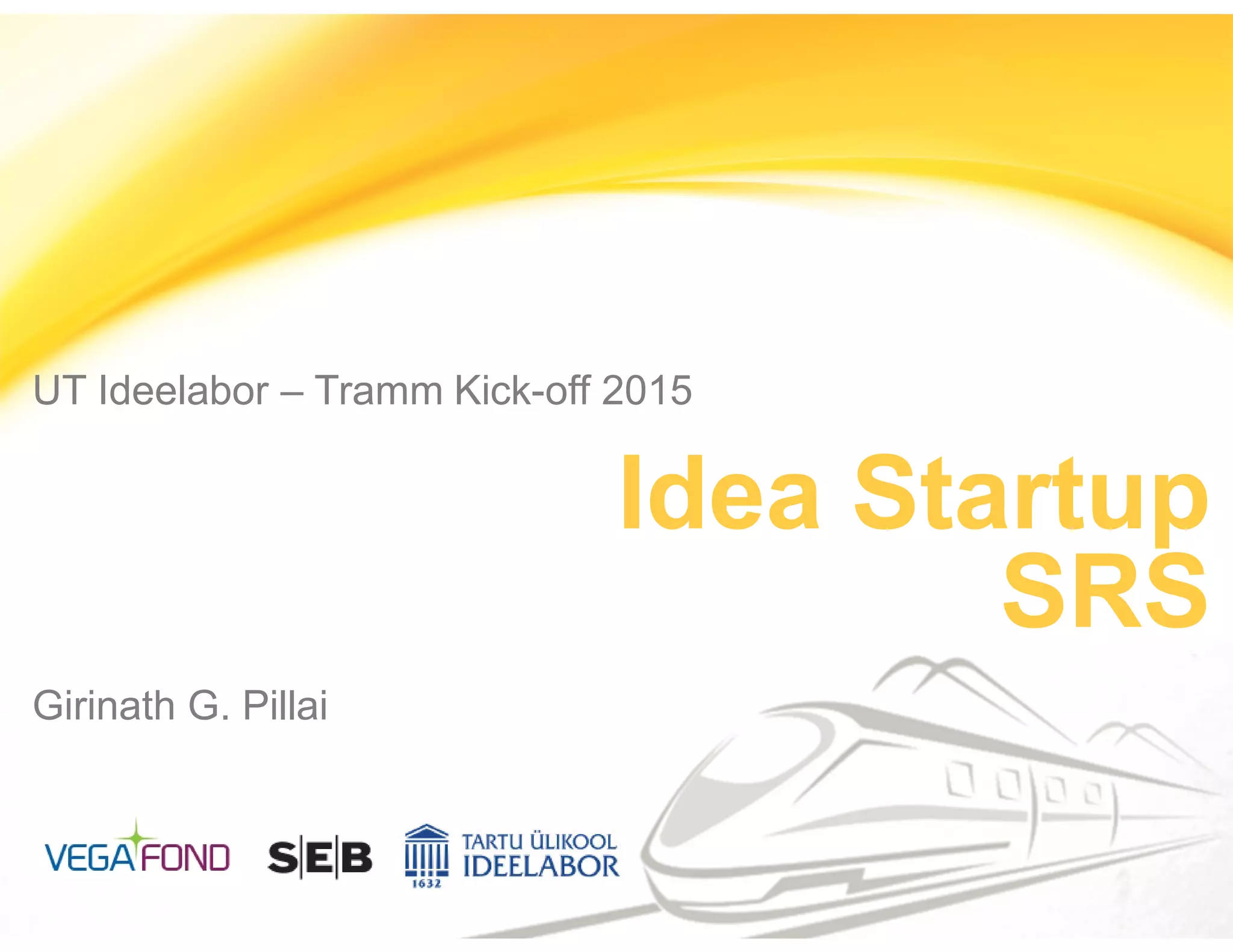
The cover slide introduces the project as 'Idea Startup SRS' presented by Girinath G. Pillai. The context is the 'UT Ideelabor – Tramm Kick-off 2015.' The presence of logos for Vega Fond, SEB, and Tartu Ülikool Ideelabor establishes the project's roots in the Estonian startup scene, specifically within a university incubator environment. The imagery of a high-speed train ('Tramm') suggests a focus on momentum and progress.
Slide 3: Vision and Framework
This slide defines the core mission: 'We make students to improve their skills' through 'entrepreneurship + innovation.' It sets up a three-step narrative flow: Problems, Vision, and Solutions. The use of emoticons (happy, neutral, sad faces) hints at the sentiment-tracking nature of the product, which is later revealed in the dashboard slide. The branding 'Understanding is Learning' is introduced here as the company's tagline.
Slide 5: The Real-Time Platform
This is the most substantive slide in the deck. It showcases a 'Dashboard - Professor' for the Student Response System. The UI includes four key metrics : 26 New Conversations, 125 New Ratings, 23 New Feedbacks, and 13 New Questions. Below these metrics are two pie charts: 'Understanding - Students' and 'Confidence Level - Students.' A chat sidebar shows a mock interaction between a professor and a student named Umesh Bhat. This slide effectively demonstrates that the product is intended to be an active, live tool used during lectures to provide professors with a 'pulse' of the room.
Slide 7: Achievements and Validation
Traction is presented in the form of award recognition. The slide highlights ~€3000 in prize money from the Vega Fund and Kaleidoscope Awards. A photo shows the team holding a rocket-shaped trophy, and a certificate from December 12, 2014, confirms a 500 Euro prize for being the 'Parima Tiimi' (Best Team). For a student project, this represents significant early-stage validation and proof of concept within their local ecosystem.
Slide 9: Idea Outline
This slide serves as a table of contents or a checklist for a complete business plan. It lists 12 points, including 'Market,' 'Competition,' 'Revenue/Business,' and 'Investment.' However, in the provided deck, these points are merely listed rather than explained. This suggests the presentation may have been used as a guide for others to follow, or that the detailed data was reserved for a verbal presentation or a separate document.
Slides 11-17: Motivational Philosophy
A significant portion of the deck (Slides 11, 13, 15, and 17) is dedicated to startup advice. Using metaphors like a cat seeing a lion in the mirror ('Be Confident'), a lion chasing a zebra ('Speed'), and a bike path ('Find the Agile path'), the founder emphasizes the soft skills required for startup success. Slide 17, 'Plan well, Research properly,' features a chalkboard drawing of a business logic flow (If Work -> Else -> $). These slides indicate that the deck was likely intended for an audience of fellow students or at a 'kick-off' event where inspiring others was as important as pitching the product itself.
Slide 19: Conclusion
The deck ends with a 'Thank You' word cloud in multiple languages, including 'aitäh' (Estonian), 'danke,' 'gracias,' and 'merci.' This reinforces the international outlook of the founder and the academic setting of the presentation.
What Works in This Deck
Product Visualization: Slide 5 provides a very clear understanding of what the software does. By showing the professor's dashboard, the founder bypasses lengthy explanations of the 'how' and moves straight to the 'what.' · Local Validation: Citing the University of Tartu and SEB Bank adds immediate credibility. For a student-led startup, showing that you have won local competitions (Slide 7) is the best way to prove that the idea has been vetted by experts. · Clear Tagline: 'Understanding is Learning' is a strong, mission-driven slogan that aligns perfectly with a student response system.
What Is Missing from This Deck
Market Size (TAM/SAM/SOM): There is no mention of how many universities or students could potentially use this system. Without market data, it is impossible to judge the scale of the opportunity. · Revenue Model: While 'Revenue/Business' is listed on Slide 9, there is no explanation of whether this is a SaaS model for universities, a freemium model for professors, or a student-pay model. · Competitive Landscape: Tools like Kahoot!, Top Hat, and Poll Everywhere were already established or emerging in 2015. The deck fails to mention how SRS differs from these existing solutions. · Team Background: Aside from the founder's name, there is no information about the technical or pedagogical expertise of the team members. · The Ask: The deck does not specify how much money the company is looking to raise or what the next milestones are.
What Founders Should Copy
The 'Dashboard' Approach: If you are building software, one high-fidelity screenshot of the most important user view (like Slide 5) is worth five slides of bullet points. · Traction via Awards: If you don't have revenue yet, use 'non-dilutive' wins (grants, lab awards, hackathon prizes) to show that you are a 'winning' team. · Clean Layout: The deck uses a consistent color palette (yellow/orange) and clean white backgrounds, which makes it easy to read even if the content is sparse.
Frequently asked questions
- What is the primary problem SRS aims to solve?
- Based on Slide 3, SRS focuses on the intersection of entrepreneurship and innovation, specifically aiming to 'make students to improve their skills.' The product, a Student Response System, addresses the lack of real-time feedback in classrooms by providing professors with immediate data on student understanding and confidence levels, thereby bridging the communication gap between the lecturer and the audience.
- How much funding has SRS raised according to the deck?
- Slide 7 explicitly mentions achievements totaling approximately €3000. This capital was sourced from the Vega Fund and the Kaleidoscope Awards (Kaleidoskoop). The slide shows a certificate from December 2014 awarding 500 Euro to the 'SRS' team, suggesting the total figure is a cumulative result of multiple small grants or prize winnings rather than a traditional seed round.
- What are the key features of the SRS professor dashboard?
- Slide 5 displays a functional UI for the 'Dashboard - Professor.' Key features include counters for 'New Conversations' (26), 'New Ratings' (125), 'New Feedbacks' (23), and 'New Questions' (13). It also includes a real-time chat window and two analytical pie charts that visualize the aggregate understanding and confidence levels of the students in the session.
- Who are the partners or supporters of the SRS project?
- The project shows strong ties to Estonian academic and financial institutions. Slide 1 and Slide 7 feature the logos of Tartu Ülikool Ideelabor (University of Tartu Idea Lab), SEB Bank, and the Vega Fond. These logos indicate that SRS was likely incubated or supported through a university-led startup program in Estonia.
- Is there a clear business model or go-to-market strategy in the deck?
- No. While Slide 9 lists 'Revenue/Business' and 'Market Strategy' as items 7 and 8 in the 'Idea Outline,' the provided slides do not contain the actual data or plans for these categories. The deck is heavily weighted toward product visualization and motivational startup philosophy rather than financial projections or customer acquisition costs.