iConsumer's July 2019 deck outlines a pivot from traditional cashback to a 100% stock-based rebate model, leveraging its status as a publicly traded entity on the OTCQB under the symbol RWRDP. By replacing cash payouts with company shares, iConsumer aims to achieve a 100% gross profit margin on its commissions, as demonstrated on Slide 11. The deck highlights a team with deep roots in the early internet shopping space, specifically the iGive platform. While the model promises high margins and a 'self-fulfilling prophecy' of stock price growth, the deck relies heavily on historical industry ex…
Key takeaways
- The company operates as a publicly traded entity on the OTCQB under the ticker RWRDP (Slide 1).
- iConsumer rewards shoppers with company shares equal to a percentage of their purchase, such as 3.2% at Bloomingdale's (Slide 9).
- The 'Cash Model' claims a 100% gross profit margin by receiving a $5 commission from retailers and rebating shares instead of cash (Slide 11).
- A strategic shift occurred on August 1, 2019, to eliminate cash back rebates entirely in favor of 100% stock rebates (Slide 13).
- The company sought a $1,000,000 raise in Q3 2019 to achieve positive cash flow within one year (Slide 13).
- Management projects that $1,000,000 in acquisition spend will yield 20,000 to 40,000 shoppers and $1,000,000 in incremental first-year revenue (Slide 15).
- The executive team features founders with multiple exits to Intel, Aegon, and WBR dating back to 1993 (Slide 17).
- The deck lacks a traditional competitor slide, instead listing 'Massive Exits' like Ebates ($960M) and Groupon ($16B) as market validation (Slide 5).
iConsumer Pitch Deck Analysis
The iConsumer deck from July 2019 presents a business model that bridges the gap between affiliate marketing and public equity. By utilizing its status as a publicly traded company, iConsumer attempts to disrupt the traditional cashback loyalty market by offering shares instead of dollars. This teardown examines the mechanics of that model and the team's plan to scale it through a $1 million capital raise.
Slide 1: Title and Positioning
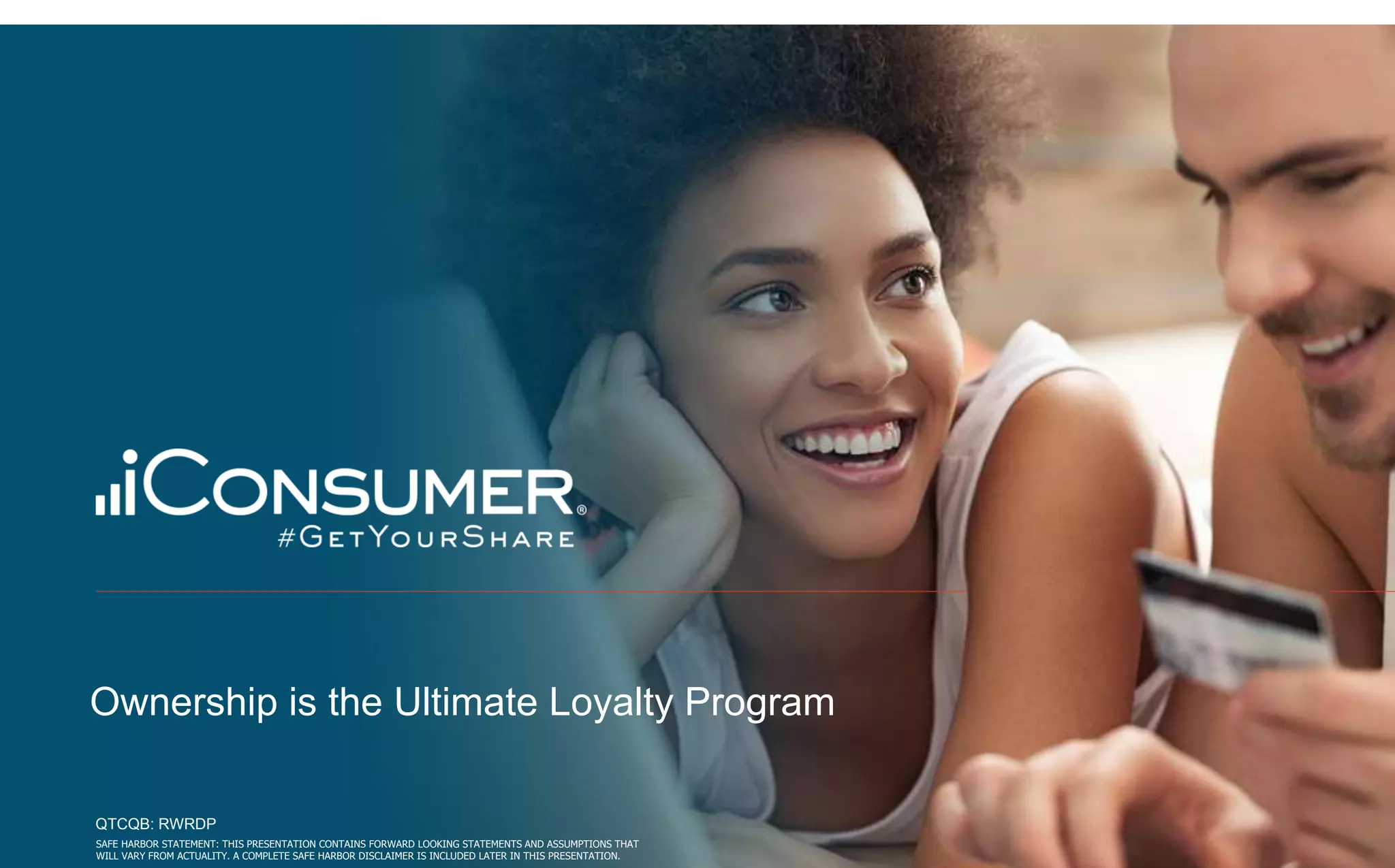
The cover slide introduces the company name and the tagline: "Ownership is the Ultimate Loyalty Program." Crucially, it includes the ticker symbol OTCQB: RWRDP at the bottom. This immediately signals to the investor that they are looking at a public company, which changes the nature of the investment from a private equity seed round to a public market placement or PIPE (Private Investment in Public Equity) style deal. The imagery of a consumer with a credit card reinforces the shopping-centric nature of the business.
Slide 3: The Customer Value Proposition
Slide 3 uses a screenshot of the iConsumer interface featuring Bloomingdale's. A large blue arrow points to a "3.2%" reward. This slide establishes the user experience: it looks and feels like a standard cashback portal (similar to Rakuten or Honey), but the underlying reward mechanism is what differentiates it. The slide is minimalist, focusing purely on the visual cue of a reward for shopping.
Slide 5: Market Validation and Comparables
Instead of a traditional market size slide (TAM/SAM/SOM), iConsumer uses "Massive Exits" to prove the value of the space. They cite:
Ebates: $960,000,000 sale to Rakuten ($450 per member). · Groupon: $16,000,000,000 IPO Valuation. · RetailMeNot: 47X P/E Ratio at its high point. · Epsilon/Conversant: $4.4 Billion acquisition by Publicis.
This slide serves to anchor the investor's expectations in high-value outcomes, though it does not explicitly state how iConsumer's specific 'stock-as-reward' model will capture a similar share of the market.
Slide 7: The Video Placeholder
Slide 7 is a placeholder for a video, featuring a collage of diverse faces and a bar chart. While the content of the video is not available in the static deck, the visual implies growth and a broad, inclusive user base. In a live pitch, this would be the moment the founders demonstrate the platform's ease of use or social impact.
Slide 9: The Mechanics of the Reward
Slide 9 provides a concrete example of the transaction flow. A customer purchases a $100 sweater from Bloomingdale's. The reward is not cash, but "Shares of OTCQB: RWRDP" equivalent to 3.2% of their purchase . By showing a physical stock certificate (an archaic but recognizable symbol of ownership), the deck attempts to make the digital reward feel tangible and valuable.
Slide 11: The Cash Model and Unit Economics
This is arguably the most important slide for a financial analyst. It breaks down the profitability of a single transaction:
Gross Revenue: $5 (the commission paid by the retailer on a $100 sale). · Cash Cost of Revenue: $0 (because the rebate is paid in stock, not cash). · Gross Profit (Cash): $5.
The deck claims a 100% cash gross profit margin on commissions. This is a powerful argument for scalability, as it suggests that every dollar of commission earned stays in the company's bank account to fund operations and growth, while the 'cost' of the reward is borne by the equity pool.
Slide 13: Strategic Inflection Points
Slide 13 outlines the roadmap for 2019 and 2020. The three key points are:
August 1, 2019: Moving to 100% stock rebates to simplify marketing and eliminate cash outflows. · 3rd Qtr: A $1MM raise with the goal of achieving positive cash flow within the year. · Late 2020: An "Uplist" to a larger exchange.
The slide mentions a "self-fulfilling prophecy" : a higher stock price encourages more shopping, which leads to more profits, which (hopefully) leads to a higher stock price. This acknowledges the circular dependency of their model on market sentiment.
Slide 15: Growth Capital and Projections
This slide quantifies the 'Ask.' The company states that $1,000,000 invested in member acquisition should yield:
20,000 – 40,000 Shoppers. · ~$1,000,000 in incremental first-year revenue. · ~$600,000 in incremental cash from operations.
These figures suggest a Customer Acquisition Cost (CAC) of $25 to $50. If the first-year revenue per user is roughly $25 to $50, the company is projecting a 12-month payback period on marketing spend, which is a standard benchmark for consumer tech.
Slide 17: The Executive Team
The team slide highlights a group of seasoned internet veterans. Robert Grosshandler (CEO) is noted as the founder of iGive (1997) and has several exits, including Intercast to Intel (1995) and SOFTA to Aegon (1993) . Sanford Schleicher (CTO) and Kimberly Logan (Ops) also share history at iGive and Onebox. The presence of logos like Intel and Aegon adds significant institutional credibility to the leadership team.
Slide 19: Safe Harbor and Contact
The final slide is a standard legal disclaimer required for public companies making forward-looking statements. It includes contact information for Robert Grosshandler and a link to the company's SEC offering circular. This reinforces the regulated nature of the investment.
What iConsumer Does Well
The deck is exceptionally clear about its economic engine . By explicitly comparing a cash-back model to a stock-back model on Slide 11, the founders make a compelling case for why their business could be more capital-efficient than traditional competitors like Rakuten. They aren't just selling a shopping portal; they are selling a high-margin financial instrument disguised as a shopping portal.
The team pedigree is another strong point. Having founders who were building e-commerce loyalty platforms as early as 1997 (iGive) suggests they have deep domain expertise and have likely seen multiple cycles of consumer behavior. The specific exit data (names of acquirers and years) provides a verifiable track record that builds trust.
What is Missing from the Deck
The most glaring omission is a detailed competitive landscape . While Slide 5 lists successful exits, it doesn't address how iConsumer will compete for users against the massive marketing budgets of Rakuten or the browser-extension dominance of Honey (which was acquired by PayPal shortly after this deck was published). The deck assumes that the 'ownership' hook is enough to win users, but it doesn't provide data on user retention or the cost of educating consumers about what 'OTCQB: RWRDP' actually is.
Furthermore, there is no historical performance data . The deck focuses on 'upcoming' inflection points and 'should yield' projections. For a company that is already public and has been operating, investors would typically expect to see a slide showing the last 12-24 months of actual user growth, GMV (Gross Merchandise Volume), and revenue to validate the current trajectory before committing more capital.
Founder's Guide: What to Copy and What to Avoid
Copy the 'Unit Economic Comparison': Slide 11 is a masterclass in showing, not just telling, how a business model pivot affects the bottom line. If your startup has a unique way of reducing COGS (Cost of Goods Sold) compared to the industry standard, use a simple table like this to highlight the margin expansion.
Copy the 'Specific Ask' Outcome: Slide 15 doesn't just ask for $1 million; it tells the investor exactly what that $1 million will 'buy' in terms of shoppers, revenue, and cash flow. This level of specificity makes the investment feel like a calculated purchase of growth rather than a blind bet on a team.
Avoid the 'Self-Fulfilling Prophecy' Logic: Slide 13 uses the phrase "self-fulfilling prophecy" and adds "(hopefully)" regarding the stock price. While honest, this can come across as speculative or 'meme-stock' logic to institutional investors. It is better to focus on the fundamental drivers of value (user growth, retention, margin) rather than suggesting that the business relies on the stock price to stay attractive to its own customers.
Avoid Omitting Current Traction: If you have been in business for years, as this team clearly has through various iterations, omitting your current active user count and revenue growth rates is a red flag. Always anchor your future projections in your recent historical reality.
Frequently asked questions
- How does iConsumer make money if it gives away rewards?
- According to Slide 11, iConsumer acts as an affiliate partner. When a customer spends $100 at a partner like Bloomingdale's, the retailer pays iConsumer a commission (e.g., $5). Instead of giving the customer a portion of that $5 in cash, iConsumer issues them RWRDP shares. This allows the company to retain the full $5 as gross profit, effectively using its own equity as the primary loyalty currency.
- What is the significance of the OTCQB: RWRDP ticker mentioned?
- The ticker indicates that iConsumer is already a publicly traded company on the OTCQB venture market. This is central to their value proposition, as it allows them to offer 'ownership' as a reward. Slide 13 notes a goal to 'Uplist' in late 2020, suggesting a move to a more senior exchange like the NASDAQ or NYSE to increase liquidity and stock price visibility.
- Who are the founders and what is their track record?
- The team, detailed on Slide 17, is led by Robert Grosshandler (CEO), Sanford Schleicher (CTO), and Kimberly Logan (Ops). They previously worked together at iGive.com. Grosshandler has a long history of exits, including SOFTA to Aegon in 1993, Intercast to Intel in 1995, and eComXpo to WBR in 2008.
- What are the projected unit economics for new member acquisition?
- Slide 15 outlines the expected return on a $1,000,000 investment in member acquisition. The company expects this to generate between 20,000 and 40,000 new shoppers. This cohort is projected to produce $1,000,000 in incremental first-year revenue and $600,000 in incremental cash from operations, implying a high-margin recovery of acquisition costs.
- What major strategic change was announced in this deck?
- Slide 13 highlights a major inflection point on August 1, 2019: the simplification of marketing by moving to 100% stock rebates. By eliminating the cash back option, the company aimed to streamline its operations and maximize the 'Cash Model' where commissions are retained as profit rather than shared with the user in cash.