iCrowdU is a social e-commerce platform that utilizes a 'CrowdPromotion' model to lower product prices as more buyers commit to a purchase. The 19-slide deck, dated March 2019, outlines a plan to capture 1% of the U.S. e-commerce market, targeting $250 million in revenue. The company seeks a $3 million Series A investment to scale its operations and reach a projected $23 million in revenue within 24 months. The deck emphasizes a hybrid model, drawing comparisons to LinkedIn, Facebook, and Amazon, while introducing a 'CrowdToken' cryptocurrency incentive system. Despite ambitious financial tar…
Key takeaways
- The company seeks a $3 million Series A investment to reach $23 million in revenue within 24 months (Slide 18).
- The business model is based on a 10% commission on each transaction (Slide 11).
- iCrowdU uses a dynamic pricing model where the price drops as more units are sold, illustrated by a smartphone example dropping from $150 to $110 (Slide 9).
- The platform incorporates a cryptocurrency incentive called 'CrowdTokens' to reward users for building their network (Slide 8).
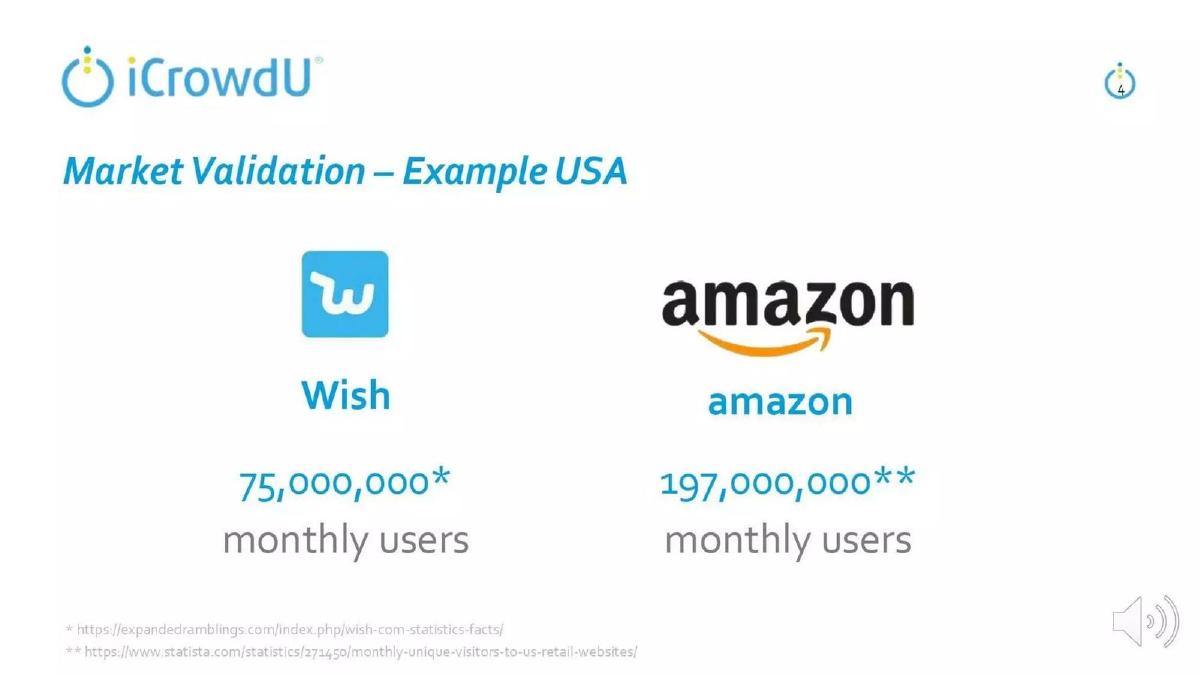
- Market validation is presented by citing user numbers from Wish (75M) and Amazon (197M) (Slide 4).
- The company claims to have already established subsidiaries in Europe, Hong Kong, and China (Slide 12).
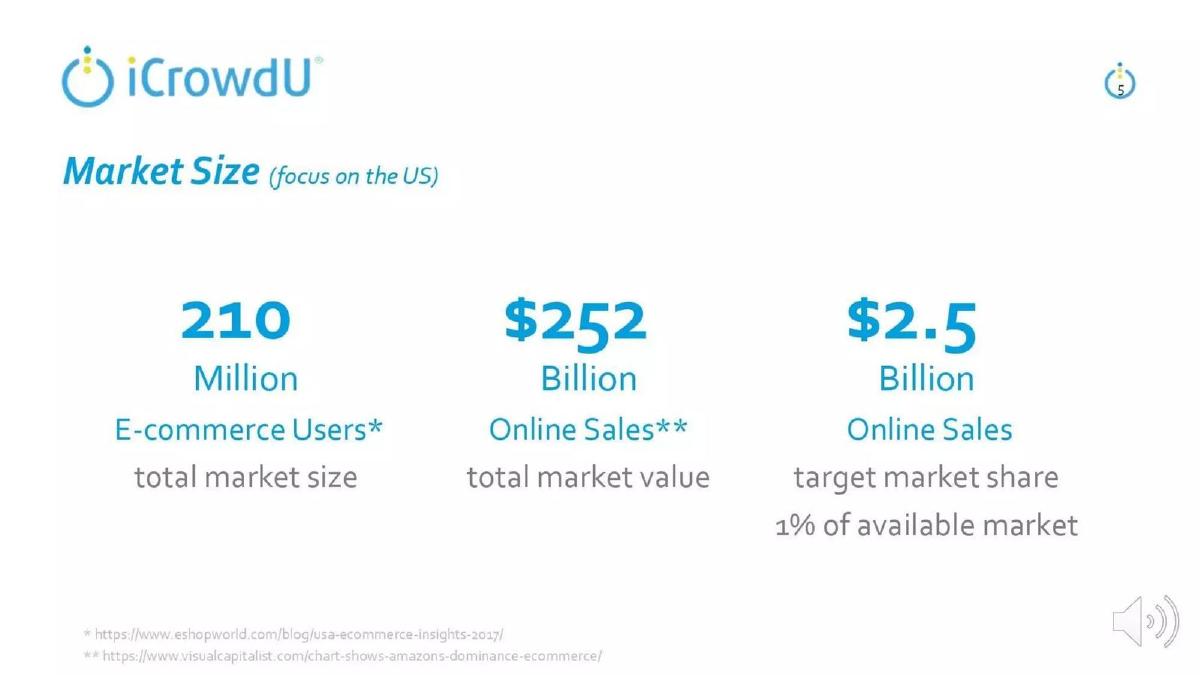
- The target market share is 1% of the available U.S. e-commerce market, which they value at $2.5 billion (Slide 5).
- The deck lists a current user base of fewer than 20,000 users across fewer than 150 countries (Slide 12).
Executive Summary and Vision
The iCrowdU pitch deck, dated March 2019, introduces a platform designed to disrupt traditional retail by connecting producers directly with consumers. The cover slide (Slide 1) sets a clear tone with the tagline: "Bringing wholesale prices to consumers and retail margins to producers." This suggests a disintermediation play, removing the "middlemen" that the company identifies as a core problem on Slide 2.
Defining the Problem and Solution
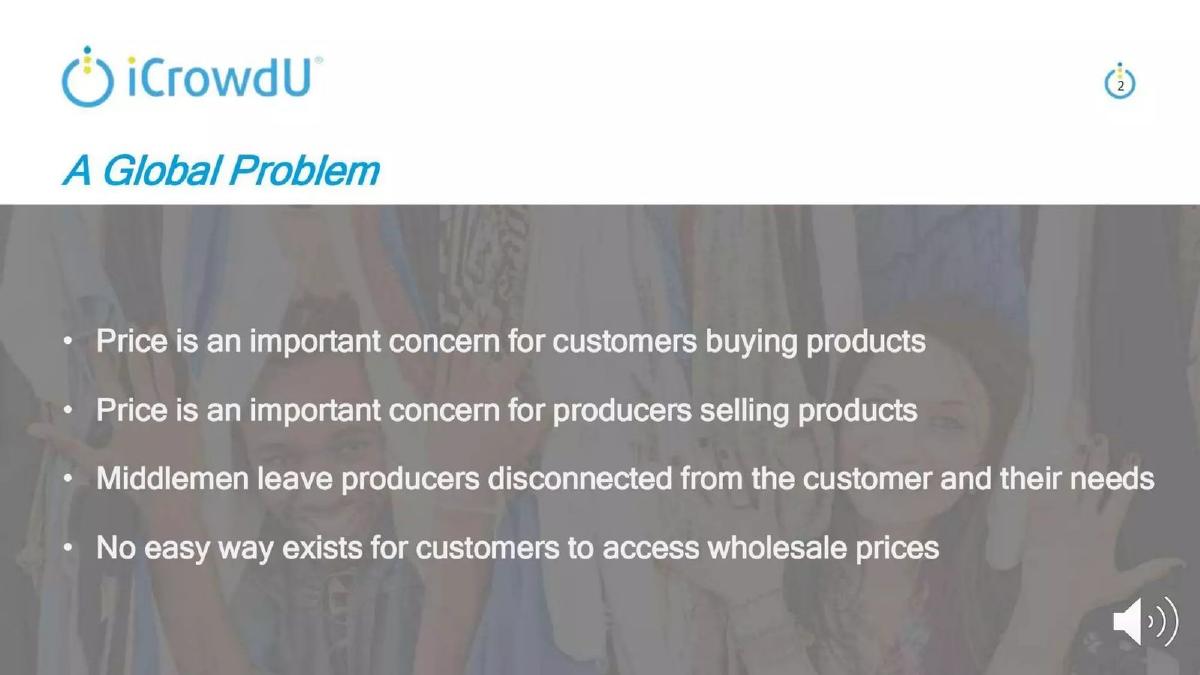
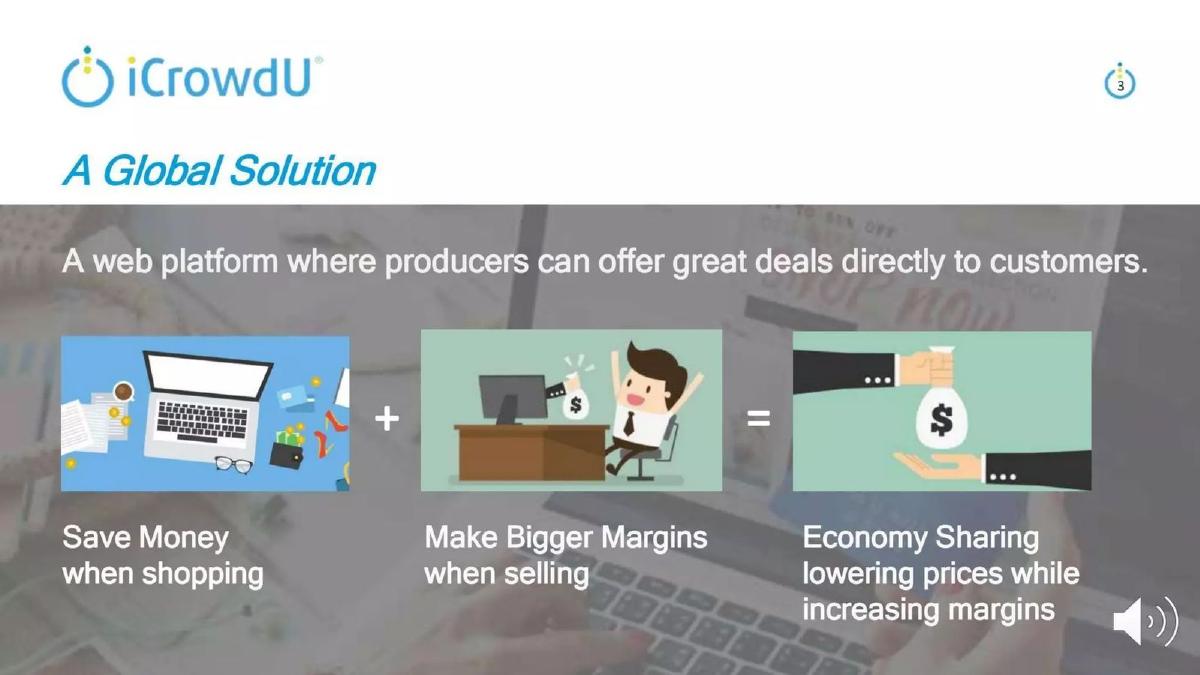
On Slide 2, titled "A Global Problem," the company lists four bullet points: price concerns for both buyers and sellers, the disconnect caused by middlemen, and the lack of consumer access to wholesale pricing. The solution (Slide 3) is presented as a web platform where producers offer deals directly to customers. The slide uses a simple equation: saving money + bigger margins = "Economy Sharing lowering prices while increasing margins."
Market Opportunity and Validation
Market Size and Competitive Landscape
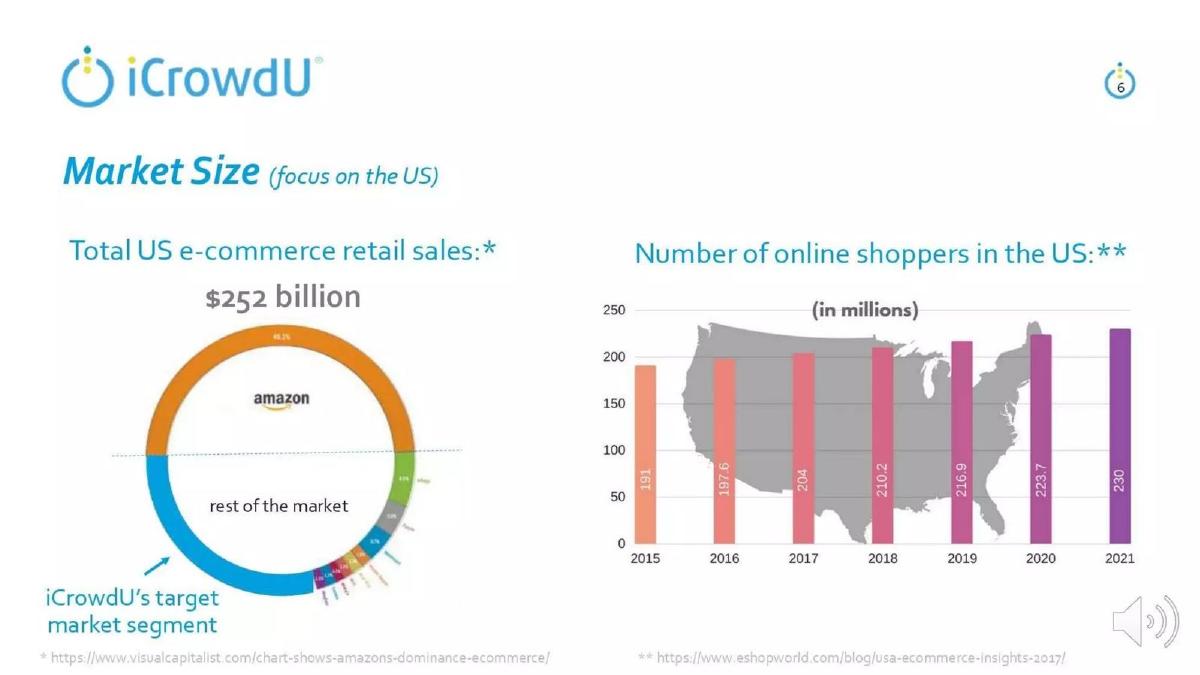
Slides 4, 5, and 6 focus on market validation and sizing, specifically targeting the United States. Slide 4 uses Wish (75,000,000 monthly users) and Amazon (197,000,000 monthly users) as benchmarks for the potential user base. Slide 5 defines the total market size as 210 million e-commerce users and $252 billion in online sales. The company sets a "target market share" of 1% of the available market, which they calculate as $2.5 billion in sales. Slide 6 provides a visual breakdown of this, showing Amazon's dominance and highlighting the "rest of the market" as iCrowdU's playground, with a bar chart projecting growth in U.S. online shoppers to 230 million by 2021.
Competitive Positioning
Slide 13 and 14 address competition. Rather than a standard 2x2 grid, Slide 13 places iCrowdU at the top of a cross-shaped diagram, with Kickstarter and GoFundMe in the center. It suggests iCrowdU sits at the intersection of "Power of the Crowd" and "Marketplace Features." Slide 14 explicitly states that iCrowdU combines the connectivity of LinkedIn, the social aspects of Facebook, the deal-finding of Wish, the ease of use of Amazon, the project funding of Kickstarter, and the community inspiration of GoFundMe. This is a bold claim, suggesting the platform is a hybrid of six major tech giants.
Product Mechanics and User Experience
The CrowdPromotion Model
Slides 7 through 10 walk through the product interface and mechanics. Slide 7 shows mobile app mockups for connecting with people, searching for promotions, and monitoring transactions. Slide 9 is the most critical for understanding the business: it explains "CrowdPromotion." In the example of a Gome U7 Mini Smart Phone, the price starts at $150. As units are sold in increments of 1,000, the price drops to $140, $130, $120, and finally a target of $110 . This gamified, volume-based discounting is the platform's primary differentiator.
Social Incentives and Blockchain
Slide 8 introduces the social layer, where users build a multi-level network (Level 1, Level 2, Level 3). The deck mentions "CrowdTokens," described as "cryptocurrency incentives." Users earn these tokens by expanding their network and can apply them at checkout (Slide 10) to further reduce prices. This indicates a heavy reliance on social engineering and tokenomics to drive user acquisition and retention.
Business Model and Growth Strategy
Revenue Streams
The business model is straightforward. Slide 11 states: "We take a 10% commission on each transaction." The slide projects "Target Revenues for iCrowdU" of $250 million (based on 1% of the market) and sets a long-term goal of $450 million in revenues by 2029. It assumes an average sales volume per customer of $1,200 per year, resulting in $120 in revenue per customer for the platform.
Go-to-Market Plan
Slide 12, "Market Adoption," outlines a three-pronged strategy: building crowds worldwide via social media (claiming over 200,000 followers), onboarding producers through roadshows and partnerships (mentioning Alibaba and MFC Bank), and expanding internationally. The company claims to have subsidiaries already established in Europe, Hong Kong, and China, with a current user base of "<20,000 users in <150 countries."
Team, Social Proof, and The Ask
Leadership and Press
Slide 15 introduces the three-person leadership team. CEO Alexander Holtermann is positioned as the business and fundraising lead with 20 years in financial markets. COO Ian Wright handles design and organization, and CTO Srdjan Vukmirovic is the technical lead with a focus on blockchain. Slide 16 and 17 provide social proof through press quotes (from Frankfurter Allgemeine Zeitung and others) and three user testimonials that emphasize the social and cost-saving aspects of the platform.
The Financial Ask
Slide 18 delivers the "Financial" ask. The company is seeking a "$3 Million Series A investment opportunity." The stated goal for this funding is to achieve "23 million dollars in revenues within 24 months." This would require reaching 255 sales transactions per day, which the company equates to 0.05% of their target U.S. market. The final slide (Slide 19) provides contact links and a call to action to view a fundraising video, which mentions a goal of reaching 500 shareholders for a potential NASDAQ IPO.
What Works in This Deck
Clear Pricing Mechanism: Slide 9 does an excellent job of explaining the "CrowdPromotion" model visually. The descending arrow and clear price points make the value proposition to the consumer immediately understandable. · Defined Revenue Model: The 10% commission stated on Slide 11 is unambiguous. Investors appreciate a simple, scalable revenue model that doesn't rely on complex advertising tiers in the early stages. · Market Context: By using Wish and Amazon as benchmarks, the deck quickly establishes the category and the scale of the opportunity, even if the 1% market share goal is a standard startup trope. · Global Ambition: The mention of existing subsidiaries in Europe and Asia (Slide 12) suggests the founders are thinking about global supply chains from day one, which is necessary for a platform promising wholesale prices.
What Is Missing from This Deck
Use of Funds Breakdown: While the deck asks for $3 million (Slide 18), it never explains how that money will be spent. There is no breakdown for marketing, engineering, operations, or legal/compliance. · Unit Economics: The deck assumes a $1,200 annual spend per user (Slide 11) but provides no data on Customer Acquisition Cost (CAC) or Lifetime Value (LTV) from their existing 20,000 users. · Logistics and Fulfillment: For a platform connecting global producers to consumers, the deck is silent on how shipping, customs, and returns are handled. This is a significant operational hurdle in cross-border e-commerce. · Regulatory and Compliance Details: Given the mention of "CrowdTokens" and "cryptocurrency incentives" (Slide 8), the deck lacks information on the legal framework or licenses required to operate a token-based economy across 150 countries. · Traction Data: The deck mentions having fewer than 20,000 users but provides no growth charts, retention rates, or historical transaction volumes to prove the model works.
What a Founder Should Copy
The "Problem" Slide Simplicity: Slide 2 uses four concise bullet points to define the pain points. It avoids jargon and focuses on the fundamental economic disconnect between producers and consumers. · Visualizing the Product Loop: The flow from Slide 8 (building a crowd) to Slide 9 (price dropping) to Slide 10 (wallet/checkout) effectively tells the story of the user journey. · Comparative Positioning: While claiming to be "LinkedIn + Facebook + Amazon" is risky, the way Slide 14 breaks down the specific attributes they are borrowing from each (connectivity, social fun, ease of use) helps clarify their product philosophy. · Direct Contact and Next Steps: Slide 19 provides multiple ways to engage, including a website, YouTube channel, and a direct link to a crowdfunding campaign, making it easy for an interested investor to do further due diligence.
Frequently asked questions
- What is the core value proposition of iCrowdU?
- According to Slide 1, the company aims to bring wholesale prices to consumers and retail margins to producers. It achieves this through 'CrowdPromotion,' a mechanism where the price of a product decreases as more people commit to buying it, effectively aggregating consumer demand to negotiate better rates directly with producers.
- How does the platform's incentive system work?
- Slide 8 details a social referral system where users 'Build your Crowd' and earn 'CrowdTokens.' These are described as cryptocurrency incentives earned through multi-level connections. Slide 10 notes that these tokens can be managed in a digital wallet and applied during checkout to secure even lower prices on products.
- What are the company's financial projections?
- Slide 11 projects $450 million in revenue by 2029, based on a $120 revenue per customer per year. More immediately, Slide 18 targets $23 million in revenue within 24 months of receiving the $3 million Series A funding, requiring approximately 255 sales transactions per day.
- Who are the key members of the leadership team?
- Slide 15 introduces Alexander Holtermann (CEO), who has 20 years of experience in financial markets; Ian Wright (COO), who holds an MBA and a background in banking and automotive design; and Srdjan Vukmirovic (CTO), an Associate Professor specializing in distributed programming and blockchain.
- What is the current scale of the business according to the deck?
- Slide 12 states the company has a social media reach of over 200,000 followers and an existing user base of less than 20,000 users. While they claim a presence in 150 countries and subsidiaries in three major regions, the transaction volume at the time of the deck appears to be in the early stages.