ID5's Series B deck is a masterclass in leveraging market tailwinds. By framing the deprecation of cookies and MAIDs by Google and Apple as a fundamental market disruption, ID5 positions its identity solution as an essential infrastructure for the $1T digital advertising market projected for 2028. The deck leans heavily on third-party validation from Sincera and eMarketer to prove market leadership, showing they have surpassed competitors like The Trade Desk and LiveRamp in publisher adoption. With a lean 8-slide structure, the company focuses on three core pillars: regulatory compliance (GDP…
Key takeaways
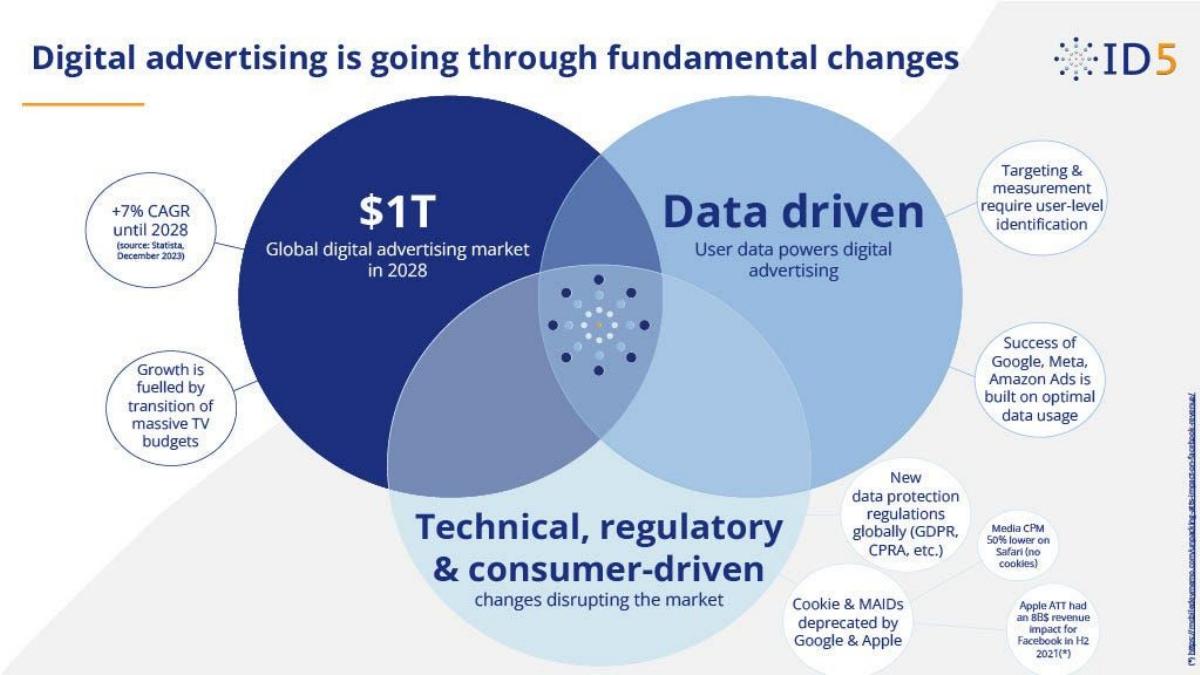
- The global digital advertising market is projected to reach $1T by 2028, according to slide 4.
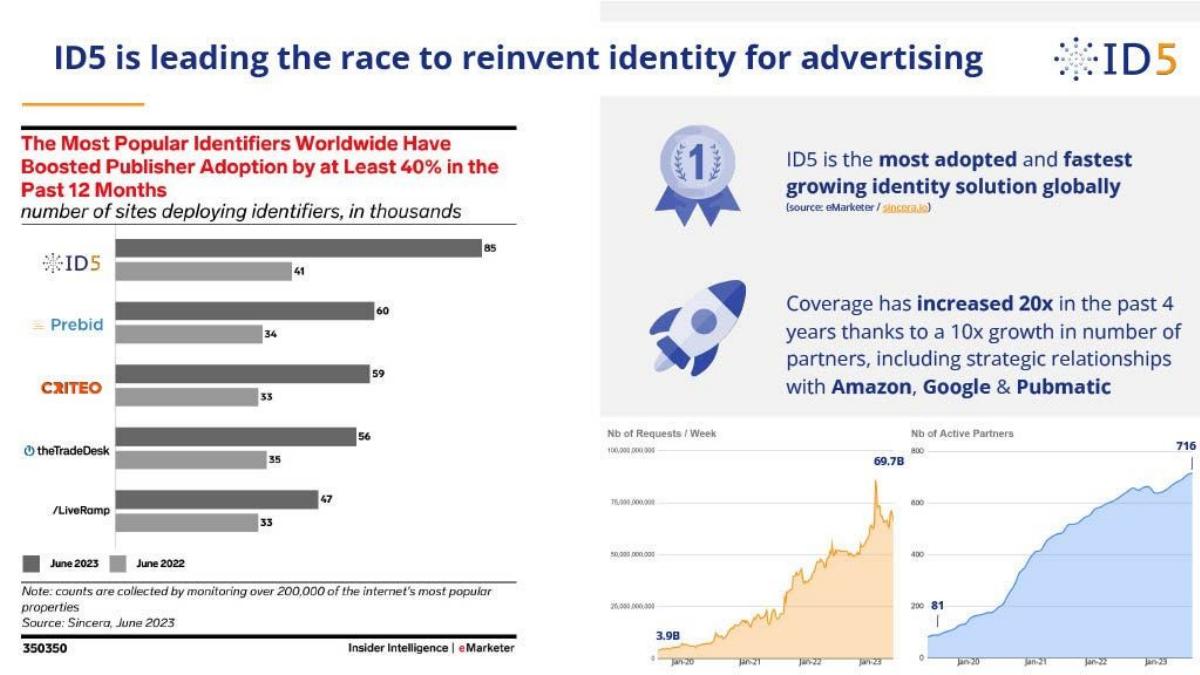
- ID5 claims to be the most adopted identity solution on the publisher side, outperforming Prebid, Criteo, and The Trade Desk in site deployments as of June 2023 (Slide 5).
- The platform handles 69.7 billion requests per week, representing a 20x increase in coverage over four years (Slide 5).
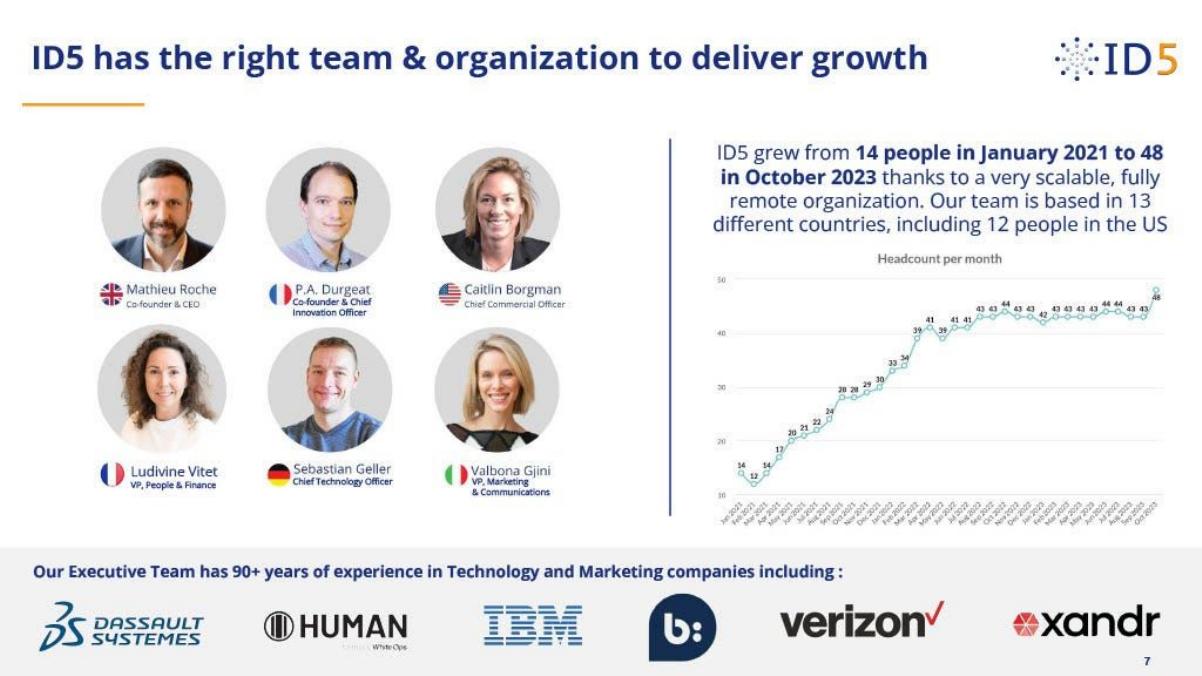
- The company grew its headcount from 14 people in January 2021 to 48 in October 2023, maintaining a fully remote organization across 13 countries (Slide 7).
- The executive team brings over 90 years of combined experience from major firms including IBM, Verizon, and Xandr (Slide 7).
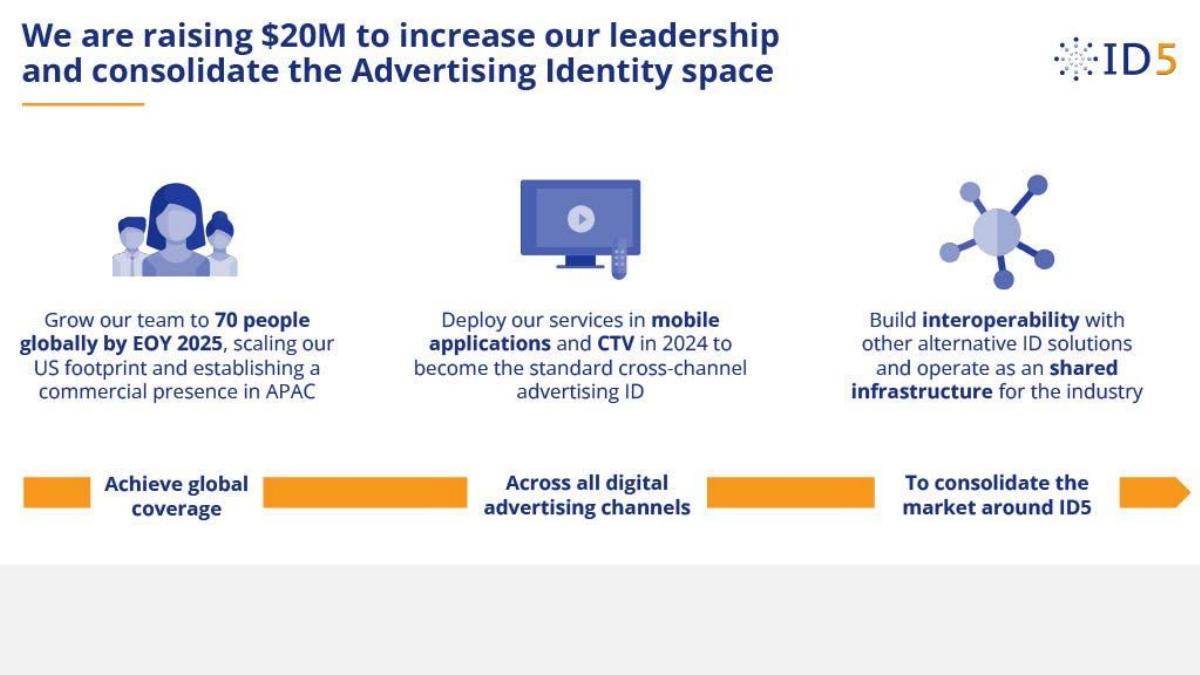
- The $20M Series B raise is earmarked for growing the team to 70 people by EOY 2025 and expanding into the APAC region (Slide 8).
- Strategic partnerships with Amazon, Google, and Pubmatic are cited as key drivers for their 10x growth in partner count (Slide 5).
- The product roadmap focuses on deploying services in mobile applications and CTV in 2024 to become a cross-channel standard (Slide 8).
Executive Summary: The Identity Power Play
ID5's Series B pitch deck is a concise, data-driven argument for why the future of digital advertising belongs to privacy-first identity providers. In just eight slides, the company establishes a massive market opportunity, proves its current dominance through third-party data, and outlines a clear path to global consolidation. By focusing on the 'why now'—the death of the cookie—ID5 transforms a technical solution into a mandatory infrastructure play for a trillion-dollar industry.
Slide 1-3: Vision and Positioning
The deck opens with a clean, professional title slide (Slide 1) and immediately moves into an 'At A Glance' summary (Slide 2). This second slide is critical; it defines ID5 as the 'identity specialist' and highlights four key value propositions: being laser-focused on identity, being a data protection leader (GDPR compliant), being signal agnostic, and being the 'most adopted ID' on the publisher side. This sets the stage for a high-growth narrative backed by compliance.
Slide 3 presents the vision: 'Become the leading global identity company powering addressable & measurable advertising to support the growth of the digital economy and enable free and safe access to the Internet.' This elevates the company's mission from a simple B2B tool to a defender of the open web, a common theme in successful ad-tech pitches.
Slide 4: The Trillion-Dollar Disruption
Slide 4 is the 'Market' and 'Problem' slide combined. It uses a Venn diagram to show the intersection of a $1T global digital advertising market (by 2028) and the 'Technical, regulatory & consumer-driven changes' disrupting it. The slide provides specific data points to heighten the sense of urgency, noting that Apple's ATT had an $8B revenue impact for Facebook in H2 2021 and that Media CPMs are 50% lower on Safari due to the lack of cookies. By citing these figures, ID5 quantifies the 'cost of doing nothing' for advertisers.
Slide 5: Proving Market Leadership
This is arguably the most important slide in the deck. ID5 uses data from Sincera and eMarketer to show they are winning the 'race to reinvent identity.' A bar chart compares site deployments, showing ID5 at 85,000 sites, comfortably ahead of industry giants like The Trade Desk (56,000) and LiveRamp (47,000). The slide also features two growth charts: one showing weekly requests hitting 69.7B and another showing active partners reaching 716. This combination of competitive benchmarking and internal growth metrics provides the 'social proof' necessary for a Series B round.
Slide 6: The Product Logic
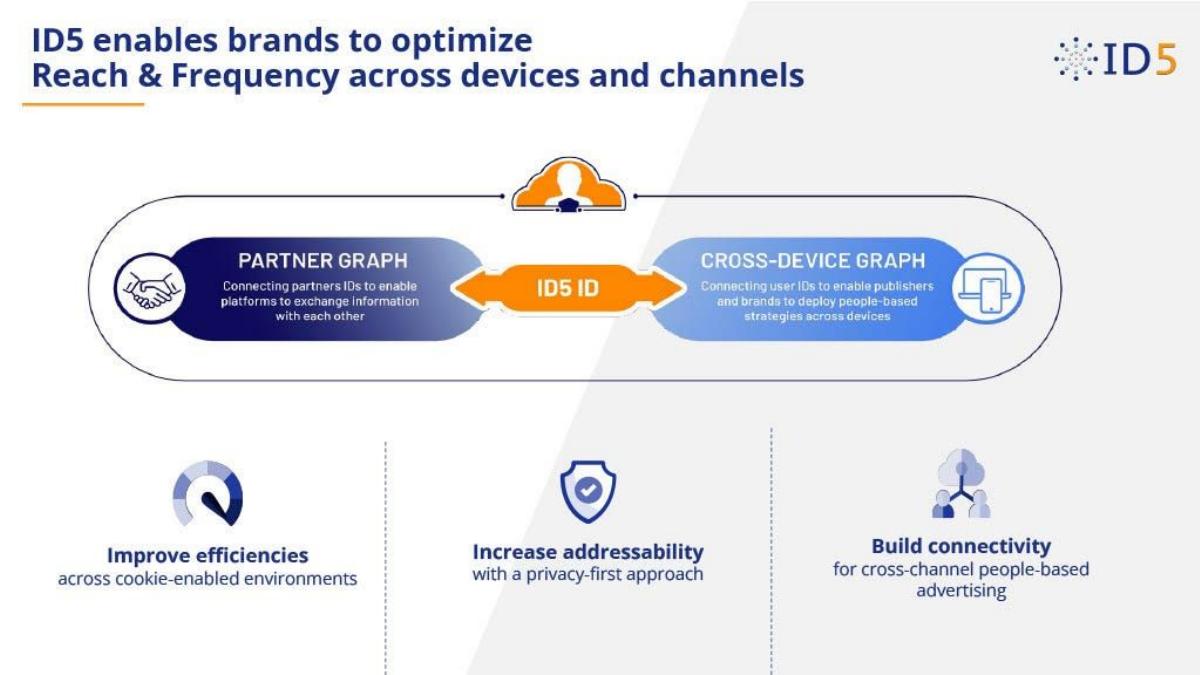
Slide 6 explains how the technology works without getting bogged down in code. It visualizes the 'ID5 ID' as the bridge between a 'Partner Graph' and a 'Cross-Device Graph.' The stated benefits are clear: improved efficiencies in cookie-enabled environments, increased addressability with a privacy-first approach, and cross-channel connectivity. This slide bridges the gap between the 'problem' (Slide 4) and the 'traction' (Slide 5) by explaining the 'how.'
Slide 7: The Scalable Team
The team slide highlights six key executives, but the real story is in the growth chart on the right. ID5 shows a headcount increase from 14 to 48 people over two years, emphasizing a 'very scalable, fully remote organization.' By listing previous experience at companies like IBM, Verizon, and Xandr, they demonstrate that the leadership has the 'big company' experience required to manage a global infrastructure player.
Slide 8: The $20M Ask and Roadmap
The final slide is the 'Ask.' ID5 is raising $20M to 'increase leadership and consolidate the Advertising Identity space.' The roadmap is divided into three clear goals: growing the team to 70 people (geographic expansion), deploying in mobile and CTV (channel expansion), and building interoperability (ecosystem expansion). The slide concludes with a chevron graphic that moves from 'global coverage' to 'all digital channels' to 'consolidate the market around ID5.'
What Works in This Deck
Third-Party Validation: Using Sincera and eMarketer data to rank themselves against competitors is a high-authority move that removes founder bias. · Quantified Pain Points: Citing the 50% lower CPMs on Safari and the $8B hit to Facebook makes the problem feel massive and immediate. · Scale Metrics: 69.7 billion requests per week is a 'wow' number that suggests the platform is already operating at internet-scale. · Clarity of Purpose: The deck doesn't try to do too much. It stays strictly focused on identity, reinforcing the 'specialist' branding from Slide 2.
What is Missing
Financial Performance: There is no mention of revenue, gross margins, or burn rate. While common in public versions of decks, these are essential for a true Series B evaluation. · Case Studies: While the deck mentions 'strategic relationships' with Amazon and Google, it lacks a specific case study showing how a brand or publisher saw a lift in ROI by using ID5. · Competitive Moat: The deck shows they are currently leading in adoption, but it doesn't explicitly explain the 'moat'—what stops a competitor from simply catching up in site deployments? · Unit Economics: There is no information on the cost to serve these 69.7B requests or the pricing model (SaaS vs. take-rate).
Founder Lessons
Focus on the 'Why Now': ID5 succeeds because it ties its existence to a specific, unavoidable market shift (cookie deprecation). If your industry is facing a regulatory or technical sea change, make that the centerpiece of your narrative.
Use External Benchmarks: If you are claiming to be a leader, don't just say it—show a chart from a recognized industry analyst. It carries ten times the weight of an internal spreadsheet.
Scale the Narrative with the Round: A Series B deck should look like ID5's—less about 'we have an idea' and more about 'we have a machine that is already winning, and we need fuel to make it go faster.' The focus on headcount growth and geographic expansion is exactly what Series B investors want to see.
Keep it Lean: Eight slides is remarkably short for a $20M raise. It shows confidence and respect for the investor's time. If you can't explain your billion-dollar opportunity in under 10 slides, you might not understand your core value proposition well enough.
Frequently asked questions
- What is the primary problem ID5 is solving?
- ID5 addresses the 'fundamental changes' in digital advertising caused by the deprecation of third-party cookies and MAIDs by Google and Apple. As shown on slide 4, these technical and regulatory shifts (GDPR, CPRA) have made traditional targeting and measurement difficult, creating a need for privacy-compliant, user-level identification.
- How does ID5 compare to its competitors in terms of adoption?
- According to slide 5, ID5 leads the market in publisher adoption. As of June 2023, ID5 was deployed on 85,000 sites, significantly higher than Prebid (60,000), Criteo (59,000), The Trade Desk (56,000), and LiveRamp (47,000).
- What are the key technical components of the ID5 solution?
- Slide 6 outlines a dual-graph approach: a 'Partner Graph' that connects partner IDs to enable platform information exchange, and a 'Cross-Device Graph' that connects user IDs across devices. This allows brands to optimize reach and frequency while maintaining a privacy-first approach.
- What is ID5's strategy for the $20M Series B funding?
- As detailed on slide 8, the funds are intended to increase headcount to 70 people, scale the US footprint, and establish a presence in APAC. Technically, they aim to expand into mobile apps and CTV to consolidate the market as a shared infrastructure.
- Does the deck provide specific financial revenue metrics?
- No. The deck focuses on 'usage' and 'adoption' metrics, such as the number of requests per week (69.7B) and the number of active partners (716). It omits specific ARR, MRR, or unit economics, which is common in sanitized Series B decks shared publicly.