iFarm's 2017 Seed deck is a concise 11-slide presentation that successfully raised $4,000,000. The company positions itself as a technology provider for the indoor farming sector rather than just a produce grower. By focusing on the 'Growtune' software and AI-driven automation, iFarm addresses the inefficiencies of traditional agriculture, claiming a reduction from a 7-step supply chain to just 2 steps. The deck is visually heavy, utilizing high-quality renders and photos of their technology in action, including drones and automated racks. While it excels at explaining the product and market…
Key takeaways
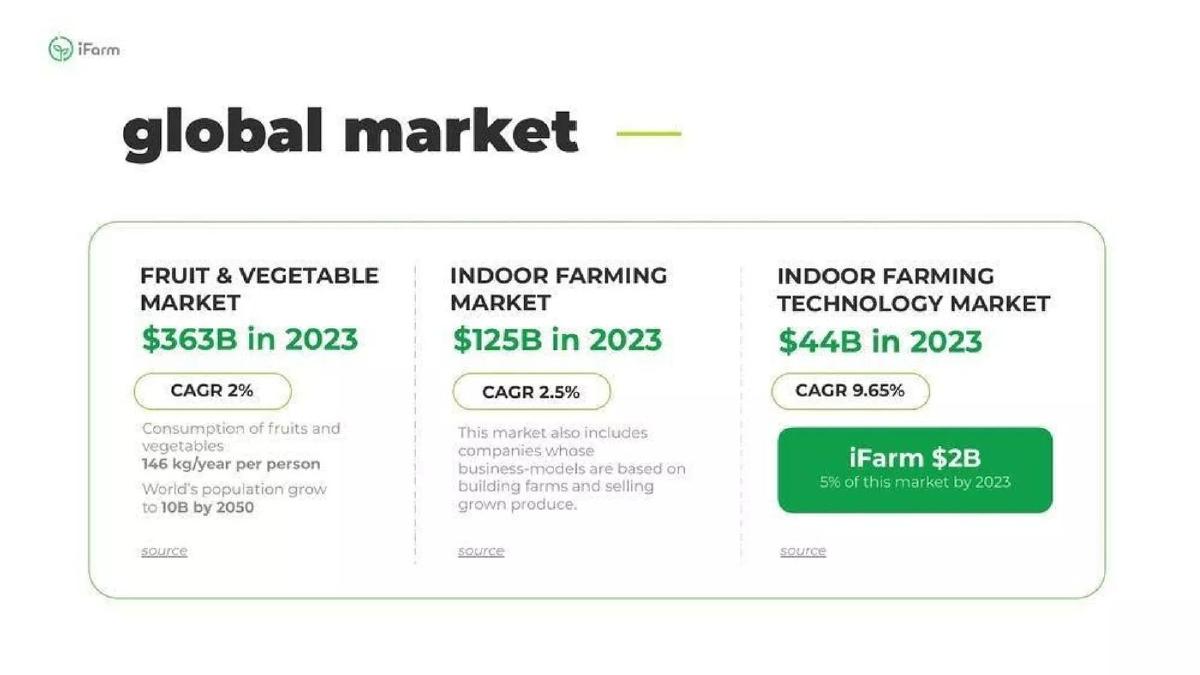
- The deck claims the indoor farming technology market will reach $44B by 2023 with a 9.65% CAGR (Slide 3).
- iFarm targets a $2B revenue goal by 2023, representing 5% of their identified market (Slide 3).
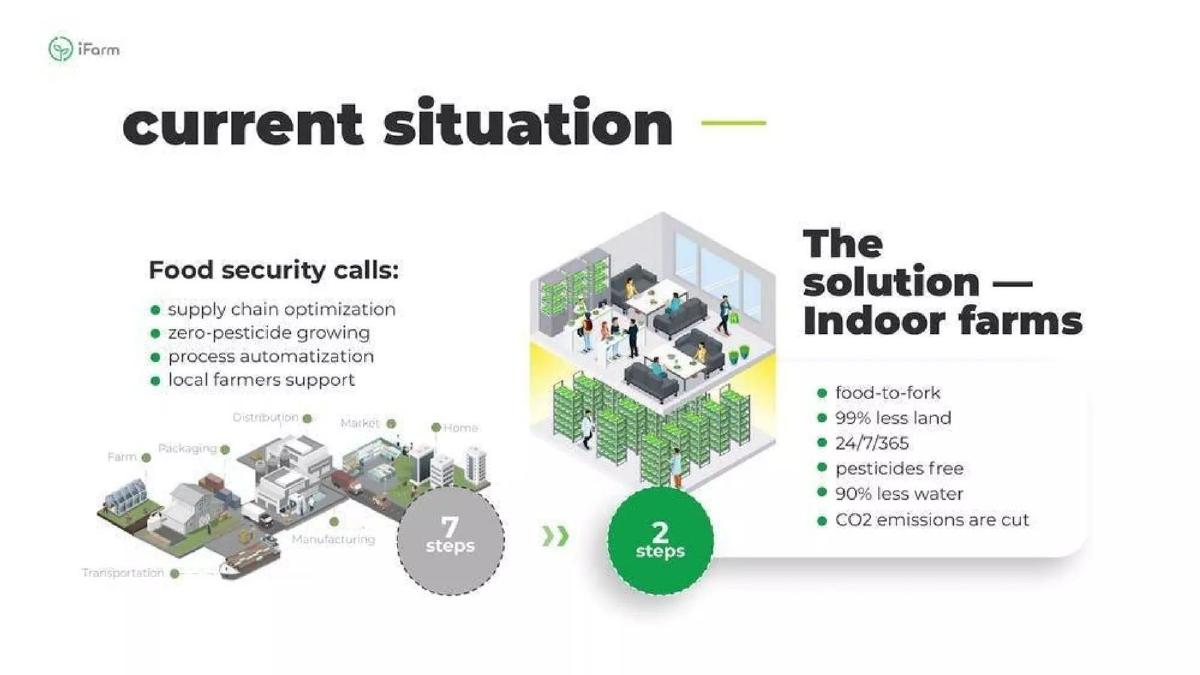
- The solution reduces the traditional 7-step food supply chain to a 2-step 'food-to-fork' model (Slide 2).
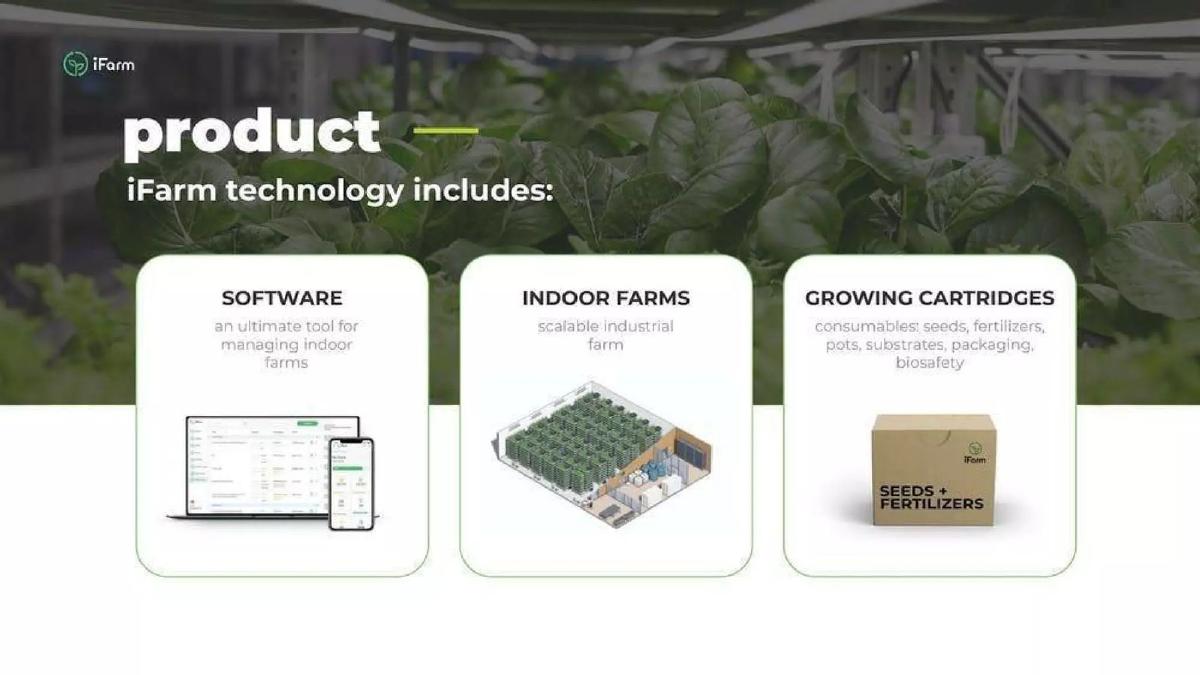
- Product offerings are split into three pillars: Software, Indoor Farms, and Growing Cartridges (Slide 4).
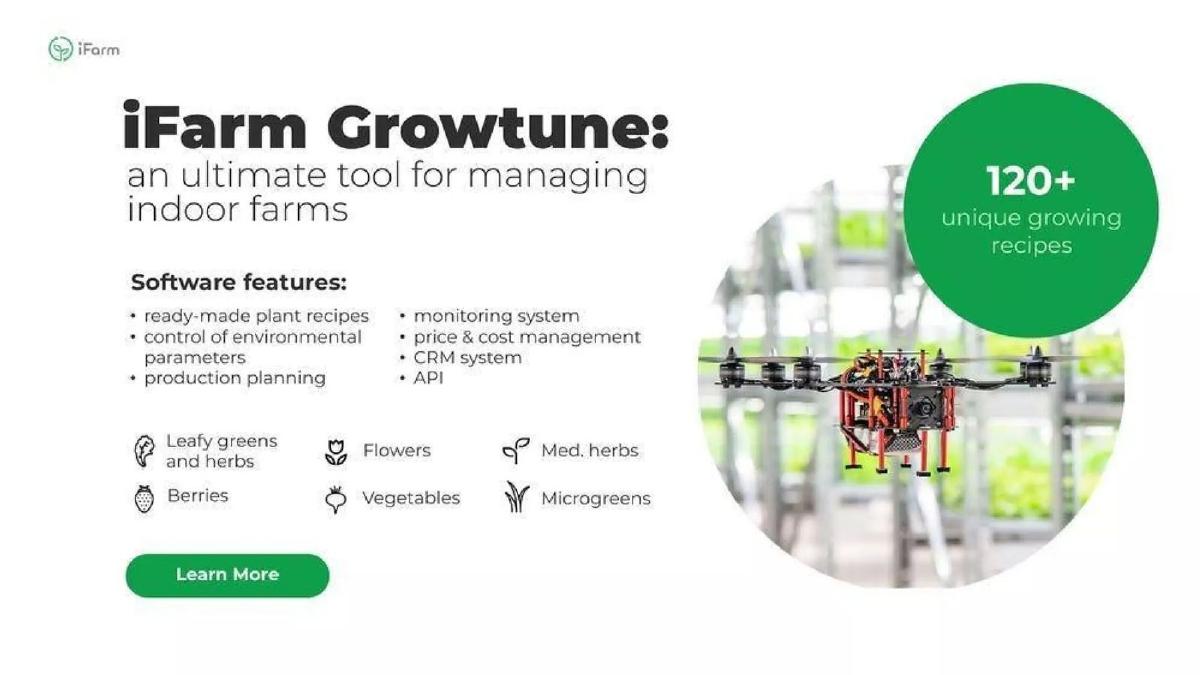
- The Growtune software includes over 120 unique growing recipes for berries, greens, and vegetables (Slide 5).
- Traction is demonstrated by 1,374 square meters launched and 11,258 square meters under design/construction (Slide 9).
- Environmental impact projections suggest a leap from 469,345 kg of food produced in 2020 to over 47 million kg by 2026 (Slide 10).
- The team consists of 40 professionals across 6 countries, led by founders with backgrounds in Alawar and Nokia (Slide 7).
The iFarm Seed Deck: Selling the Future of Automated Agriculture
iFarm's 2017 Seed deck is a masterclass in visual storytelling for a hardware-plus-software startup. With only 11 slides, the company managed to secure $4,000,000 by focusing on the massive inefficiency of the current food supply chain and offering a high-tech, automated alternative. The deck avoids dense text blocks, opting instead for clean iconography and professional photography of their vertical farming systems and software interfaces.
The Hook: Problem and Market Opportunity
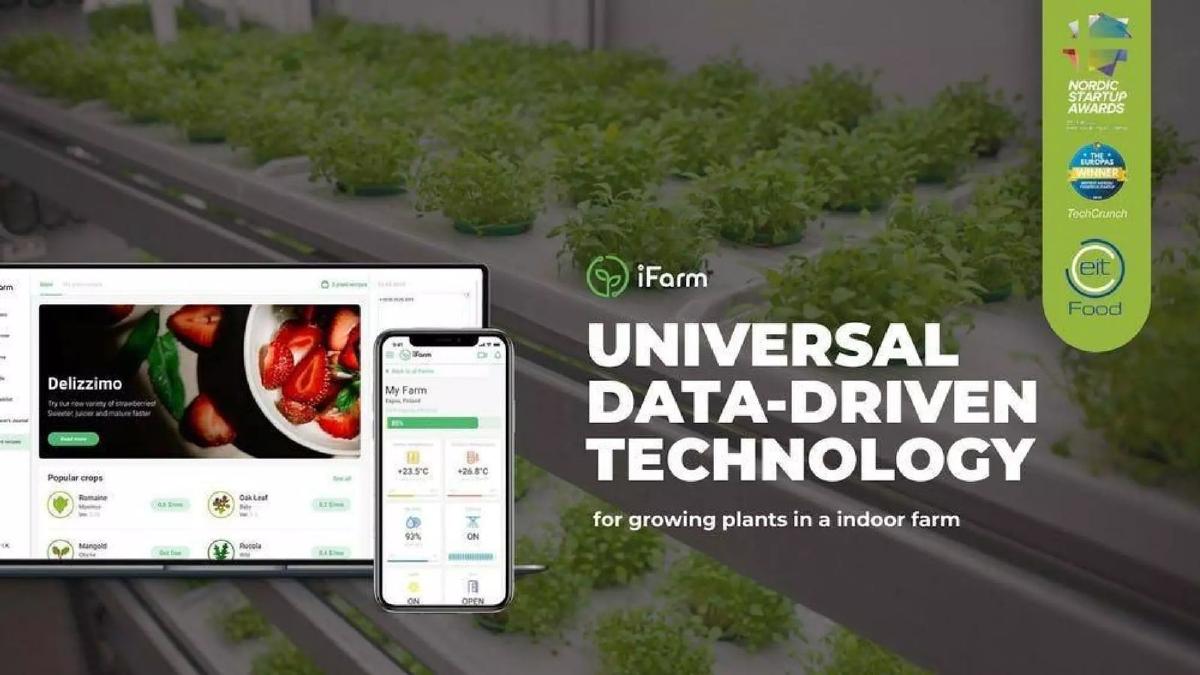
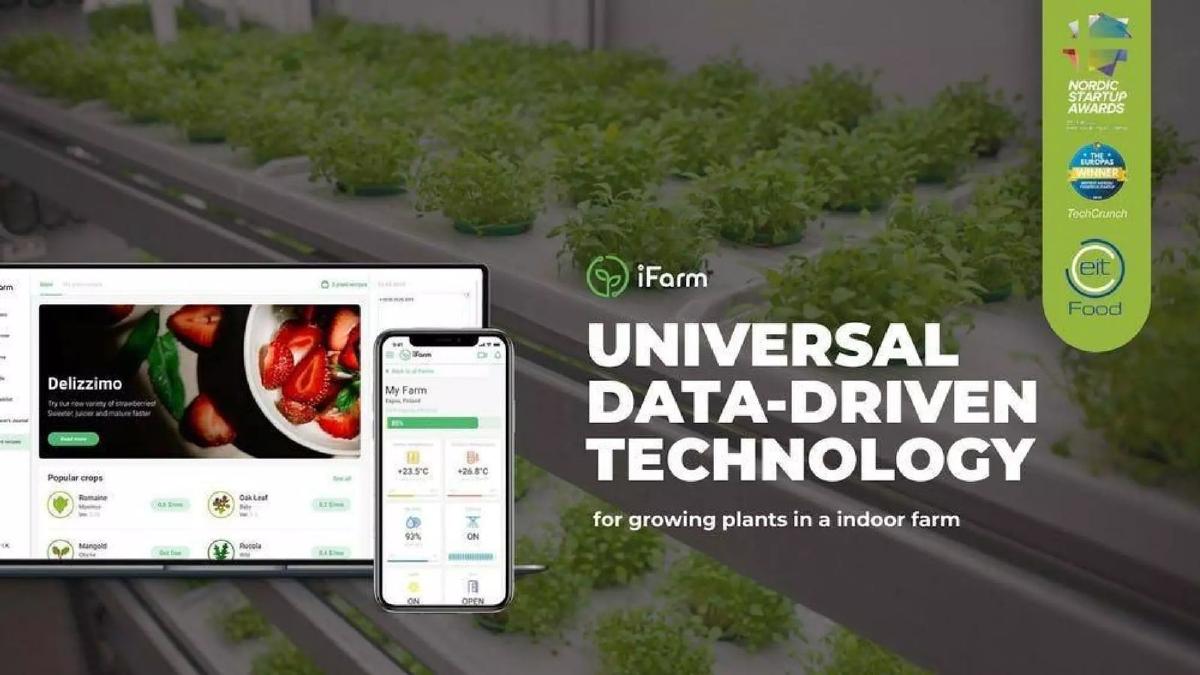
Slide 1: Title Slide The opening slide establishes iFarm as a 'Universal Data-Driven Technology' provider. It immediately showcases their mobile and desktop interfaces alongside a lush indoor farm background. Notably, it displays three awards: Nordic Startup Awards, The Europas, and EIT Food, providing instant third-party validation.
Slide 2: Current Situation This slide uses a 'before and after' infographic to illustrate the value proposition. It contrasts a traditional 7-step supply chain (Farm, Transportation, Packaging, Manufacturing, Distribution, Market, Home) with a 2-step 'Indoor Farm' solution. The slide lists key benefits: 99% less land, 24/7/365 growing, pesticide-free, and 90% less water usage.
Slide 3: Global Market iFarm segments the market into three tiers: the $363B Fruit & Vegetable market, the $125B Indoor Farming market, and the $44B Indoor Farming Technology market (all figures projected for 2023). They explicitly state a goal to capture 5% of the technology market, which they value at $2B by 2023. This slide effectively narrows their focus from the broad agriculture sector to their specific niche as a tech provider.
Product and Technology Deep Dive
Slide 4: Product Overview The product is presented as a three-pronged ecosystem: Software (Growtune), Indoor Farms (scalable hardware), and Growing Cartridges (consumables like seeds and fertilizers). This 'razor and blade' model is attractive to investors as it promises both large upfront sales and recurring revenue.
Slide 5: iFarm Growtune This slide focuses on the software, which they call the 'ultimate tool for managing indoor farms.' It highlights features like ready-made plant recipes, CRM systems, and price/cost management. A key metric is shared here: '120+ unique growing recipes' covering berries, vegetables, and microgreens. The visual includes a drone, hinting at the automation discussed later.
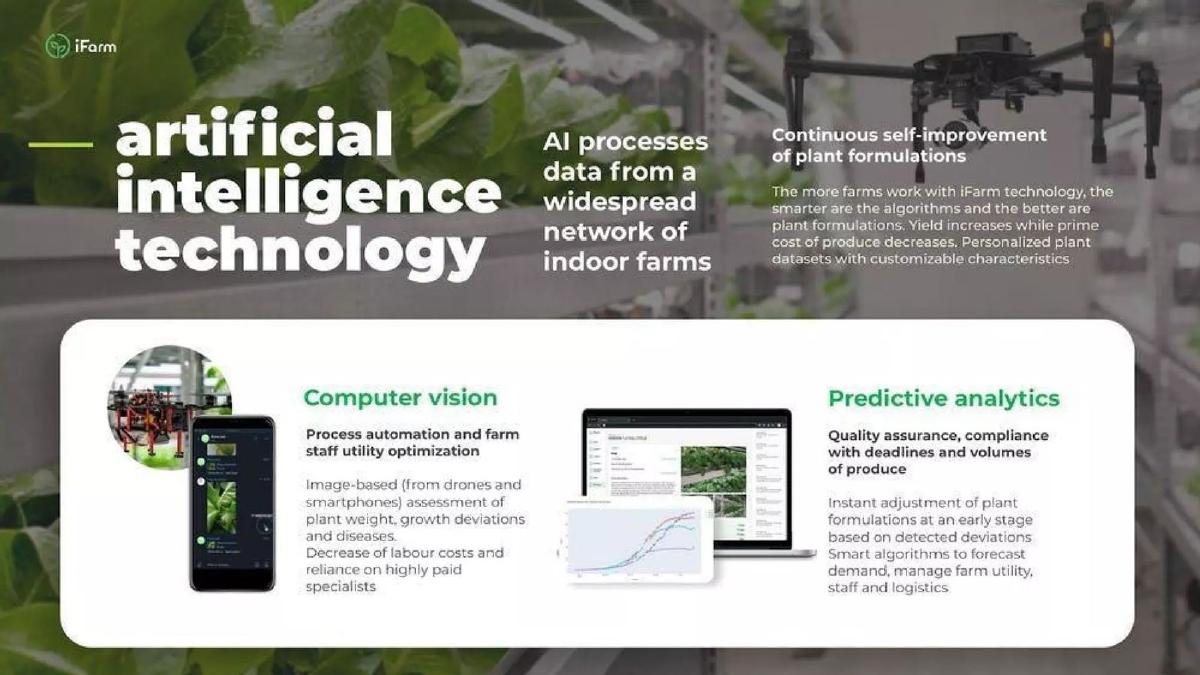
Slide 6: Artificial Intelligence Technology iFarm leans heavily into the 'AI' narrative. They describe a 'continuous self-improvement' loop where data from a widespread network of farms makes the algorithms smarter. They specify two use cases: Computer Vision (using drones and smartphones to assess plant weight and health) and Predictive Analytics (adjusting formulations and forecasting demand). This slide is designed to convince investors that iFarm is a data company, not just a greenhouse manufacturer.
Team and Global Footprint
Slide 7 & 8: Our Team Slides 7 and 8 are identical in this version of the deck. They highlight a 'Distributed team of 40 professionals in 6 countries.' The leadership bios are brief but impressive, citing experience at Alawar, Welltory, Nokia, and Kaspersky. The inclusion of a group photo of the team in branded t-shirts helps humanize the high-tech pitch.
Slide 9: Traction The traction slide uses a map to show their global reach. They report 1,374 square meters 'Launched' and 11,258 square meters under 'Design & Construction.' The map shows offices in Helsinki, Moscow, Novosibirsk, Dubai, and Delaware, indicating a very aggressive early-stage international expansion strategy.
Impact and Contact
Slide 10: Environmental Impact This slide serves as a projection of their success. It compares 2020 figures (469,345 kg of food produced) to 2026 targets (47,520,000 kg). It translates this production into 'land saved' (418 million square meters) and 'water saved' (61 billion liters). This appeals to the growing segment of ESG (Environmental, Social, and Governance) investors.
Slide 11: Contact Us The final slide provides contact details for their Finland HQ, USA office, and Russia office. It includes social media links and their website URL, maintaining the professional, clean aesthetic of the rest of the deck.
What Works in the iFarm Deck
Clear Market Segmentation: By breaking down the market into three distinct categories on Slide 3, iFarm shows they understand exactly where they fit in the value chain. They aren't trying to be a grocery store; they are a technology vendor. · Visual Proof of Product: The use of high-quality renders and photos of actual hardware (Slide 4 and 6) makes the technology feel tangible and ready for market, which is crucial for a Seed round involving physical goods. · The 'Network Effect' of Data: Slide 6 does an excellent job of explaining why more customers make the product better. The idea that every new farm improves the 'growing recipes' for everyone else is a powerful competitive moat. · Supply Chain Simplification: The 7-step vs. 2-step graphic on Slide 2 is a classic, effective way to communicate a complex value proposition in seconds.
What is Missing from the iFarm Deck
The Ask: There is no mention of how much capital is being raised, the valuation, or the specific milestones the $4M will help them achieve. While this is sometimes left for the verbal pitch, its absence in the deck leaves a gap in the narrative. · Unit Economics: For a hardware and consumables business, investors want to see the cost to build a farm vs. the revenue it generates. The deck mentions 'price & cost management' as a software feature but provides no data on iFarm's own margins. · Competition: The vertical farming space was already crowded in 2017 (e.g., Plenty, AeroFarms). The deck makes no attempt to differentiate iFarm from these competitors or explain why their 'Growtune' software is superior to existing solutions. · Financial Projections: While Slide 10 gives food production targets, it omits revenue and EBITDA projections. Investors need to see the path to profitability, especially in a capital-intensive industry like AgriTech.
What a Founder Should Copy
The 'Product Ecosystem' Slide: Slide 4 is a perfect example of how to present a complex offering. By grouping everything into Software, Hardware, and Consumables, the founder makes a complicated business model easy to digest. · Third-Party Validation: Placing award logos on the title slide (Slide 1) immediately builds trust before the investor even reads the first bullet point. · Metric-Driven Traction: Instead of just saying 'we are growing,' Slide 9 gives specific square footage for both launched and upcoming projects. This provides a clear sense of scale and momentum. · Impact-to-Scale Translation: Slide 10 is excellent for founders in the 'Impact' space. It doesn't just say 'we save water'; it projects exactly how many liters will be saved based on their production targets, making the environmental benefit quantifiable.
Frequently asked questions
- What is iFarm's core business model according to the deck?
- iFarm operates as a technology and service provider for indoor farming. According to Slide 4, they sell a three-part solution: 'Growtune' management software, scalable industrial indoor farm hardware, and consumables known as 'Growing Cartridges' which include seeds and fertilizers. This suggests a hybrid model of capital equipment sales and recurring revenue through software and consumables.
- How does iFarm use Artificial Intelligence in its operations?
- As detailed on Slide 6, iFarm uses AI for 'continuous self-improvement of plant formulations.' Their technology utilizes computer vision via drones and smartphones to assess plant weight and detect diseases. This data feeds into predictive analytics to adjust plant formulations in real-time and forecast demand, aiming to decrease labor costs and reliance on specialists.
- What are the specific environmental claims made by the company?
- Slide 2 and Slide 10 outline significant environmental benefits. The company claims their indoor farms use 99% less land and 90% less water than traditional farming. By 2026, they project their technology will have saved over 61 billion liters of water and 418 million square meters of land compared to conventional methods.
- What information is missing from this pitch deck?
- The deck is missing several critical components typically found in a Seed round presentation. There is no slide detailing the specific 'Ask' (how much they are raising and on what terms), no financial projections beyond high-level impact stats, no unit economics, and no slide addressing the competitive landscape or their specific moats against other vertical farming players.
- Where is iFarm currently operating?
- Slide 9 shows a global footprint with a headquarters in Helsinki, Finland, and additional offices in Moscow, Novosibirsk, Dubai, and Delaware (USA). The map indicates active or planned projects across Europe (including the UK, Netherlands, Germany, and Switzerland), the Middle East (Saudi Arabia, UAE), and North America.