idwall’s 21-slide deck focuses heavily on the massive financial leak caused by credential fraud in the Brazilian market. Founded in 2016, the company used this deck to highlight a $3 billion local problem, immediately followed by a high-signal 'Early Adopters' slide featuring 99 (which raised $125M) and Moip (acquired for $55M). The deck is structurally simple, using a progressive reveal of target industries—Fintech, P2P Marketplaces, On-Demand Economy, Corporations, and Banks—to demonstrate a broad horizontal application. While it lacks a traditional team slide with full bios, it compensates…
Key takeaways
- The deck identifies a massive $3 billion credential fraud problem specifically within the Brazilian market (Slide 12).
- Early traction is validated by high-profile logos including 99, Vindi, and Moip, plus a pipeline of 130 companies (Slide 13).
- Financial growth is shown through a jump from $114k ARR to a projected $400k ARR within a few months (Slide 14).
- The startup secured institutional backing from Monashees and Canary, two of the most prominent funds in Latin America (Slide 15).
- Strategic angel investors include the Head of Legal at Google Brazil and the Head of Payments LATAM & Asia at Netflix (Slide 16).
- The product suite is clearly divided into three pillars: Validate ID, Identity Check, and Background Check (Slides 17-19).
- The deck utilizes a 'progressive reveal' design for its target sectors, building momentum before reaching the 'Banks' category (Slides 2-7).
- There is no dedicated slide for the full founding team's history or technical background, only a contact slide for Lincoln Ando (Slide 21).
The idwall Pitch Deck: A Strategic Regional Play
idwall, founded in 2016 and headquartered in São Paulo, is a prominent player in the identity verification and background check space. This 21-slide deck is a focused narrative on capturing the Brazilian market by solving a multi-billion dollar fraud problem. With $51.8 million raised to date, the company’s early materials provide a clear look at how they leveraged local traction to attract global-tier investors.
Slides 1-7: The Market Hook and Sector Expansion
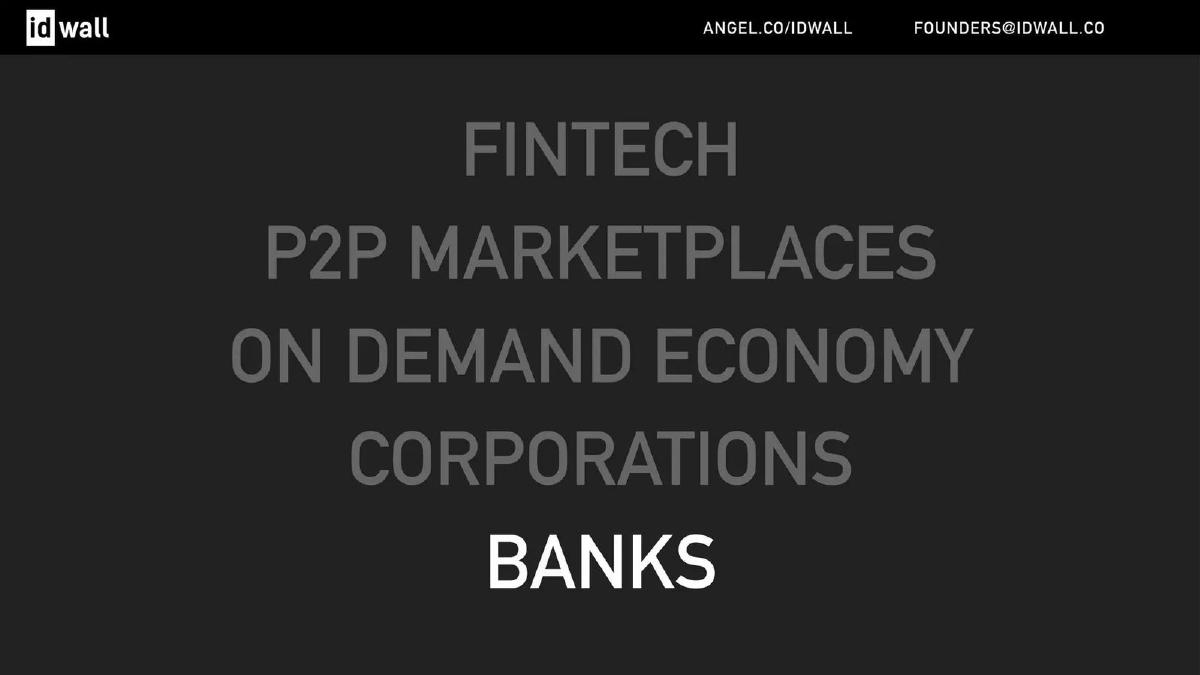
The deck opens with a minimalist title slide ( Slide 1 ) featuring the tagline "Trust Through Technology." What follows is a series of slides ( Slides 2 through 7 ) that use a progressive reveal technique. Each slide adds a new target industry to the list, starting with Fintech and moving through P2P Marketplaces , On Demand Economy , Corporations , and finally Banks . This sequence is designed to show the horizontal scalability of the product. By the time the viewer reaches Slide 8 , which features a large question mark, the implication is that the potential for identity verification is nearly limitless across the digital economy.
Slides 9-12: Defining the $3 Billion Problem
Slide 9 uses a high-contrast image of an online sign-up process to transition into the core problem. Slides 10 and 11 identify three specific pain points: Credential fraud , Fake accounts , and Ensuring compliance . The deck then delivers its most impactful data point on Slide 12 : a large Brazilian flag accompanied by the figure $3B in credential fraud . This anchors the startup’s value proposition in a massive, quantifiable local loss, making the solution a 'must-have' rather than a 'nice-to-have' for Brazilian enterprises.
Slides 13-16: Traction, Growth, and Social Proof
The 'Early Adopters' slide ( Slide 13 ) is a standout. It doesn't just list names; it provides context for their success. It highlights 99 (which raised $125M) and Moip (acquired by WireCard for $55M). It also notes +2 banks and a +130 companies on the pipeline . This slide proves that idwall is already integrated with the region's top-tier tech companies.
Slide 14 provides the hard numbers. It shows an $114k ARR (Annual Recurring Revenue) and a Projected ARR for April 2017 of $400k . This nearly 4x projected growth in a short window is a classic venture capital growth curve.
The investor slides ( Slides 15 and 16 ) further solidify the company's credibility. Listing Monashees and Canary signals that the best local institutional capital is already on the cap table. Slide 16 adds 'smart money' validation by featuring heads of legal and payments from Google and Netflix , as well as the former COO of Serasa Experian . For a company dealing with legal compliance and credit checks, having the former COO of Serasa (a major credit bureau) as an investor is a massive signal of industry trust.
Slides 17-19: The Product Deep Dive
idwall breaks its product into three distinct modules, each with its own slide:
Validate ID (Slide 17): Shows a visual of a Brazilian driver's license being scanned with an error message: "The name doesn't match the ID." This demonstrates the OCR and validation tech. · Identity Check (Slide 18): Displays a mobile interface asking a user to identify people they know, illustrating a knowledge-based authentication (KBA) layer. · Background Check (Slide 19): Lists the ability to look for criminal records, debt collection, lawsuits, and credit checks for both individuals and companies. A magnifying glass over a JSON code snippet suggests an API-first approach.
Slides 20-21: The Recap and Contact
Slide 20 provides a summary: solving credential fraud, adoption by market leaders, and the fact that the Seed round is closed . Interestingly, the deck does not include a slide for the new 'Ask' or a breakdown of how new capital will be spent. The final slide ( Slide 21 ) features founder Lincoln Ando with his contact information, but notably lacks a broader team slide showing the engineering or operations leadership.
What Works in the idwall Deck
Regional Dominance: By focusing specifically on the $3B fraud problem in Brazil, idwall makes a compelling case for why a localized solution is better than a generic global one. · High-Signal Logos: Featuring 99 and Moip immediately tells investors that the product can handle enterprise-scale volume and has passed the security audits of major financial players. · Clear Product Segmentation: Dividing the product into Validate, Identity, and Background checks makes a complex technical solution easy to understand for non-technical investors. · Strategic Angels: The inclusion of the Serasa Experian and Google Brazil executives is a masterstroke in building 'domain authority' through association.
What is Missing from the idwall Deck
The Team Slide: While Lincoln Ando is featured at the end, there is no slide detailing the backgrounds of the co-founders or the technical team. In a security-focused startup, the 'who' is often as important as the 'what.' · The Ask: The deck mentions the seed round is closed but doesn't specify what they are looking for next. This suggests the deck might have been used for a demo day or a general update rather than a direct solicitation for a new round. · Unit Economics: There is no mention of Customer Acquisition Cost (CAC), Lifetime Value (LTV), or churn rates, which are critical for Series A and B investors. · Competition: The deck ignores the competitive landscape. It doesn't explain how idwall differs from legacy credit bureaus or other emerging fintech security startups.
What a Founder Should Copy
The Progressive Reveal: Using slides 2-7 to build a list of industries is a great way to show market breadth without cluttering a single slide. · Quantifying the Pain: Slide 12's use of a single, massive number ($3B) tied to a specific geography is the most memorable part of the deck. Founders should find their 'one big number.' · Contextualizing Traction: Don't just put a logo on a slide. Follow idwall's lead on Slide 13 by adding a 'Why this logo matters' note (e.g., 'Raised $125M' or 'Acquired for $55M'). It transfers the success of the client to the startup.
Frequently asked questions
- What is the primary problem idwall is solving?
- According to slides 10 through 12, idwall addresses 'Credential fraud,' 'Fake accounts,' and 'Ensuring compliance.' The deck emphasizes the scale of this issue in Brazil, citing that credential fraud accounts for a $3 billion loss in that market alone.
- How does idwall demonstrate product-market fit?
- The company uses slide 13 to list 'Early Adopters' that are recognizable leaders in the Brazilian ecosystem, such as the ride-sharing app 99 and the payment processor Moip. They also cite a pipeline of 130 companies and two banks, suggesting strong demand across multiple sectors.
- Who are the key investors mentioned in the deck?
- Slide 15 lists Monashees (described as a major Series A and B fund in LATAM) and Canary (described as the biggest seed fund in Brazil). Slide 16 adds high-level individual investors from Google, Netflix, and Serasa Experian.
- What are the core features of the idwall platform?
- The product is broken down into three specific functions: Validate ID (instant document validation, slide 17), Identity Check (verifying user identity through knowledge-based questions, slide 18), and Background Check (searching criminal records, debt, and credit history, slide 19).
- Is there a clear financial 'Ask' in this deck?
- No. Slide 20 provides a 'Recap' stating that the 'Seed round closed,' but the deck does not explicitly state the amount being raised for the subsequent round or how the capital will be allocated. This is common in decks used for introductory meetings or bridge rounds.