Aphelion Orbitals presented a 12-slide deck in late 2018 seeking a $2.5M Pre-A round to transition from R&D to commercial suborbital and orbital launches. The company, based in Union City, NJ, identifies a massive bottleneck in the current aerospace market: long lead times (12-36 months) and high CAPEX ($500M+) for large missions. Their solution, the Helios vehicle, is designed for a 20kg payload at a $750,000 price point, targeting a 40% YoY growth rate in the nanosatellite sector. The deck highlights significant technical progress, including a 9.5kN production engine and four pending patent…
Key takeaways
- The company is seeking $2.5M in Pre-A funding to begin launching commercial payloads and initiate production (Slide 10).
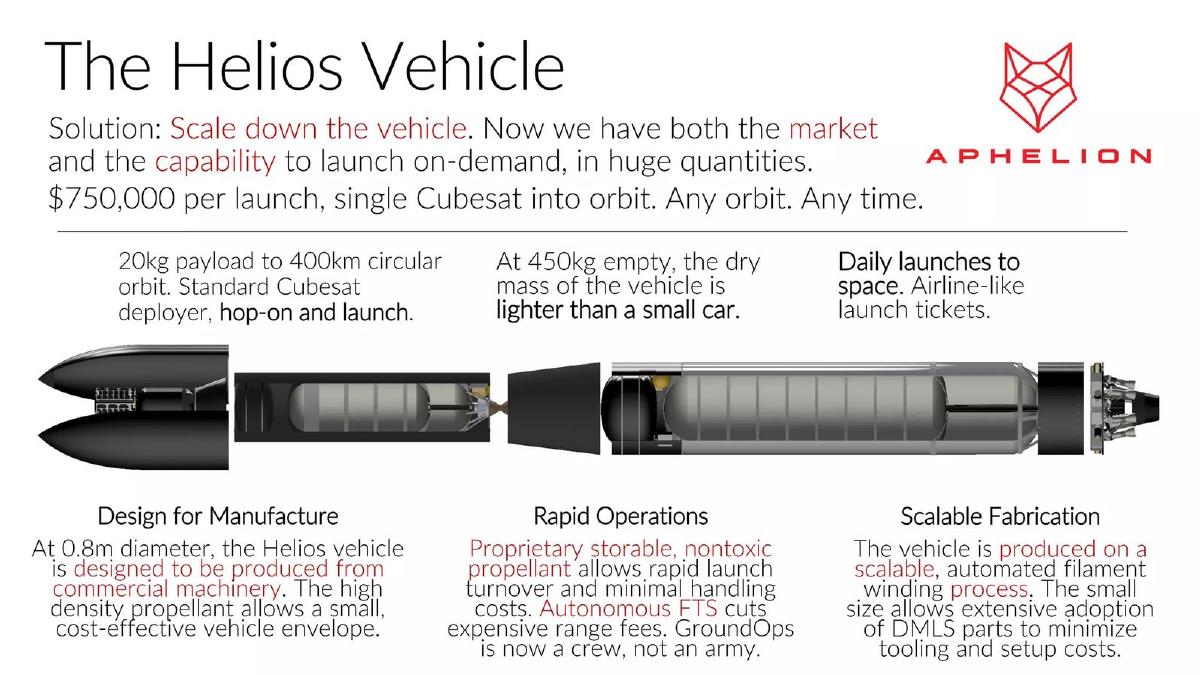
- Aphelion claims a price point of $750,000 per launch for a single Cubesat into any orbit (Slide 5).
- The Helios vehicle is designed for a 20kg payload to a 400km circular orbit with a dry mass of only 450kg (Slide 5).
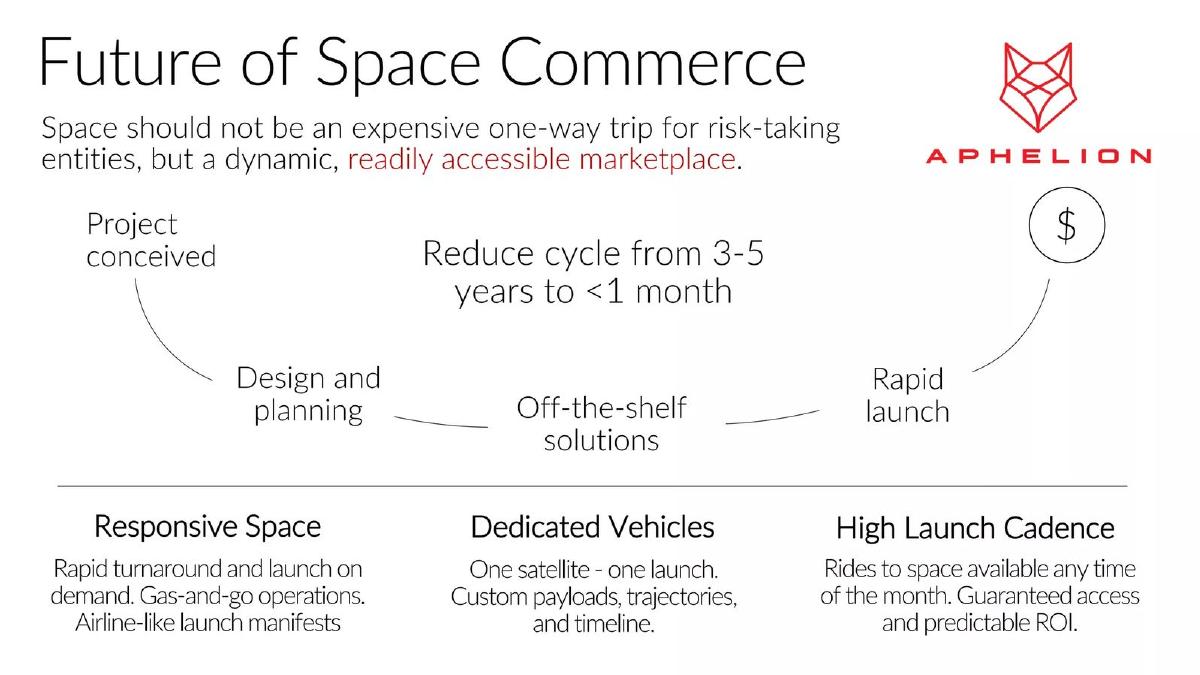
- The deck identifies a market need to reduce the space commerce cycle from 3-5 years to less than 1 month (Slide 4).
- Technical progress includes a 9.5kN production engine currently undergoing testing and four pending patents (Slide 8).
- The business case assumes capturing 60% of the nanosatellite market to reach 200 launches per year and $150M in revenue (Slide 7).
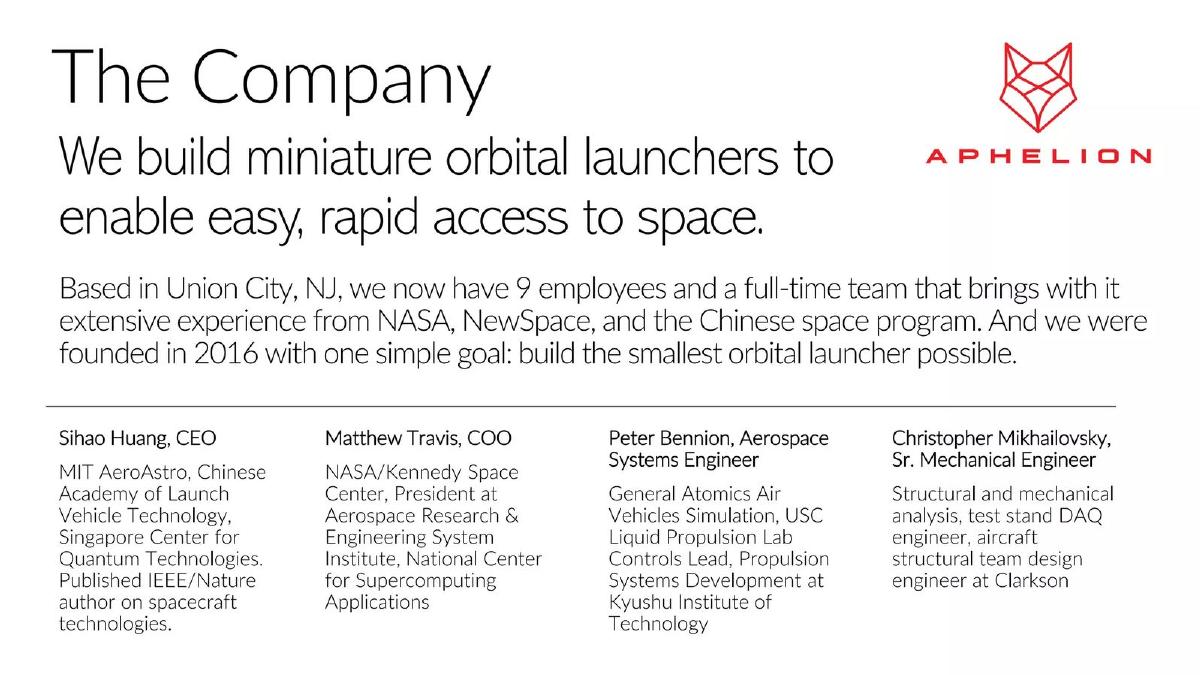
- The team consists of 9 employees with experience from NASA, MIT AeroAstro, and the Chinese space program (Slide 2).
- Competitive positioning places Aphelion at the lowest end of both cost and payload mass compared to SpaceX, Rocket Lab, and Virgin Orbit (Slide 12).
Aphelion Orbitals: The Nanolauch Disruptor
Aphelion Orbitals entered the NewSpace race with a specific, narrow focus: the miniaturization of orbital launch. While giants like SpaceX focused on heavy lift and reusability, Aphelion’s 2018 deck argues that the real bottleneck is the 'long turnaround time' and 'operational complexity' of large missions. This teardown examines their 12-slide pitch for a $2.5M Pre-A round.
Slide 1: Title Slide
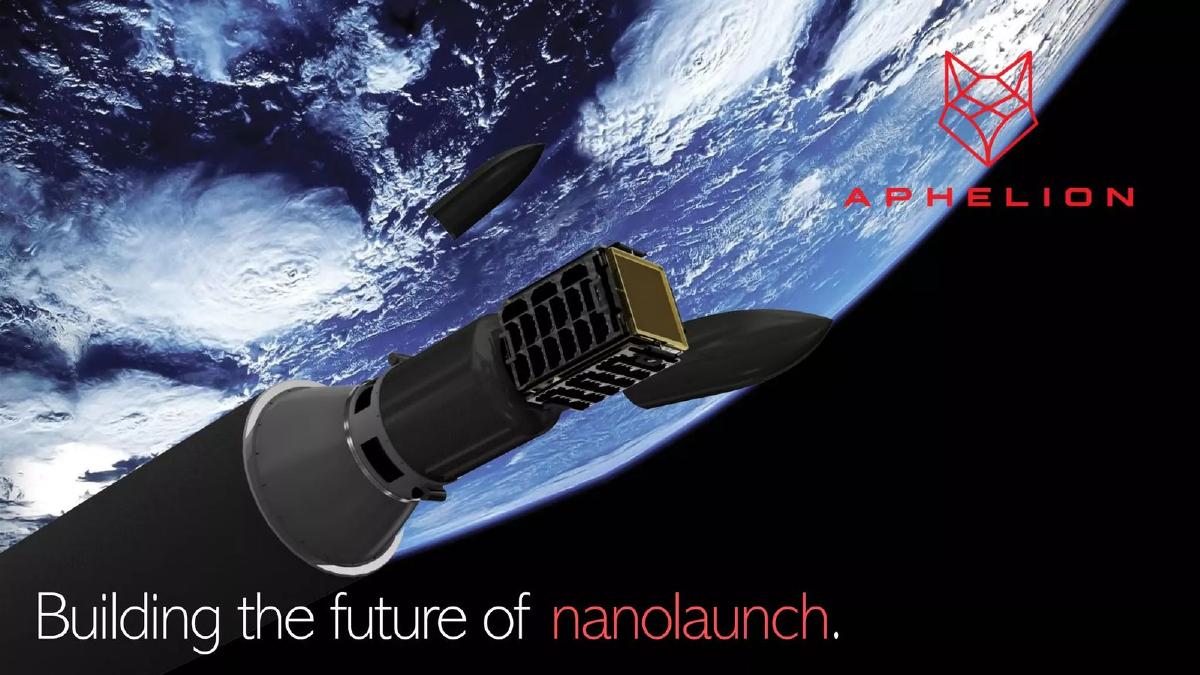
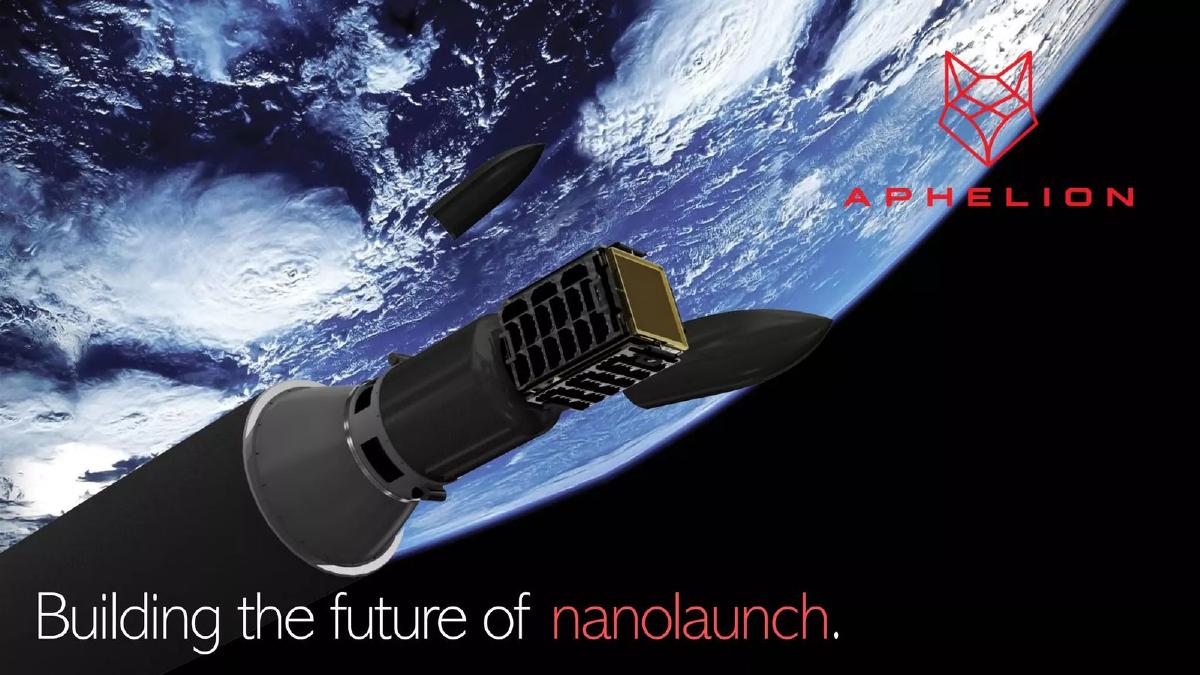
The deck opens with a high-quality render of a Cubesat being deployed from a fairing against the backdrop of Earth. The tagline, "Building the future of nanolaunch," immediately establishes the company's niche. The branding is clean, featuring a geometric fox head logo that remains consistent throughout the presentation.
Slide 2: The Company and Team
Aphelion introduces itself as a Union City, NJ-based company founded in 2016. The team slide is strong for a seed-stage aerospace startup. It lists 9 employees and highlights a 'full-time team' with experience from NASA, NewSpace, and the Chinese space program. Key figures include CEO Sihao Huang (MIT AeroAstro) and COO Matthew Travis (NASA/Kennedy Space Center). The inclusion of specific engineering backgrounds in liquid propulsion and structural analysis provides necessary technical weight.
Slide 3: The Issue Today
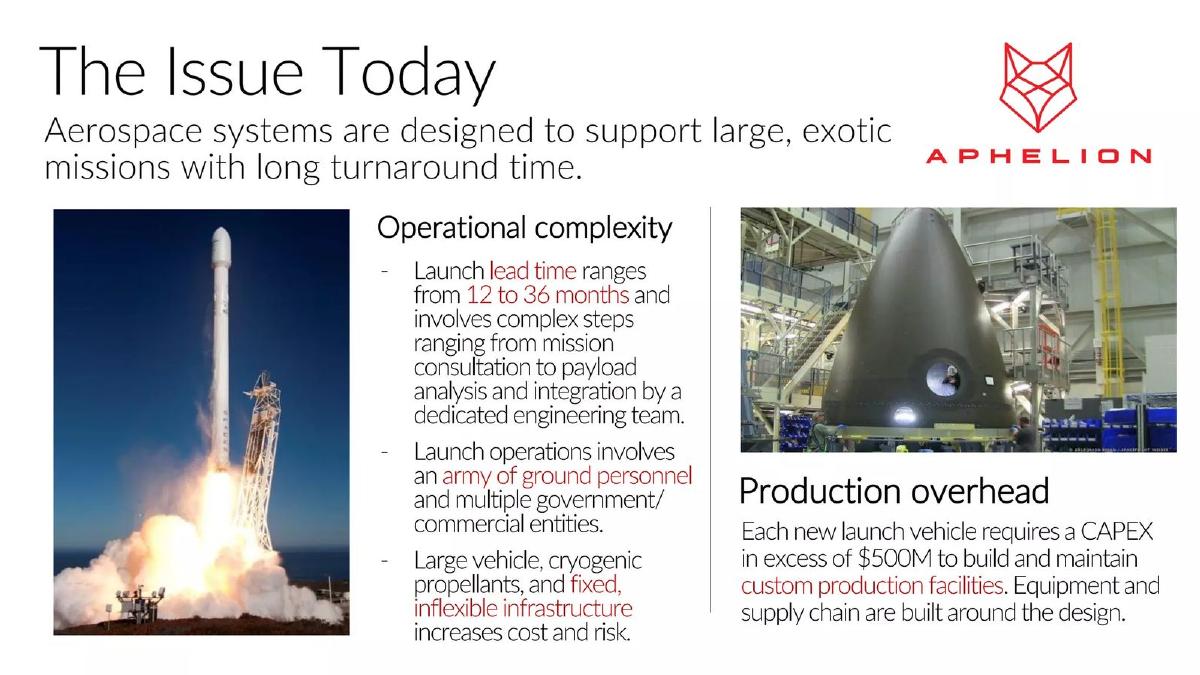
This slide defines the market pain point. It cites launch lead times of 12 to 36 months and the requirement of an 'army of ground personnel.' Most notably, it points out the massive $500M+ CAPEX required for custom production facilities for large vehicles. By framing the current industry as 'fixed' and 'inflexible,' Aphelion sets the stage for their agile alternative.
Slide 4: Future of Space Commerce
Aphelion proposes a shift from a 'one-way trip for risk-taking entities' to a 'readily accessible marketplace.' The core metric here is the reduction of the project cycle from 3-5 years to less than 1 month. They emphasize 'airline-like launch manifests' and 'gas-and-go operations,' which are ambitious claims in a highly regulated and dangerous industry.
Slide 5: The Helios Vehicle
This is the core product slide. The Helios vehicle is described as a 0.8m diameter rocket capable of carrying a 20kg payload to a 400km circular orbit. The price point is set at $750,000 per launch. Technical highlights include a dry mass of 450kg (lighter than a small car), a proprietary storable nontoxic propellant, and the use of automated filament winding and DMLS (3D printing) parts to minimize tooling costs.
Slide 6: Dedicated Cubesat Launch Market
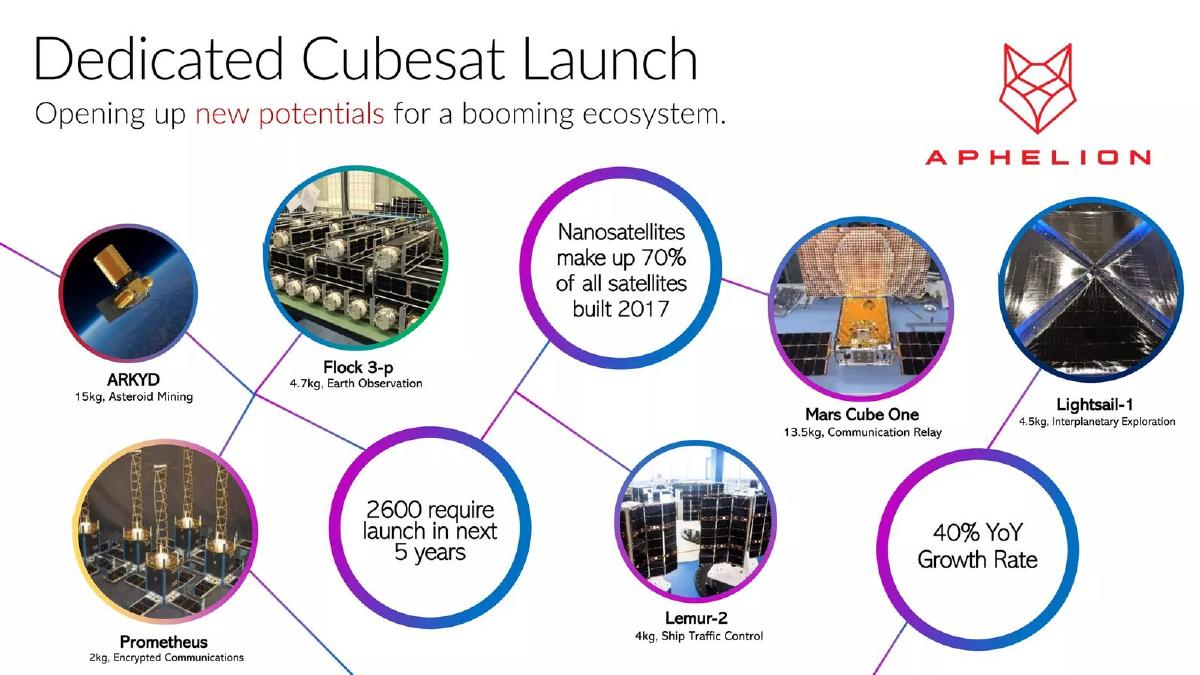
To justify the focus on small payloads, Aphelion notes that nanosatellites made up 70% of all satellites built in 2017. They cite a 40% YoY growth rate and state that 2,600 units will require launch in the next 5 years. They list specific examples like ARKYD (Asteroid Mining) and Flock 3-p (Earth Observation) to show the diversity of the ecosystem.
Slide 7: The Business Case
The financial projections are aggressive. Aphelion assumes a scenario of 200 launches per year at the $0.75M price point to reach $150M in revenue. They claim a 45% net profit on current market prices and suggest they can breakeven at just 4% of the market. However, the slide also notes an assumption of capturing 60% of the nanosatellite market for the 200-launch figure, which is a significant hurdle for a new entrant.
Slide 8: Development Progress
This slide serves as the 'traction' proof for an R&D-heavy company. It shows a 9.5kN production engine currently undergoing testing and a 57kN Aerospike engine planned for Q3 2019. They also introduce 'Trailblazer,' a commercial suborbital vehicle with a planned first launch in Q2 2019. The mention of 4 patents pending adds a layer of intellectual property protection to the pitch.
Slide 9: Modular Spacecraft Systems
Interestingly, Aphelion isn't just building rockets. This slide reveals a secondary product line: plug-and-play space-qualified satellite modules. These include on-board computers, communication systems, and solar panels. The slide notes that 2 satellites are currently being built for customers, which represents actual commercial traction beyond just engine testing.
Slide 10: Funding Status
The 'Ask' is clearly defined: $2.5M for a Pre-A round. This follows a $500,000 Seed round in September 2017. The goals for this capital include bringing Trailblazer to market, qualifying Helios propulsion, and competing in the DARPA Launch Challenge for prizes up to $10M. This slide effectively shows how private capital can be leveraged to unlock much larger government prizes.
Slide 11: Contact Information
A standard closing slide with the Union City address and contact details. It maintains the clean, minimalist aesthetic of the rest of the deck.
Slide 12: Competitive Landscape (Appendix)
The final slide is a scatter plot of Launch Cost (USD) vs. Payload Mass (kg). Aphelion places itself in the bottom-left corner—the lowest cost and lowest mass. They compare themselves against established players like SpaceX, ULA, and Arianespace, as well as NewSpace peers like Rocket Lab and Vector. This visual effectively communicates their 'smallest orbital launcher possible' strategy.
What Works in This Deck
Clear Niche: By focusing exclusively on 'nanolaunch,' Aphelion avoids direct comparison with SpaceX's heavy-lift capabilities and instead targets a specific, growing market segment. · Technical Credibility: The combination of the team's NASA/MIT pedigree and photos of actual hardware (engines and satellite modules) helps mitigate the 'vaporware' risk common in aerospace startups. · Market Context: Slide 6 does a good job of quantifying the 'booming ecosystem' of nanosatellites, providing a 'why now' for the investment.
What Is Missing or Weak
Unit Economics Detail: While Slide 7 gives high-level revenue targets, it lacks a detailed breakdown of the cost of goods sold (COGS) per launch. Achieving a 45% net profit in orbital launch is historically difficult. · Regulatory Path: Launching rockets requires extensive FAA and international licensing. Slide 10 mentions 'FAA Licensing initiated,' but a more detailed roadmap of regulatory milestones would be beneficial. · Launch Site Strategy: The deck mentions 'any orbit, any time,' but does not specify which spaceports or mobile launch platforms they intend to use, which is a critical operational detail for 'airline-like' frequency.
Founder Takeaways
Hardware is Traction: If you are in a deep-tech or hardware space, show the engines, the boards, and the prototypes. Renders are good for vision, but photos of hardware undergoing testing (Slide 8) build trust. · Leverage Government Prizes: Aphelion successfully uses the DARPA Launch Challenge as a potential non-dilutive funding source to make their $2.5M ask seem more impactful. · Define Your Corner: The competitive matrix on Slide 12 is a masterclass in positioning. By choosing axes (Cost and Mass) where they are the extreme outlier, they make their value proposition visually undeniable.
Frequently asked questions
- What is the primary value proposition of Aphelion Orbitals?
- Aphelion Orbitals focuses on 'nanolaunch,' specifically building the smallest orbital launchers possible to enable rapid, on-demand access to space. According to Slide 5, they aim to offer launches for $750,000 per Cubesat, significantly lower than traditional aerospace providers. Their goal is to move the industry toward 'airline-like' launch manifests where missions can be executed in less than a month rather than several years.
- What technical milestones has the company achieved?
- As of the deck's publication, the company reported having a 9.5kN production engine with a proprietary injector architecture undergoing testing. Slide 8 also mentions a 57kN electrically pumped Aerospike engine planned for Q3 2019 and a commercial suborbital vehicle called 'Trailblazer' with a planned first launch in Q2 2019. They also claim to have four patents pending and two satellites currently being built for customers.
- How does Aphelion plan to use the $2.5M Pre-A funding?
- According to Slide 10, the $2.5M will be used to bring the Trailblazer vehicle to market, begin launching commercial suborbital payloads, and qualify the Helios propulsion systems. Additionally, the funds are intended to help the company compete in the DARPA Launch Challenge, which offers top prizes ranging from $8M to $10M for responsive small satellite launches.
- What are the projected economics for the Helios vehicle?
- Slide 7 outlines a 'Business Case' where 200 launches per year at $0.75M each generates $150M in revenue. They also project a secondary tier of 200 launches at $0.3M each for $60M in revenue. The company claims a 45% net profit margin at current market prices and states they can reach breakeven by capturing just 4% of the total market.
- Who are the key members of the leadership team?
- The team is led by CEO Sihao Huang, an MIT AeroAstro alum with experience at the Chinese Academy of Launch Vehicle Technology. COO Matthew Travis brings experience from NASA's Kennedy Space Center. The engineering leads, Peter Bennion and Christopher Mikhailovsky, have backgrounds at General Atomics, the USC Liquid Propulsion Lab, and aircraft structural design (Slide 2).