The Aphria 2015 investor presentation is a study in operational transparency for a capital-intensive industry. Rather than focusing on the cultural zeitgeist of cannabis, the deck treats medical marijuana as a high-stakes agricultural and pharmaceutical play. With a management team boasting over 75 combined years of experience in pharma and agri-business (Slide 3), the narrative centers on production efficiency and capacity expansion. The deck provides specific inventory projections, such as a June 2015 target of ~550 kg (Slide 7), and a clear $7.5 million capital expenditure roadmap to quadr…
Key takeaways
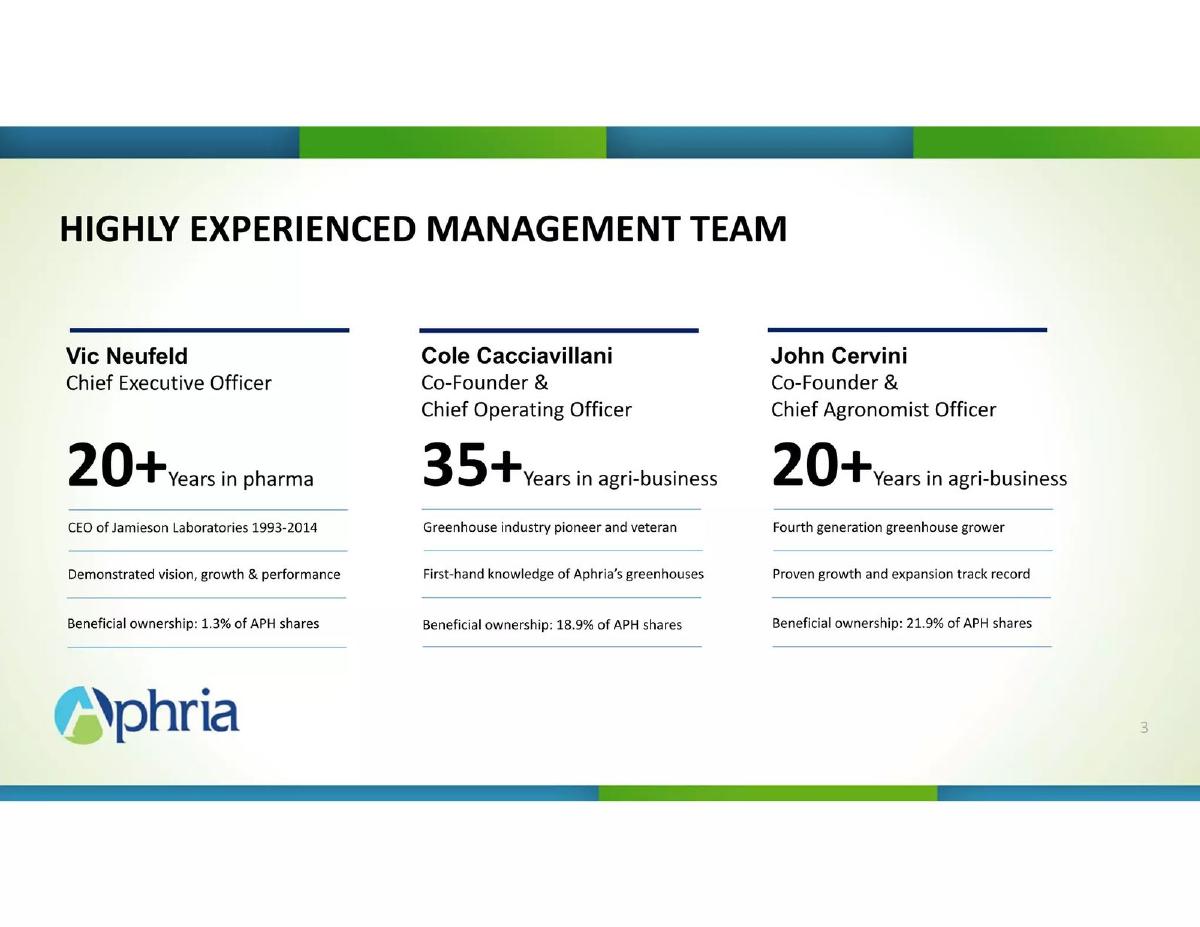
- The management team is positioned as a primary asset, citing over 75 years of combined experience in pharmaceutical and agricultural sectors on Slide 3.
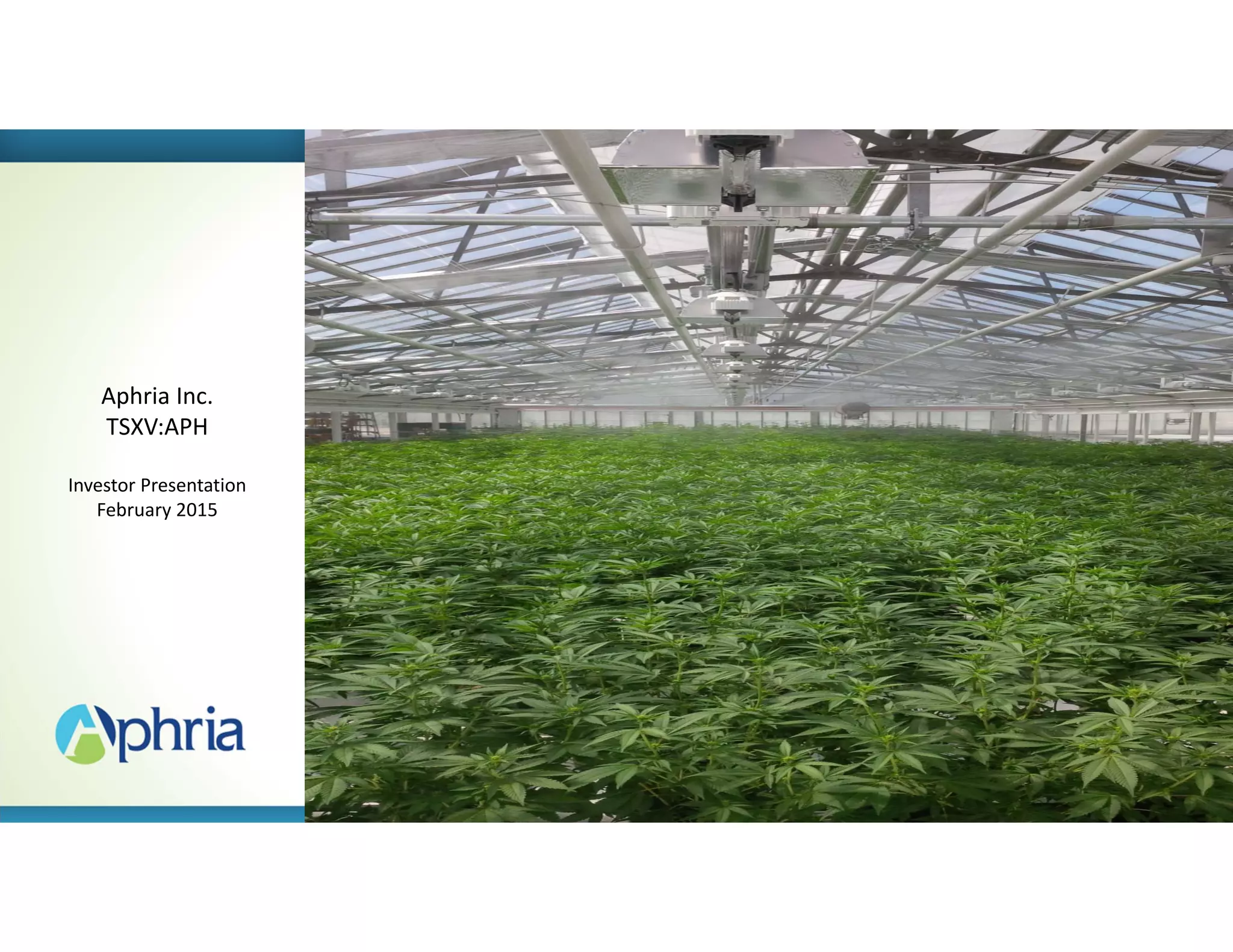
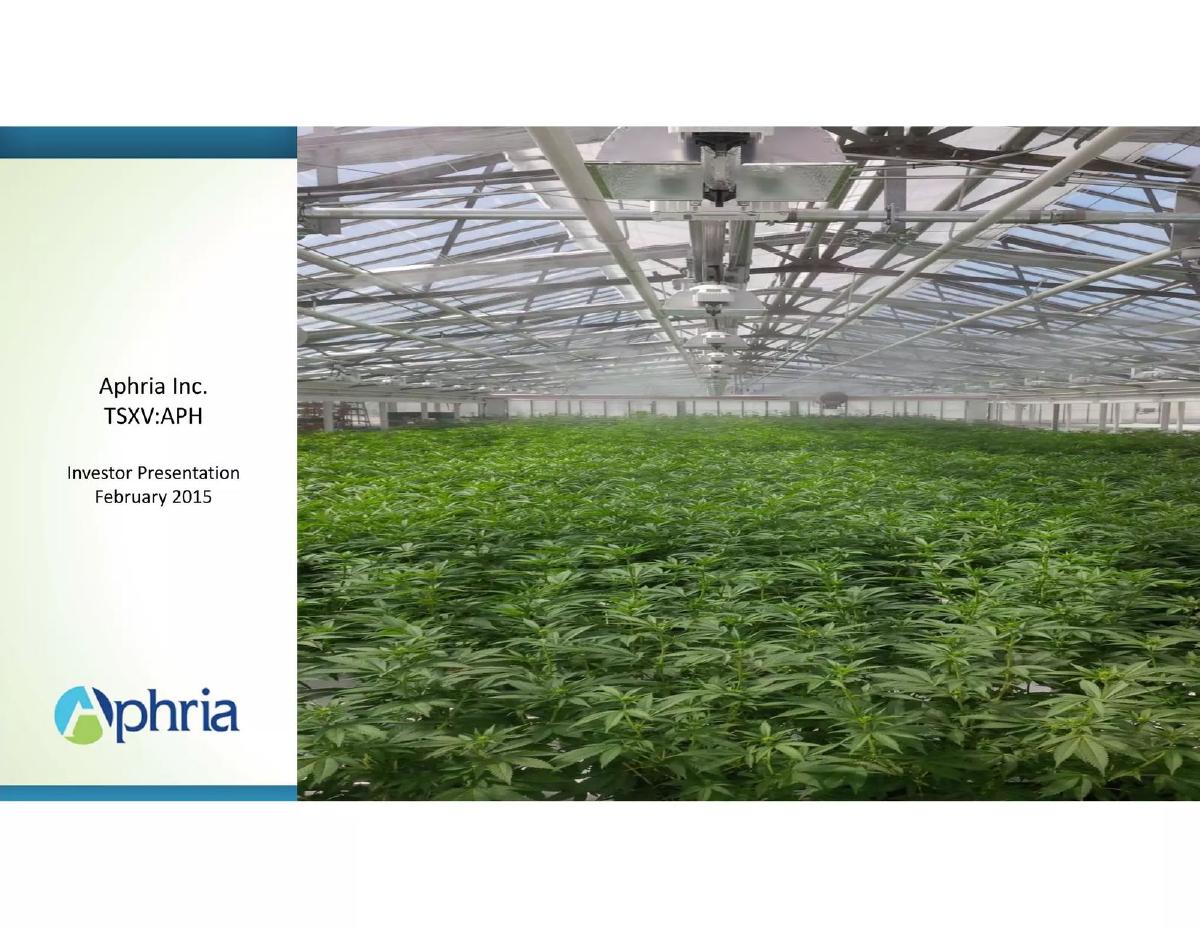
- Aphria identifies as a TSXV-listed entity (TSXV:APH) as of the February 2015 presentation date on Slide 1.
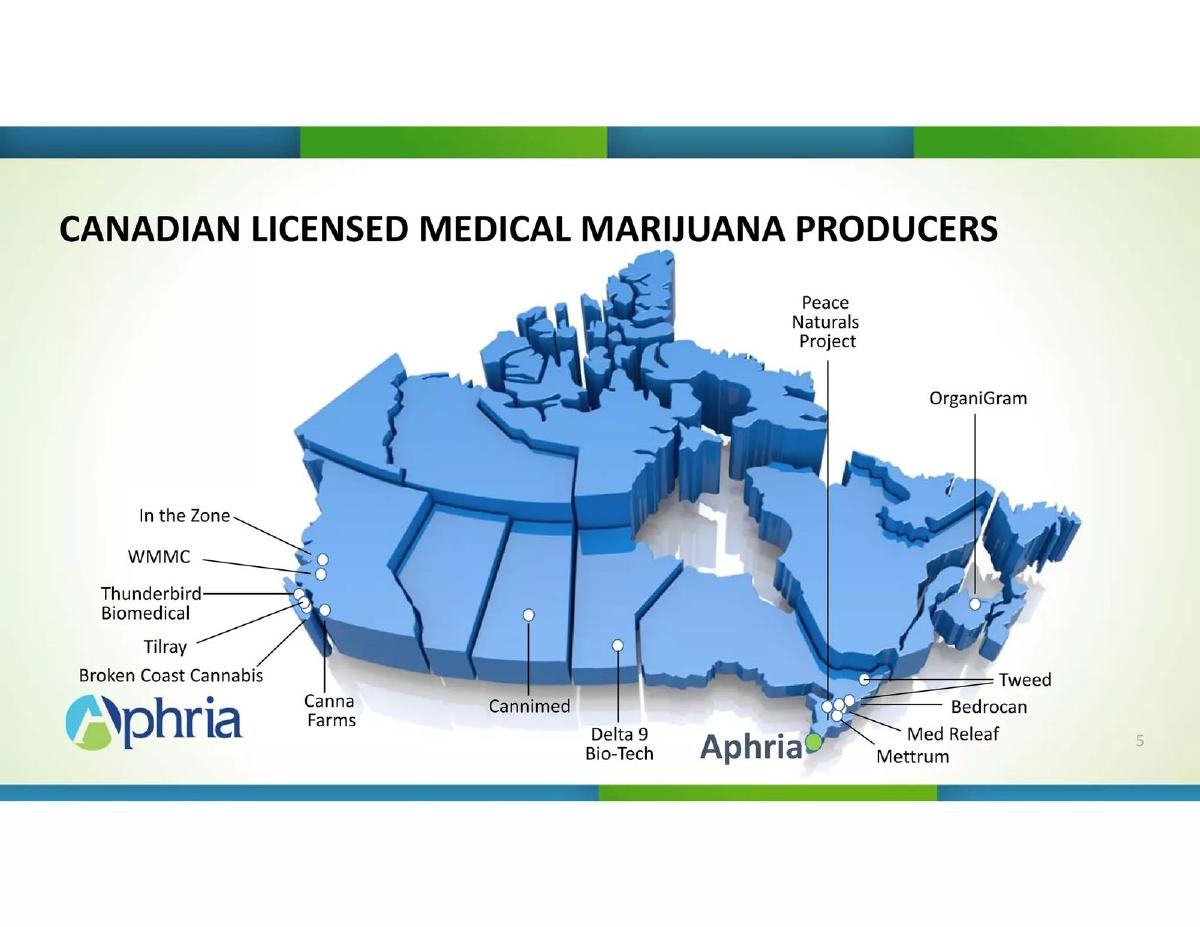
- The company maps its competitive landscape across Canada, identifying 14 other licensed producers including Tilray and Tweed on Slide 5.
- Production scaling is quantified with a goal of reaching a run rate of 110-120 kg per month by June 2015, as shown on Slide 7.
- The growth strategy is segmented into three pillars: Patient Acquisition, Increase Harvest Yields, and Facility Expansion on Slide 9.
- Technical yield improvements are categorized into four operational areas: Shaping, Sizing, Spacing, and Selection on Slide 11.
- A specific $7.5 million CAPEX plan is detailed to quadruple production capacity to 100,000 sq. ft. on Slide 13.
- The deck anticipates future regulatory shifts, specifically mentioning potential legalization of recreational use and edibles/oil on Slide 15.
Executive Summary: The Professionalization of Cannabis
The Aphria 2015 Investor Presentation represents a pivotal moment in the Canadian cannabis industry. At a time when the sector was often viewed with skepticism, Aphria presented a deck that looked and felt like a traditional agricultural or pharmaceutical offering. By focusing on square footage, harvest yields, and CAPEX schedules, the company moved the conversation away from the product's stigma and toward its potential as a commodity at scale.
Slide 1: Title and Market Positioning
The cover slide establishes immediate credibility by listing the company's ticker symbol, TSXV:APH . Dated February 2015, the slide uses a high-resolution image of a professional greenhouse facility. This visual choice is intentional; it frames the company as a large-scale agricultural operator rather than a boutique grower. The branding is clean, utilizing a blue and green color palette that evokes health and nature.
Slide 3: Management Team and Ownership
Aphria leads with its 'Highly Experienced Management Team.' This is a classic 'bet on the jockey' slide. Vic Neufeld (CEO) is credited with 20+ years in pharma, specifically noting his tenure as CEO of Jamieson Laboratories from 1993-2014. Cole Cacciavillani (COO) and John Cervini (CAO) bring a combined 55+ years of agri-business experience. Crucially, the slide lists 'Beneficial ownership' for each executive, ranging from 1.3% to 21.9%. This transparency regarding insider stakes is designed to align management interests with those of potential investors.
Slide 5: Competitive Landscape
The deck provides a geographic map of 'Canadian Licensed Medical Marijuana Producers.' It identifies competitors such as Tweed, Tilray, Bedrocan, and MedReleaf . By mapping these entities, Aphria demonstrates a clear understanding of the market's fragmentation and its own physical location in Leamington, Ontario. This slide serves to validate the industry as a whole—showing that Aphria is part of a regulated, growing cohort of legitimate businesses.
Slide 7: Production and Sales Projections
This slide uses a bar and line chart to visualize 'Growing Production, Inventory and Sales.' It highlights a specific milestone: June 2015 inventory of ~550 kg . The text notes that monthly production is estimated to reach a run rate of 110-120 kg by June 2015. This level of granular forecasting is rare in early-stage decks and suggests a high degree of confidence in their biological assets and facility throughput.
Slide 9: The Growth Strategy
The 'Significant Opportunities for Near to Mid-Term Growth' slide uses a simple three-pillar graphic. The strategy is straightforward: 1) Patient Acquisition, 2) Increase Harvest Yields, and 3) Facility Expansion. This hierarchy tells investors exactly how the company intends to generate value: get more customers, get more product out of every plant, and build more space to grow more plants.
Slide 11: Operational Optimization
Titled 'Increase Harvest Yields,' this slide breaks down the technical levers of their agricultural process: Shaping, Sizing, Spacing, and Selection . While the slide lacks specific data points, it serves as a placeholder for a deeper operational discussion. It signals that Aphria isn't just growing plants; they are engineering a process to maximize the return on every square foot of their facility.
Slide 13: Capital Expenditure and Expansion
This is arguably the most important slide for a serious investor. It outlines a $7.5 million expansion plan to quadruple production capacity to 100,000 sq. ft. It notes a starting cash position of ~$10.0 million as of January 1, 2015. The bar chart provides a quarterly breakdown of the CAPEX schedule, ending in May 2016. This provides a clear 'use of funds' narrative, even if a specific 'ask' isn't explicitly stated on the slide.
Slide 15: Future Regulatory Outlook
The 'Future Full of Opportunities' slide addresses the 'elephant in the room': recreational legalization. It categorizes opportunities into near-term (yields, expansion) and long-term (regulatory changes, edibles, geographic expansion, and industry consolidation). By placing recreational use in the long-term bucket, Aphria maintains its image as a disciplined, medical-first operator while acknowledging the massive tailwinds that could accelerate growth.
Slide 17: Contact and Corporate Information
The final slide returns to the greenhouse imagery and provides the corporate address in Leamington, Ontario, along with investor relations contact information. It reinforces the physical reality of the business—a P.O. Box and a street address for a massive facility.
What Works in This Deck
Operational Focus: The deck avoids the 'lifestyle' trap of the cannabis industry. It focuses entirely on production metrics, square footage, and management experience. · Transparency: Listing the specific beneficial ownership of the management team (Slide 3) builds immediate trust with institutional investors. · Clear Roadmap: The CAPEX schedule on Slide 13 is excellent. It shows that the company isn't just asking for money; they have a timed plan for how that money turns into physical infrastructure. · Competitive Context: Slide 5 does a great job of showing that Aphria is part of a real, regulated industry by listing its peers.
What Is Missing
Unit Economics: While production in kilograms is mentioned, the deck does not explicitly state the cost to produce per gram or the average selling price per gram. This makes it difficult to calculate projected margins. · Patient Metrics: Slide 9 mentions 'Patient Acquisition' as a pillar, but the provided slides do not show current patient counts or acquisition costs (CAC). · The 'Ask': The provided slides do not include a specific funding request or valuation. While the CAPEX is listed at $7.5M, it isn't clear if they are currently raising that amount or if it is already funded by their $10M cash position. · Financial Statements: There is no summary P&L or balance sheet, which is standard for a company already listed on an exchange like the TSXV.
Founder Takeaways
Treat your 'vice' business like a 'value' business. If you are in a controversial or emerging industry, your deck should be twice as boring and professional as a standard SaaS deck. Aphria’s focus on agricultural fundamentals (yields, spacing, CAPEX) made them appear safe to conservative capital.
Quantify your management's 'skin in the game.' If the founders own a significant portion of the company, say so. It proves you are committed to the long-term outcome. Conversely, if you have a CEO who has run a major firm for 20 years, that needs to be the first thing an investor sees.
Map the infrastructure. For hardware or bio-tech companies, the physical facility is the product. Using real photos of your facility (as seen on Slides 1 and 17) and providing a square-footage expansion plan (Slide 13) makes the investment feel tangible and less speculative.
Use regulatory uncertainty as a tiered opportunity. Don't build your whole pitch on a law that hasn't passed yet. Aphria focused on the current medical market (near-term) and treated recreational legalization as a 'bonus' (long-term). This protects your credibility if regulations move slower than expected. Be specific with your milestones. Saying 'we will grow' is meaningless. Saying 'we will reach a run rate of 110-120 kg per month by June 2015' (Slide 7) gives investors a specific metric to hold you accountable to in the next meeting.
Frequently asked questions
- What is Aphria's primary competitive advantage according to the deck?
- Aphria emphasizes its leadership team's deep roots in traditional industry. Slide 3 highlights CEO Vic Neufeld’s 20+ years in pharma and Co-Founders Cole Cacciavillani and John Cervini’s extensive agricultural backgrounds (35+ and 20+ years respectively). This suggests a focus on professionalized, large-scale operations rather than a 'startup' approach to cannabis.
- How does the company plan to improve its production efficiency?
- Slide 11 outlines a four-step process to increase harvest yields: Shaping, Sizing, Spacing, and Selection. While the slide is high-level, it signals to investors that the company is focused on the granular, technical aspects of agricultural optimization to drive margins.
- What are the specific financial requirements for their expansion?
- Slide 13 details a $7.5 million expansion cost to reach 100,000 sq. ft. of production space. It provides a quarterly CAPEX schedule starting at $0.8M in Q3 2015 and peaking at $3.75M in Q2 2016, showing a clear roadmap for capital deployment.
- Does the deck address the recreational marijuana market?
- Yes, but as a long-term opportunity. Slide 15 categorizes 'Legalization of recreational use' and 'Edibles & oil' under mid-to-long-term opportunities driven by changes in the regulatory environment, keeping the immediate focus on the existing medical framework.
- What was Aphria's cash position at the start of 2015?
- According to Slide 13, Aphria reported a cash position of approximately $10.0 million as of January 1, 2015. This figure was used to anchor their ability to fund the $7.5 million expansion project described in the same slide.