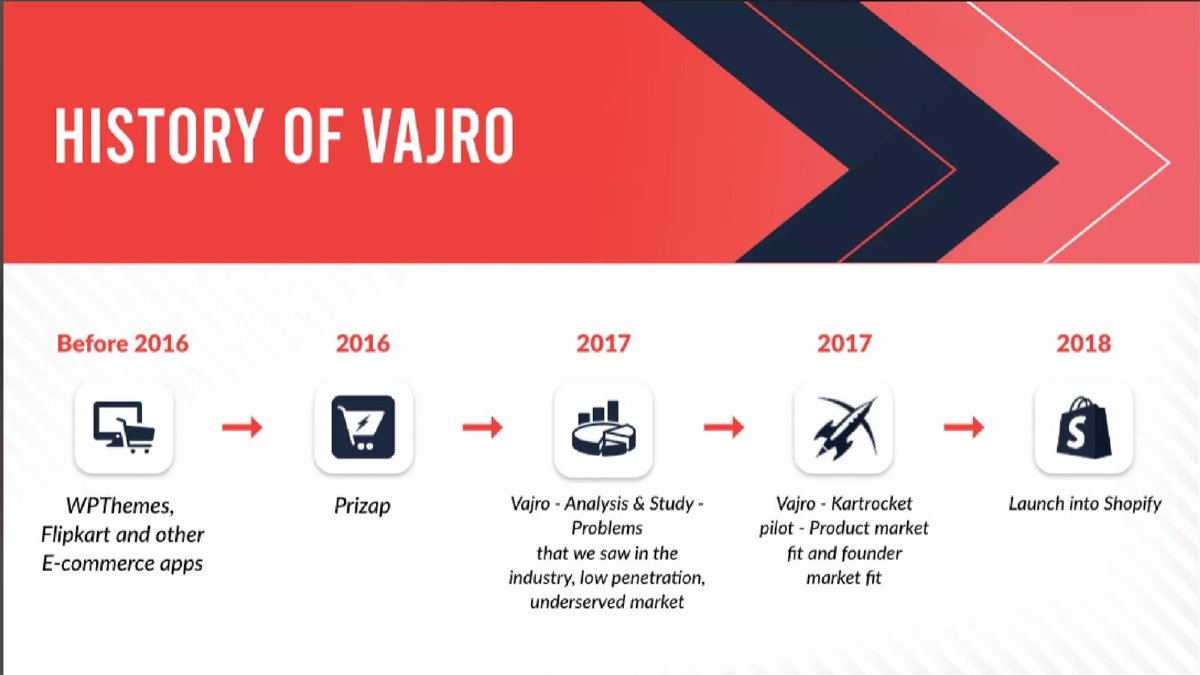
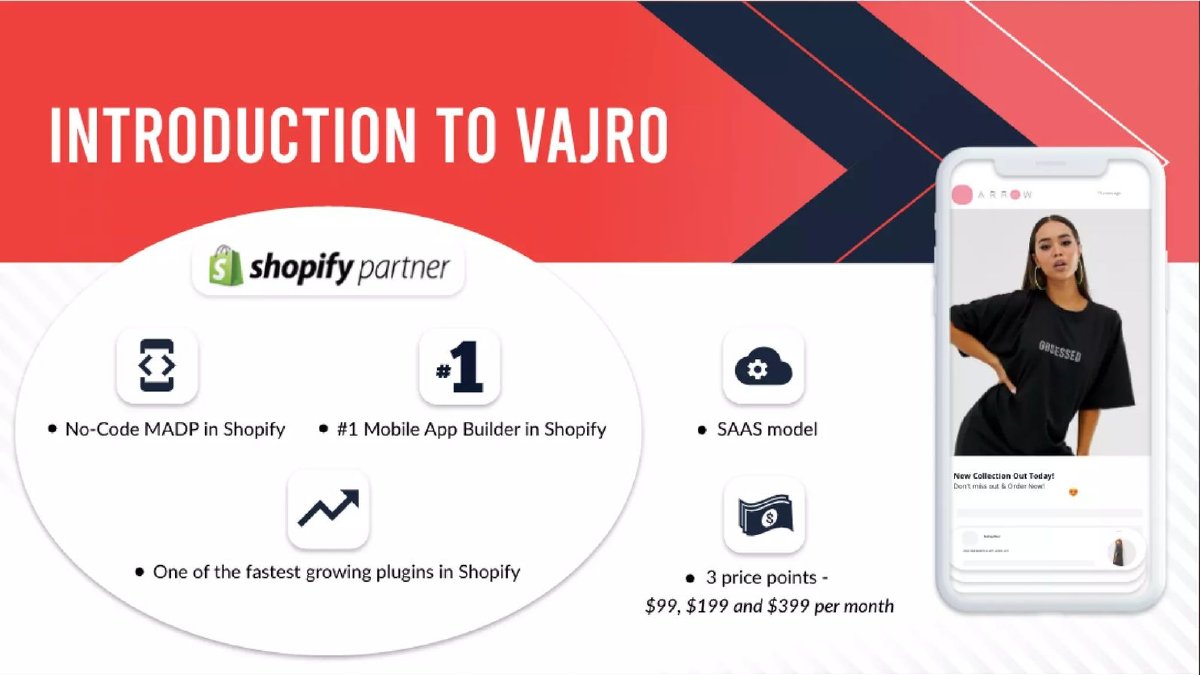
Vajro is an e-commerce mobile app builder that leverages the massive shift toward mobile shopping. The deck highlights a clear evolution from 'Vajro 1.0'—characterized by organic growth and early product-market fit—to 'Vajro 2.0,' which saw accelerated adoption during the pandemic era. With a specific focus on the Shopify ecosystem, including a Shopify Plus certification and a high-tier $999/month enterprise plan, the company demonstrates a move toward higher-value clients. The deck seeks $5 million in new capital to drive expansion into other platforms like WooCommerce and Magento. While sev…
Key takeaways
- The company identifies as an E-Commerce Mobile App Builder on Slide 1, targeting the $4.5 trillion e-commerce market.
- Market data on Slide 3 notes that over 80% of online sessions and 68% of payments in e-commerce stores now come from mobile devices.
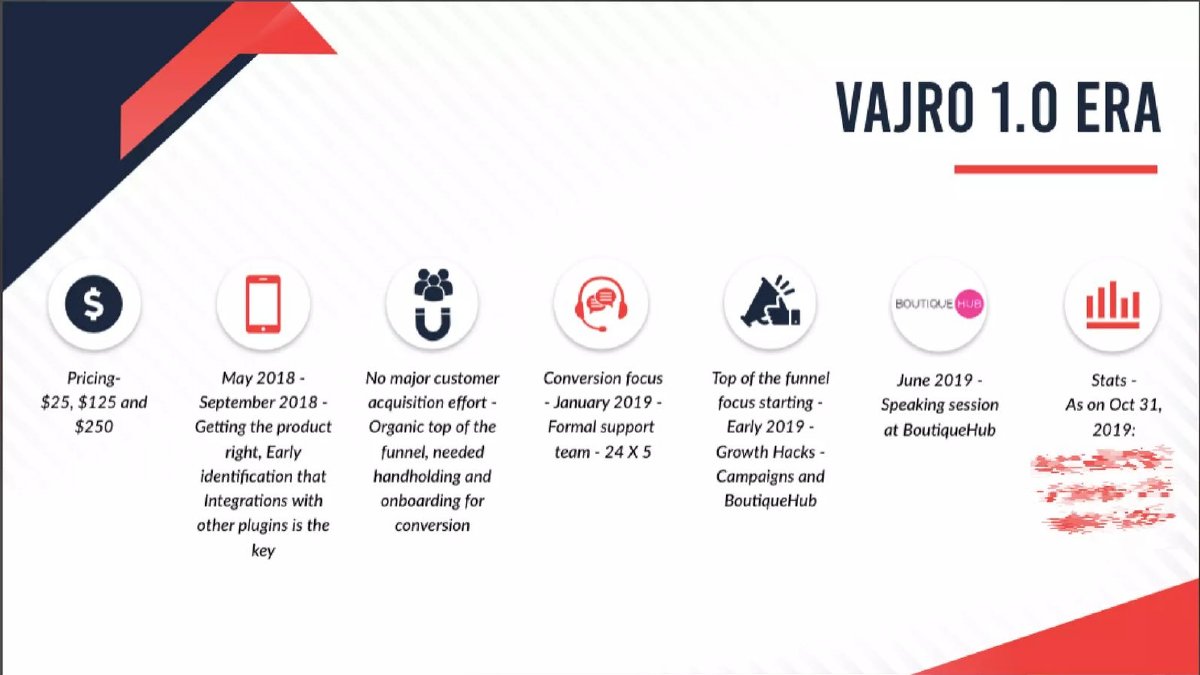
- Slide 4 details an early pricing strategy ranging from $25 to $250 during the 'Vajro 1.0' era.
- The 'Vajro 2.0' era, defined as the Pandemic Era on Slide 5, shows a significant upward trend in active paying clients through late 2020 on Slide 6.
- Strategic focus has shifted toward the enterprise segment with a Shopify Plus certification and a plan starting at $999/month, as shown on Slide 7.
- The deck explicitly asks for a 'Current Round $5 million' on Slide 8 to fund expansion into WooCommerce, Magento, and BigCommerce.
- Valuation logic is transparently stated on Slide 9 as being based on a 10x ARR multiple, including clients under trial.
- The deck lacks a dedicated team slide or detailed breakdown of unit economics like CAC and LTV in the provided pages.
Deck Overview
The Vajro pitch deck is a 26-slide presentation (of which 9 key slides are analyzed here) that positions the company as a vital infrastructure layer for the mobile commerce revolution. The deck uses a clean, high-contrast red and navy blue visual theme. It follows a narrative arc that moves from market opportunity to historical execution, and finally to a specific capital request for future expansion. The core strength of the deck is its focus on the Shopify ecosystem, which provides a recognizable and scalable context for investors.
Slide 1: Title and Identity
The opening slide is minimalist, featuring the Vajro logo and a clear value proposition: "E-COMMERCE MOBILE APP BUILDER." The visual includes a smartphone mockup showing various e-commerce interfaces (fashion, food, wellness), immediately communicating that the product is versatile across different retail verticals. This slide succeeds by not overcomplicating the message; the investor knows exactly what the company does within three seconds.
Slide 2: The Story of Angel Isaac
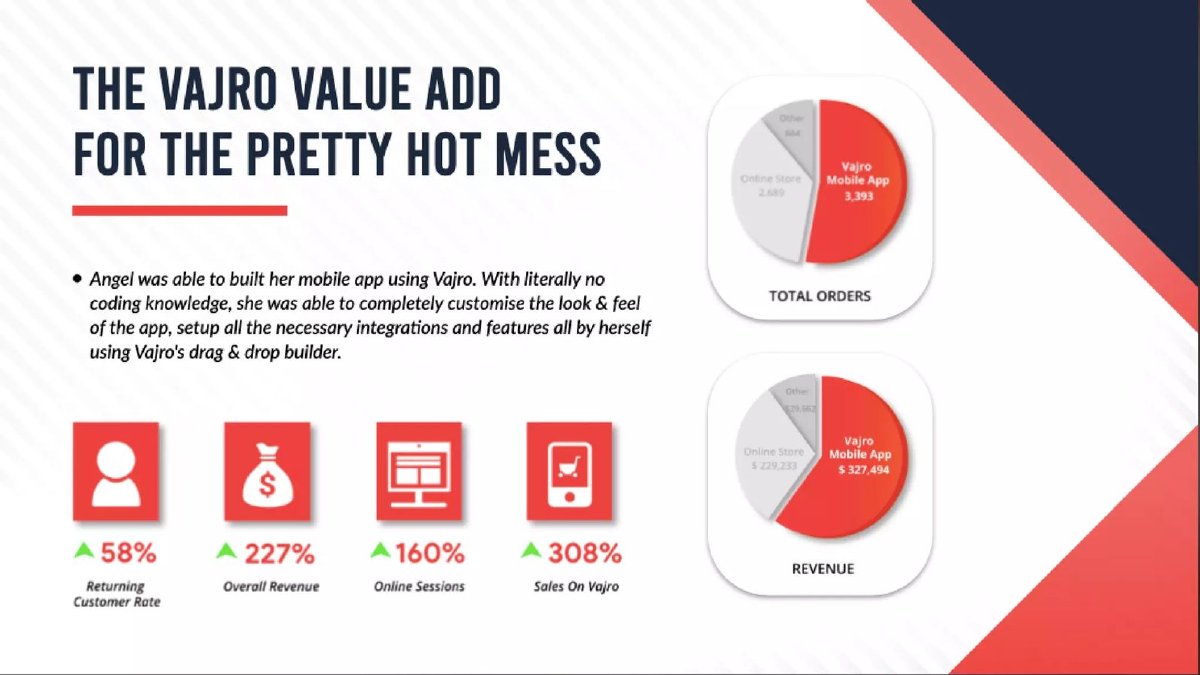
Vajro uses a persona-based approach to illustrate the problem and solution. Angel Isaac is presented as a wellness boutique owner in NY, USA, who was "looking for more avenues for growing her revenues and engaging better with her customers." By using a real-world example (or a highly specific archetype), the company grounds its technical solution in a tangible business need: revenue growth and customer engagement. The slide shows the mobile app version of her store, contrasting it with a standard web view.
Slide 3: The E-Commerce Market
This slide provides the macro-economic justification for the business. It cites three critical statistics:
The eCommerce market was expected to grow to $4.5 trillion by 2021 . · Over 80% of online sessions for ecommerce stores now come from mobile devices. · Mobile devices account for over 68% of all payments in ecommerce stores.
These figures establish that mobile is no longer a secondary channel but the primary driver of e-commerce, making a mobile app builder a "must-have" rather than a "nice-to-have" for merchants.
Slide 4: Vajro 1.0 Era
This slide serves as a historical timeline of the company's early stages. It highlights a tiered pricing model of $25, $125, and $250 . Key milestones include:
May 2018 - September 2018: Product development and identifying that integrations with other plugins are key. · January 2019: Establishment of a formal 24x5 support team. · June 2019: A speaking session at BoutiqueHub, indicating early community engagement.
The slide admits to having "No major customer acquisition effort" early on, relying instead on an organic top-of-funnel, which suggests strong initial product-market fit.
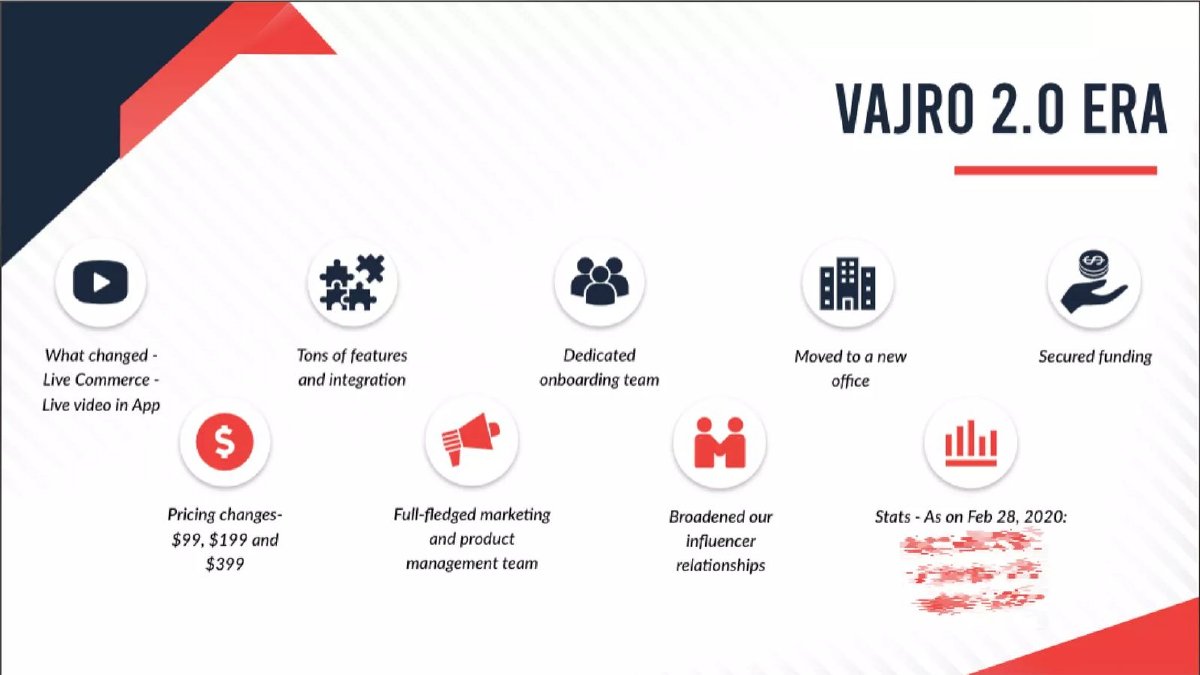
Slide 5 & 6: Vajro 2.0 and the Pandemic Era
Slide 5 marks a transition point, labeling the period starting in 2020 as the "Pandemic Era." Slide 6 provides the data to back this up with a chart of "ACTIVE PAYING CLIENTS." Although the specific Y-axis numbers are redacted, the trend line from March 2020 to December 2020 shows consistent, month-over-month growth. This visualizes the company's ability to capture the tailwinds of the global shift toward digital commerce during lockdowns.
Slide 7: Foundation for the Future
This is a strategic roadmap slide. It highlights a move toward the enterprise market, specifically within the Shopify ecosystem. Key elements include:
Shopify Plus Certification: A significant barrier to entry that signals platform trust. · Enterprise Plan: A new pricing tier starting at $999/month , which is a massive jump from the $250 ceiling in the 1.0 era. · SalesCatcher: Mention of a specific tool or integration to drive sales.
This slide demonstrates that the company is moving up-market to increase Average Revenue Per User (ARPU).
Slide 8: Driving Capital Efficiency
This is the "Ask" slide. It compares a previous (redacted) round to the "Current Round $5 million." The primary usage of these funds is clearly illustrated through logos: WooCommerce, Magento, and BigCommerce . This tells investors that the Shopify playbook is proven, and the capital will be used to replicate that success across other major e-commerce platforms. The slide also projects a growth target "IN 3 YEARS," though the specific revenue goal is redacted.
Slide 9: The Valuation Game
The final slide in this set is unusually transparent about valuation logic. It states that the "Current valuation basis is 10x our ARR number." It also notes that they include "clients under trial" in this calculation, which is a point an investor would likely scrutinize. The slide outlines a three-year projection, claiming that a 10x multiple on future revenues would result in a significant return on the $5 million investment. This slide is designed to appeal to the financial logic of a VC, framing the investment as a clear multiple-expansion opportunity.
What Works Well
The deck excels at segmenting the company's history into distinct "eras." By separating the 1.0 (Product/Market Fit) and 2.0 (Scaling/Pandemic) phases, the founders demonstrate an ability to adapt to market conditions. The focus on the Shopify Plus certification is a major credibility booster, as it suggests a level of technical and business maturity that generic app builders lack. Furthermore, the explicit valuation math on Slide 9 removes ambiguity, allowing investors to immediately understand how the founders are thinking about their exit potential.
What Is Missing
Team Slide: There is no information about the founders' backgrounds or the technical team's expertise. · Unit Economics: While ARR is mentioned, there is no data on Customer Acquisition Cost (CAC), Lifetime Value (LTV), or Churn rates, which are critical for a SaaS business. · Competitive Landscape: The deck does not mention competitors like Tapcart or Plobal Apps, which also operate in the Shopify mobile app space. · Product Deep Dive: While we see mockups, there is no explanation of the "no-code" interface or how easy it is for a merchant to actually deploy an app.
Founder's Takeaway
Founders should emulate Vajro's clear transition from SMB to Enterprise . Moving from a $25/month product to a $999/month product is a classic path to venture-scale returns, and Vajro documents this transition effectively. Additionally, the use of platform-specific milestones (like the Shopify Plus certification) is a great way to signal "moat" building. However, be cautious about including "clients under trial" in your ARR calculations; while Vajro is honest about doing it, most sophisticated investors will discount those numbers during due diligence. If you use this tactic, ensure your trial-to-paid conversion rate is exceptionally high and documented.
Frequently asked questions
- What is Vajro's core product offering?
- Vajro is a no-code or low-code mobile app builder specifically designed for e-commerce stores. As stated on Slide 1 and Slide 7, they allow merchants to convert their web-based stores into native mobile applications, with a heavy emphasis on the Shopify and Shopify Plus ecosystems.
- How much capital is Vajro raising in this deck?
- According to Slide 8, titled 'Driving Capital Efficiency,' the company is seeking a current round of $5 million. The slide indicates this capital is intended to sustain growth over a three-year horizon and facilitate expansion into new e-commerce platforms.
- What platforms does Vajro support?
- While the deck highlights a deep 'Shopify Journey' on Slides 5 and 7, Slide 8 reveals plans to use the new capital to expand primary usage to WooCommerce, Magento, and BigCommerce (represented by their respective logos).
- How does Vajro calculate its valuation?
- Slide 9, 'The Valuation Game,' states that their current valuation basis is 10x their Annual Recurring Revenue (ARR) number. Notably, they include clients currently under trial in this ARR calculation, which is a non-standard but aggressive accounting approach for a pitch deck.
- What was the impact of the pandemic on their business?
- The deck classifies their growth phase starting in early 2020 as 'Vajro 2.0 Pandemic Era' on Slide 5. Slide 6 shows a chart of 'Active Paying Clients' with a consistent upward slope from March 2020 through December 2020, suggesting the shift to online shopping accelerated their customer acquisition.