Vaayu’s 2022 seed deck is a study in focused storytelling. With only 12 slides, the company successfully articulated a complex value proposition: automated, real-time carbon tracking specifically for the retail sector. The deck avoids the common pitfall of over-explaining the science of climate change, instead leaning on market sentiment data—such as the fact that 72% of consumers are buying more environmentally friendly products—and high-profile validation from figures like Bill Gates. By showcasing a clean dashboard and specific customer testimonials from brands like Missoma and Armedangels…
Key takeaways
- The company positions itself as the world's first automated carbon software specifically for retailers (Slide 3).
- Consumer demand is a primary driver, with 72% of respondents in a 6,000-person survey buying more eco-friendly products than five years ago (Slide 4).
- The founding team highlights experience from major brands including Zalando, Babbel, and Ted Baker (Slide 5).
- The software integrates directly with point-of-sale systems to calculate the footprint of every transaction (Slide 7).
- Product modules allow retailers to track specific areas like last-mile delivery, packaging, and logistics (Slide 7).
- Vaayu provides a live dashboard for real-time carbon information, moving away from static annual reports (Slide 8).
- The deck includes social proof through testimonials from Missoma, Organic Basics, and Armedangels (Slide 9).
- The long-term vision is to empower retailers to reduce 1 gigaton of carbon emissions by 2030 (Slide 10).
The Narrative of Real-Time Carbon Accountability
Vaayu entered the market at a time when 'ESG' was transitioning from a buzzword to a regulatory and consumer requirement. Their seed deck, used to raise $11.5M in 2022, reflects a high degree of confidence. It does not get bogged down in the minutiae of carbon sequestration or chemical formulas. Instead, it focuses on the automation and integration of data within the retail stack. The deck is visually sparse, using a muted palette and bold typography to convey a sense of modern, enterprise-grade reliability.
Slides 1-3: The Hook and the Mission
The deck opens with a minimalist title slide (Slide 1) and immediately moves into a high-level quote from Barack Obama on Slide 2: "We are the first generation to feel the effect of climate change and the last generation who can do something about it." This establishes the urgency of the mission without requiring the founders to spend time on the 'why' of their business.
Slide 3 delivers the Value Proposition : "Vaayu is the world's first automated carbon software. Empowering retailers to track and cut carbon in real-time." This slide also features a placeholder for a video, indicating that the product's interface and functionality are best demonstrated through motion rather than static images. The mention of 'real-time' is the key differentiator here, as most carbon reporting at the time was done annually via consultants.
Slide 4: Market Dynamics and Consumer Sentiment
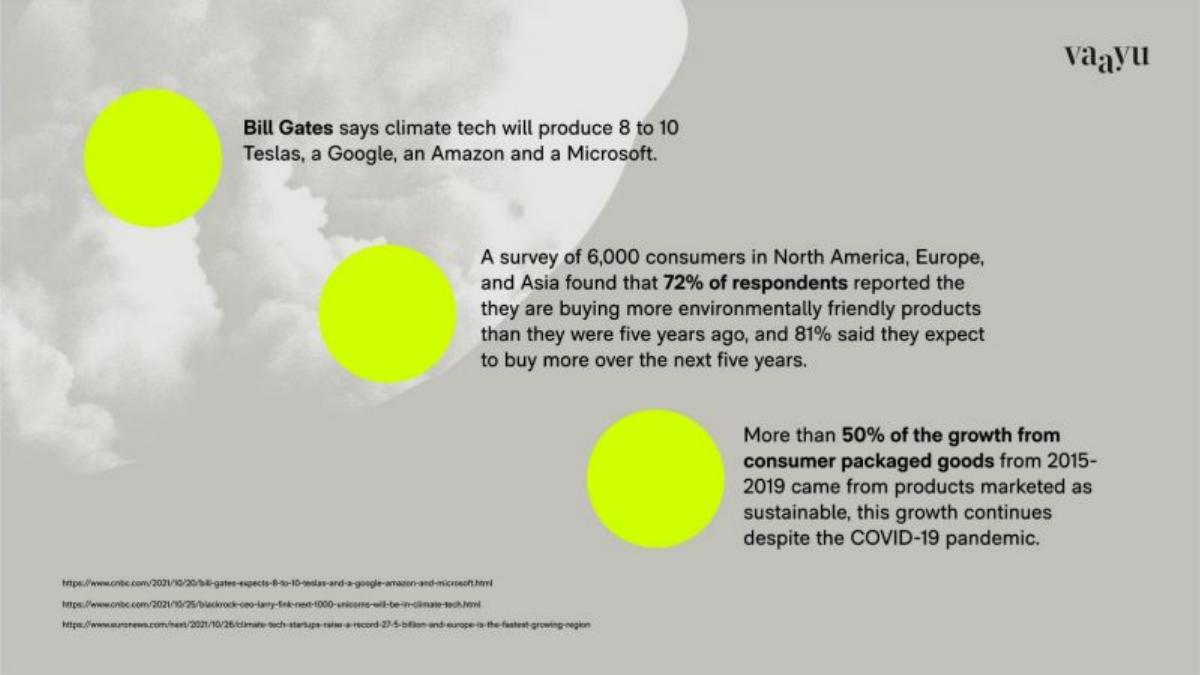
Vaayu uses Slide 4 to build a business case for sustainability. They cite three major points:
Bill Gates: A quote suggesting climate tech will produce 8 to 10 'Teslas' and other tech giants. · Consumer Survey: Data from 6,000 consumers showing 72% are buying more eco-friendly products. · CPG Growth: A statistic stating that 50% of growth in consumer packaged goods (2015-2019) came from sustainable products.
This slide successfully shifts the conversation from 'saving the planet' to 'capturing market growth,' which is a much more compelling narrative for venture capitalists.
Slide 5: The Team
The 'Team' slide is critical for a seed-stage company. Namrata Sandhu (CEO) and Luca Schmid (CTO) are presented alongside a list of high-profile companies where the broader team has experience. Brands like Zalando, Babbel, Ted Baker, Bally, and Michael Kors are listed. This is a strategic move to show that the team understands the specific pain points of the retail and fashion industries from the inside.
Slides 6-8: Product and Integration
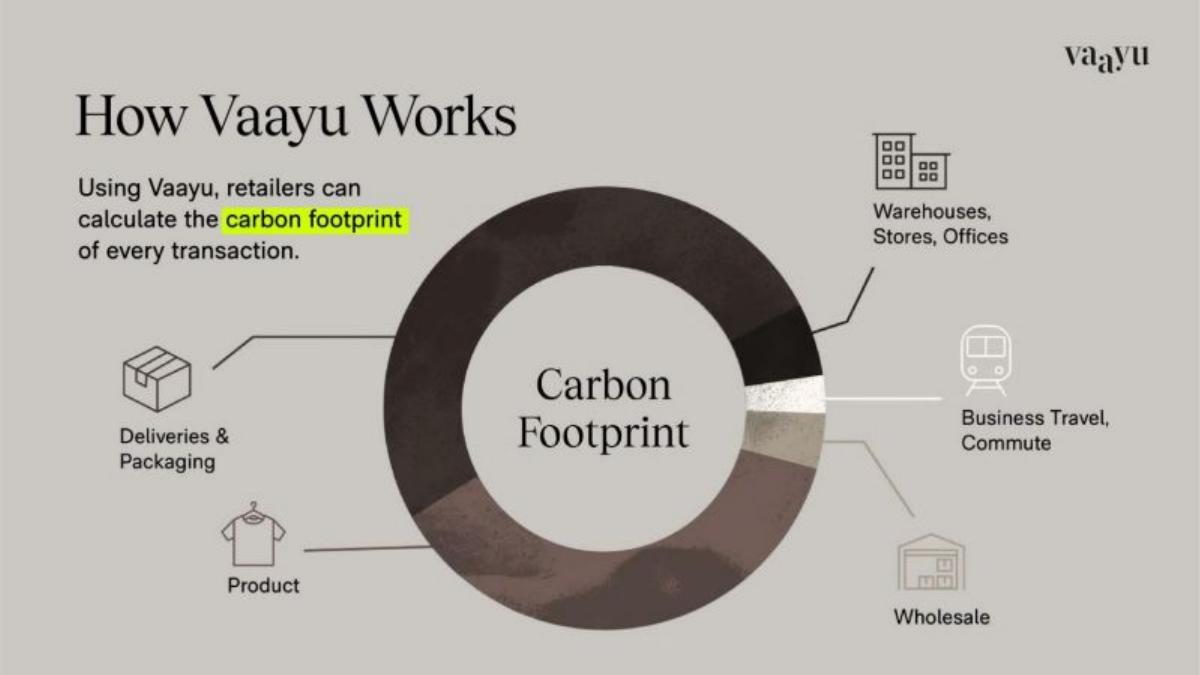
Slide 6 uses a donut chart to visualize the various components of a retailer's carbon footprint: Product, Deliveries & Packaging, Warehouses/Stores/Offices, Business Travel, and Wholesale. This sets the stage for how the software actually functions.
Slide 7, titled "Connecting and Using Vaayu," outlines a four-step process: 1. Integration: Connecting with point-of-sale systems. 2. Modules: Retailers select relevant areas like last-mile delivery or inbound logistics. 3. Identification: The software identifies reduction measures. 4. Offsetting: Retailers can choose to offset unavoidable emissions via third-party providers.
Slide 8 shows the "Live Data" dashboard. The UI is clean and professional, displaying metrics like 321.23 kg CO2e and a score of 50/100 . This visual proof is essential to convince investors that the product isn't just a concept, but a functioning tool providing granular data.
Slides 9-12: Validation and Vision
Slide 9 provides social proof through three customer testimonials. Missoma highlights the real-time data aspect, Organic Basics mentions making carbon a core KPI, and Armedangels claims the software "saves us months of work on calculations." These quotes address the three main benefits of the platform: accuracy, strategic integration, and efficiency.
Slide 10 presents the "Big Hairy Audacious Goal" (BHAG): reducing 1 gigaton of carbon emissions by 2030. By comparing this to the annual emissions of Germany and France, Vaayu gives investors a sense of the potential scale of their impact.
The deck concludes with a simple contact slide (Slide 11) and a closing logo. Notably, there is no slide detailing the specific amount being raised, the valuation, or the use of funds. This is common in decks that are shared widely or used as a teaser before a formal pitch meeting.
What Vaayu Does Well
The deck is exceptionally disciplined. It identifies a specific niche—retail—and stays within it. By focusing on automation , it solves a known problem in the industry: the high cost and slow speed of manual carbon auditing. The use of recognizable retail brand logos in the team and testimonial slides provides instant credibility that would take pages of text to establish otherwise.
What is Missing from the Deck
While the deck is effective for a seed round, it leaves several questions unanswered for a lead investor:
Business Model: There is no mention of pricing. Is it a SaaS subscription, a per-transaction fee, or a module-based pricing structure? · Competition: The deck does not address other carbon accounting platforms (like Watershed or Persefoni). It relies entirely on the 'world's first' claim for retailers. · Unit Economics: There is no data on the cost of customer acquisition (CAC) or the lifetime value (LTV) of these retail contracts. · The Ask: As mentioned, the deck does not state how much money they are looking for or what milestones that money will help them achieve.
Founder's Playbook: What to Copy
Founders should emulate Vaayu's modular explanation of technology . Slide 7 is a perfect example of how to explain a complex technical integration in four simple steps. Additionally, the use of comparative scale on Slide 10 (comparing carbon to the emissions of specific countries) is a brilliant way to make abstract numbers feel tangible. Finally, the aesthetic consistency of the deck—using a professional, high-end design—signals that the company is ready to sell to enterprise clients, not just small startups.
Frequently asked questions
- What is Vaayu's core product offering?
- Vaayu offers automated carbon tracking software designed specifically for the retail industry. Unlike traditional carbon accounting which is often manual and retrospective, Vaayu integrates with point-of-sale systems to provide real-time data on the carbon footprint of every transaction, covering everything from raw materials to last-mile delivery.
- How does Vaayu integrate with existing retail infrastructure?
- According to slide 7, the software integrates directly with a retailer's point-of-sale (POS) systems. This allows for the automatic collection of transaction data, which is then processed through various modules such as packaging, logistics, and product lifecycle to calculate emissions without manual data entry.
- Who are the founders and what is their background?
- The company was co-founded by Namrata Sandhu (CEO) and Luca Schmid (CTO). The team brings a mix of retail, technology, and climate science experience, with previous tenures at companies like Zalando, Babbel, Ted Baker, and Michael Kors, as noted on slide 5.
- What market validation does the deck provide?
- Vaayu points to a survey of 6,000 consumers showing that 72% are actively seeking environmentally friendly products. Additionally, they cite that over 50% of growth in consumer packaged goods from 2015-2019 came from products marketed as sustainable, proving a clear financial incentive for retailers to use their software.
- What is the primary goal stated in the pitch deck?
- Beyond the immediate software utility, Vaayu sets a massive impact goal on slide 10: to empower retailers to reduce 1 gigaton of carbon emissions by 2030. They contextualize this by stating it is equivalent to the annual emissions produced by Germany and France combined.