VADE addresses the congestion and inefficiency of urban curbs caused by the rise of rideshare and delivery services. Their core innovation is a business model pivot: they bypass slow municipal procurement cycles by providing hardware to cities for free, instead charging a recurring subscription fee for the resulting data. The deck outlines a dual-revenue stream targeting both government entities (B2G) for enforcement and analytics, and private companies (B2B) via API calls for wayfinding and fleet management. While the deck excels at defining a clear value proposition and competitive position…
Key takeaways
- The problem is defined as an inefficient curb system overwhelmed by private companies like Uber and UPS (Slide 3).
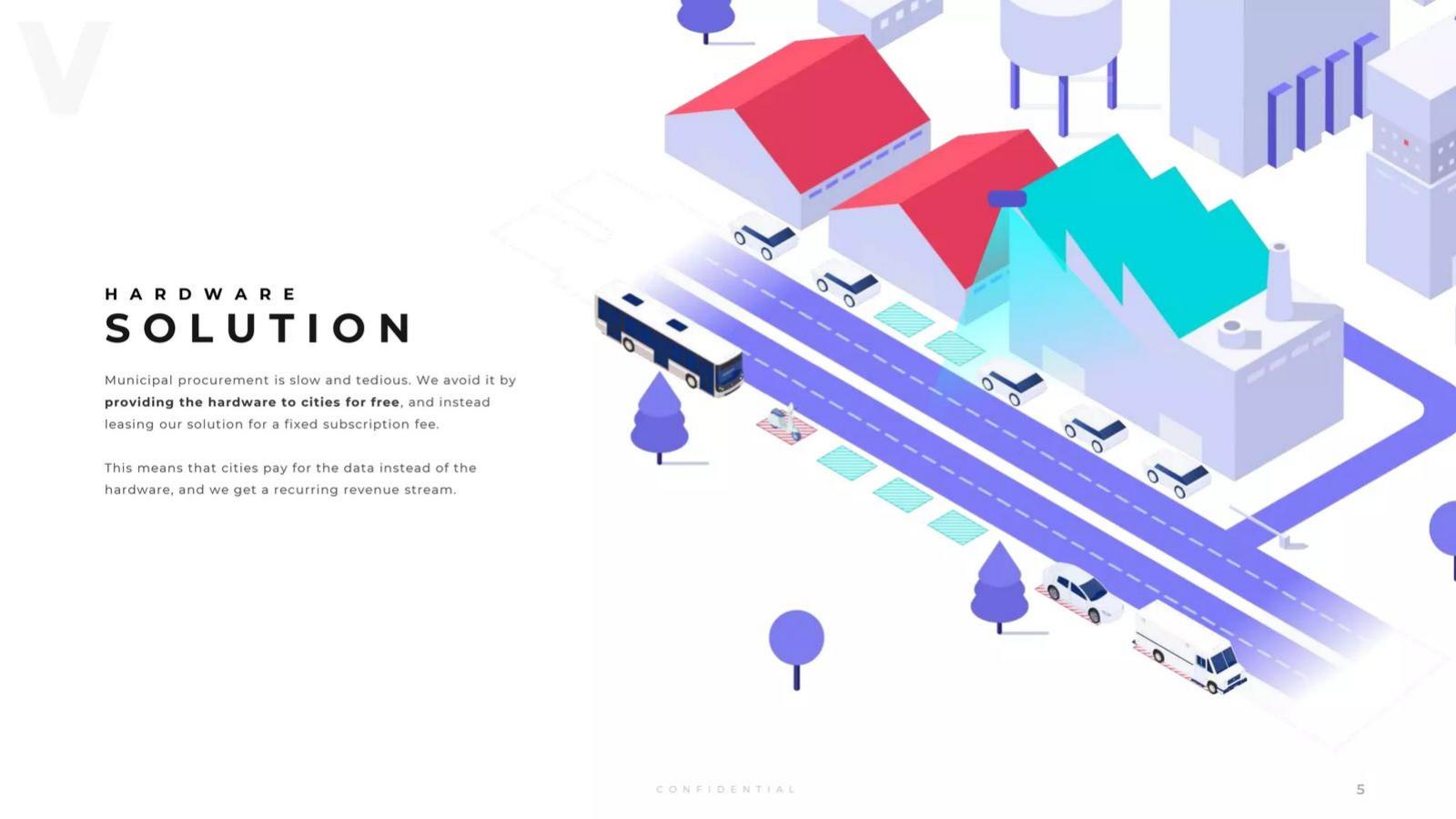
- VADE bypasses slow municipal procurement by providing hardware for free and leasing the data solution for a fixed fee (Slide 5).
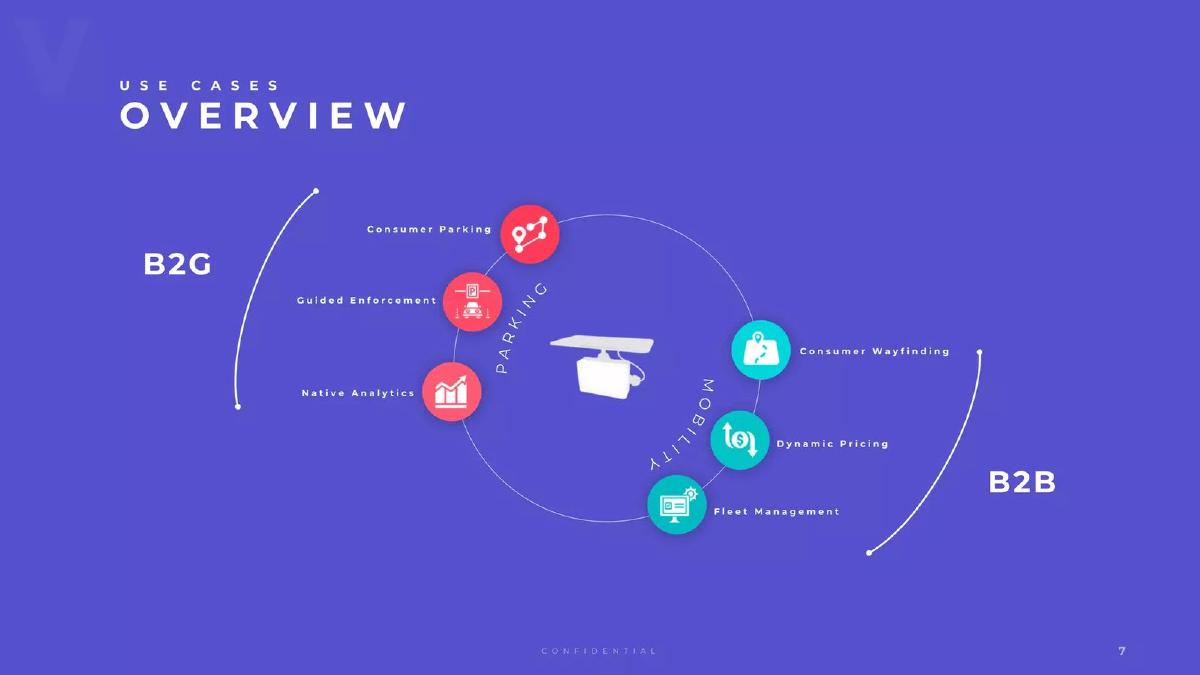
- Revenue is split between B2G (Parking) and B2B (Mobility) use cases (Slide 7).
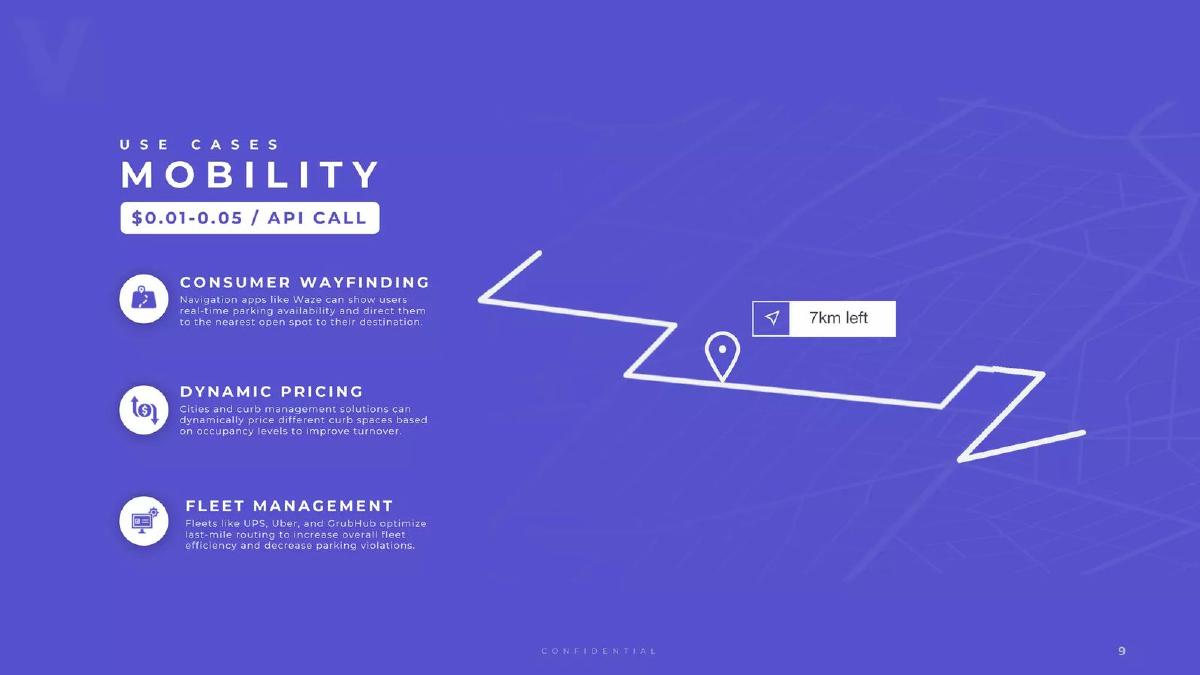
- B2B mobility data is priced at $0.01-$0.05 per API call for wayfinding and fleet management (Slide 9).
- The company positions itself as a 'Data-as-a-Service' (DaaS) provider with low switching costs compared to traditional SaaS competitors (Slide 11).
- Competitors listed include major players like Verizon and niche firms like CivicSmart and Nwave (Slide 11).
- The deck features an advisor slide with industry veterans from Flowbird and United Public Safety, but lacks a slide for the founding team (Slide 13).
- There is no mention of current revenue, total addressable market (TAM), or the specific amount of capital being raised.
Executive Summary: The Curb Management Opportunity
VADE presents a compelling case for the modernization of urban curbs. As cities grow, the demand for curb space from rideshare (Uber/Lyft), parcel delivery (UPS), and food delivery (GrubHub) has created a chaotic and inefficient environment. VADE's deck focuses on the transition from hardware-heavy municipal contracts to a nimble Data-as-a-Service (DaaS) model. By removing the upfront cost for cities, they aim to scale faster than traditional vendors who are bogged down by multi-year procurement cycles.
Slide 1: Title and Branding
The deck opens with a minimalist title slide featuring the VADE logo and the tagline "CONNECTING THE CURB." The background uses a subtle isometric city illustration, establishing the urban tech context immediately. The inclusion of the website URL (www.vadepark.com) provides a clear call to action for further research.
Slide 3: Defining the Curb Crisis
Slide 3 identifies the core problem: "The growth of cities and increase in curb usage by private companies has led to a massively inefficient system." The slide uses an isometric graphic to show a congested street filled with Uber Eats, Lyft, and UPS vehicles. It highlights that cities are currently stuck with "antiquated technology and policy solutions." A flow chart at the bottom illustrates how cities and curbs sit at the center of a web involving micro-mobility, rideshare, citizens, parcel delivery, and food delivery.
Slide 5: The Hardware-as-a-Service Pivot
This is the most critical slide in the deck regarding business strategy. VADE acknowledges that "Municipal procurement is slow and tedious." To solve this, they state: "We avoid it by providing the hardware to cities for free, and instead leasing our solution for a fixed subscription fee." This model ensures that cities pay for the data rather than the physical assets, providing VADE with a "recurring revenue stream." The graphic shows a cleared street with designated zones for different types of vehicles, representing the 'solved' state.
Slide 7: Use Cases Overview
Slide 7 breaks the market into two segments: B2G (Business to Government) and B2B (Business to Business) . The B2G side focuses on Consumer Parking, Guided Enforcement, and Native Analytics. The B2B side focuses on Consumer Wayfinding, Dynamic Pricing, and Fleet Management. A central icon represents the hardware sensor, positioned as the source of truth for all these applications.
Slide 9: The B2B Mobility Revenue Model
Slide 9 zooms in on the Mobility use case, providing a specific pricing metric: "$0.01-0.05 / API CALL." It details three specific sub-sectors:
Consumer Wayfinding: Navigation apps like Waze showing real-time parking availability. · Dynamic Pricing: Cities adjusting curb space prices based on occupancy levels to improve turnover. · Fleet Management: Companies like UPS and Uber optimizing last-mile routing to decrease parking violations.
Slide 11: Competitive Landscape
VADE uses a standard 2x2 matrix to position itself. The X-axis ranges from SaaS (High Switching Costs) to DaaS (Low Switching Costs) . The Y-axis ranges from Procurement (Slow Adoption) to Pay Per Use (Fast Adoption) . VADE places itself in the top-right quadrant (Fast Adoption/DaaS). Competitors like Verizon are placed in the top-left, while CivicSmart, IPS Group, and Visionful are placed in the bottom-left (Slow Adoption/SaaS). Nwave is positioned as a DaaS provider but with slower adoption than VADE.
Slide 13: The Advisory Board
While the deck lacks a slide for the founders, Slide 13 introduces four advisors:
Tom Szubka: Senior Consultant at Walker Consulting, formerly Director of Operations at Flowbird. · David Young: CFO at United Public Safety. · Charlie Ansanelli: Founder of Rockstack Capital, formerly Founder of ParkPlease (acquired). · Scott Albert: Venture Partner at CoFounders Capital, formerly Co-Founder of Aurora.
This slide lends significant industry credibility to the project, particularly in the realms of parking operations and municipal safety.
Slide 15: Conclusion
The deck ends with a simple "THANK YOU" and a repeat of the website URL. There is no specific call to action regarding a funding round or next steps beyond "speaking to you."
What Works in the VADE Deck
1. Clear Business Model Innovation: The decision to give hardware away for free to bypass procurement is a classic 'Trojan Horse' strategy that addresses a well-known pain point in GovTech. Investors generally like models that shorten sales cycles.
2. Specific Pricing: Providing a range for API call costs ($0.01-$0.05) gives a concrete sense of how the B2B side of the business scales. It moves the conversation from abstract 'data value' to a measurable unit of revenue.
3. Visual Consistency: The use of isometric illustrations across slides 3 and 5 helps explain a complex physical environment (the city street) in a way that is easy to digest. The branding is professional and cohesive.
What is Missing from the VADE Deck
1. The Founders: The most glaring omission is the absence of a team slide. While the advisors are impressive, investors back founders, not just advisors. The lack of information on who is actually building and running the company is a significant red flag for a standard pitch deck.
2. Traction and Proof of Concept: There are no mentions of current city partners, pilot programs, or the number of sensors currently deployed. Without this, the deck feels like a theoretical proposal rather than a growing business.
3. Financials and The Ask: The deck does not state how much capital is being raised, the valuation, or how the funds will be used. Furthermore, there are no projections showing the path to profitability or the expected growth of the recurring revenue stream.
Founder Takeaways
Focus on the 'How' of Sales: VADE correctly identifies that the biggest hurdle in B2G is not the technology, but the procurement process. Founders in the GovTech space should follow this lead by highlighting exactly how they intend to shorten the time between first contact and a signed contract.
Segment Your Revenue: By splitting the deck into B2G and B2B, VADE shows they understand that their data has value to multiple stakeholders. This diversifies their risk; if a city is slow to adopt, they can still monetize the data through private fleet partnerships.
Use Advisors to Fill Gaps: If you are a first-time founder in a highly regulated or specialized industry (like municipal parking), having advisors from established players like Flowbird or United Public Safety (as seen on Slide 13) is essential for building trust with both investors and potential government clients.
Frequently asked questions
- What is VADE's primary product?
- VADE provides a hardware-enabled data platform for curb management. According to Slide 5, they install hardware in cities to monitor curb usage and provide real-time data to municipalities and private fleets. The goal is to replace antiquated technology with a modern, data-driven approach to urban parking and mobility.
- How does VADE make money?
- VADE utilizes two distinct revenue models. For cities (B2G), they charge a fixed subscription fee for data access (Slide 5). For private mobility companies (B2B), they charge between $0.01 and $0.05 per API call for services like consumer wayfinding and fleet routing optimization (Slide 9).
- How does the company handle the slow pace of government sales?
- Slide 5 explicitly states that VADE avoids the 'slow and tedious' municipal procurement process by providing the hardware to cities for free. By removing the upfront capital expenditure for the city, they transition the sale into a recurring operational expense for data, which typically has a lower barrier to approval.
- Who are VADE's main competitors?
- Slide 11 maps out the competitive landscape, placing VADE in the high-adoption, low-switching-cost quadrant. Competitors include large telecommunications companies like Verizon, as well as specialized firms such as CivicSmart, IPS Group, Visionful, and Nwave.
- What information is missing from this pitch deck?
- The deck is missing several critical components for a full fundraise: a slide introducing the founders/management team, a detailed breakdown of unit economics, historical traction or pilot results, a financial forecast, and a specific 'Ask' slide detailing how much money they are raising and how it will be spent.