Valerie Health's 13-slide Series A deck is a clinical example of how to present a vertical AI solution to sophisticated investors. By focusing on the 'front office'—a notorious bottleneck in independent medical practices—the company avoids the crowded clinical AI space and targets operational efficiency. The deck relies heavily on growth momentum, claiming a tripling of revenue quarter-over-quarter and providing specific evidence of account expansion (e.g., growing from 1 to 50 locations with a single client). While the deck omits detailed unit economics or a competitive matrix, it compensate…
Key takeaways
- The company identifies a specific $34B Total Addressable Market based on 451k independent MDs at a $75k ARR per MD price point (Slide 9).
- Valerie Health uses a 'wedge' strategy targeting PE-backed groups, which represents a $3.7B sub-segment of their total market (Slide 9).
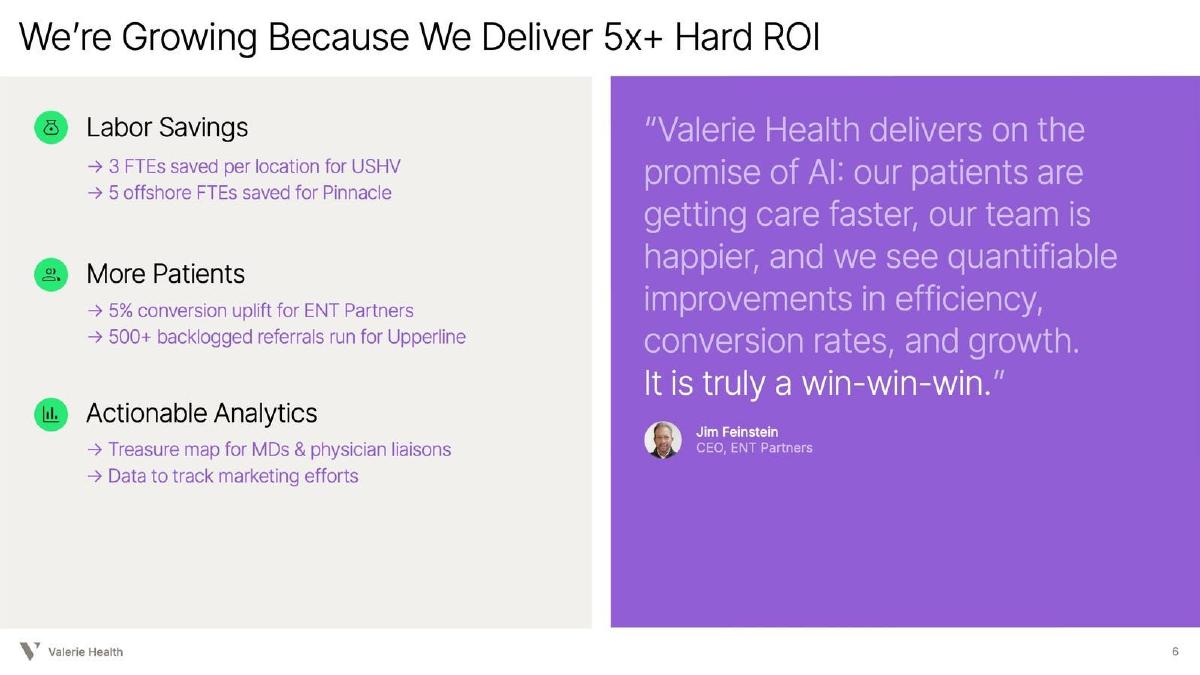
- The deck claims a '5x+ hard ROI' for customers, though the specific components of this ROI calculation are not detailed on the slide (Slide 6).
- Expansion proof is a core pillar of the pitch, showing one customer (Upperline Health) growing from 1 location to 50 locations (Slide 7).
- The team slide highlights significant domain expertise, including a CEO with two exits and a CTO who founded UberHealth (Slide 11).
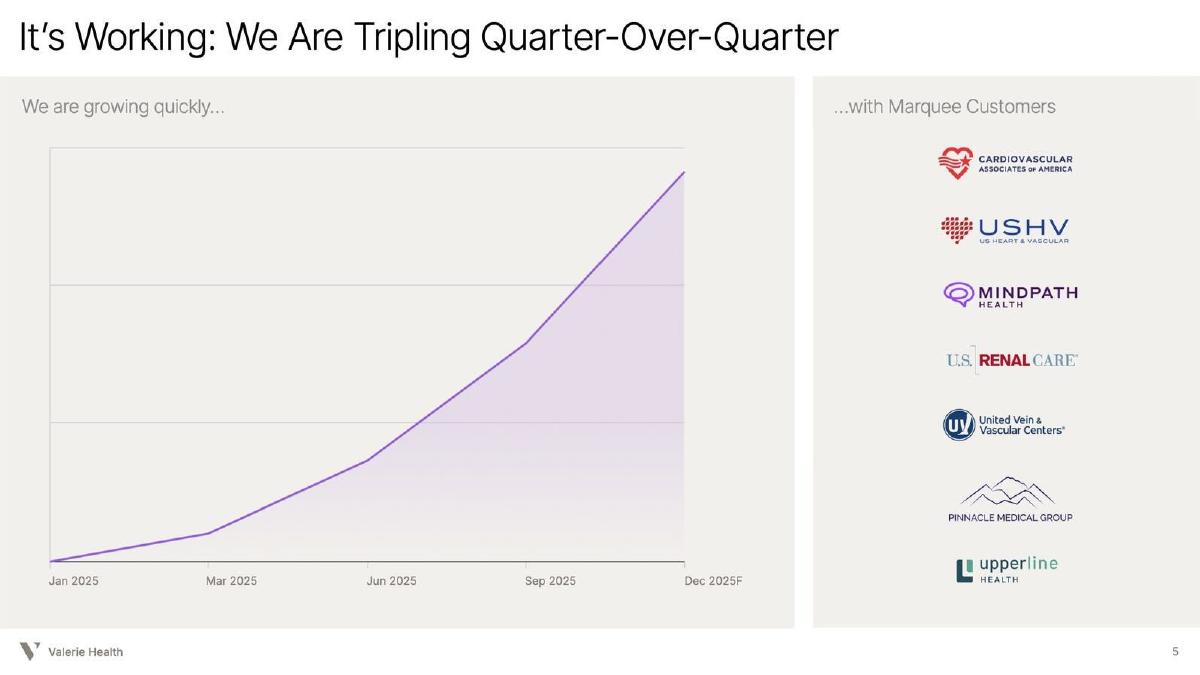
- The revenue chart shows an aggressive upward trajectory from January 2025 through a forecasted December 2025, claiming the company is 'tripling quarter-over-quarter' (Slide 5).
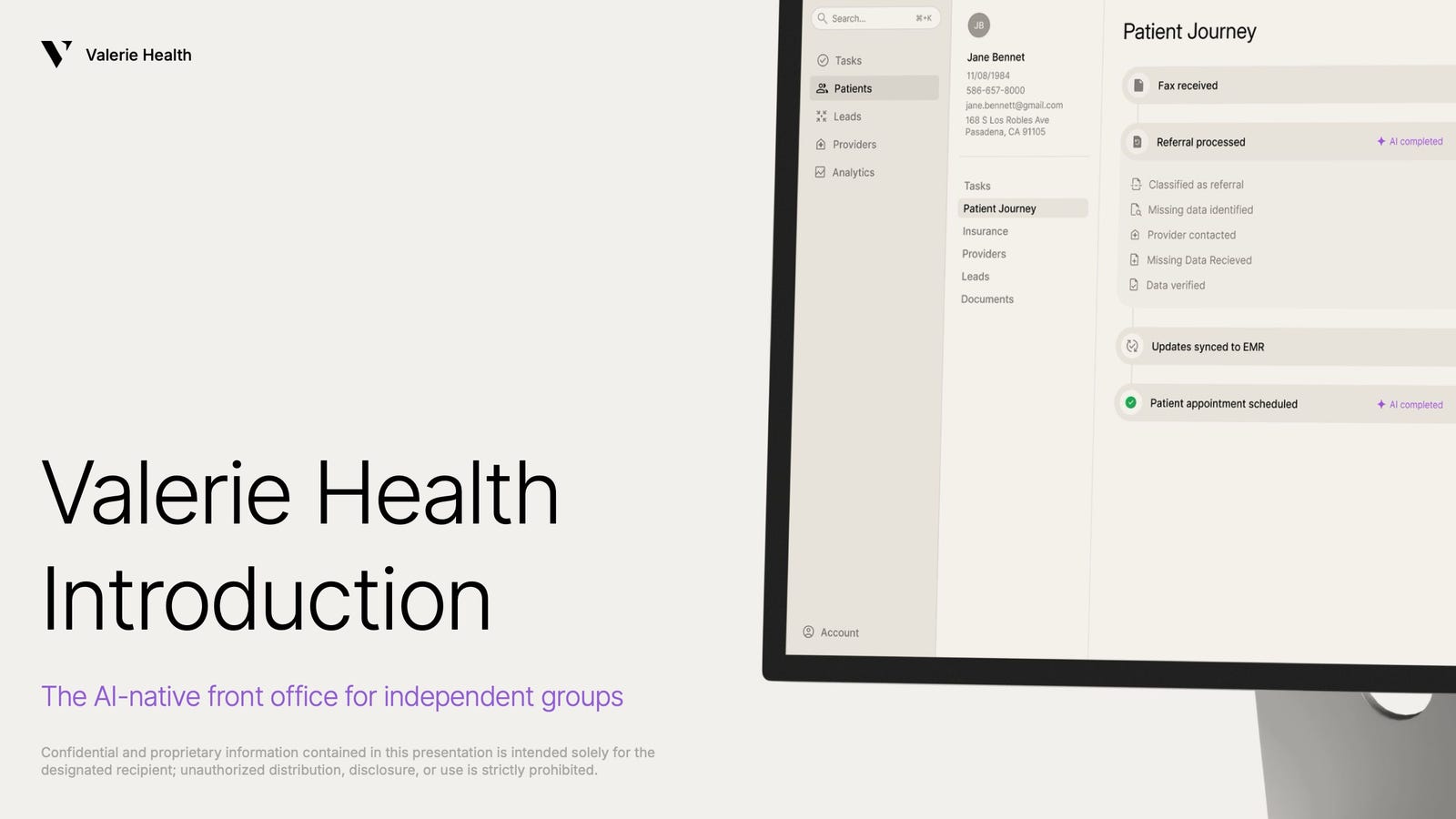
- The product is positioned as an 'AI-native front office,' with UI mockups showing automated fax processing and EMR syncing (Slide 1).
- The deck asks for $25M (Slide 12), though publisher reports indicate the round eventually closed at $30M in 2024.
The Strategy of the Vertical AI Wedge
Valerie Health’s Series A deck is a study in focused execution. In a market saturated with 'AI for Healthcare' pitches, Valerie distinguishes itself by ignoring the clinical side of medicine—where liability and regulatory hurdles are highest—and focusing instead on the 'front office.' This teardown examines how a 13-slide deck successfully argued for a $30M investment by emphasizing operational ROI and a clear path to market dominance through private equity-backed medical groups.
Slide 1: Introduction and Product Vision
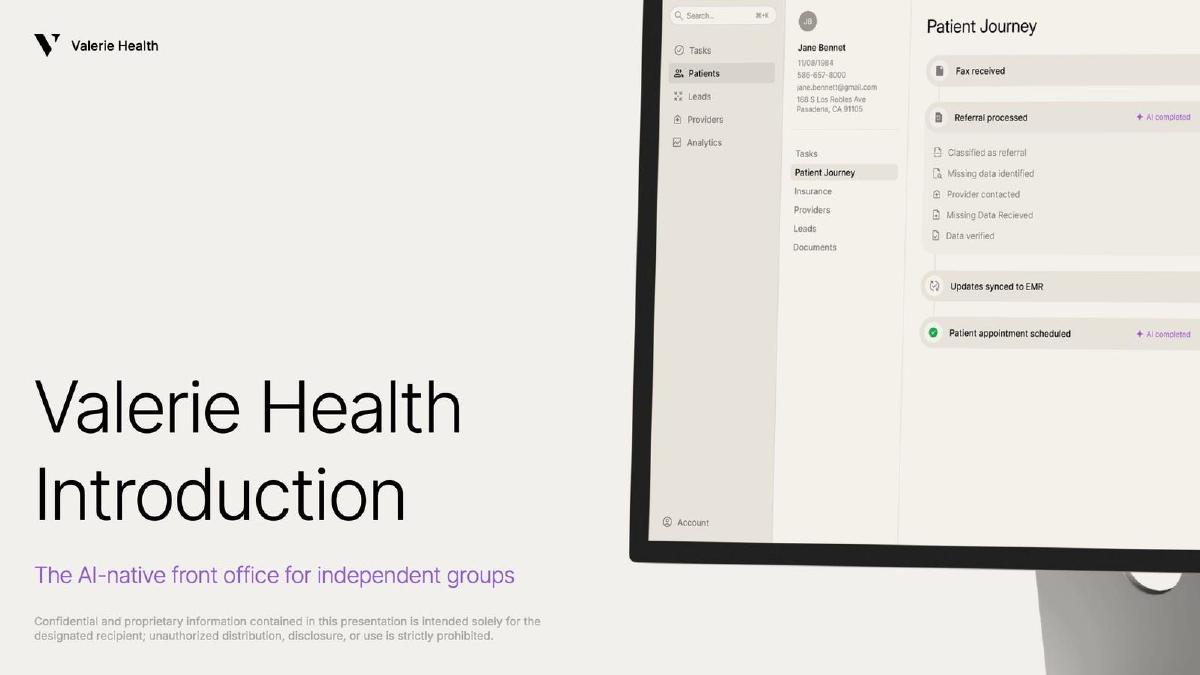
The cover slide does more than just state the company name. It features a high-fidelity UI mockup of the platform in action. The visual highlights a 'Patient Journey' tracker where tasks like 'Fax received,' 'Referral processed,' and 'Patient appointment scheduled' are marked as 'AI completed.' By placing the product front and center, Valerie immediately defines itself as a workflow automation tool rather than a vague data analytics play. The subtitle, 'The AI-native front office for independent groups,' establishes the target demographic right away.
Slide 2 & 3: The Problem and Mission
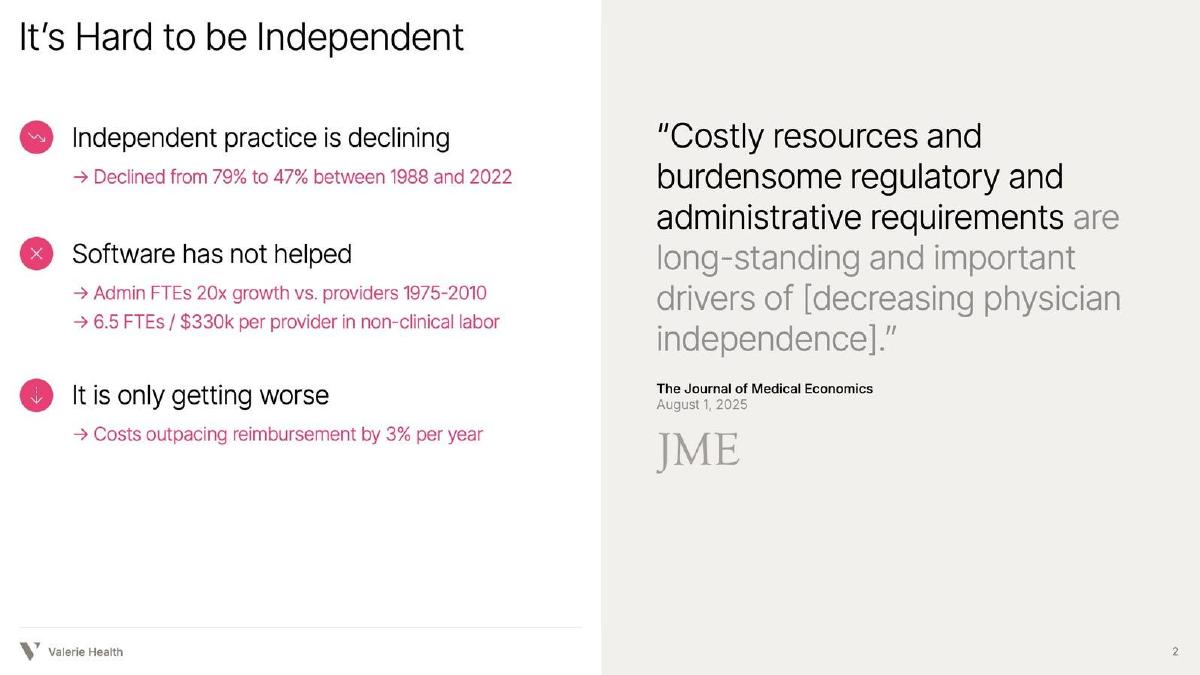
Slide 2 addresses the pain point: 'It's hard to be an independent provider group.' While the text is minimal, the implication in the healthcare industry is clear—rising administrative costs and burnout are forcing independent practices to sell to large hospital systems. Slide 3 presents the mission: 'Valerie Health elevates independent practice.' The goal is to make these practices the 'easiest, highest-quality, and most profitable place to deliver care.' This is a powerful emotional hook for investors who view the consolidation of healthcare as a systemic problem.
Slide 4: The AI Front-Office Solution
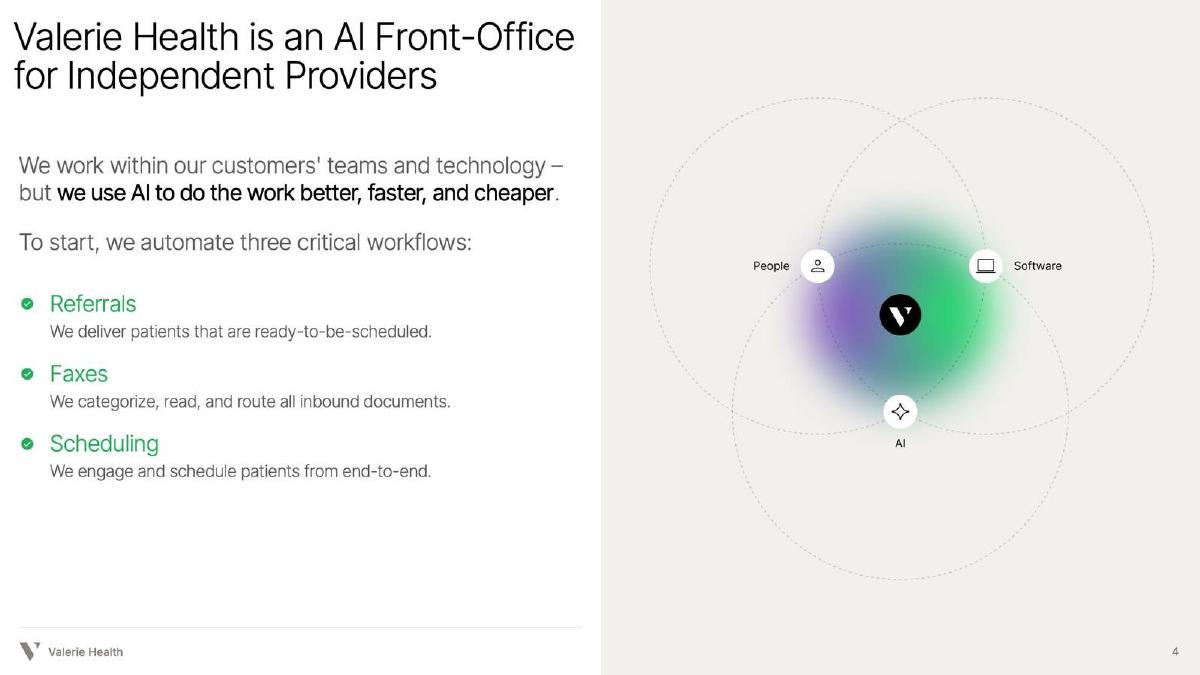
This slide defines the product category. By calling itself an 'AI front-office,' Valerie positions its software as a digital employee capable of handling the high-volume, low-complexity tasks that usually require a large administrative staff. This sets the stage for the ROI argument that follows.
Slide 5: Traction and Momentum
Slide 5 is the 'money slide.' Titled 'It's Working: We Are Tripling Quarter-Over-Quarter,' it features a steep growth curve. Although the Y-axis lacks specific dollar denominations, the X-axis shows a timeline from January 2025 to a forecasted December 2025. The right side of the slide lists 'Marquee Customers,' including Cardiovascular Associates of America, Mindpath Health, and U.S. Renal Care. Listing these specific, large-scale provider groups provides social proof that the product scales beyond small family practices.
Slide 6 & 7: The ROI and Expansion Story
Slide 6 claims the company delivers '5x+ hard ROI.' In healthcare SaaS, 'hard ROI' usually refers to direct labor savings or increased billings. Slide 7 provides the 'Land and Expand' evidence, which is critical for a Series A. It shows Upperline Health growing from 1 location to 50 locations, ENT Partners growing from 1 group to 3 groups, and USHV growing from 10 MDs to 40 MDs. This data proves that once Valerie gets a foot in the door, the customer sees enough value to roll it out across their entire organization.
Slide 8 & 9: Market Opportunity and the PE Wedge
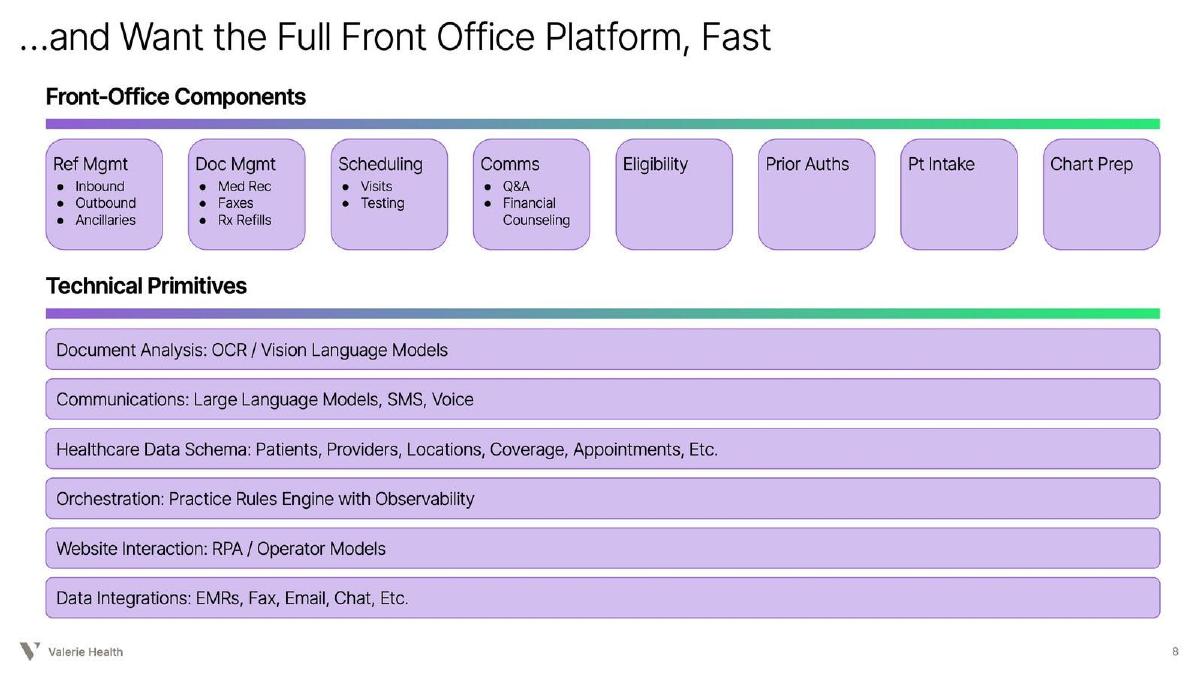
Slide 8 notes that 'Customers want the full front office platform, fast,' suggesting a high 'pull' from the market. Slide 9 quantifies this opportunity. The math is simple and aggressive: 451,000 MDs multiplied by $75,000 ARR per MD equals a $34 billion TAM. Crucially, the slide identifies a 'wedge': Private Equity-backed groups. These groups represent 49,000 providers and a $3.7 billion market. Targeting PE-backed groups is a brilliant strategic move because these groups are incentivized to implement efficiency-driving technology across their entire portfolio to maximize their eventual exit value.
Slide 10 & 11: Execution and Team
Slide 10 focuses on the 'Exceptional tech and ops' that allow the company to build faster than competitors. Slide 11 introduces the founders. Pete Shalek (CEO) is described as a '2x Exited Founder' with experience at Optum and AbleTo. Nitin Joshi (CTO) is the founder of UberHealth with a background at Stripe and Uber. The slide also includes a 'logo farm' of companies where the team and investors have previously worked, including Snowflake, DoorDash, and Oscar. This establishes a 'pedigree' that reduces perceived execution risk.
Slide 12 & 13: The Ask and Closing
Slide 12 states the company is 'Raising $25M.' According to publisher reports, the company actually closed $30M, indicating that the traction shown on Slide 5 and the expansion metrics on Slide 7 were likely enough to create a competitive bidding environment among VCs. Slide 13 is a standard closing slide with the company logo.
What Valerie Health Does Well
Specific Expansion Metrics: Most decks show a generic growth chart. Valerie shows exactly how many locations or MDs they added within specific customer accounts (Slide 7). This is the most honest way to prove product-market fit.
The 'Wedge' Strategy: By identifying PE-backed groups as their primary entry point (Slide 9), they show investors they have a sophisticated go-to-market strategy. They aren't just 'selling to doctors'; they are selling to financial consolidators who control thousands of doctors.
High-Value Pricing Narrative: Estimating $75k ARR per MD (Slide 9) is a bold claim. It suggests that Valerie isn't a cheap utility, but a core piece of infrastructure that replaces or augments significant human labor costs.
What is Missing from the Deck
Competitive Landscape: There is no slide addressing competitors. In the crowded 'AI for Healthcare' space, investors would want to know how Valerie differs from incumbents like Epic or other AI startups focusing on medical billing and scheduling.
Unit Economics: While they claim a '5x hard ROI' for customers, they do not show their own unit economics (LTV, CAC, or Gross Margins). At the Series A stage, investors typically want to see that the cost of acquiring these large provider groups is sustainable.
Implementation Details: Healthcare tech is notorious for long implementation cycles and 'integration hell' with legacy EMRs. The deck mentions 'Exceptional tech and ops' (Slide 10) but doesn't explain how they overcome the technical hurdles of syncing with fragmented medical databases.
Lessons for Founders
Use 'Hard ROI' Language: If you are building B2B AI, don't just talk about 'efficiency.' Use the phrase 'Hard ROI' and be prepared to back it up with labor-replacement or revenue-generation data. Valerie’s 5x claim (Slide 6) is a powerful anchor for valuation discussions.
Quantify Your Expansion: If you have one customer that grew from 1 to 50 units, that is more valuable than 50 customers who only use 1 unit. Highlight the 'Land and Expand' journey visually as Valerie did on Slide 7.
Identify Your Wedge: Don't just show a massive TAM. Show the specific sub-segment (the 'wedge') that you are going to own first. Valerie’s focus on PE-backed groups (Slide 9) makes their $34B market claim feel much more attainable and strategic.
Pedigree Matters in Regulated Markets: In healthcare, 'who you know' and 'where you've been' matters. If your team has exits or experience at major incumbents like Optum or UberHealth, give that information its own dedicated space to build immediate trust with institutional investors.
Frequently asked questions
- What is Valerie Health's specific product offering?
- Valerie Health provides an AI-native front-office platform for independent healthcare provider groups. According to Slide 4 and the UI mockup on Slide 1, the platform automates administrative tasks such as processing incoming faxes, identifying missing patient data, syncing updates to Electronic Medical Records (EMR), and scheduling patient appointments.
- How does Valerie Health calculate its market size?
- On Slide 9, the company presents a bottom-up TAM calculation. They identify 451,000 MDs working in independent groups and estimate an Annual Recurring Revenue (ARR) of $75,000 per MD through front-office automation. This results in a total market opportunity of $34 billion.
- What evidence of 'Product-Market Fit' does the deck provide?
- The deck uses two primary signals: rapid growth and account expansion. Slide 5 shows a chart indicating the company is tripling quarter-over-quarter, while Slide 7 lists specific 'marquee customers' like Mindpath Health and Upperline Health that have significantly expanded their footprint after an initial pilot.
- Who are the founders of Valerie Health?
- The company was founded by Pete Shalek (CEO) and Nitin Joshi (CTO). Shalek is a two-time exited founder with 15+ years in the provider space (Optum, AbleTo). Joshi was the founder of UberHealth and has 15+ years of technical experience at companies like Stripe and Uber (Slide 11).
- What was the result of this fundraising round?
- While Slide 12 of the deck explicitly asks for $25M, publisher reports from Business Insider indicate that Valerie Health successfully raised $30M for its Series A in 2024. This suggests the round was oversubscribed or the target was increased during the roadshow.