Ututi's deck presents a solution for the higher education sector, positioning itself as the next step in the evolution of academic technology—moving beyond simple Learning Management Systems (LMS) like Moodle toward 'Social Software.' The deck outlines a clear freemium model targeting individual teachers at 5 € per month, while offering basic features like news walls and file sharing for free. With a stated break-even goal of September 2012 and a target of 20 universities by 2013, the company demonstrated early traction in Lithuania and Poland. However, the deck lacks critical details on the…
Key takeaways
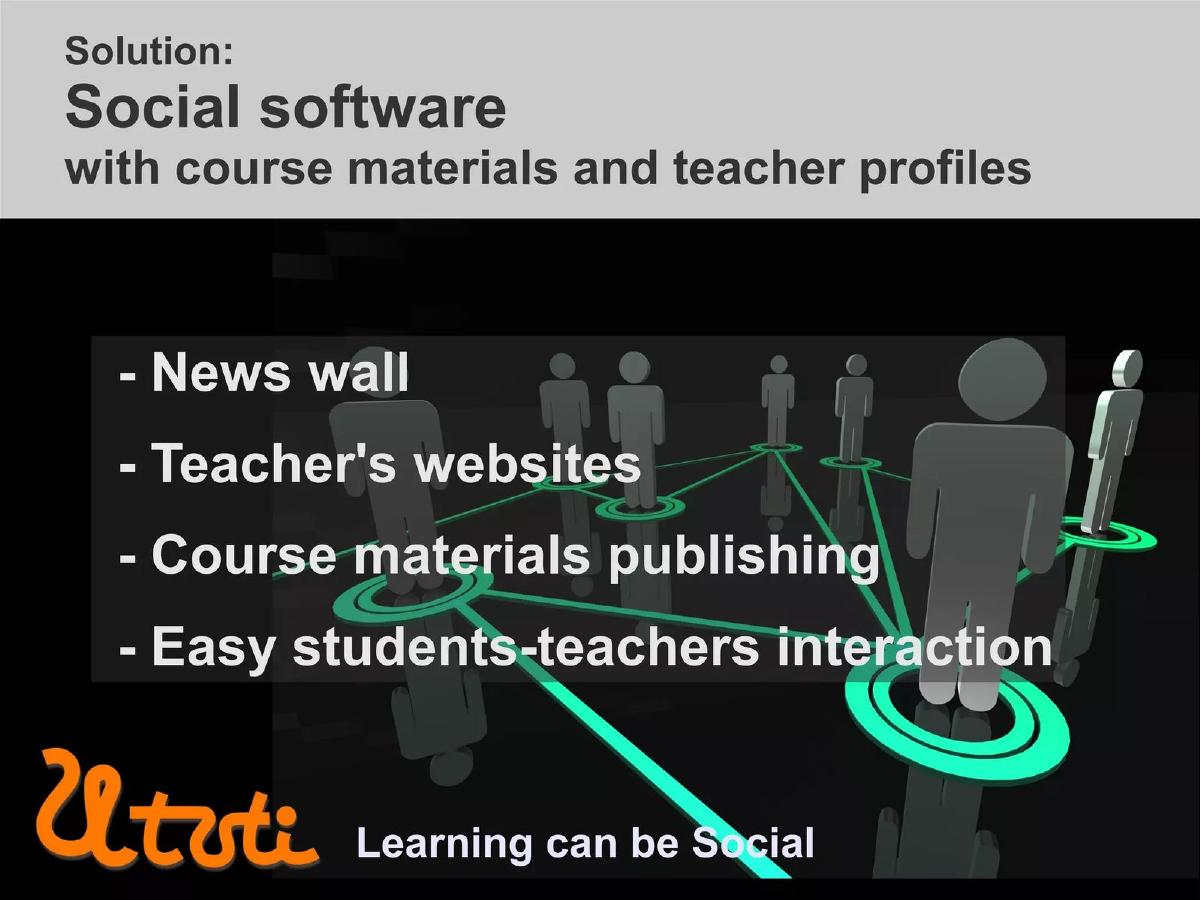
- Ututi defines its product as 'Social software with course materials and teacher profiles' on slide 2.
- The company positions itself at the top of a maturity curve, surpassing Moodle and OpenScholar in terms of social collaboration (Slide 3).
- The business model is a two-tier freemium structure, charging 5 € per teacher per month for premium features like custom branding and Moodle integration (Slide 4).
- Basic users are charged 1 € for mobile app access, while premium users receive it for free (Slide 4).
- Financial projections on slide 5 show a break-even target for September 2012, with operating income expected to significantly outpace expenses by Q3 2013.
- The growth goal stated on slide 5 is to reach 20 universities and 6,000 teachers within the 2013 calendar year.
- Ututi had already secured angel investment and established a presence in Lithuania and Poland by the time of this pitch (Slide 6).
- The deck completely omits a team slide, failing to identify the founders or their relevant expertise beyond a single contact email (Slide 7).
Ututi Pitch Deck Analysis
Ututi represents an interesting moment in the evolution of EdTech, specifically targeting the transition from static Learning Management Systems (LMS) to social learning environments. The deck is concise, focusing on product utility and a straightforward monetization path, though it leaves several institutional investor questions unanswered.
Slide 1: Title and Vision
The cover slide establishes the company's core value proposition: "Tools for creating Social networks for higher education." The visual uses a network graph of human silhouettes, emphasizing connectivity. The branding is simple, with an orange logo that stands out against a dark background. It immediately identifies the target sector (Higher Education) and the product category (Social Networks).
Slide 2: The Solution
Slide 2 defines the product as "Social software with course materials and teacher profiles." It lists four key features: a News wall, Teacher's websites, Course materials publishing, and Easy student-teacher interaction. This slide attempts to bridge the gap between a social media platform (like Facebook) and a functional academic tool. The tagline "Learning can be Social" reinforces the company's underlying philosophy.
Slide 3: Market Trends and Positioning
Ututi uses a maturity curve to position itself against competitors and legacy technologies. The X-axis is labeled "Philosophy, Products" and the Y-axis "Maturity." The curve starts with "Computer + projector" and moves through E-mail, LMS (citing Moodle), Course Publishing (citing OpenScholar), and Online Collaboration (citing PBWorks and Nixity). Ututi places itself at the top of this curve under the banner of "Social Software." This is a classic positioning tactic to show that the market is evolving toward the specific solution the founder is building.
Slide 4: The Freemium Business Model
This is the most detailed slide in the deck, providing a clear comparison between the Basic (Free) and Premium (5 €/teacher per month) tiers. Key differentiators for the paid tier include:
Storage: 5 GB per group vs 200 MB. · Privacy: Controlled access vs public course materials. · Customization: Custom themes and branding. · Integration: Moodle integration (crucial for enterprise adoption). · Mobile: Free mobile apps for premium users, while basic users pay 1 €.
The decision to charge 1 € for the mobile app for free users is a notable micro-transaction strategy, likely intended to cover hosting or development costs for the non-paying user base.
Slide 5: Financial Goals and Projections
The deck presents a bar chart comparing "Operating income" (blue) and "Total Operating Expences" (red) from Q1 2011 to Q3 2013. The chart indicates that the company was loss-making through 2011 and early 2012. A prominent text box declares "Break-even on September 2012." The projections for 2013 show a significant scaling of income, aiming for a goal of "20 Universities and 6000 Teachers." The spelling error in "Expences" is a minor but noticeable detail that could affect professional perception in a formal pitch environment.
Slide 6: Current Traction
Titled "Current situation," this slide provides the "why now" and proof of concept. It states that Ututi has:
Received an angel investment. · Established a presence in Lithuania and Poland. · Signed partnership agreements with the first universities. · Ongoing development of social features.
This slide serves to de-risk the investment by showing that the product is already in market and has achieved some level of institutional validation.
Slide 7: Contact Information
The final slide is a simple contact card held by a hand. It provides an email address (jaro@ututi.com), a Twitter handle (@chompomonim), and a LinkedIn profile (in/jarolt). While it provides a way to reach the founder, it highlights the absence of a proper team slide.
What Works in This Deck
Clear Product Definition: Within the first two slides, the viewer knows exactly what Ututi does and who it is for. There is no jargon-heavy fluff.
Transparent Pricing: The freemium table is excellent. It clearly defines the value of the premium product and shows a realistic path to revenue from individual teachers, which is often an easier entry point than top-down university sales.
Visual Positioning: The maturity curve on slide 3 effectively communicates the founder's view of the market's direction. It frames Ututi not just as a tool, but as the logical next step in educational technology.
What is Missing
The Team: This is the most glaring omission. Investors back people, especially at the early stage. We do not know if the founders are educators, engineers, or career entrepreneurs. The only hint of a person is the "Jaro" mentioned in the contact email.
The Ask: The deck ends without asking for anything. Are they raising a Seed round? A Series A? How much do they need, and what milestones will that money help them reach? Without an "Ask" slide, this feels more like a progress report than a fundraising pitch.
Market Size (TAM/SAM/SOM): While the goal of 6,000 teachers is specific, it doesn't indicate the total size of the opportunity. Investors need to know if this can become a $100M+ revenue business, which requires data on the total number of universities and teachers globally or in their target regions.
Competitive Depth: Slide 3 mentions competitors, but it doesn't explain how Ututi wins against them other than being "more mature." A slide detailing specific feature advantages or user experience wins over Moodle would have been beneficial.
Founder Takeaways
Use a Freemium Table: If you have a tiered pricing model, copy the layout of slide 4. It is clean, easy to read, and immediately explains the monetization strategy.
Show the Break-Even Point: If you are close to profitability, highlighting the break-even month (as seen on slide 5) is a powerful way to show fiscal responsibility and a sustainable business model.
Don't Forget the Team: Never leave out a team slide. Even if your team is small, highlight your relevant experience. In EdTech, having a mix of pedagogical and technical expertise is a significant selling point.
Define the 'Ask': Every pitch deck should have a clear concluding slide that states how much capital you are seeking and what you will do with it. Don't leave the investor guessing about your needs.
Frequently asked questions
- What is the primary problem Ututi is trying to solve?
- Based on slide 3, Ututi identifies a lack of 'maturity' in existing educational tools. It suggests that previous technologies like email, LMS (Moodle), and online course publishing are insufficient for modern needs. Ututi aims to provide a more collaborative, social layer for higher education that integrates course materials with social networking features like news walls and teacher profiles.
- How does Ututi plan to generate revenue?
- Ututi employs a freemium model detailed on slide 4. They offer a 'Basic' version for free, which includes a news wall and 200MB of storage. The 'Premium' version costs 5 € per teacher per month and unlocks 5GB of storage, controlled access, custom branding, user imports, and Moodle integration. Interestingly, they also charge basic users 1 € for mobile app access.
- What is the current traction of the company according to the deck?
- Slide 6 notes that the company has already received angel investment and is operational in Lithuania and Poland. They have signed partnership agreements with their first universities and are actively developing new social features. Slide 5 shows a steady climb in operating income starting from Q3 2011, projecting a break-even point in late 2012.
- What are the biggest omissions in this pitch deck?
- The most significant omission is the 'Team' slide. There is no information regarding who is building the product or their qualifications. Additionally, there is no specific 'Ask' slide detailing how much capital they are looking to raise or how they intend to spend it. The deck also lacks a detailed competitive analysis beyond a single maturity chart.
- Who is the target customer for Ututi?
- The monetization strategy on slide 4 suggests the primary paying customer is the individual teacher (5 €/teacher/month). However, slide 5 and 6 mention goals involving '20 Universities' and 'partnership agreements with first Universities,' indicating a B2B2C approach where they seek institutional buy-in to reach a critical mass of educators and students.