Uthando African Experiences is a travel marketplace aiming to decentralize the African tourism industry by connecting international visitors directly with local experiences and crafts. The deck identifies a lack of access to authentic, non-packaged tours as a primary market pain point. With a target market of 7 million users across five key African nations, the company seeks a $300,000 angel investment to reach 500,000 transactions within 12 months. Their business model relies on a $20 service fee per transaction, projecting $10 million in revenue. While the deck highlights a strong social mi…
Key takeaways
- The company identifies a market gap in fixed-price, packaged African tours that lack a central marketplace for authentic experiences (Slide 2).
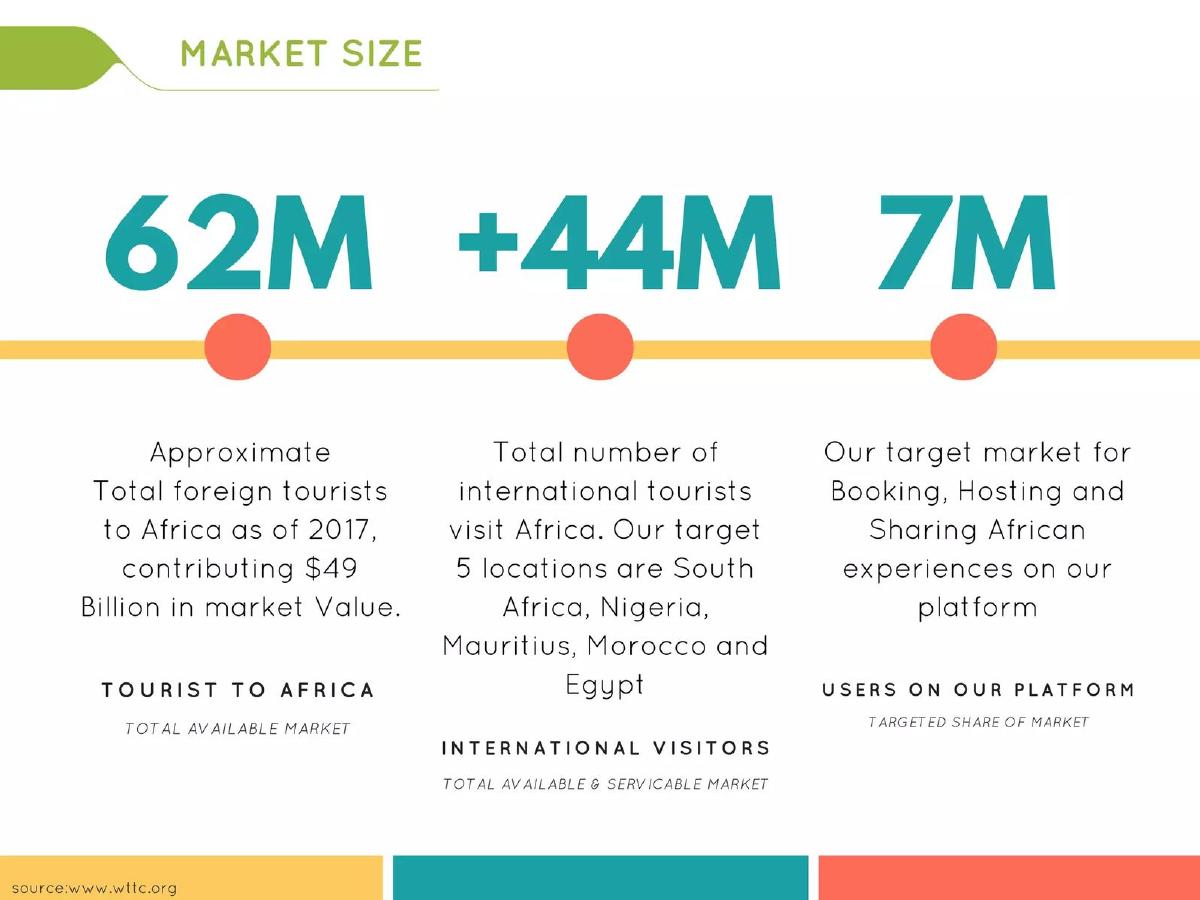
- Uthando targets a total available market of 62 million foreign tourists to Africa, valued at $49 billion as of 2017 (Slide 3).
- The primary geographic focus includes South Africa, Nigeria, Mauritius, Morocco, and Egypt (Slide 3).
- Market validation is drawn from Airbnb's 1.2 million guests in Africa and Travelstart's 1.5 million monthly active users (Slide 4).
- The social mission focuses on empowering 3,000 tribes to share cultural wisdom and fund local education and health facilities (Slide 5).
- The startup is seeking a $300,000 angel round to fund 12 months of operations (Slide 6).
- Revenue projections are based on a $20 service fee per transaction, aiming for $10 million in revenue from 500,000 transactions (Slide 6).
- The platform includes a marketplace for original African art and crafts alongside tour bookings (Slide 7).
Uthando African Experiences: Decentralizing the Safari
The Uthando African Experiences pitch deck presents a vision for a modernized, community-driven tourism sector across the African continent. By moving away from the traditional, rigid 'safari package' model, the company seeks to create a peer-to-peer marketplace that benefits both the traveler seeking authenticity and the local communities providing the experiences. The deck focuses heavily on the social impact and the sheer scale of the African tourism market, though it leaves several operational questions unanswered.
Slide 1: Title and Tagline
The cover slide introduces the brand 'Uthando' with a floral logo and a heart icon. The subtitle, 'Uthando Africa Marketplace,' is supported by the tagline: 'Book and share real African Experiences.' The aesthetic is clean and leans into a lifestyle/travel brand identity rather than a strictly corporate one.
Slide 2: The Problem
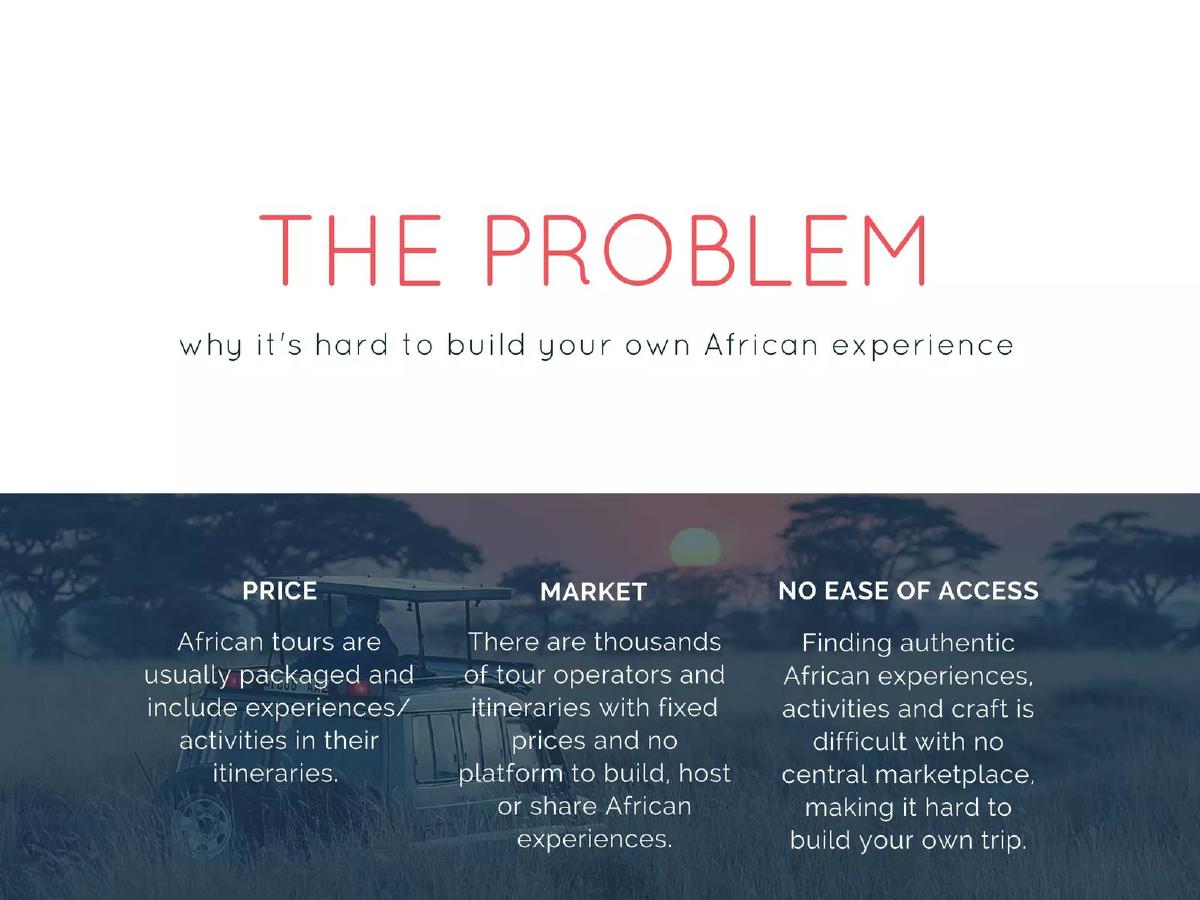
Slide 2, titled 'THE PROBLEM: why it’s hard to build your own African experience,' breaks the market friction into three categories: Price , Market , and No Ease of Access . The slide argues that African tours are typically over-packaged and expensive. It notes that while thousands of operators exist, there is no central platform to 'build, host or share' these experiences, making it difficult for independent travelers to customize their trips.
Slide 3: Market Size
This slide utilizes 2017 data from the WTTC to establish the scale of the opportunity. It cites 62 million total foreign tourists to Africa, contributing $49 billion in market value. The 'Total Available & Servicable Market' is narrowed down to 44 million international visitors across five specific countries: South Africa, Nigeria, Mauritius, Morocco, and Egypt. Finally, the company sets a 'Targeted Share of Market' at 7 million users for booking, hosting, and sharing on their platform.
Slide 4: Market Validation
To prove that a digital marketplace for African travel is viable, Slide 4 points to two major players. First, it notes that Airbnb hosted over 1.2 million guests in Africa in 2017 and offers 90+ experiences in South Africa alone. Second, it cites Travelstart as one of Africa’s largest online travel booking sites, boasting 1.5 million+ monthly active users. This slide serves to show that the digital infrastructure and consumer appetite for online booking already exist in the region.
Slide 5: Community Involvement
This slide highlights the social mission of the startup. It states that Africa is home to 3,000 tribes and that Uthando’s model focuses on empowering these communities. By allowing Village Elders, chefs, and community members to host 'permitted visitors,' the platform aims to generate revenue that can fund 'much need education and health facilities.' The slide includes a graphic of a medical vehicle to reinforce this impact-driven narrative.
Slide 6: The Ask and Financial Projections
Slide 6 is the most data-dense slide regarding the business's future. The company is seeking a $300,000 Angel Round to cover 12 months of financing. The stated goal for this period is to reach 500,000 transactions. With a service fee of $20 per transaction, the company projects $10 million in revenue over those 12 months. This revenue figure also includes commissions from an integrated Arts & Crafts marketplace.
Slide 7: Product Showcase
The final slide in this set shows a mockup of the 'Uthando Africa Marketplace' website. The interface features categories like 'Customized Solo & Group Services' and an 'African Marketplace' for art and crafts. The mockup includes dates from May 2018, suggesting the deck was likely produced around that time. The UI appears to be a standard e-commerce/booking layout, emphasizing visual imagery of the experiences and products offered.
What Uthando African Experiences Does Well
The deck excels at identifying a specific, relatable pain point in the travel industry: the 'package tour' trap. By framing the problem as a lack of access to authenticity, Uthando taps into a major trend in global tourism where travelers increasingly value local connection over sanitized resort experiences. The market sizing is also handled well, using reputable sources like the WTTC to ground the opportunity in reality rather than speculation. Furthermore, the inclusion of a social impact component (Slide 5) makes the pitch attractive to 'double bottom line' investors who look for both financial returns and social good.
What is Missing from the Deck
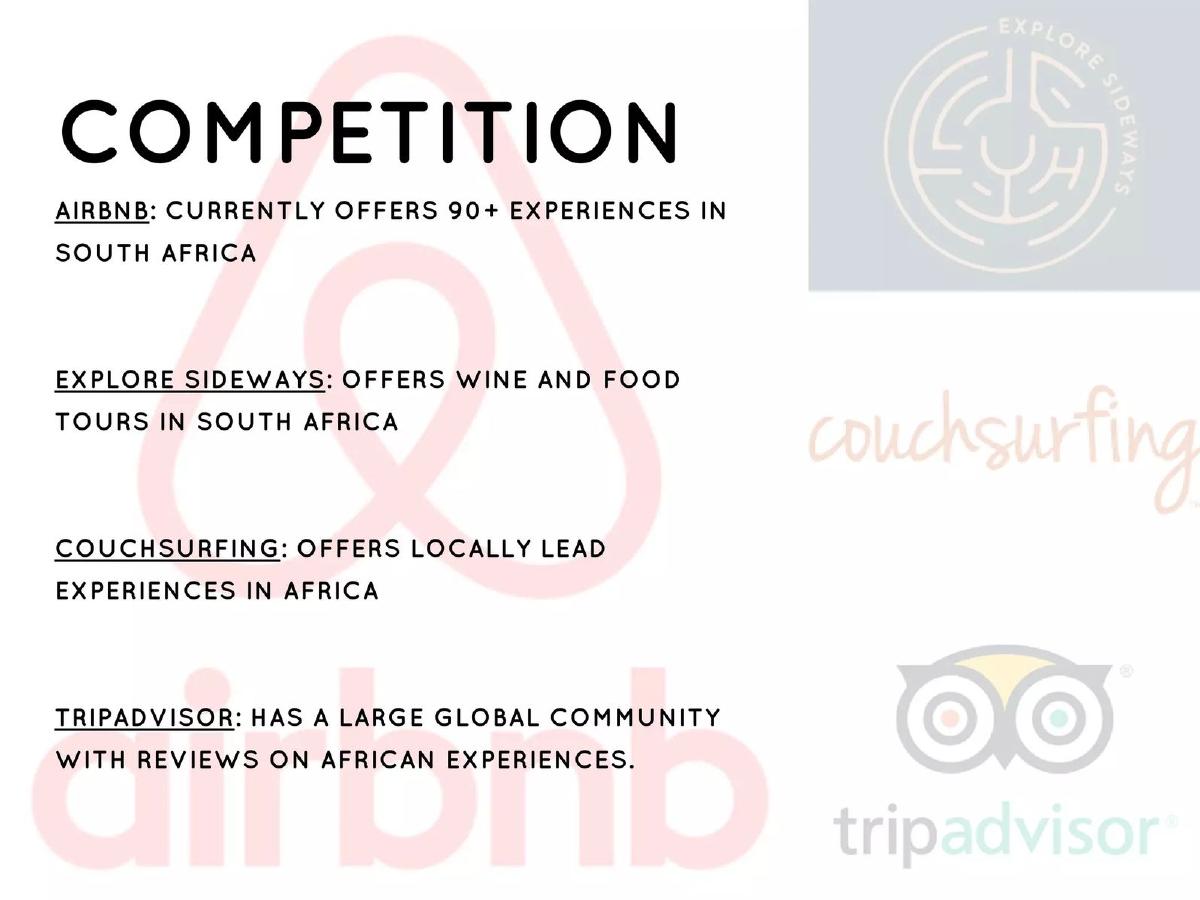
The most glaring omission is the Team Slide . In an angel round, investors are primarily betting on the founders' ability to execute. Without bios, LinkedIn profiles, or a summary of past successes in travel or tech, it is impossible to assess the execution risk. Additionally, the deck lacks a Traction Slide . While it mentions the goal of 500,000 transactions, it does not state how many transactions have been completed to date or how many hosts are currently on the platform. The Competition Slide is also missing; while Airbnb and Travelstart are mentioned as validation, there is no direct comparison of how Uthando's features or pricing beat these incumbents. Finally, the Unit Economics are thin—a $20 flat fee is mentioned, but there is no discussion of Customer Acquisition Cost (CAC) or Lifetime Value (LTV), which are critical for a marketplace business.
Founder's Guide: What to Copy and What to Avoid
Copy the Market Segmentation: Slide 3 is a great example of how to take a massive 'Total Available Market' (62M tourists) and logically narrow it down to a 'Serviceable Obtainable Market' (7M users) based on specific geographic targets. This shows investors you have a focused go-to-market strategy rather than a 'boil the ocean' approach.
Avoid the 'Revenue Leap': Slide 6 projects $10 million in revenue from a $300,000 investment within 12 months. For an early-stage marketplace, a 33x return on investment in year one is an incredibly aggressive claim that may trigger skepticism. Founders should ensure their revenue projections are backed by a clear growth engine (e.g., specific marketing channels) rather than just multiplying a fee by a large, round number of transactions.
Copy the Social Integration: If your business has a social mission, integrate it as Uthando did on Slide 5. They didn't just say 'we help people'; they specified who (3,000 tribes) and how (funding health and education). This specificity makes the impact feel tangible and integrated into the business model rather than an afterthought.
Frequently asked questions
- What is the specific problem Uthando is trying to solve?
- According to Slide 2, the problem is threefold: high prices due to packaged tours, a fragmented market with thousands of operators but no central platform, and a lack of ease of access for travelers looking for authentic African experiences, activities, and crafts.
- How does Uthando plan to make money?
- Slide 6 outlines a transactional revenue model. The company charges a flat $20 service fee for hosting, booking, and sharing experiences. Additionally, they earn commissions from orders placed through their Arts & Crafts marketplace.
- What is the scale of the investment they are seeking?
- As stated on Slide 6, Uthando is looking for a $300,000 angel round. This capital is intended to provide 12 months of financing to help the platform scale to its goal of 500,000 transactions.
- Which regions in Africa is the company targeting?
- Slide 3 specifies five target locations for their initial growth: South Africa, Nigeria, Mauritius, Morocco, and Egypt. These are selected from a broader pool of 62 million international tourists visiting the continent.
- Does the deck provide information on the founders?
- No. The provided slides do not include a team slide, biographies, or any information regarding the founders' backgrounds or expertise in the travel or technology sectors.