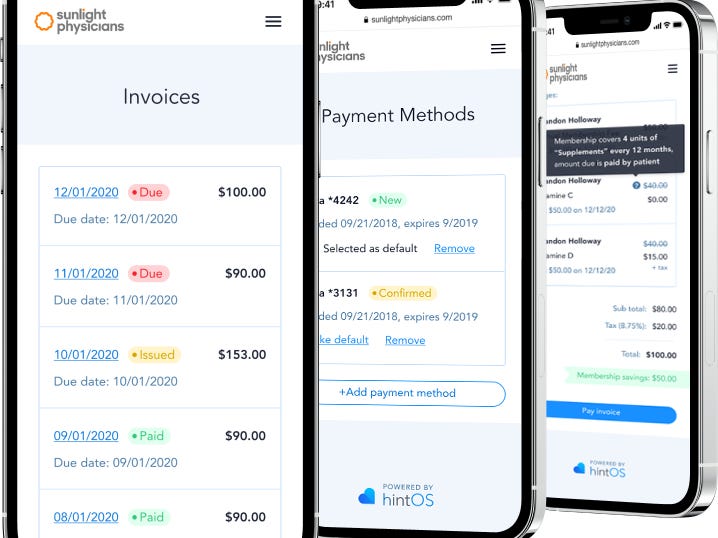
Hint Health's Series B deck is a masterclass in narrative-driven infrastructure pitching. By framing the traditional insurance-based fee-for-service (FFS) model as a 'tapeworm' on economic competitiveness (Slide 2), the company positions its HintOS platform as the essential utility for the growing Direct Primary Care (DPC) movement. The deck excels by contrasting a convoluted 9-step patient journey in traditional care (Slide 4) against a streamlined 3-step DPC experience (Slide 6). Beyond the narrative, the deck provides heavy-hitting proof points: over $1.5B in processed payments, 2,500+ pro…
Key takeaways
- The deck uses a strong emotional hook, labeling the current insurance infrastructure as the 'tapeworm of American economic competitiveness' (Slide 2).
- It visualizes the friction of the status quo through a chaotic 9-step patient journey map involving long waits and hidden fees (Slide 4).
- Direct Primary Care is presented as a simplified $75/month subscription model with no other fees, improving both access and doctor satisfaction (Slide 6).
- Traction is significant, with the platform supporting 2,500+ providers across 1,800+ clinical locations (Slide 8).
- Financial scale is demonstrated by the $1.5B+ in payments processed through the HintOS platform (Slide 8).
- The company showcases elite SaaS fundamentals, specifically a 96% Gross MRR Retention Rate and a 122.7% Net MRR Retention Rate (Slide 12).
- Customer satisfaction is verified by a high Net Promoter Score (NPS) of 71.7 over the last six months (Slide 12).
- The deck introduces 'Hint Connect' as a strategic growth driver to link DPC clinics with employers and health plans (Slide 10).
Executive Summary: The Infrastructure for a Post-Insurance World
Hint Health’s Series B pitch deck, which supported a $45M raise in 2022, is a clinical example of how to pitch a 'movement' alongside a software product. The company provides the operating system (HintOS) for Direct Primary Care (DPC), a model where doctors charge patients or employers a flat monthly fee instead of billing insurance. The deck is structured to first delegitimize the incumbent system before presenting Hint as the inevitable infrastructure for the replacement. With $1.5B+ in payments already flowing through the system (Slide 8) and exceptional retention metrics (Slide 12), the deck moves quickly from a philosophical argument to a proven financial engine.
Slide 1: The Product in Action
The deck opens with a high-fidelity visual of the HintOS platform on mobile devices. It shows a clean interface for 'Sunlight Physicians' featuring invoices, payment methods, and membership savings. By showing a $100.00 invoice with a $50.00 'Membership savings' line item, Hint immediately establishes the value proposition: transparency and direct billing. This slide sets the tone that the product is live, polished, and patient-centric.
Slide 2: The Macro Problem - The 'Tapeworm'
Slide 2 pulls no punches, stating 'Healthcare is Broken Due to the Insurance Fee-For-Service (FFS) Status Quo.' It describes the FFS infrastructure as the 'tapeworm of American economic competitiveness.' The visual shows a concentric ring diagram where the Primary Care Team is buried at the center, surrounded by layers of ancillaries, planned procedures, and unplanned care, all wrapped in the 'Insurance FFS' chassis. The argument is that innovation built on this 'broken chassis' is doomed to fail.
Slide 4: The Patient Journey Friction
To illustrate the 'dismantling of primary care,' Slide 4 maps out a 9-step nightmare for a patient who isn't feeling well. The journey involves calling for an appointment, waiting 90 minutes in a clinic, paying $300 to be seen, driving to a pharmacy, and waiting 30 minutes for a prescription, only to have no follow-up. It ends with a red price tag for 'Insurance-based Care' marked with '$$$' and a warning that 'Co-pays and hidden fees [are] likely.' This slide effectively builds empathy for the patient and frustration with the status quo.
Slide 6: The DPC Solution - Radical Simplicity
Slide 6 mirrors the previous slide but replaces the 9-step chaos with a 3-step DPC journey. Step 1: Text clinician. Step 2: Clinician diagnoses and prescribes meds onsite. Step 3: Clinician texts follow-up. The price tag is replaced with a yellow '$75/mo' tag with the bold declaration: 'NO OTHER FEES.' This contrast is the heart of the pitch, positioning DPC as the 'restoration' of the doctor-patient relationship.
Slide 8: Traction and Scale
Having established the 'why,' Slide 8 provides the 'what.' HintOS is shown to power 'thousands of clinics nationally.' The slide lists logos of prominent DPC practices like Proactive MD and Nextera Healthcare. The bottom of the slide features a heavy-duty metrics bar: 2,500+ providers, 1,800+ clinical locations, $1.5B+ in payments, 15+ networks, 3+ health systems, and 850K+ active lives. These figures prove that Hint is not a niche tool but a market leader in the DPC space.
Slide 10: Hint Connect - The Network Effect
Slide 10 introduces 'Hint Connect,' described as a 'Curated National DPC Network.' The visual is a glowing node-map of the United States. This slide is critical for a Series B pitch because it moves the company beyond a SaaS billing tool and into the realm of a marketplace or network orchestrator. By connecting clinics with employers, Hint creates a moat that is much harder to disrupt than simple billing software.
Slide 12: SaaS Fundamentals and Loyalty
Slide 12 is the 'investor's slide.' It displays a Revenue Cohort Growth chart that shows consistent, layered expansion over time. The specific metrics provided are elite: a 96% Gross MRR Retention Rate and a 122.7% Net MRR Retention Rate. The latter is particularly important, as it indicates that existing customers are growing their usage of Hint significantly over time. An NPS of 71.7 further validates that the 'fiercely loyal customers' mentioned in the headline are a reality, not just marketing speak.
Slide 14: The Vision
The deck concludes its narrative arc on Slide 14 with a simple vision statement: 'To redesign the healthcare system to enable easy access to high quality affordable care.' It is a broad, ambitious goal that aligns with the 'tapeworm' problem identified at the beginning of the deck.
What Hint Health Does Well
The 'Status Quo' Villain: The deck does an excellent job of making the current insurance-based system look absurdly complicated. By using the term 'tapeworm,' they create a visceral reaction that makes the investor want to see the system replaced.
Visual Contrast: The side-by-side comparison of the 9-step insurance journey versus the 3-step DPC journey is the most effective part of the deck. It distills a complex regulatory and financial shift into a simple user experience improvement.
Hard Metrics: Many healthcare startups hide behind 'pilot' data. Hint leads with $1.5B in processed payments and 122.7% Net Revenue Retention. These are 'Tier 1' SaaS metrics that justify a large Series B valuation regardless of the industry.
What is Missing from the Hint Health Deck
Team Background: The provided slides do not include a team slide. For a $45M raise, investors typically want to see the deep healthcare and technical expertise of the leadership team. While the metrics speak for themselves, the 'who' is missing here.
Competitive Landscape: The deck assumes DPC is the only alternative to FFS. It does not address other value-based care models or direct competitors in the DPC software space (like Elation Health or Spruce Health, though they often partner). Investors would likely ask how Hint defends its position against EMRs (Electronic Medical Records) adding billing features.
Unit Economics and Margins: While MRR retention is shown, the deck lacks detail on Customer Acquisition Cost (CAC) or the specific take-rate Hint earns on that $1.5B in payments. Is it a flat SaaS fee per provider, or a percentage of transactions?
The 'Ask': There is no slide detailing how much capital is being raised or how it will be spent. While we know from external reports that this was a $45M round, the deck itself doesn't outline the roadmap for that capital—whether it's for sales expansion, R&D for Hint Connect, or international growth.
Founder Takeaways: Copy These Strategies
Use Cohort Charts: If your retention is good, show the 'layer cake' cohort chart (Slide 12). It is the most honest and persuasive way to show that your product is sticky and that your business grows even without new sales. · Map the 'Before and After': Don't just list features. Map the current user journey (with all its pain) and show how your product deletes steps. The 9-step vs. 3-step comparison (Slides 4 and 6) is a perfect template for any workflow-improvement startup. · Quantify the Ecosystem: Hint didn't just count users; they counted 'Active Lives' and 'Payments' (Slide 8). If you are building infrastructure, show the total volume of activity happening on top of your platform to demonstrate your importance to the industry. · Bridge to a Larger Story: Hint starts with a billing tool but ends with a 'National Network' (Slide 10). Always show how your current product is just the first step toward a much larger, more defensible market position.
Frequently asked questions
- What is the core problem Hint Health aims to solve?
- Hint Health targets the 'broken' insurance fee-for-service (FFS) status quo. As stated on Slide 2, they believe this infrastructure is wrongly used for the majority of healthcare, acting as a drain on economic competitiveness and dismantling the integrity of primary care by introducing excessive friction and hidden costs for patients.
- How does Hint Health define the Direct Primary Care (DPC) solution?
- According to Slide 6, DPC is a model where patients pay a flat monthly fee—illustrated as $75/month—for high-quality, personalized care with no other fees. This allows for direct clinician communication via text, no wait times, and same-day medication delivery, bypassing the insurance billing maze entirely.
- What are the key performance indicators (KPIs) shown in the deck?
- Slide 8 and Slide 12 highlight several KPIs: 2,500+ providers, 1,800+ clinical locations, $1.5B+ in processed payments, 850K+ active lives, a 96% Gross MRR Retention Rate, and a 122.7% Net MRR Retention Rate. They also report an NPS of 71.7.
- What is 'Hint Connect' and why is it important?
- As shown on Slide 10, Hint Connect is a curated national DPC network. It serves as a growth driver by connecting Hint's clinic clients with innovative health plans and employers, effectively moving Hint from a pure software utility to a network orchestrator.
- Does the deck include a team slide or a specific use of funds?
- Based on the 16 slides provided, there is no team slide detailing the founders' backgrounds, nor is there a specific 'Ask' slide or 'Use of Funds' breakdown. The deck focuses primarily on the market shift, product utility, and growth metrics.