The WAVYLLE.com pitch deck introduces a web platform designed to simplify sharing book recommendations. It identifies challenges in choosing books, distrust in reviews, and difficulty sharing personal recommendations as core problems. The proposed solution is a platform where users can recommend books and generate shareable links, aiming to earn a 5% commission on books sold through these links. The deck presents a competitive analysis comparing WAVYLLE.com to Goodreads and BookSloth, highlighting its strengths in easy sharing, personal recommendations, and trusted reviews. However, it lacks…
Key takeaways
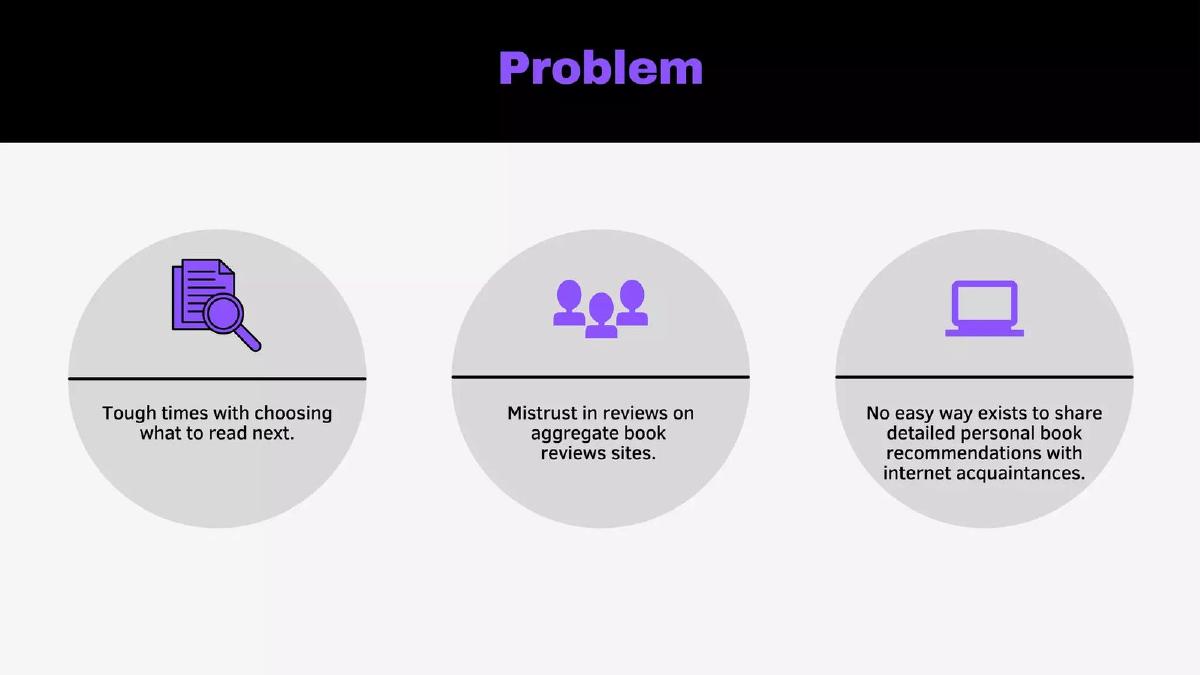
- The deck identifies three core problems: difficulty choosing books, distrust in aggregate reviews, and lack of easy sharing for personal recommendations (Slide 2).
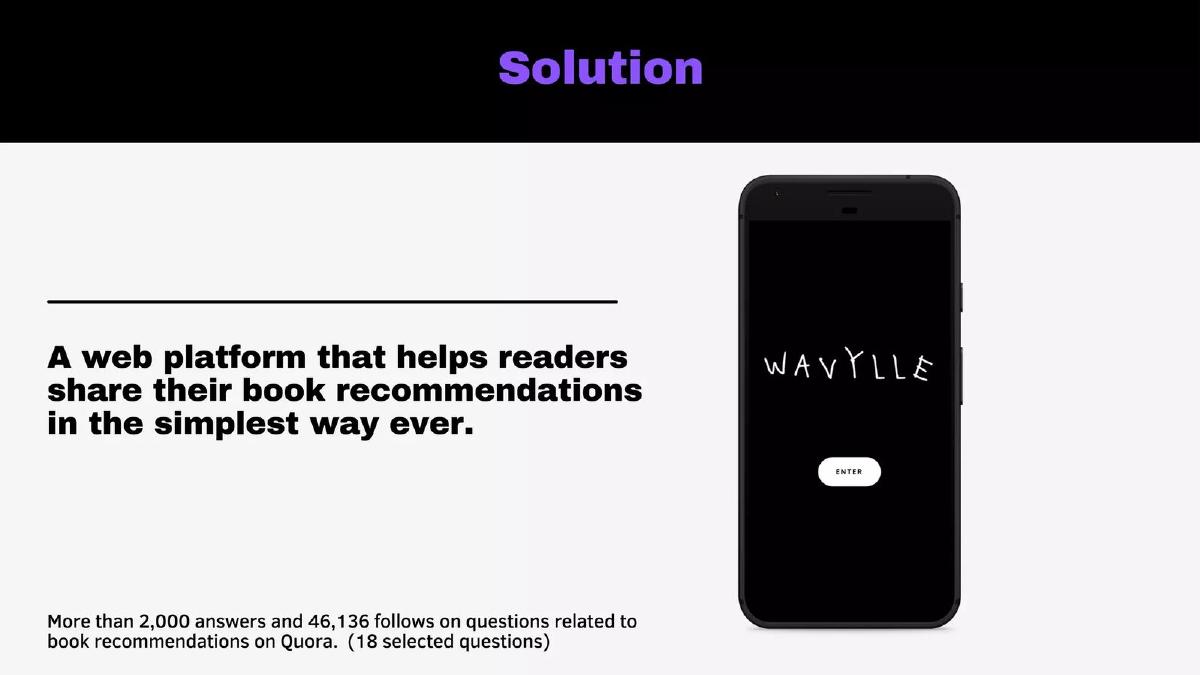
- WAVYLLE.com is presented as a web platform for readers to share book recommendations in 'the simplest way ever' (Slide 3).
- The product workflow involves users recommending a book, receiving a shareable link, and then sharing it (Slide 4).
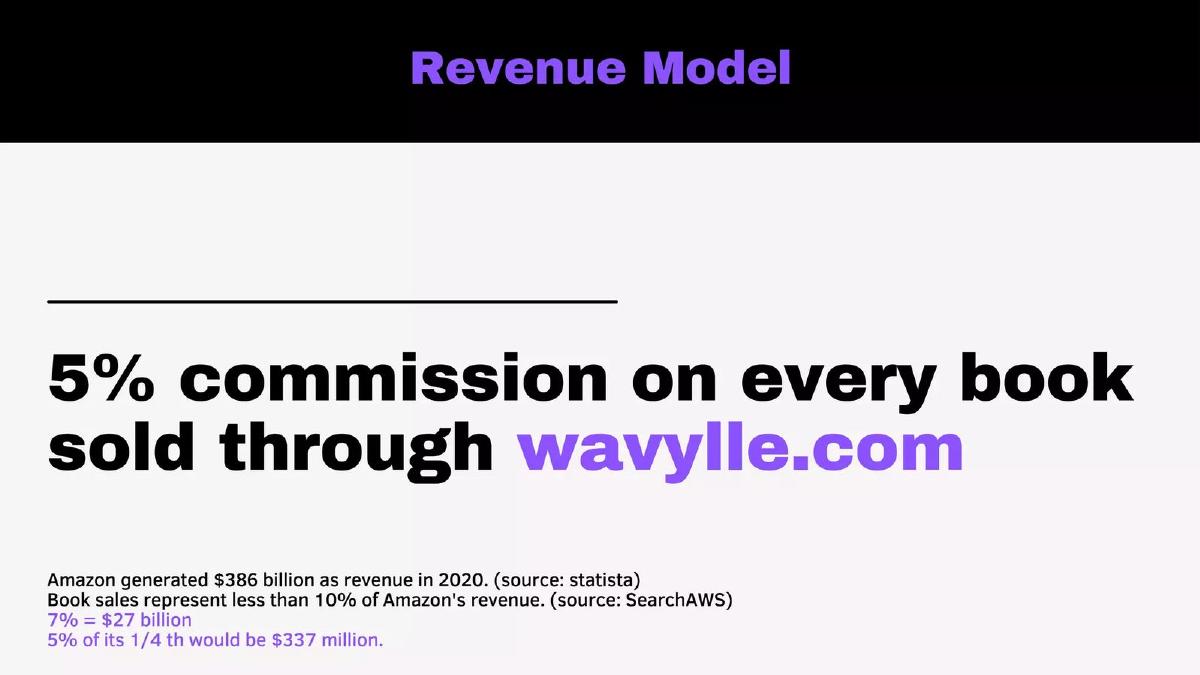
- The revenue model is based on a '5% commission on every book sold through wavylle.com' (Slide 6).
- The deck calculates a potential market of $337 million based on 5% of one-quarter of Amazon's book sales (Slide 6).
- A competitive analysis table compares WAVYLLE.com to Goodreads and BookSloth across four features: Catalogued Data, Easy sharing, Personal recommendations, and Trust in reviews by users (Slide 8).
- Future optimizations include automation, user profiles, custom categories, removing the 'Your Book Recommendation Plug' tagline, and adding used book options (Slide 9).
- The deck does not include a team slide, market size beyond a single calculation, financial projections, or an explicit ask for investment.
WAVYLLE.com Pitch Deck Teardown
This teardown analyzes the pitch deck for WAVYLLE.com, a company positioned as 'Your Book Recommendation Plug.' The deck consists of 10 slides and aims to introduce a platform for sharing book recommendations. The analysis will proceed slide-by-slide, followed by sections on what works well, what is missing, and key takeaways for founders.
Slide 1: Cover
The first slide serves as the cover page for the pitch deck. It features the company name, WAVYLLE.com , prominently displayed in large, bold, white sans-serif font against a black background. Below the company name, in a smaller font, is the tagline: 'Your Book Recommendation Plug.' This slide immediately establishes the company's name and its core offering.
Slide 2: Problem
Titled 'Problem,' this slide outlines three key issues WAVYLLE.com aims to address within the book recommendation space. Each problem is represented by a circular icon with a purple graphic and a brief descriptive text. The problems identified are:
'Tough times with choosing what to read next.' (Icon: magnifying glass over a document) · 'Mistrust in reviews on aggregate book reviews sites.' (Icon: three stylized people) · 'No easy way exists to share detailed personal book recommendations with internet acquaintances.' (Icon: laptop)
This slide effectively uses visuals and concise text to articulate the pain points for potential users.
Slide 3: Solution
The 'Solution' slide presents WAVYLLE.com's answer to the problems previously identified. The main text describes the solution as: 'A web platform that helps readers share their book recommendations in the simplest way ever.' To the right, an image of a smartphone displays the WAVYLLE.com logo and an 'ENTER' button, visually representing the platform. Below the main text, a data point is included: 'More than 2,000 answers and 46,136 follows on questions related to book recommendations on Quora. (18 selected questions).' This statistic attempts to quantify the existing demand or interest in book recommendations.
Slide 4: Product
This slide, labeled 'Product,' illustrates the user flow of the WAVYLLE.com platform through a series of three smartphone screens and connecting arrows. The process is broken down into three steps:
RECOMMEND: The first screen shows a form where a user can input their full name, email address, and details for 'Book 1,' including title, author, and an optional review. A checkbox for data consent is also visible. · WITHIN NEXT 36 HOURS: The middle screen depicts a notification from 'WAVYLLE' stating 'Here's your shareable link, Wavy.' This implies the link generation process. · LET THEM KNOW: The third screen shows a social media profile (resembling Instagram) with a link 'wavylle.com/yournamehere' in the bio section, suggesting how the generated link can be shared.
The slide provides a visual, step-by-step explanation of how the product works from a user's perspective.
Slide 5: After Math
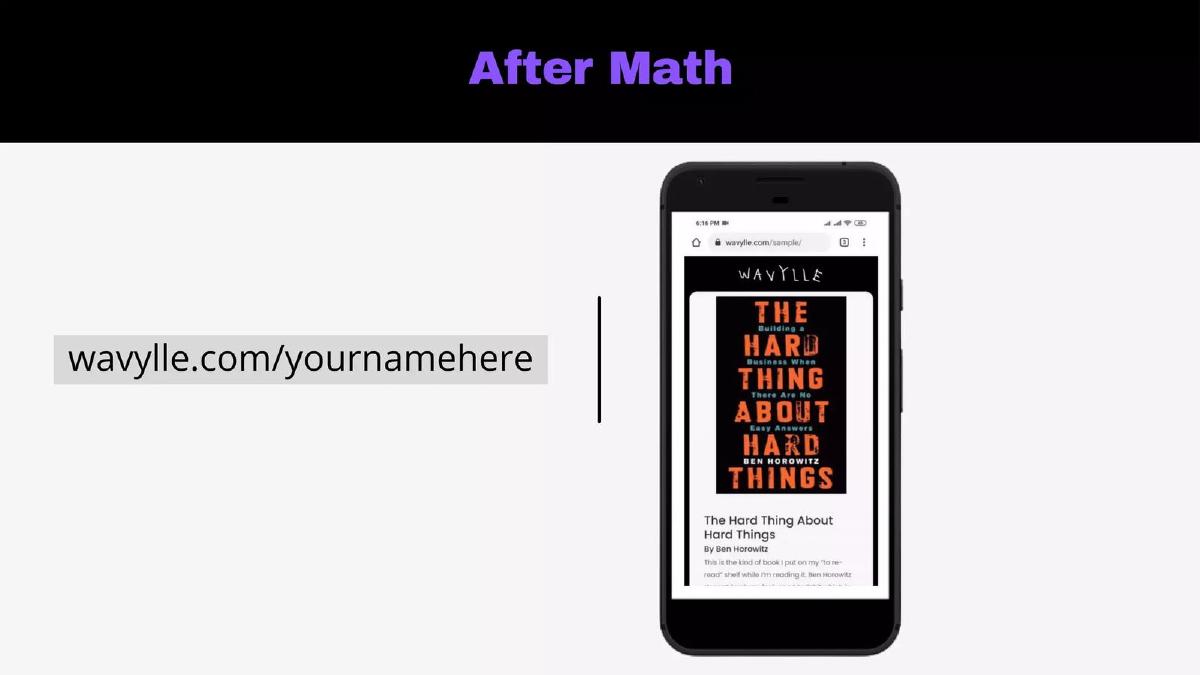
The 'After Math' slide demonstrates the outcome of using the WAVYLLE.com platform. It shows a URL, 'wavylle.com/yournamehere,' prominently displayed next to a smartphone screen. The smartphone screen displays a webpage featuring a book cover ('The Hard Thing About Hard Things') and details about the book, including its title, author, and a short description. This slide clarifies what a shared recommendation link looks like when accessed by another user.
Slide 6: Revenue Model
The 'Revenue Model' slide clearly states how WAVYLLE.com intends to generate income. The core model is presented as: '5% commission on every book sold through wavylle.com.' Below this, some market data and calculations are provided:
'Amazon generated $386 billion as revenue in 2020. (source: statista)' · 'Book sales represent less than 10% of Amazon's revenue. (source: SearchAWS)' · '7% = $27 billion' (This implies an estimation of Amazon's book sales) · '5% of its 1/4 th would be $337 million.' (This calculates a potential market share for WAVYLLE.com)
This slide attempts to quantify the potential revenue opportunity for the business model.
Slide 7: Competition
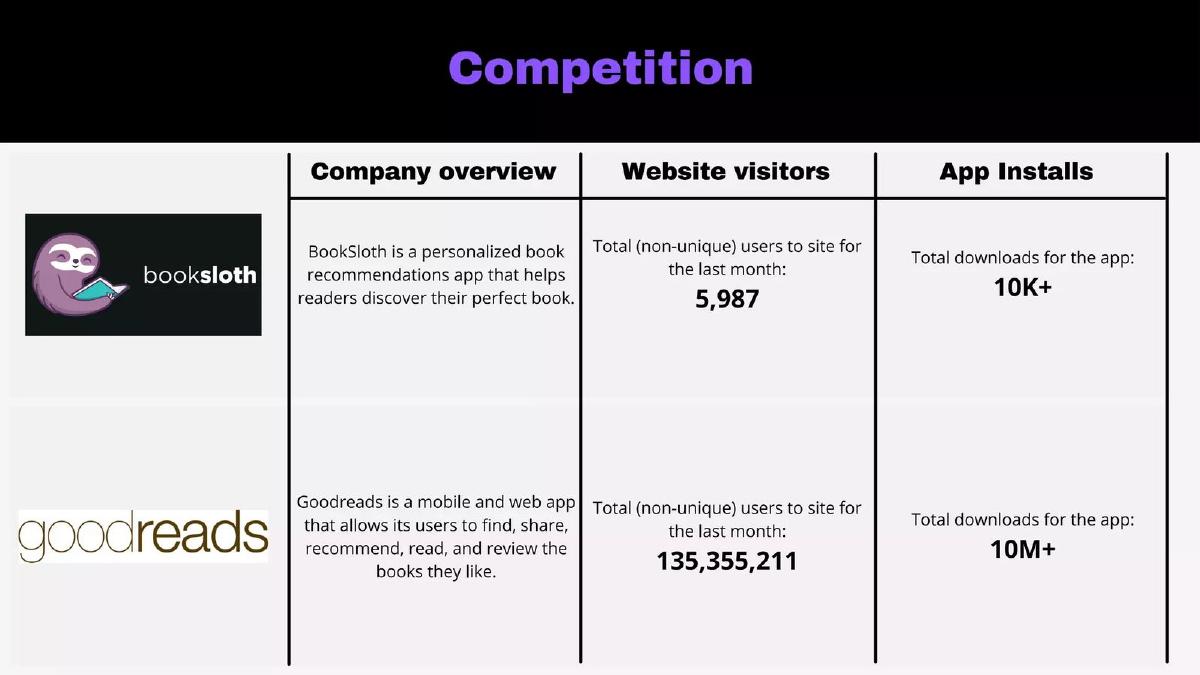
The 'Competition' slide introduces two existing players in the book recommendation space: BookSloth and Goodreads. It presents a table with three columns: 'Company overview,' 'Website visitors,' and 'App Installs.' For each competitor, the following information is provided:
BookSloth: 'BookSloth is a personalized book recommendations app that helps readers discover their perfect book.' Website visitors: 'Total (non-unique) users to site for the last month: 5,987.' App Installs: 'Total downloads for the app: 10K+'. · Goodreads: 'Goodreads is a mobile and web app that allows its users to find, share, recommend, read, and review the books they like.' Website visitors: 'Total (non-unique) users to site for the last month: 135,355,211.' App Installs: 'Total downloads for the app: 10M+'.
This slide provides a quantitative overview of the competitive landscape, focusing on user metrics.
Slide 8: WAVYLLE Vs. Competitors
Following the previous slide, this 'WAVYLLE Vs. Competitors' slide offers a feature-by-feature comparison. It uses a checkmark (✓) or cross (X) system to indicate the presence or absence of certain features for WAVYLLE, Goodreads, and BookSloth. The features compared are:
Catalogued Data: WAVYLLE (X), Goodreads (✓), BookSloth (✓) · Easy sharing: WAVYLLE (✓), Goodreads (✓), BookSloth (X) · Personal recommendations: WAVYLLE (✓), Goodreads (✓), BookSloth (X) · Trust in reviews by users: WAVYLLE (✓), Goodreads (X), BookSloth (X)
This slide aims to highlight WAVYLLE.com's competitive advantages, particularly in 'Trust in reviews by users' and 'Easy sharing' compared to BookSloth.
Slide 9: Future Optimizations
The 'Future Optimizations' slide outlines WAVYLLE.com's plans for platform development. Five distinct future features or improvements are presented with circular icons and brief descriptions:
'Automation of processes' (Icon: gear) · 'User Profiles' (Icon: three stylized people) · 'Custom Categories' (Icon: gear with a star) · 'No more 'Your Book Recommendation Plug'' (Icon: lightbulb) · 'Making used books available as a buying option' (Icon: open book)
This slide gives investors insight into the product roadmap and strategic direction.
Slide 10: Thank You
The final slide is a simple 'Thank You' message. It displays 'Thank You' in large, bold, white text against a black background. Below it, contact information is provided: 'Contact: wavylle@gmail.com.' This slide concludes the presentation and offers a way for interested parties to get in touch.
What Works Well
The WAVYLLE.com pitch deck has several commendable aspects. Firstly, the problem statement on Slide 2 is clear and relatable. The three identified problems—difficulty choosing books, distrust in reviews, and lack of easy sharing—resonate with common frustrations among readers. The use of distinct icons for each problem makes the slide easy to digest and remember. Secondly, the solution on Slide 3 is presented concisely, and the accompanying mobile app visual immediately gives an impression of the product. The Quora statistic, while not a direct market size, attempts to show existing interest in the problem space, which is a good effort to validate demand. The product workflow on Slide 4 is visually intuitive. By showing a step-by-step process with smartphone mockups, the founders effectively communicate how a user would interact with the platform, making the concept tangible. The 'After Math' slide (Slide 5) further clarifies the end result of the product, showing what a shared recommendation looks like. This helps investors visualize the user experience. The revenue model on Slide 6 is straightforward, proposing a commission-based approach, which is common and understandable. The attempt to quantify the market opportunity using Amazon's book sales, while simplified, shows an awareness of potential scale. Finally, the competitive analysis (Slides 7 and 8) is a strong point. Slide 7 provides quantitative data for competitors, while Slide 8 offers a qualitative feature comparison. This two-pronged approach helps investors understand the landscape and WAVYLLE.com's proposed differentiation. The 'Future Optimizations' slide (Slide 9) demonstrates foresight and a clear product roadmap, indicating that the founders have considered the evolution of their platform.
What Is Missing
Despite its strengths, the WAVYLLE.com pitch deck has significant omissions that would be critical for securing investment. The most glaring absence is a dedicated Team slide . Investors primarily invest in people, and without knowing who is behind WAVYLLE.com, their experience, or their relevant skills, it's difficult to assess the team's capability to execute. This is a fundamental component of any pitch deck. Secondly, while Slide 6 attempts to quantify a revenue opportunity, a comprehensive Market Size (TAM/SAM/SOM) analysis is missing. The calculation based on Amazon's book sales is a starting point but doesn't fully define the addressable market for a book recommendation platform. Investors need to understand the total potential scale of the business. Thirdly, there are no Financial Projections . A pitch deck should include a forecast of revenue, expenses, and profitability over the next 3-5 years, demonstrating the company's financial viability and growth trajectory. Fourthly, there is no explicit 'Ask' slide . The deck does not state how much money the company is seeking, what the funds will be used for, or what milestones they expect to achieve with that investment. This leaves investors unsure of the purpose of the pitch. Fifth, the deck lacks information on Traction . While the Quora statistic is a proxy for interest, it doesn't represent actual user engagement or growth on the WAVYLLE.com platform itself. Metrics like user acquisition, engagement rates, retention, or early revenue would be crucial. Lastly, details on Marketing and User Acquisition Strategy are absent. How will WAVYLLE.com attract its initial users and scale its user base? This is vital for a platform-based business.
What a Founder Should Copy
Founders can learn from several aspects of the WAVYLLE.com deck. The clear and concise articulation of the problem statement on Slide 2, using simple language and illustrative icons, is highly effective. This approach ensures that investors quickly grasp the core issues the company aims to solve. The visual presentation of the product workflow on Slide 4 is also excellent. Showing, rather than just telling, how users interact with the platform makes the concept much more tangible and understandable. This visual storytelling is a powerful tool for early-stage companies. The decision to include a competitive analysis with both quantitative and qualitative data (Slides 7 and 8) is another strong element. Providing specific user numbers for competitors, alongside a feature comparison, gives investors a comprehensive view of the market landscape and helps position the company's unique selling propositions. Furthermore, outlining future optimizations (Slide 9) demonstrates a forward-thinking approach and a clear product roadmap, which can instill confidence in the team's vision for growth and development. The simplicity and clean design throughout the deck, with a consistent color scheme and minimal text, also contribute to its readability and professional appearance. These elements collectively contribute to a pitch that is easy to follow and visually engaging, which are important qualities for any fundraising presentation.
Frequently asked questions
- What problem does WAVYLLE.com aim to solve?
- WAVYLLE.com aims to solve three problems: the difficulty in choosing what to read next, the distrust users have in reviews on aggregate book review sites, and the lack of an easy way to share detailed personal book recommendations with internet acquaintances (Slide 2).
- How does WAVYLLE.com generate revenue?
- WAVYLLE.com's revenue model is based on a 5% commission on every book sold through its platform. The deck provides a calculation suggesting a potential market of $337 million based on a fraction of Amazon's book sales (Slide 6).
- What are WAVYLLE.com's key differentiators from competitors?
- According to the competitive analysis, WAVYLLE.com differentiates itself by offering easy sharing, personal recommendations, and fostering trust in user reviews, areas where it marks itself as superior or equal to Goodreads and BookSloth (Slide 8).
- What future plans does WAVYLLE.com have for its platform?
- WAVYLLE.com plans several future optimizations, including automation of processes, user profiles, custom categories, removing its current tagline, and making used books available as a buying option (Slide 9).
- What critical information is missing from this pitch deck?
- The pitch deck notably omits several critical pieces of information for investors, including a slide detailing the team, a comprehensive market size analysis, financial projections, a clear funding 'ask,' and details on current traction or user acquisition strategies.