Waygo (formerly Waigo) utilized a 14-slide deck in 2011 to raise seed capital following its time in the 500 Startups accelerator. The deck is notable for its minimal text and heavy reliance on imagery to establish a visceral sense of 'being lost' in a foreign country. It highlights a patent-pending algorithm capable of real-time, offline visual translation. With a clear revenue model based on trip-length passes ($2.99 for 3 days to $14.99 for unlimited) and a demonstrated 50% monthly growth rate, the deck successfully bridged the gap between a niche utility and a scalable travel tool. The pre…
Key takeaways
- The deck uses a 'show, don't tell' approach, using Slide 2 and 3 to visually overwhelm the viewer with foreign signage before presenting the solution.
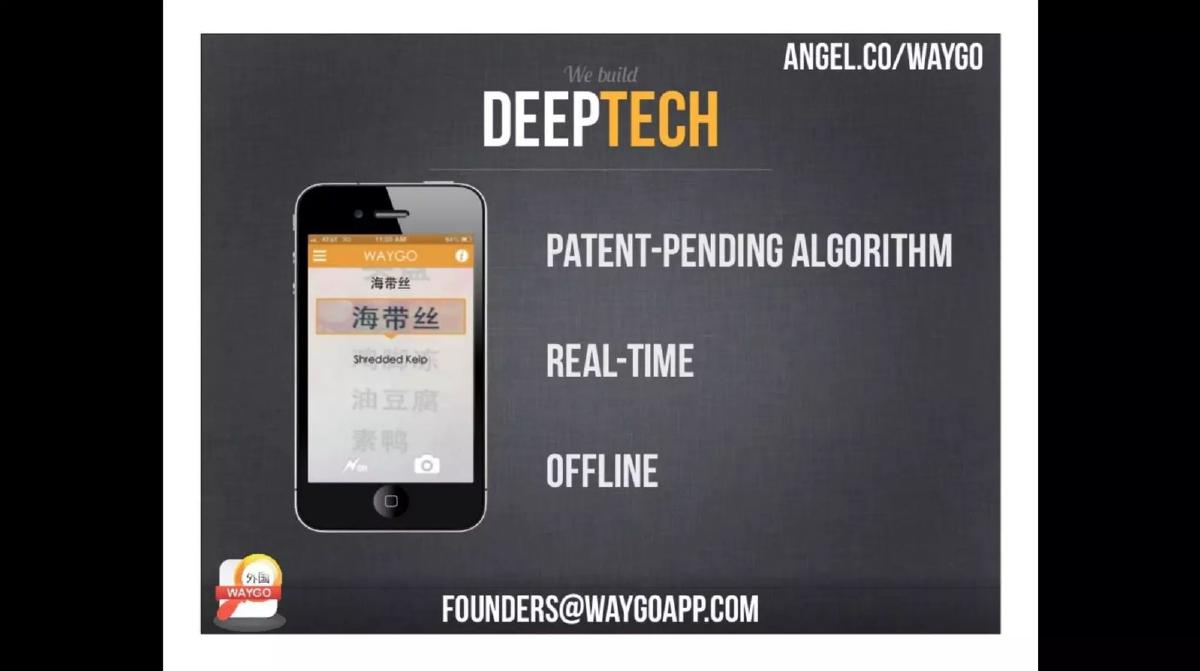
- Waygo emphasizes its technical moat by labeling the product as 'Deep Tech' with a 'Patent-Pending Algorithm' on Slide 5.
- Offline functionality is highlighted as a core competitive advantage on Slide 5, addressing the specific pain point of high roaming costs for travelers.
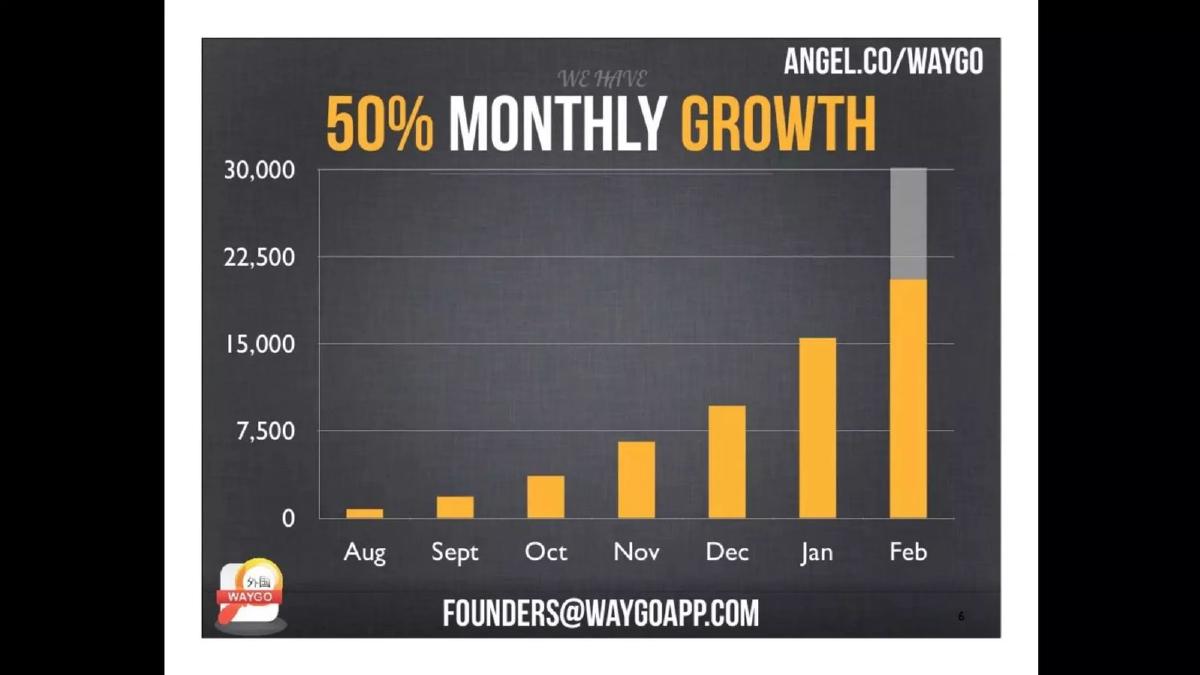
- Traction is presented as a 50% monthly growth rate, with a bar chart on Slide 6 showing a significant jump in February.
- User engagement is quantified on Slide 7, stating an average of 140 translations per week per active user.
- The revenue model is transparently tiered on Slide 9, offering 3-day, 2-week, and unlimited access options.
- The total addressable market is framed as 500 million annual international travelers across six major global regions on Slide 11.
- The fundraising ask is explicitly stated as $500,000 on Slide 14, with $315,000 already committed, creating a sense of momentum.
Introduction: The Power of Visual Context
The Waygo pitch deck from 2011 is a relic of the early mobile utility era, yet it remains a gold standard for how to present a technical solution to a human problem. At just 14 slides, the deck wastes no time on fluff. It follows a classic narrative arc: establish a visceral pain point, present a 'magic' solution, prove technical defensibility, and show market momentum. By the time the investor reaches the final slide, the 'ask' feels like a logical next step rather than a cold request for cash.
Slides 1-4: Establishing the Problem and the 'Magic'
Slide 1 is a standard title slide, introducing 'Waygo Translator' with the tagline 'instant, visual translation on your smartphone.' It sets the expectation for a utility-focused product.
Slides 2 and 3 are perhaps the most effective in the deck. Slide 2 is a full-bleed photograph of a busy street in a Chinese-speaking city, covered in dense, overlapping neon signs and banners. There is no text on this slide. Slide 3 repeats the exact same image but overlays the word 'LOST?' in large, orange block letters. This pair of slides forces the investor to inhabit the customer's shoes. It bypasses intellectualizing the problem and goes straight to the feeling of helplessness a traveler feels when they cannot read their surroundings.
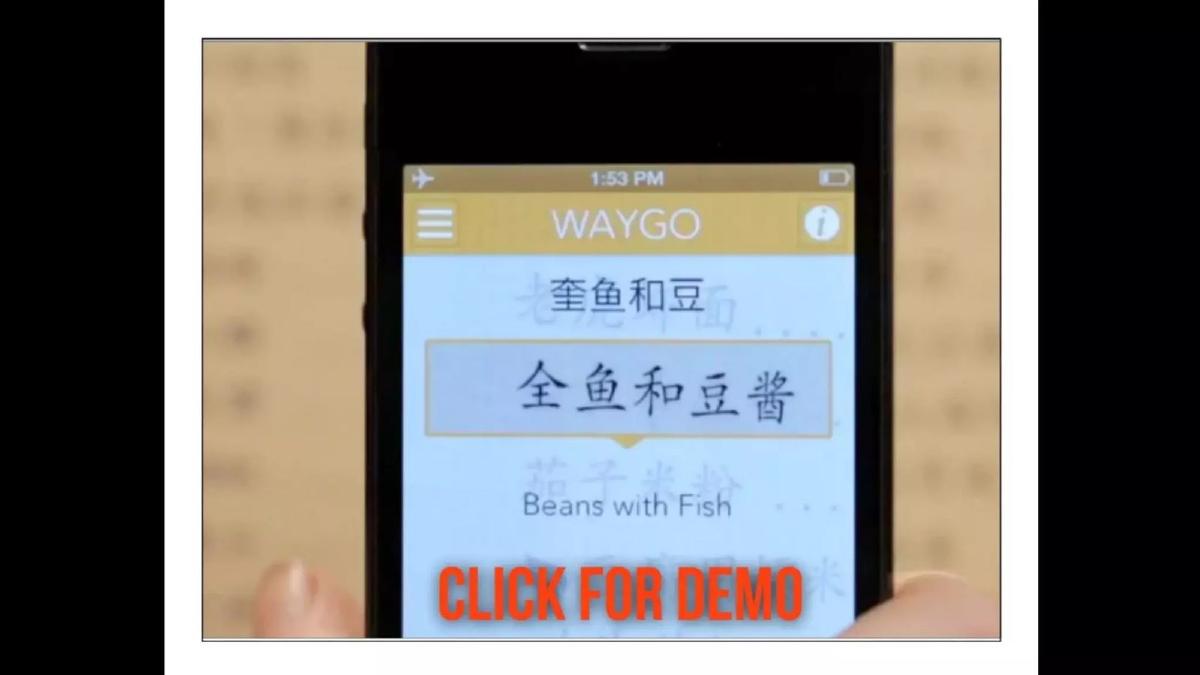
Slide 4 serves as the 'demo' slide. It shows a smartphone screen hovering over Chinese text, with a clear English translation ('Beans with Fish') appearing instantly in a call-out box. The text 'CLICK FOR DEMO' suggests that in a live presentation, this was the moment for a video or a physical walkthrough. This immediate transition from 'Lost' to 'Solved' is the core of the Waygo pitch.
Slides 5-8: Technology, Traction, and Engagement
Slide 5 pivots to the 'how.' Waygo positions itself as 'Deep Tech,' a term used here to justify a higher valuation than a simple wrapper app. The slide lists three key pillars: a 'Patent-Pending Algorithm,' 'Real-Time' processing, and most importantly, 'Offline' capability. In 2011, when data roaming was prohibitively expensive, the offline feature was a massive competitive advantage over tools like Google Translate, which then relied heavily on the cloud.
Slide 6 provides the 'hard' traction data. It features a bar chart showing '50% Monthly Growth' from August to February. While the Y-axis (ranging from 0 to 30,000) doesn't explicitly state if these are downloads or active users, the upward trajectory is steep and consistent. The February bar includes a greyed-out top section, likely indicating projected growth for the remainder of that month.
Slide 7 focuses on 'App Engagement.' The key metric here is 'Average 140 Translations / Week.' This is a high-frequency usage stat that suggests the app isn't just downloaded and forgotten, but used multiple times a day during a trip. The slide also includes a testimonial from Gus Balbontin of Lonely Planet, providing early industry validation.
Slide 8 outlines the distribution strategy. It categorizes partners into 'Done' (English First) and 'Pipeline' (Lonely Planet, American Airlines, and TripIt). This demonstrates that the team is thinking about B2B2C channels to lower their customer acquisition costs.
Slides 9-11: The Business Model and Market Size
Slide 9 is a refreshingly simple revenue model slide. It lists three price points: $2.99 for 3 days , $7.99 for 2 weeks , and $14.99 for unlimited . This pricing strategy is perfectly tailored to the travel use case, allowing the company to monetize short-term users while offering a high-value tier for frequent travelers.
Slide 10 attempts to quantify the immediate opportunity. It shows the Chinese flag multiplied by '10M Annual English Speakers.' This slide is slightly ambiguous—it likely refers to the number of English-speaking travelers visiting China annually, which represents the immediate target market for their first language pair.
Slide 11 expands the vision to the global stage. It cites '500M Annual International Travelers' and displays the flags of China, Japan, South Korea, France, Spain, and the USA. This indicates that while they are starting with Chinese-to-English, the underlying technology is language-agnostic and can scale to any major travel corridor.
Slides 12-14: The Team and The Ask
Slide 12 introduces the four-man founding team: Ryan Rogowski (CEO), Kevin Clark (Product), Huan-Yu Wu (Tech), and Rob Sanchez (Ops). The photos are casual, consistent with the 500 Startups 'hacker' culture of the era.
Slide 13 is a clever cultural nod. It features the Chinese characters for 'Five Hundred Thousand US Dollars' (五十万 美金). This reinforces the company's focus on the Asian market while leading into the final financial slide.
Slide 14 closes the deck with a clear, bold ask: '$500K.' Crucially, it includes a call-out bubble stating '$315K CLOSED.' This is a tactical move to create FOMO (fear of missing out). It tells prospective investors that the round is more than half-full and they need to act quickly to secure the remaining $185,000.
What Works in the Waygo Deck
1. Visual Storytelling: The 'Lost?' slide is a masterclass in establishing a problem. It doesn't use bullet points to explain why not being able to read signs is bad; it shows a confusing image that makes the viewer feel the problem.
2. Clear Monetization: Many early-stage apps struggle to explain how they will make money. Waygo's time-based passes are intuitive and clearly presented on Slide 9.
3. Technical Moat: By emphasizing 'Offline' and 'Patent-Pending,' the deck moves the conversation away from being a 'commodity app' and toward being a 'proprietary technology company.'
What is Missing from the Waygo Deck
1. Competitive Landscape: The deck does not mention Google Translate or other OCR (Optical Character Recognition) competitors. While Waygo's offline capability was a differentiator, a slide acknowledging the competition and why Waygo wins would have added depth.
2. Unit Economics: While we see the price points, we don't see the cost to acquire a customer (CAC) or the lifetime value (LTV). For a utility app, these metrics are vital for proving long-term sustainability.
3. Roadmap Specifics: Slide 11 shows flags for future expansion, but there is no timeline or technical explanation of how they will adapt the algorithm for Romance languages versus character-based languages.
What a Founder Should Copy
1. The 'Social Proof' Ask: If you have already raised a portion of your round, put it on the final slide. Seeing '$315K Closed' makes the investment feel de-risked and urgent.
2. High-Frequency Metrics: Don't just show downloads. Show how often people use the product. Waygo's '140 translations per week' is a much more powerful metric than total installs because it proves utility.
3. Minimalist Design: This deck uses very few words. It relies on images and large-font numbers to convey its points. This keeps the audience focused on the founder's speech rather than reading the slides.
Frequently asked questions
- What is Waygo's primary value proposition?
- Waygo provides instant, visual translation via a smartphone camera. Its primary differentiator, as noted on Slide 5, is that the technology works entirely offline. This is critical for international travelers who may not have access to reliable or affordable data roaming while navigating foreign cities.
- How does Waygo plan to make money?
- According to Slide 9, the company uses a time-based micro-transaction model. Users can pay $2.99 for a 3-day pass (ideal for short trips), $7.99 for a 2-week pass, or $14.99 for unlimited lifetime access. This aligns the cost directly with the duration of the user's travel.
- What evidence of market fit does the deck provide?
- The deck cites 50% monthly growth on Slide 6 and high engagement levels on Slide 7, where users average 140 translations per week. Additionally, Slide 8 lists a partnership with English First (EF) as 'Done' and mentions a pipeline including Lonely Planet, American Airlines, and TripIt.
- Who are the key members of the Waygo team?
- Slide 12 introduces the leadership: Ryan Rogowski (CEO), Kevin Clark (Director of Product), Huan-Yu Wu (Director of Tech), and Rob Sanchez (Director of Business Ops). The catalogue facts note the team had presence in Mountain View, Taipei, and Shanghai.
- What was the specific fundraising goal in this deck?
- Slide 14 explicitly states a fundraising target of $500,000. It also includes a 'social proof' element by highlighting that $315,000 of that round had already been closed, leaving only $185,000 in remaining room for new investors.