Pilota’s 2019 seed deck is a masterclass in identifying a specific, high-friction problem—flight disruptions—and proposing a data-driven solution. The company leverages machine learning to predict delays and proactively rebook passengers on alternate flights for free. Their strategy shifts the burden from frustrated travelers and expensive manual rebooking teams at Travel Management Companies (TMCs) to an automated, predictive platform. With a dual revenue model consisting of a $20 protection fee per flight and a monthly subscription for analytics, Pilota targets an $8B market. The deck benef…
Key takeaways
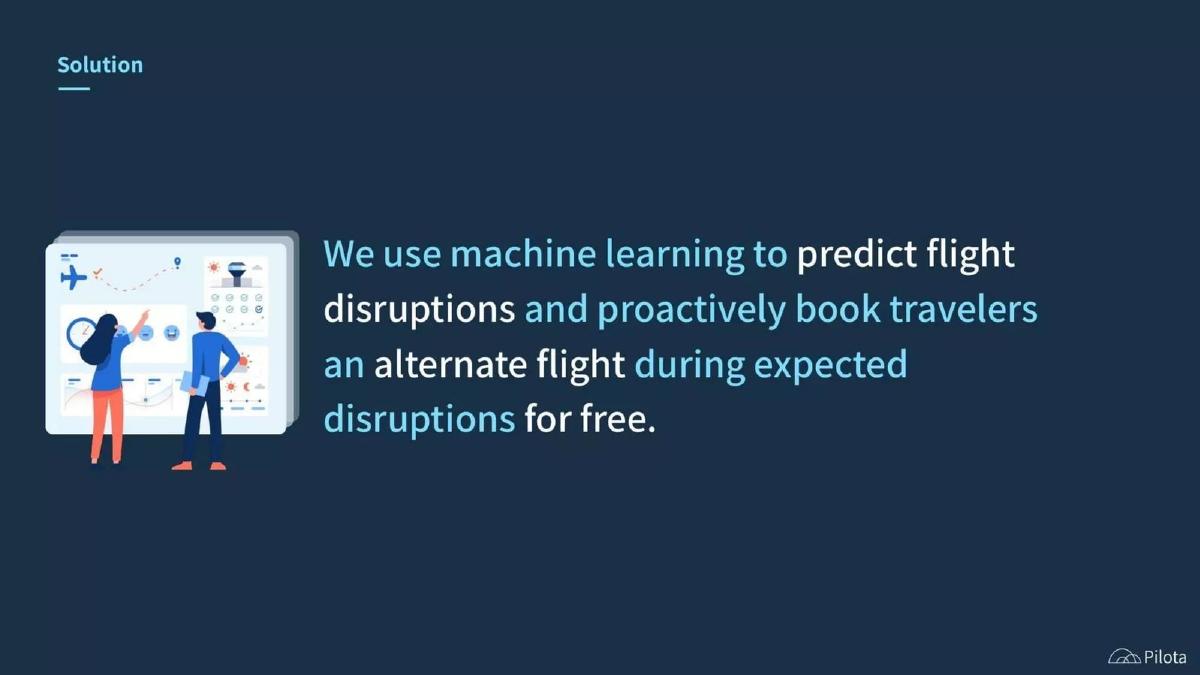
- The core product uses machine learning to predict disruptions and rebook travelers on alternate flights for free (Slide 5).
- Pilota targets Travel Management Companies (TMCs) to solve the high cost of manual flight monitoring and rebooking (Slide 9).
- A single flight disruption costs a client's company an average of $1,200 per employee in lost productivity and rebooking fees (Slide 10).
- The revenue model is two-pronged: a $20 average protection fee per flight and a monthly subscription for analytics (Slide 13).
- The Total Addressable Market for the TMC sector is estimated at $8B, based on 9,386+ US TMCs (Slide 14).
- Future opportunities include expansion into insurance, credit card bundles, and direct-to-consumer services (Slide 15).
- The founding team has deep technical roots, including a licensed pilot and engineering graduates from Cornell University (Slide 17).
- The deck omits a specific funding ask, current traction metrics, and a detailed competitive landscape analysis.
The Hook: A Relatable Travel Nightmare
Slides 1-3: Problem Identification
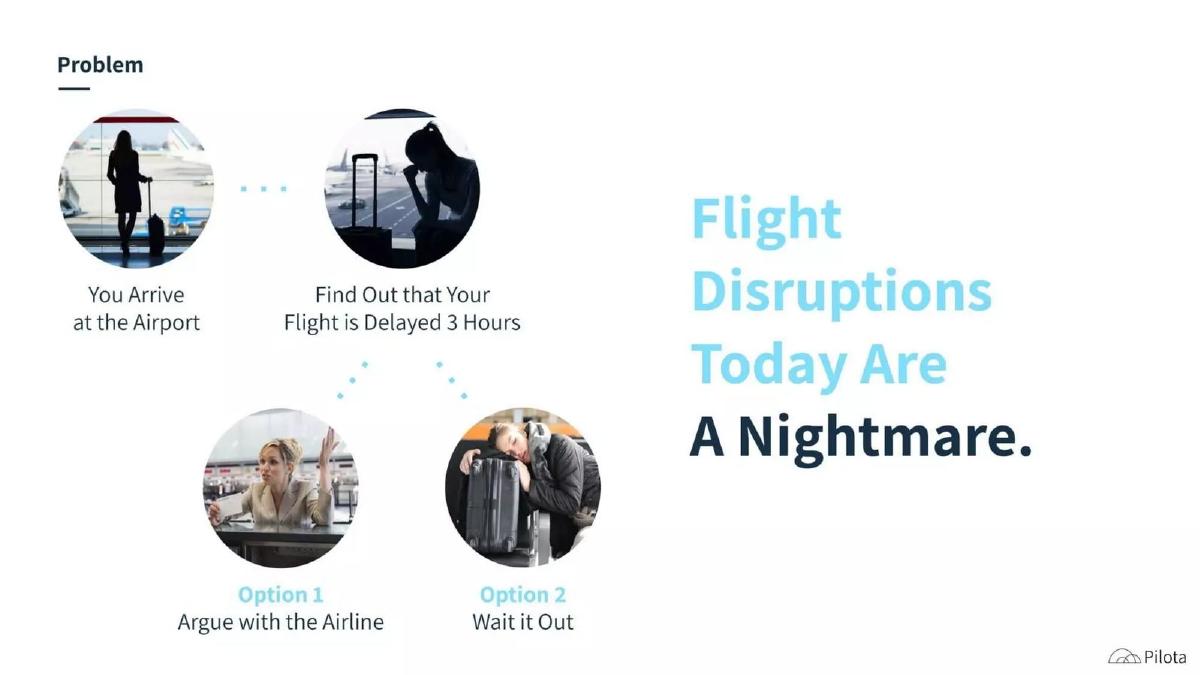
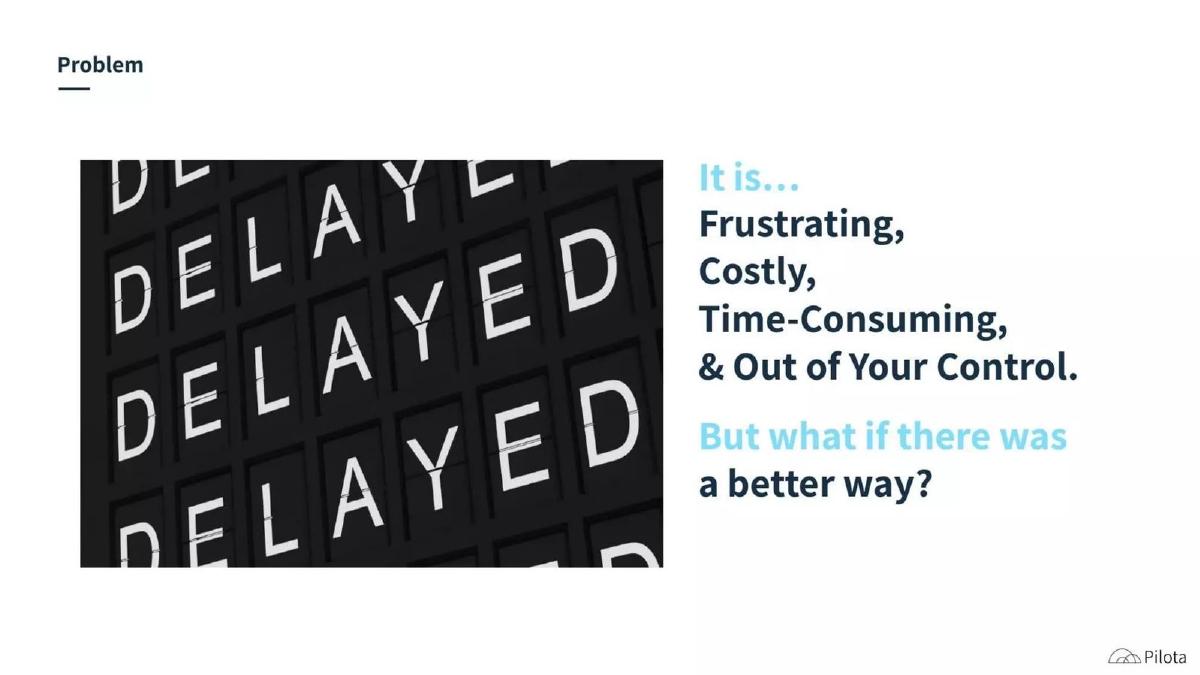
Pilota opens with a clean title slide (Slide 1) stating their mission: "Flight Disruptions, Solved." This immediately sets the stage for a solution-oriented pitch. Slides 2 and 3 lean heavily into the emotional and financial pain of air travel. Slide 2 uses a storyboard approach to show the "Nightmare" of arriving at an airport only to find a three-hour delay, leaving travelers with two poor options: argue with the airline or wait it out. Slide 3 reinforces this with a high-impact visual of a departure board full of "DELAYED" notices, labeling the experience as frustrating, costly, and time-consuming.
The Solution: Predictive Automation
Slides 4-8: Product Walkthrough
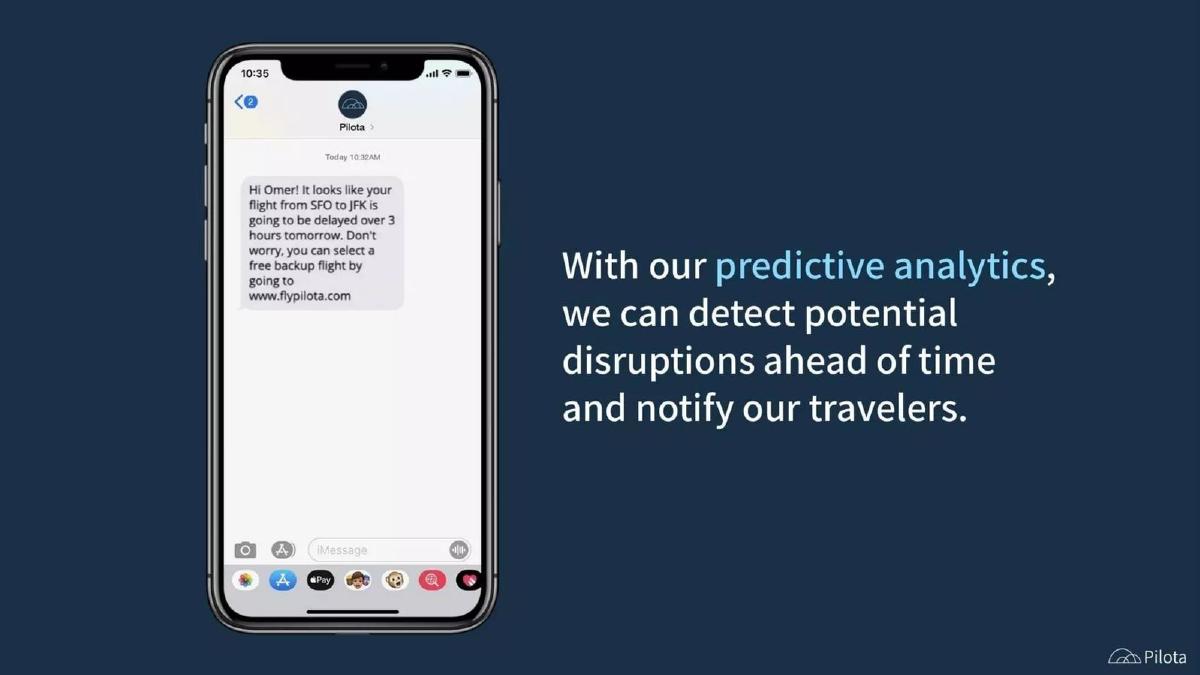
Slide 4 serves as a transition, introducing Pilota as the better way. Slide 5 delivers the core value proposition: using machine learning to predict disruptions and proactively rebook travelers on alternate flights for free. This is a bold claim that shifts the service from a simple notification tool to an active travel agent. Slides 6 and 7 provide a product demo via mobile mockups. Slide 6 shows a text message notification informing a traveler of a predicted delay 24 hours in advance, while Slide 7 shows the rebooking interface where a user can select a new flight from multiple carriers (JetBlue, American, Alaska, Delta) with one click. Slide 8 concludes the solution section with an emotional payoff image of a traveler arriving home on time.
Go-To-Market: The B2B Strategy
Slides 9-10: Targeting the TMC Market
Rather than trying to acquire individual travelers one by one, Pilota targets Travel Management Companies (TMCs). Slide 9 defines TMCs as entities that handle corporate travel, noting there are over 9,386 TMCs in the US averaging 90,000 bookings each. Slide 10 explains the "Why": TMCs currently keep full teams on call to manually monitor flights, which is inefficient. Furthermore, a single disruption costs a client's company an average of $1,200 per employee in rebooking costs and lost productivity. By automating this, Pilota offers a clear ROI to the enterprise.
Competitive Advantage and Revenue
Slides 11-13: The Edge and the Economics
Slides 11 and 12 emphasize the "Proactive Solution." The key differentiator is the ability to get passengers on a new flight prior to the disruption announcement. This allows the traveler to choose the best flight on any airline, whereas airlines typically only rebook passengers on their own subsequent flights. Slide 13 outlines the revenue model: an average $20 Protection Fee per flight and a Monthly Subscription Fee for analytics. This dual-stream approach suggests both transactional and recurring revenue potential.
Market Size and Future Opportunity
Slides 14-15: Scaling the Vision
Slide 14 calculates the Total Addressable Market (TAM) at $8B . This is derived from the number of US TMCs and an assumption of $900k revenue from a single TMC (based on $20 fee x 50% booking capture). Slide 15 looks beyond TMCs, identifying future opportunities with insurance and credit card companies (bundling), airports and airlines (internal operations), and direct-to-consumer services for leisure travelers.
Validation and Team
Slides 16-18: Backing and Pedigree
Slide 16 displays institutional validation, listing 500 Startups, Cornell University, and Dorm Room Fund as backers. Slide 17 introduces the team, highlighting a strong mix of technical and industry expertise. CEO Saniya Shah is a former founder and Cornell MBA; CTO Cyrus Ghazanfar and Head of R&D Kulvinder Lotay bring engineering backgrounds; and Head of Product Omer Winrauke is notably a Licensed Pilot . The presence of advisors from Travelocity and PhDs in operations management adds further weight. The deck ends on Slide 18 with contact information.
What Works in This Deck
Clarity of Value: The deck does an excellent job of explaining a complex machine learning product in simple, human terms. The use of mobile mockups (Slides 6-7) makes the "proactive rebooking" concept feel tangible rather than theoretical.
B2B Focus: By identifying TMCs as the primary customer, Pilota avoids the high customer acquisition costs (CAC) of the consumer travel market. They successfully frame their product as a cost-saving tool for enterprises rather than just a convenience for travelers.
Strong Team-Market Fit: Having a licensed pilot on the product team and technical founders from Cornell provides the necessary credibility to build a predictive engine for the aviation industry.
What Is Missing From This Deck
Traction Data: There are no slides indicating current progress. Investors cannot see if Pilota has run successful pilots, how many flights they have successfully predicted, or if they have any signed Letters of Intent (LOIs) from TMCs.
The Ask: The deck completely omits a funding slide. It is unclear how much money the company is seeking, the valuation, or the specific milestones they intend to reach with the capital.
Competitive Landscape: While the deck mentions that airlines are the "old way," it doesn't address other travel tech startups or legacy flight tracking services (like FlightStats or Google Flights) that might be moving into predictive analytics.
What a Founder Should Copy
The "Option 1 vs Option 2" Framework: Slide 2 is a great way to illustrate the inadequacy of current solutions. By showing that both existing options are bad, you create a vacuum that only your product can fill.
Quantifying the Pain: Using a specific figure like "$1,200 per employee" (Slide 10) for the cost of a disruption gives the sales pitch a concrete anchor. It moves the conversation from "this is a nice tool" to "this is a financial necessity."
Visualizing the TAM: Slide 14 is a strong example of a bottom-up market sizing. Instead of just throwing out a large number, they show the math: (Number of TMCs) x (Bookings) x (Fee) = Market Size. This makes the $8B figure feel earned rather than invented.
Frequently asked questions
- How does Pilota make money?
- According to slide 13, Pilota employs a hybrid revenue model. They charge an average 'Protection Fee' of $20 on a flight-by-flight basis and also offer a monthly subscription fee for access to their predictive analytics platform. This allows them to capture value from both individual transactions and long-term enterprise partnerships.
- Who is the primary customer for Pilota?
- While the service benefits travelers, the deck identifies Travel Management Companies (TMCs) as the primary target. Slide 9 explains that TMCs handle corporate travel needs and currently rely on costly manual teams to monitor flights. Pilota aims to automate this process to save these companies time and money.
- What is the 'unfair advantage' mentioned in the deck?
- The advantage lies in being proactive rather than reactive. Slide 11 notes that by detecting disruptions ahead of time, Pilota can rebook passengers before the airline even makes an official announcement. This allows travelers to avoid the chaos of mass cancellations and choose flights on any airline, not just the original carrier.
- Is there any evidence of institutional support?
- Yes. Slide 16 highlights that Pilota is backed by 500 Startups, Cornell University, and the Dorm Room Fund, along with various angel investors. This provides significant credibility for a seed-stage startup, particularly one coming out of a university ecosystem.
- What key information is missing from this pitch deck?
- The deck is notably missing a 'The Ask' slide, meaning it does not state how much capital is being raised or how it will be used. It also lacks a traction slide showing current user numbers, revenue, or pilot program results, and does not provide a detailed competitor comparison.