Pigment’s 2022 Series B deck is a high-signal presentation that relies heavily on the quality of its early adopters and the clarity of its technical workflow. By showcasing logos like Deliveroo, Gong, and Brex on slide 3, the company establishes immediate market fit among 'decacorns.' The deck follows a logical progression from the 'spreadsheet problem' to a modular solution architecture (Sync, Model, Report). While it lacks traditional financial projections or a detailed 'Ask' slide, the strength of its 90 NPS and 4.75 G2 score serves as a proxy for de-risking the investment. This is a deck…
Key takeaways
- The company highlights a blue-chip customer list including Deliveroo, Gong, Carta, and Brex to establish immediate credibility (Slide 3).
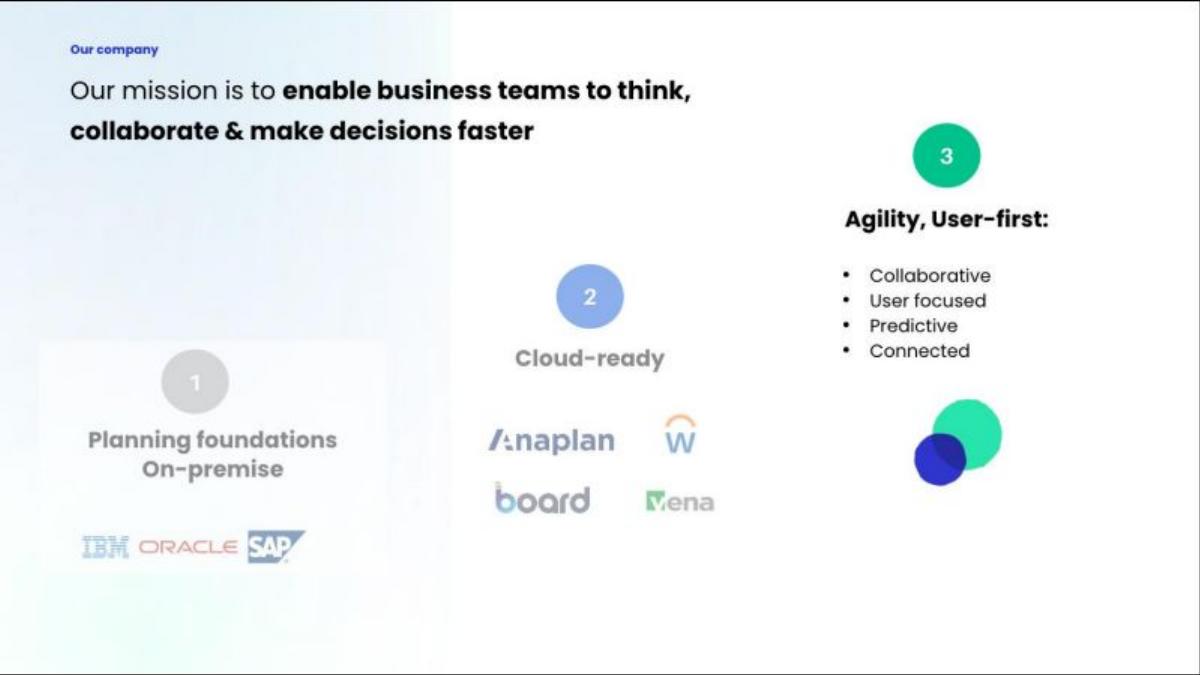
- Pigment positions itself as the third generation of planning, moving beyond on-premise (IBM/Oracle) and first-gen cloud (Anaplan/Workday) (Slide 4).
- The deck uses relatable 'Excel memes' to illustrate the pain points of legacy spreadsheet-based solutions (Slide 5).
- Product architecture is simplified into a three-step process: Sync Data, Model with Pigment Blocks, and Report with Boards (Slides 8-10).
- A 90 NPS and 4.75/5 G2 score are used as primary indicators of customer satisfaction and product quality (Slide 11).
- The deck provides specific functional use cases for P&L variance analysis, headcount planning, and sales capacity (Slides 13-15).
- Founding team pedigree is emphasized, noting experience at Google, Index Ventures, and Criteo (Slide 3).
- The presentation omits a specific funding 'Ask' and detailed financial forecasts, focusing instead on platform capabilities.
Introduction and Mission
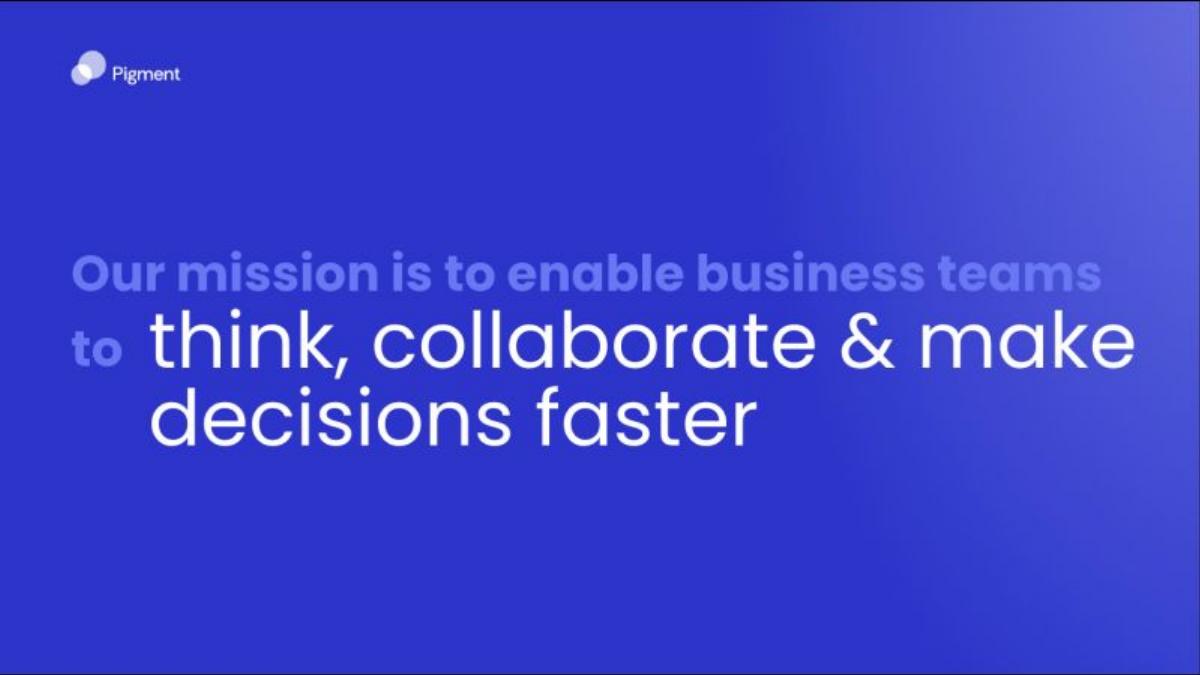
The Pigment Series B deck opens with a minimalist title slide (Slide 1) dated March 2022. It immediately transitions into a high-level mission statement on Slide 2: "Our mission is to enable business teams to think, collaborate & make decisions faster." This sets a broad, strategic tone, moving the conversation away from simple accounting software toward a more holistic decision-making platform.
The Company and Momentum
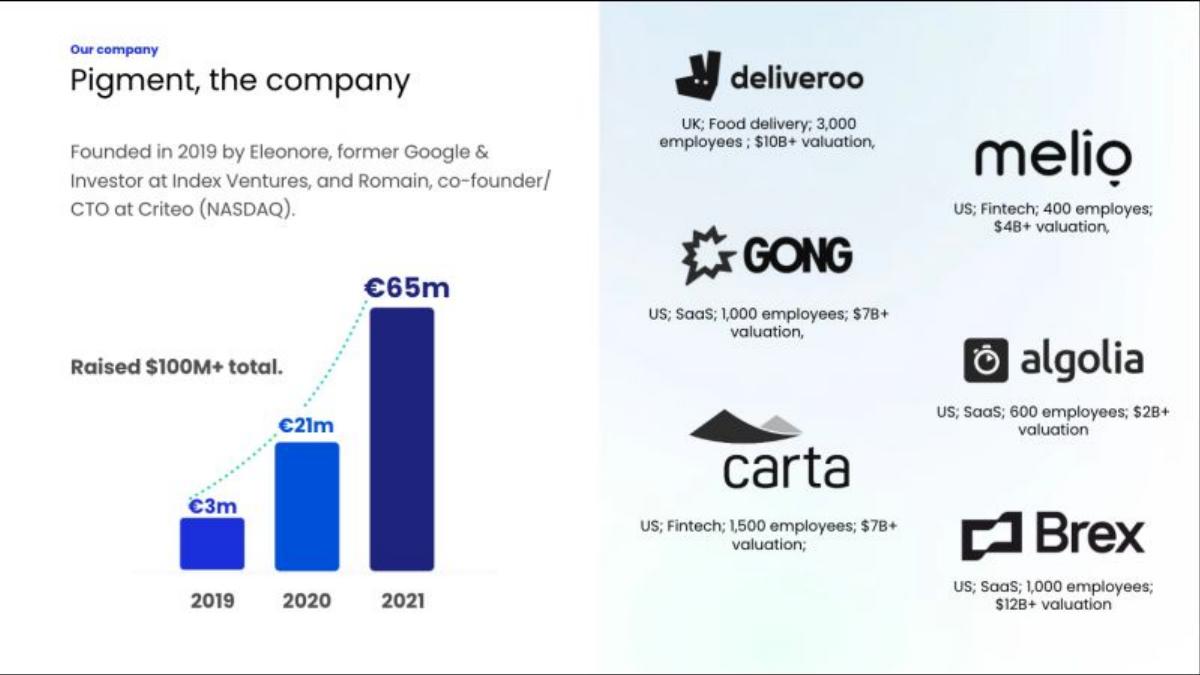
Slide 3 is a dense 'traction and team' slide. It identifies the founders—Eleonore (ex-Google/Index Ventures) and Romain (ex-Criteo)—leveraging their institutional pedigree. The slide also visualizes their funding trajectory, showing a jump from €3m in 2019 to €21m in 2020, and finally €65m in 2021, with a note stating they have "Raised $100M+ total."
The right side of Slide 3 is perhaps the most important part of the deck for a Series B investor. It lists six high-profile 'decacorn' and unicorn customers: Deliveroo ($10B+ valuation), Gong ($7B+), Carta ($7B+), Melio ($4B+), Algolia ($2B+), and Brex ($12B+). By showing that the fastest-growing companies in the world rely on Pigment, the founders effectively bypass the need to prove market validity.
Market Positioning and Problem Definition
Slide 4 provides a sophisticated view of the competitive landscape. Instead of a standard 2x2 matrix, Pigment uses a chronological 'waves' approach. They relegate giants like IBM and Oracle to 'Wave 1' (On-premise). They place current market leaders like Anaplan and Workday in 'Wave 2' (Cloud-ready). Pigment claims 'Wave 3,' which they define as "Agility, User-first." This positioning suggests that even cloud-based incumbents are now 'legacy' compared to Pigment’s architecture.
Slide 5 addresses the 'Status Quo'—spreadsheets. Using memes (including the 'Ref!' seagull and Friends characters), the deck highlights the pain points of Excel: "Models are bespoke, fragile and inaccurate," and "Hard to connect models in real time." This injects some personality into a traditionally dry B2B category while reinforcing a universal frustration for finance teams.
The Solution: Pigment the Platform
Slide 7 introduces the platform's core promise: "The most powerful modeling tool combined with the usability of spreadsheets." It promises to turn a "1x analyst into a 10x analyst." The slide includes a clean UI screenshot and a row of integration logos, including Snowflake, Salesforce, and Tableau.
Slides 8, 9, and 10 use a progressive build to explain the product's three-step workflow:
1. Sync Data: Pulling from spreadsheets and APIs. · 2. Model with Pigment Blocks: Using Transactions, Dimensions, Metrics, and Tables to build the logic. · 3. Report with Boards: Visualizing the data for business performance and sales overviews.
This 'Sync-Model-Report' framework is a clear way to explain a complex technical product to investors who may not be FP&A (Financial Planning and Analysis) experts.
Social Proof and Use Cases
Slide 11 doubles down on customer satisfaction. It features a testimonial from Herut Uval, FP&A Lead at Melio, and highlights two key metrics: a 90 NPS and a 4.75/5 G2 Score. For a Series B company, an NPS of 90 is exceptionally high and serves as a strong indicator of product-led growth potential.
Slides 13, 14, and 15 provide deep dives into specific use cases. Slide 13 shows a "P&L in hours," highlighting automatic data connectors with NetSuite and Salesforce. Slide 14 focuses on "Headcount planning," showing integrations with Workday and BambooHR. Slide 15 covers "Sales Capacity," demonstrating how the tool connects top-down and bottom-up approaches in real time. These slides prove that the platform is not just a general modeling tool but a specialized solution for the most critical departments in an enterprise.
What Works in the Pigment Deck
1. Exceptional Social Proof: By leading with a list of high-growth, high-valuation customers (Slide 3), Pigment proves that they have won the 'early adopter' market of sophisticated tech companies. This is often more persuasive to VCs than raw revenue numbers alone.
2. Clear Product Architecture: The three-step 'Sync, Model, Report' visualization (Slides 8-10) is a masterclass in simplifying a complex B2B SaaS product. It makes the platform feel approachable and logical.
3. Competitive Framing: The 'Three Waves' slide (Slide 4) is a brilliant way to frame the competition. It doesn't just say Pigment is better; it says Pigment is the inevitable next step in the evolution of the industry.
4. Use Case Specificity: Instead of staying at a high level, the deck shows exactly what the product looks like for a P&L, a hiring plan, and a sales forecast. This grounds the 'vision' in practical utility.
What is Missing from the Pigment Deck
1. Financial Projections: The deck is notably silent on future revenue targets, burn rate, or specific growth milestones. While this information was likely in a separate data room, its absence in the main deck is a reminder that this was a product-and-traction-led raise.
2. The 'Ask': There is no slide detailing how much they are raising or how they intend to spend the capital. According to the catalogue facts, they raised $65M, but the deck itself does not state the round size or terms.
3. Unit Economics: There is no mention of CAC (Customer Acquisition Cost), LTV (Lifetime Value), or payback periods. For a Series B, these are usually standard, but Pigment chose to focus on NPS and customer logos as their primary health metrics.
4. Market Size (TAM): The deck assumes the investor already knows that the enterprise planning market is massive. It does not include a traditional 'TAM/SAM/SOM' slide.
What Other Founders Should Copy
1. The 'Logos as Validation' Strategy: If you have high-profile customers, put them on page 3, not page 15. Pigment uses their customers to do the heavy lifting of proving the product works.
2. The Evolution Narrative: Frame your company as the 'next generation' rather than just a 'better version' of what currently exists. Use the 'Waves' approach to make incumbents look dated.
3. High-Fidelity UI: The screenshots in this deck are clean, professional, and look like a finished product. For a tool that sells itself on 'usability,' the UI must look superior to the 'Wave 1' and 'Wave 2' competitors.
4. Focus on NPS: If your revenue is still scaling but your users love you, highlight your NPS. A 90 NPS is a 'screaming' signal to an investor that you have built something people actually want to use.
Conclusion
The Pigment Series B deck is a lean, high-signal document. It avoids the fluff of traditional 'market opportunity' slides and focuses entirely on three things: who is building it, who is using it, and how it works. By the time an investor reaches the 'Thank You' slide (Slide 16), the narrative is clear: Pigment is the modern standard for planning, validated by the world's most successful startups.
Frequently asked questions
- What is Pigment's core value proposition according to the deck?
- Pigment positions itself as 'the most powerful modeling tool combined with the usability of spreadsheets.' According to slide 7, the platform aims to turn a '1x analyst into a 10x analyst' by enabling better collaboration and data synchronization across the organization.
- How does Pigment differentiate itself from competitors like Anaplan?
- Slide 4 categorizes competitors into three waves. Wave 1 is on-premise (IBM, Oracle, SAP). Wave 2 is 'Cloud-ready' (Anaplan, Workday, Board, Vena). Pigment claims the Wave 3 spot, defined by being 'Agility, User-first,' collaborative, predictive, and connected.
- What specific integrations does the platform support?
- The deck explicitly lists and shows logos for several integrations across slides 8 and 13-15, including NetSuite, Salesforce, Workday, BambooHR, Personio, Snowflake, and Google Sheets.
- Who are the founders and what is their background?
- As stated on slide 3, the company was founded in 2019 by Eleonore (former Google and Investor at Index Ventures) and Romain (co-founder and CTO at Criteo, which is a NASDAQ-listed company).
- What metrics are used to prove traction in the Series B deck?
- Rather than focusing on ARR growth rates, the deck emphasizes capital raised (€65m in 2021), a total of $100M+ raised to date, and a high-quality customer base of high-valuation startups. It also highlights a 90 NPS and 4.75/5 G2 score on slide 11.