PilotDesk’s 14-slide deck, which secured a $3M Seed round in 2024, is a study in minimalist B2B SaaS positioning. The company targets the labor-intensive ad operations sector, offering a no-code AI platform to automate repetitive tasks. Rather than relying on dense technical diagrams, the deck uses a modular product framework—branding specific automation functions as 'Pilots'—to demonstrate versatility across the advertising ecosystem. While the deck is notably light on competitive analysis and financial projections, it excels at defining an Ideal Customer Profile (ICP) that spans streaming c…
Key takeaways
- The deck defines the company as a 'no-code AI workflow automation platform' specifically for ad operations (Slide 3).
- A modular product strategy is employed, categorizing features into five distinct 'Pilots' like YieldPilot and TrafficPilot (Slide 6).
- The value proposition centers on ending repetitive tasks to allow account managers to focus on revenue-generating projects (Slide 2).
- The platform is positioned as highly scalable, claiming to work for organizations ranging from one to one thousand people (Slide 5).
- PilotDesk explicitly targets 'mature and complex' ad businesses with large teams, rather than small-scale advertisers (Slide 7).
- The deck omits a traditional 'Team' slide, which is unusual for a successful $3M Seed raise (Slides 1-14).
- There is no mention of current revenue, user growth metrics, or specific case study data in the provided slides (Slides 1-14).
- The 'Vision' slide emphasizes the dual benefit of increasing advertiser performance while simultaneously reducing costs (Slide 2).
Introduction
PilotDesk entered the 2024 fundraising market with a clear, albeit minimalist, pitch for the adtech sector. Raising $3M for a Seed round in a year where AI hype often overshadowed actual utility, PilotDesk focused on a very specific pain point: the high operational overhead of managing complex advertising campaigns. The deck, consisting of 14 slides, avoids the common pitfall of over-explaining the underlying AI models, instead focusing on the workflow outcomes for the end user.
Slide 1: Title Slide
The deck opens with a clean, branded title slide featuring the PilotDesk logo—a stylized set of overlapping translucent squares in purple and green. There is no tagline or subtitle on this initial slide, keeping the focus entirely on the brand identity. The copyright date at the bottom indicates the materials were developed in 2023, leading into their 2024 raise.
Slide 2: The Vision
Slide 2 establishes the 'Why' of the company. It defines the vision as ending repetitive tasks for ad operators and account managers. The strategic goal stated here is to 'Unlock the ability to focus on what matters,' which they define as increasing revenue/performance and reducing costs. This is a standard but effective 'Efficiency Play' narrative, positioning the software as a tool for liberation from drudgery.
Slide 3: The Definition
This slide provides the 'What.' It defines PilotDesk as 'A no-code AI workflow automation platform for ad operations and account management.' By using the terms 'no-code' and 'AI' in the same sentence, the company signals to investors that their product is both modern (AI-driven) and accessible (no-code), reducing the friction for adoption within non-technical agency departments.
Slide 4: Value Proposition - Time
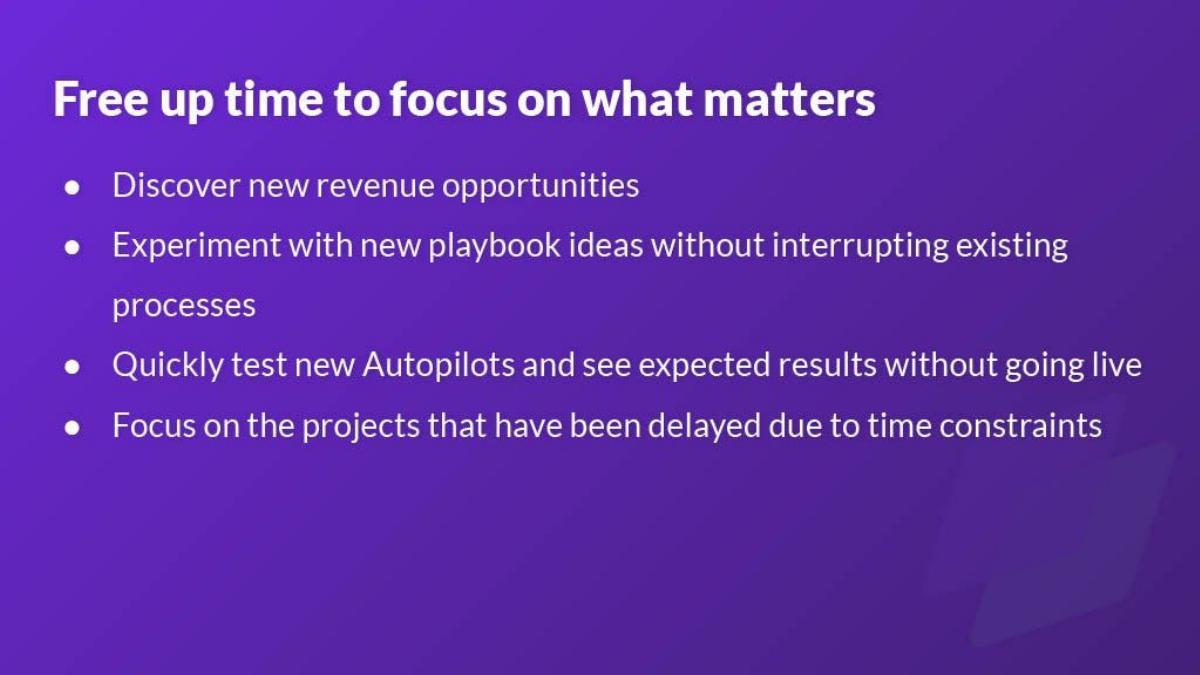
Titled 'Free up time to focus on what matters,' this slide lists four bullet points that expand on the vision. It mentions discovering new revenue opportunities and experimenting with new 'playbook ideas' without interrupting existing processes. Notably, it introduces the term 'Autopilots,' suggesting a feature where users can test automation results before going live, which addresses a common fear in ad-ops: that an automated error could lead to massive budget waste.
Slide 5: Product Characteristics
Slide 5 outlines the core attributes of the platform: Intuitive, No code, Self-serve, and Completely customizable. The most significant claim on this slide is that the platform 'Scales for an organization of one or one thousand.' This suggests a horizontal scalability that appeals to both boutique agencies and the enterprise-level 'Agency Holding Companies' mentioned later in the deck.
Slide 6: The Modular Approach
This is arguably the most important slide in the deck. It breaks down PilotDesk into five distinct 'Pilots':
YieldPilot: Automated publisher yield optimization. · TrafficPilot: Automated trafficking from CRM to downstream platforms. · OptiPilot: Automated direct and programmatic demand optimization. · AnalyticsPilot: Automated account management tasks (emails, presentations). · AlertsPilot: Automated alerts for any ad ops action.
This modularity is a clever sales and fundraising tactic. It suggests that the company can land and expand within a client, starting with one 'Pilot' and eventually automating the entire department.
Slide 7: Ideal Customer Profile (ICP)
Slide 7 is highly specific about who the product is for. It targets 'mature and complex' ad businesses with 'large ad ops' teams. The industries listed include streaming companies, OEMs, agency holding companies, adtech platforms, and digital agencies. By explicitly stating a desire to help clients 'flatline opex,' PilotDesk is speaking directly to the CFOs and COOs of these large organizations who are looking to scale revenue without a linear increase in headcount.
Slides 8-14: Omissions and Structural Notes
While the text for slides 8 through 14 was not provided in detail beyond the company name, the absence of key slides in the primary narrative flow is worth noting. In the provided sequence, there is no dedicated Team slide, no Competition slide, and no Financials/Ask slide. In a standard $3M Seed deck, these are usually mandatory. If these were omitted from the public version of the deck, it suggests the founders relied heavily on their personal backgrounds or a separate data room to convey these critical details to Business Insider or their investors.
What PilotDesk Does Well
The PilotDesk deck is a masterclass in 'Problem-Solution' clarity. By Slide 3, any investor knows exactly what the company builds. By Slide 6, they know exactly how the product is structured. The use of the 'Pilot' naming convention for different modules creates a cohesive product ecosystem that feels like a comprehensive suite rather than a single-feature tool.
Furthermore, the ICP slide (Slide 7) is excellent. Many startups make the mistake of saying 'everyone is our customer.' PilotDesk does the opposite; they specify that their ideal client has a 'complex ad business' and a 'large team.' This specificity gives investors confidence that the founders understand their market and aren't going to waste capital chasing small, unprofitable leads.
What is Missing from the Deck
The most glaring omission is the lack of a Team slide. In a Seed round, investors are primarily betting on the founders' ability to execute. Without seeing the pedigree of the team—especially in a niche field like ad-ops—it is difficult to judge the 'moat' of the company. If the founders come from major agencies or adtech giants, that information should be front and center.
Additionally, there is a total lack of social proof or traction metrics. Even at the Seed stage, investors want to see a pilot program, a waitlist, or at least a case study showing how much time 'TrafficPilot' saved a beta user. The deck relies entirely on the promise of efficiency without providing a single data point to prove the platform actually works as intended.
Finally, there is no mention of the competitive landscape. Ad-ops automation is a crowded space, with legacy players and new AI entrants. Failing to address how PilotDesk differs from existing RPA (Robotic Process Automation) tools or native platform automations (like those built into Google Ad Manager) is a missed opportunity to define their unique value proposition.
Lessons for Founders
Founders can learn two major lessons from the PilotDesk deck. First, the power of modular branding. By breaking their platform into 'Pilots,' they make a complex AI product feel manageable and easy to purchase. It allows a customer to say, 'I don't need the whole thing, but I definitely need YieldPilot.'
Second, the focus on 'Flatlining Opex' is a very timely message. In the current economic climate, companies are less interested in 'growth at all costs' and more interested in 'efficiency at all costs.' Aligning your AI product with the goal of keeping headcount steady while increasing output is a winning narrative for 2024 and beyond. However, founders should be careful not to follow the minimalist lead too closely; always include your team's credentials and whatever traction data you have, no matter how early.
Frequently asked questions
- What is the core product offering of PilotDesk?
- PilotDesk offers a no-code AI workflow automation platform designed for advertising professionals. As shown on Slide 6, the product is modular, consisting of specialized tools like YieldPilot for publisher optimization, TrafficPilot for CRM-to-platform trafficking, and AnalyticsPilot for automated account management tasks like emails and presentations.
- Who is PilotDesk's target customer?
- The company targets large-scale entities with complex advertising operations. According to Slide 7, their Ideal Customer Profile includes streaming companies, OEMs (hardware manufacturers supported by ads), agency holding companies, adtech platforms, and digital agencies. They specifically look for clients with 'large ad ops teams' and a desire to 'flatline opex.'
- How does PilotDesk differentiate its AI capabilities?
- PilotDesk positions its AI as 'Autopilots' that allow users to test new playbooks and see expected results without going live (Slide 4). The focus is on 'no-code' and 'self-serve' functionality, implying that ad operations staff can build and deploy automations without needing a technical engineering background (Slide 5).
- What financial or growth metrics are included in the deck?
- The provided 14-slide deck contains no specific financial metrics, revenue figures, or user growth data. It focuses entirely on the vision, product modularity, and customer profiling. While publisher reports indicate a $3M raise, the deck itself relies on qualitative value propositions rather than quantitative proof points.
- What are the primary benefits PilotDesk promises to its users?
- The primary benefits are time reclamation and cost reduction. Slide 2 and Slide 4 highlight that by ending repetitive tasks, operators can discover new revenue opportunities, experiment with new ideas without interrupting existing processes, and finally address projects that were previously delayed due to time constraints.