Pijon's 13-slide deck represents a classic 'Trojan Horse' strategy in the startup world. While the business began as a subscription service sending care packages to college students, the pitch focuses heavily on the backend value: a marketplace for physical media. By 2013, the company had already published over 150,000 ad units and partnered with 80+ brands. The deck successfully highlights a massive reduction in 'transaction velocity'—shrinking a 7-month process to just 7 days—to justify its $1M seed round. However, the deck is notably missing a team slide and a specific financial 'ask,' rel…
Key takeaways
- The company launched in Q3 2013 and quickly scaled to over 80 brands (Slide 3).
- Pijon claims to have published more than 150,000 ad units within its first few months of operation (Slide 3).
- A core value proposition is the reduction of transaction velocity from 7 months to 7 days (Slide 6).
- The business model shifted from a simple box service to 'The Ad Network for Physical Media' (Slide 7).
- The platform targets specific demographics, starting with college students aged 18-23, with plans to expand to adults 31-45 and mature audiences 46+ (Slide 9).
- Pijon reported a 10x Quarter-over-Quarter growth in Gross Merchandise Value (GMV) between Q4 2015 and Q1 2016 (Slide 10).
- The deck identifies a $26.9 billion Total Addressable Market (TAM) for US ad spending with a 20% margin for the platform (Slide 11).
- The deck cites that 58% of consumers express buying interest after trying a product, supporting their sampling-led model (Slide 12).
The Trojan Horse of E-Commerce: Pijon's $1M Seed Deck
Pijon's 2013 pitch deck is a fascinating example of a startup attempting to rebrand a traditional business model—subscription boxes—into a high-margin technology play. By labeling themselves as 'The Ad Network for Physical Media,' the founders shifted the conversation from logistics and inventory to data, targeting, and marketplace dynamics. This teardown explores how they used 13 slides to convince investors that care packages were actually a multi-billion dollar advertising opportunity.
Slides 1-4: The Hook and Early Traction
The deck opens with a minimalist title slide (Slide 1) featuring a concentric circle logo in teal, followed immediately by a product shot (Slide 2). The text on Slide 2, 'Started shipping care packages two years ago, and we realized the value of physical media,' sets the stage for the pivot. It acknowledges their history while signaling a new strategic direction. The image shows a PijonBox filled with branded items like a Quirky desk organizer and travel wipes, grounding the 'physical media' concept in a tangible product.
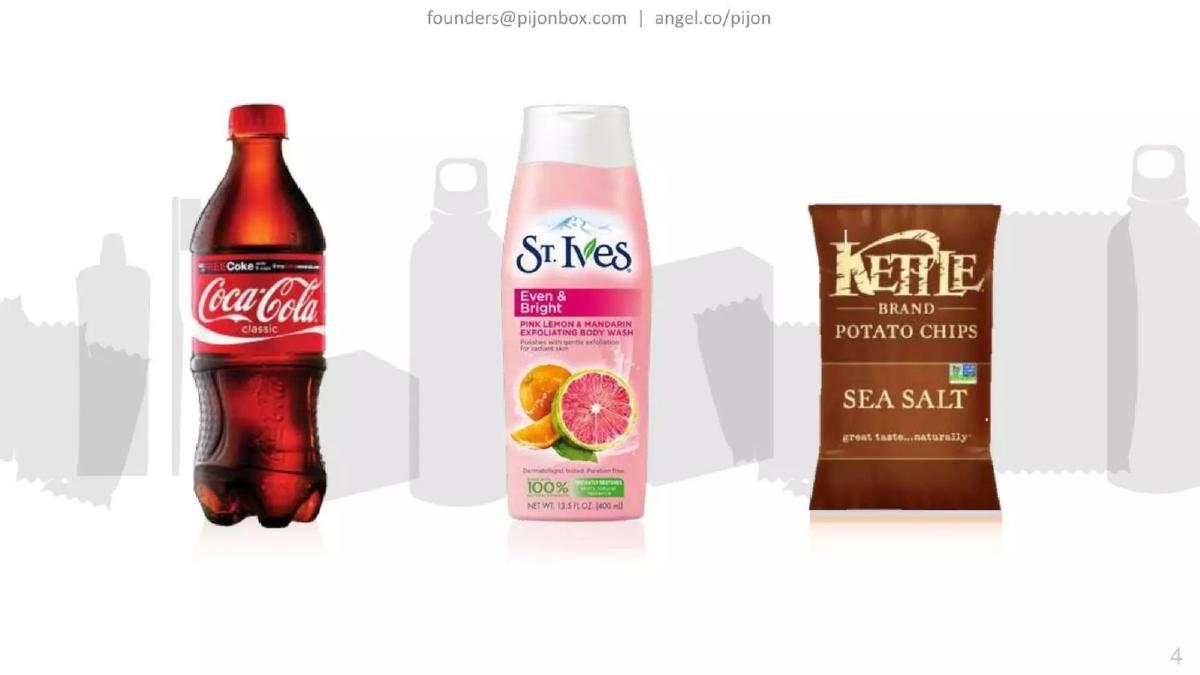
Slide 3 provides the first hard numbers. Launched in Q3 2013, the company claims to have 'Published 150,000+ ad units' and partnered with '80+ Brands.' This is a strong start for a seed deck, showing that the marketplace already has supply-side interest. Slide 4 reinforces this by displaying logos of major brands like Coca-Cola, St. Ives, and Kettle Brand, proving that they can attract blue-chip advertisers even in their early stages.
Slides 5-7: The Problem and the Pivot
Slide 5 identifies the pain points in the current physical advertising market: 'Inefficient, Manual Process,' 'Unknown Channel Capabilities,' and 'Limited Distribution Volume.' This is the 'why now' of the deck. Traditional product sampling is often a fragmented, unmeasurable mess. Pijon positions itself as the solution to these legacy issues.
Slide 6 is arguably the most important slide in the deck for a venture investor. It visualizes 'Transaction Velocity Increasing,' showing a shift from '7 months' to '7 days.' In the world of advertising, speed is a competitive advantage. If Pijon can truly execute a physical campaign in a week—a process that usually takes a full academic semester or longer—they have a legitimate technological moat. This leads directly to Slide 7, which officially introduces 'pijon marketplace: The Ad Network for Physical Media.'
Slides 8-10: The Marketplace Mechanics
Slide 8 illustrates the ecosystem. On the left are 'Brand Advertisers' (Coke, St. Ives, etc.) and on the right are 'Distribution Channels' (Chegg, Events, Retailers, Hotels). Pijon sits in the middle as the orchestrator. This slide clarifies that Pijon isn't just shipping their own boxes anymore; they are a platform that can plug into other companies' shipping streams (like Chegg's textbook deliveries).
Slide 9 details the demographic roadmap. The core focus is 'COLLEGE 18-23,' but the slide shows expansion plans into 'ADULT 31-45' and 'MATURE 46+.' By including logos like Macy's and BuildingLink.com in these outer rings, they demonstrate that their 'physical ad network' is not limited to dorm rooms. Slide 10 provides a growth snapshot, showing a '~10x GMV' increase between Q4 2015 and Q1 2016, reaching a '$250,000' milestone. Note: The year 2016 on this slide suggests this deck may have been updated or used for follow-on discussions after the initial 2013 launch mentioned in the catalogue.
Slides 11-13: Market Size and Conversion
Slide 11 tackles the TAM (Total Addressable Market). Citing eMarketer, it points to a '$26.9b TAM' for US ad spending and claims a '20% Margin' for the Pijon platform. This is a standard 'big market' slide designed to show the ceiling for the business. Slide 12 backs up the efficacy of the model with consumer data: '58% of consumers express buying interest after trying' and '30% conversion' for well-targeted sampling. These figures, sourced from the USDA and marketing studies, provide third-party validation for Pijon's core premise that 'trying is buying.'
The deck concludes on Slide 13 with a repeat of the marketplace branding and contact information. It is a clean, if somewhat abrupt, ending to a highly visual presentation.
What Works in the Pijon Deck
The Velocity Metric: The comparison between a 7-month and 7-day transaction cycle is a powerful way to demonstrate efficiency and technological disruption in a stale industry. · Visual Clarity: The deck uses a consistent color palette and very little text. It is designed to be presented, not read as a document, which usually keeps an investor's attention on the founder. · Brand Validation: Showing Coca-Cola and St. Ives early on removes the 'will anyone use this?' doubt that plagues many seed-stage startups. · Strategic Pivot: The transition from a 'box company' to an 'ad network' is handled well. It reframes a low-margin logistics business into a high-margin scalable platform.
What is Missing from the Pijon Deck
The Team: There is no mention of the founders' backgrounds, their previous exits, or why they are the right people to build a physical ad network. This is a major omission for a seed round. · The Ask: The deck does not state how much money is being raised or what the milestones for the next 18 months look like. · Competition: The deck ignores the existence of other sampling services (like Birchbox or Julep) or traditional agencies that handle these activations. Investors want to know how Pijon wins against incumbents. · Unit Economics: While a 20% margin is mentioned, there is no detail on the cost of acquisition (CAC) for brands or the lifetime value (LTV) of the distribution partnerships.
What a Founder Should Copy
The Concentric Circle Strategy: Slide 9 is an excellent way to show how a company starts in a niche (College) and expands into adjacent markets (Adults/Mature) without losing focus. · The 'Problem' Slide: Slide 5 uses simple, punchy phrases to describe industry pain points. Founders should avoid long bullet points and stick to these high-level descriptors. · Third-Party Data: Using sources like eMarketer and the USDA (Slide 11 and 12) adds credibility to the market opportunity, especially when the business model relies on changing consumer behavior.
Frequently asked questions
- What is the primary business model described in the Pijon deck?
- Pijon positions itself as a 'Marketplace' and an 'Ad Network for Physical Media.' While it started by shipping care packages to college students, the deck emphasizes its role as a bridge between brand advertisers (like Coca-Cola and St. Ives) and distribution channels (like Chegg and retailers). It monetizes by facilitating targeted product sampling and physical advertising at scale.
- How does Pijon justify the move into physical advertising?
- The deck uses consumer psychology and market size to justify the model. Slide 12 notes that 58% of consumers express buying interest after trying a product and well-targeted sampling can see a 30% conversion rate. By combining these high conversion rates with a $26.9 billion TAM, Pijon argues that physical media is an undervalued but highly effective channel.
- What are the most significant metrics mentioned in the deck?
- Key metrics include reaching 1,400+ campuses (catalogue fact), publishing 150,000+ ad units (Slide 3), and achieving a 10x Q-o-Q growth in GMV (Slide 10). Perhaps the most impressive operational metric is the reduction of the transaction cycle from 7 months to 7 days, suggesting a significant technological or process advantage over traditional sampling methods.
- Who is the target audience for Pijon's distribution?
- Slide 9 illustrates a concentric circle of targeting. The core 'bullseye' is college students aged 18-23. The next ring targets adults aged 31-45 (associated with BuildingLink.com), and the outer ring targets 'Mature' consumers aged 46+ (associated with Macy's). This suggests a strategy of starting with a niche and expanding into broader demographic segments.
- What critical information is missing from this pitch deck?
- The deck is missing three standard pillars of a seed-stage pitch: a Team slide (who is building this?), a Competition slide (who else is in the subscription or sampling space?), and a Funding Ask (how much are they raising and what is the use of funds?). While the catalogue indicates a $1M raise, the deck itself is silent on these points.