PyannoteAI’s pitch deck is a masterclass in leveraging open-source credibility to secure venture capital. Instead of pitching a hypothetical product, the founders highlight that their existing open-source toolkit is already the foundational layer for 'every conversational speech AI company,' as noted on slide 3. The deck emphasizes technical pedigree, featuring a CSO with over 10 years of research in speaker diarization and 30+ authored papers. By positioning their technology as the 'new frontier in AI,' PyannoteAI frames their $9M Seed round not as a search for product-market fit, but as an…
Key takeaways
- The deck positions speaker diarization as the critical bottleneck for the entire conversational AI market on slide 3.
- CSO Hervé Bredin is highlighted as a CNRS researcher since 2008 with 30+ authored papers on the topic on slide 2.
- The company claims its open-source toolkit has been maintained since 2013, providing a decade-long head start on slide 3.
- The product vision extends beyond simple diarization to include voice identification, confidence scores, and speech separation on slide 6.
- Deployment flexibility is a core value proposition, offering Live streaming, Batch, SDK, On-premise, and API options on slide 6.
- The team includes high-profile advisors from Hugging Face and OpenAI to bolster technical credibility on slide 2.
- The 'Use of proceeds' on slide 7 is divided into R&D, Model Training/Infra, and Go-to-market, though specific dollar allocations are omitted.
- The deck uses a 'Speaker Intelligence Platform for developers' tagline to define its B2B developer-first orientation on slide 5.
The Foundational Layer of Voice AI
PyannoteAI’s pitch deck for their 2024 Seed round is a concise 14-slide presentation that leans heavily on technical authority and existing market ubiquity. As reported by Business Insider, the company raised $9M to commercialize a toolkit that has been a staple of the open-source community for years. The deck does not spend time convincing investors that voice AI is a growing market; instead, it focuses on the fact that Pyannote is already the engine under the hood for most of the industry.
Slide 1: Title Slide
The deck opens with a minimalist black background featuring green wave-like graphics, evoking audio frequencies. The text reads 'Voice, the new frontier in AI.' Below the main title, the company logo appears with the subtitle 'Speaker Intelligence Platform for developers.' This immediately establishes the target audience: B2B and developer-centric, rather than a consumer-facing application.
Slide 2: The Team and Advisors
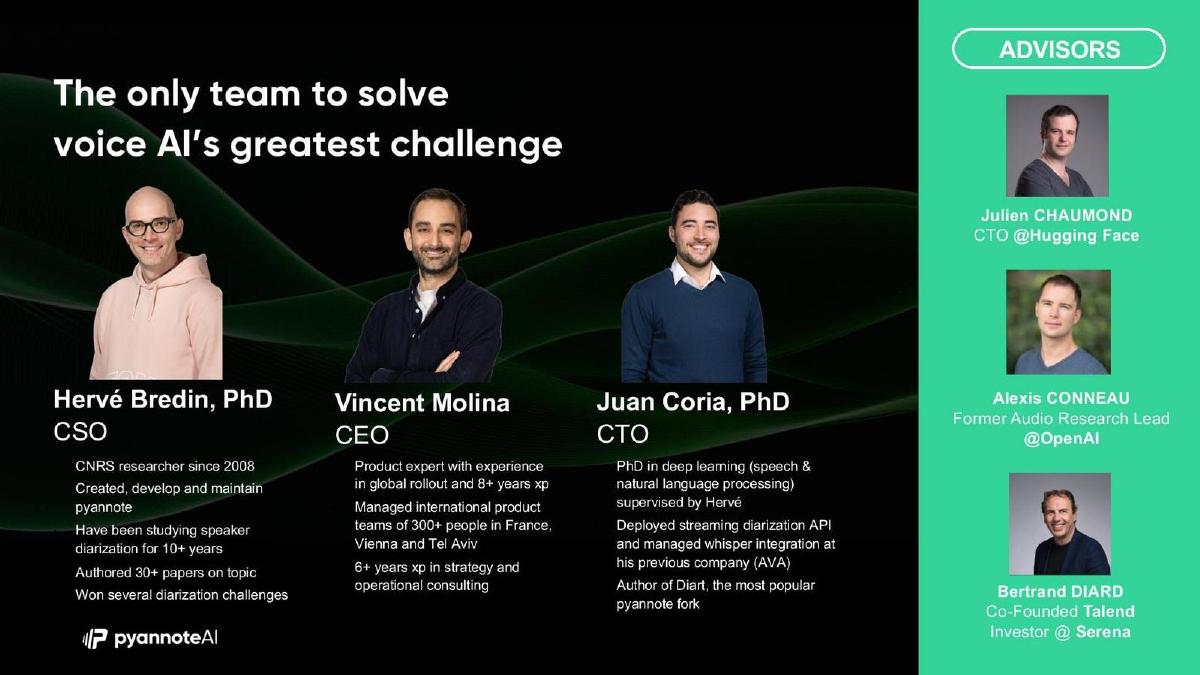
Slide 2 introduces the leadership team, emphasizing deep academic and operational roots. Hervé Bredin, PhD (CSO) , is presented as a CNRS researcher since 2008 who has studied speaker diarization for over 10 years and authored 30+ papers. Vincent Molina (CEO) is described as a product expert who managed international teams of 300+ people. Juan Coria, PhD (CTO) , is noted for his PhD in deep learning and for authoring 'Diart,' described as the most popular pyannote fork. The right side of the slide lists high-caliber advisors: Julien Chaumond (CTO @ Hugging Face), Alexis Conneau (Former Audio Research Lead @ OpenAI), and Bertrand Diard (Co-founder of Talend). This slide serves to eliminate any doubt regarding the team's technical capability to execute in a complex AI niche.
Slide 3: The Problem - Speaker Diarization
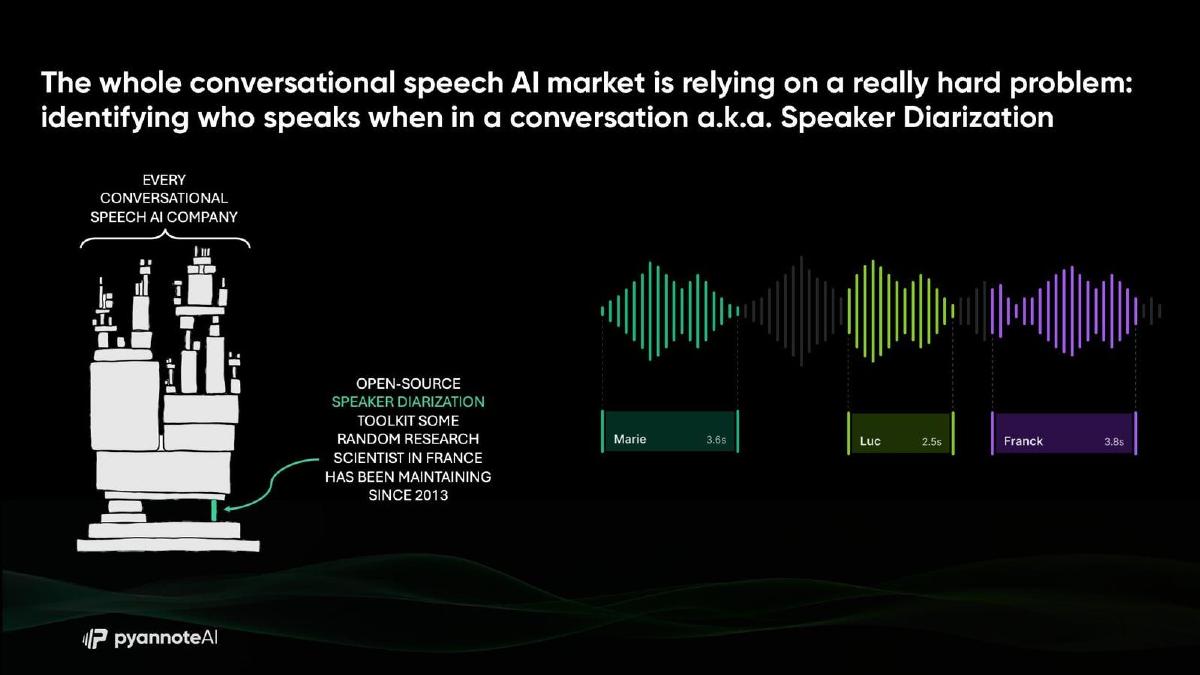
This slide defines the core technical challenge. It states: 'The whole conversational speech AI market is relying on a really hard problem: identifying who speaks when in a conversation a.k.a. Speaker Diarization.' A graphic on the left depicts a complex structure representing 'EVERY CONVERSATIONAL SPEECH AI COMPANY,' supported by a small green block labeled 'OPEN-SOURCE SPEAKER DIARIZATION TOOLKIT SOME RANDOM RESEARCH SCIENTIST IN FRANCE HAS BEEN MAINTAINING SINCE 2013.' This is a bold claim of market dependency, positioning Pyannote as the load-bearing infrastructure for the entire sector.
Slide 4: Open Source Leadership
Slide 4 is a simple transition slide with the text: 'pyannote open source is already leading the way.' It reinforces the narrative that the company is not starting from zero but is instead formalizing a project that already has significant industry traction.
Slide 5: The Commercial Vision
Another transition slide, Slide 5 repeats the subtitle from the cover: 'Speaker Intelligence Platform for developers.' This marks the shift in the deck from discussing the open-source past to the commercial future.
Slide 6: The Speaker Intelligence Platform
This slide provides the technical breakdown of the product offering. It divides the platform into 'Speaker diarization' (segmenting speakers) and 'Beyond diarization.' The latter includes Voice identification , Confidence scores , and Speech separation . The slide also details the deployment flexibility: Live streaming vs. Batch , and SDK , On-premise , or API . This addresses a key enterprise requirement: the ability to process data securely on-site or via flexible cloud integrations.
Slide 7: The Ask and Use of Proceeds
The final slide in the provided sequence outlines the funding goals. It states they are 'Now raising to accelerate and build the most advanced Speaker Intelligence Platform.' The use of proceeds is categorized into:
The slide lists three strategic pillars: 1) Grow community & build commercial platform, 2) Build the best research & tech team, and 3) Deliver the vision on Speaker Platform. While the publisher reported a $9M raise, the slide itself does not specify the dollar amount or the valuation, which is common in decks intended for broad distribution.
What Works in This Deck
The 'Infrastructure' Narrative: By showing that the entire industry already uses their open-source code (Slide 3), PyannoteAI creates a powerful sense of inevitability. Investors are often wary of 'feature' companies; Pyannote positions itself as a 'foundation' company.
Technical Pedigree: In AI, the 'who' is often as important as the 'what.' Highlighting a CSO with 30+ papers and a decade of specific focus on one problem (Slide 2) builds immense trust. The inclusion of advisors from Hugging Face and OpenAI further validates their standing in the AI research community.
Product Breadth: Slide 6 does an excellent job of showing that the company isn't just a 'one-trick pony.' By moving from diarization to identification and separation, they demonstrate a roadmap for increasing their Average Revenue Per User (ARPU) and becoming a comprehensive audio intelligence suite.
What Is Missing From the Deck
Business Metrics: There is no mention of current revenue, number of active developers using the open-source version, or growth rates of the community. While the 'infrastructure' claim is strong, quantifying it with GitHub stars, downloads, or enterprise logos would have made it unassailable.
Competitive Landscape: The deck implies they are the only ones who have solved this (Slide 2: 'The only team to solve voice AI's greatest challenge'), but it does not address competitors like AssemblyAI, Deepgram, or the internal teams at Big Tech firms (Google, AWS, Microsoft) who also offer diarization services.
Unit Economics and Pricing: There is no information on how they plan to price the API or SDK. For a Seed round, investors typically want to see a basic model of how the company will capture value from its open-source users.
Founder Takeaways
Own Your Niche: Pyannote doesn't try to be a general 'AI company.' They focus exclusively on 'Speaker Intelligence.' Founders should learn to define their category narrowly enough to be the undisputed leader, then show how that category is essential to a larger market.
Leverage Open Source as a Moat: If you have an open-source project, use it to prove market demand. Pyannote’s slide 3 is a perfect example of how to turn 'we give code away for free' into 'we are the industry standard that everyone depends on.'
Focus on Deployment: For B2B AI, how the product is delivered matters. By including 'On-premise' and 'SDK' on Slide 6, Pyannote signals to investors that they can serve high-security enterprise clients who won't send their audio data to a third-party cloud API.
Frequently asked questions
- What is the core problem PyannoteAI is solving?
- According to slide 3, the company focuses on 'Speaker Diarization,' which is the process of identifying who speaks when in a conversation. They argue that the entire conversational speech AI market relies on this 'really hard problem' to function effectively, positioning their technology as a foundational infrastructure layer for the industry.
- How does PyannoteAI leverage its open-source history?
- The deck highlights that their open-source toolkit has been maintained since 2013. Slide 3 uses a graphic to show that 'every conversational speech AI company' is built on top of this toolkit, which they describe as having been maintained by a 'research scientist in France' (CSO Hervé Bredin) for over a decade.
- What features are included in their commercial platform?
- Slide 6 outlines a 'Speaker Intelligence Platform' that goes 'Beyond diarization.' It includes voice identification (identifying specific speakers), confidence scores for creating clean datasets, and speech separation. It also offers multiple delivery methods including API, SDK, and on-premise solutions for both live and batch processing.
- Who are the key members of the leadership team?
- The team on slide 2 consists of CSO Hervé Bredin (CNRS researcher), CEO Vincent Molina (product expert with experience in teams of 300+), and CTO Juan Coria (PhD in deep learning). They are supported by advisors including Julien Chaumond (CTO at Hugging Face) and Alexis Conneau (former Audio Research Lead at OpenAI).
- What are the primary goals for the $9M Seed round?
- Slide 7 lists three main objectives: growing the community and building the commercial platform, hiring the 'best research & tech team' around the founders, and delivering their vision for a platform that offers 'unchallengeable speaker insights.' The funds are earmarked for R&D, model training, and go-to-market efforts.