Cambridge Technology Enterprises (CTE) uses its Q1 FY17 investor presentation to signal a transition from a standard IT services provider to a high-growth leader in Big Data, Cloud, and AI. The deck is anchored by a specific financial goal: reaching USD 2 million in monthly revenue by March 2017 (Slide 3). With a reported 74% revenue growth from Q1 FY16 to Q1 FY17 (Slide 7), the company leverages a robust partner ecosystem including AWS, Oracle, and Tableau to differentiate itself (Slide 4). The introduction of 'Cambridge Innovations' (Slide 5) suggests a strategic move to capture the U.S. st…
Key takeaways
- The company sets a hard target of USD 2 Million in monthly revenue by March 2017 (Slide 3).
- CTE positions itself at the convergence of Big Data, Cloud, Artificial Intelligence, and Machine Learning (Slide 2).
- A diverse partnership network is highlighted, featuring major players like AWS, Oracle (Platinum Partner), and Rackspace (Slide 4).
- The 'Cambridge Innovations' (CI) initiative was launched in Q3 FY16 to partner with U.S. startups (Slide 5).
- Revenue grew from 140 Million INR in Q1 FY16 to 244 Million INR in Q1 FY17, representing 74% growth (Slide 7).
- The management team features deep technical and financial expertise, including alumni from MIT, Harvard, and Stanford (Slide 9).
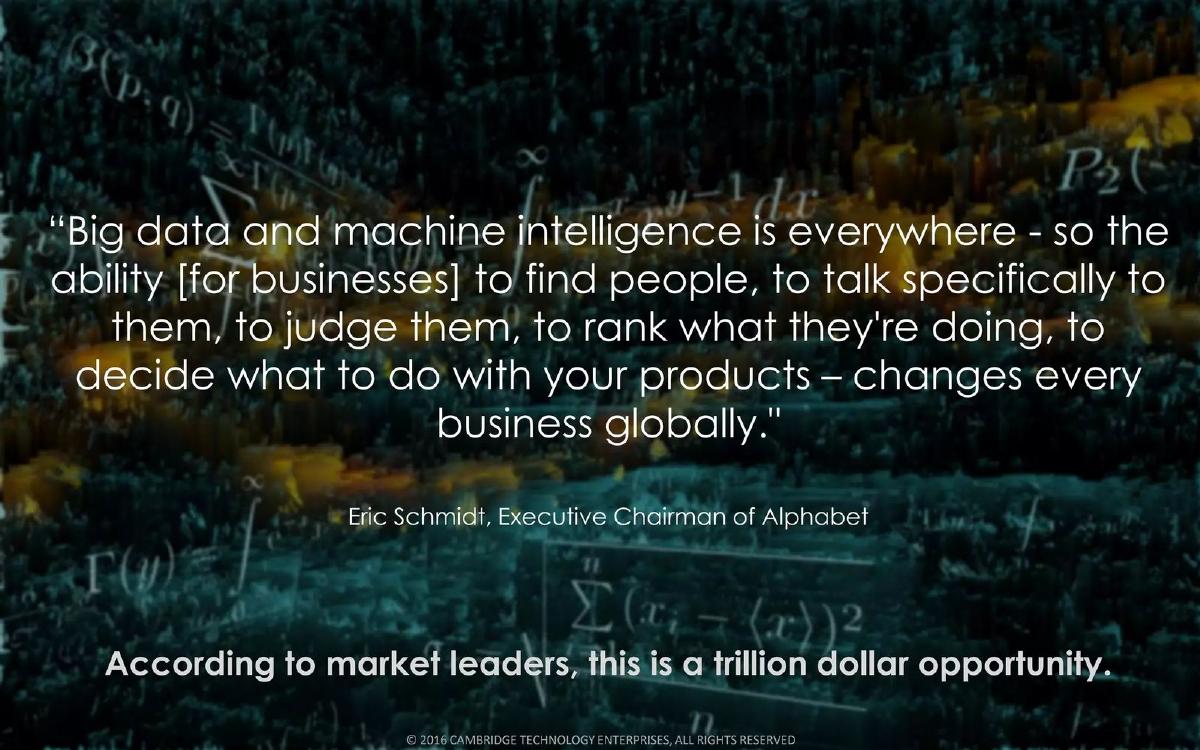
- The company identifies a total addressable market opportunity exceeding $1 trillion (Slide 8).
- Recruiting is explicitly identified as a current business challenge (Slide 8).
Cambridge Technology Enterprises: A Strategic Update on Growth and Innovation
The Q1 FY17 Investor Presentation for Cambridge Technology Enterprises (CTE) is a focused, data-driven update designed to reassure investors of the company's trajectory. Rather than a traditional 'problem-solution' startup deck, this presentation functions as a corporate progress report, emphasizing revenue milestones and strategic initiatives like Cambridge Innovations.
Slide 1: Title Slide
The cover slide is minimalist, featuring the Cambridge Technology Enterprises logo and the specific reporting period: Q1FY17 Investor Presentation, dated July 2016. The branding is clean, utilizing a multi-colored 'X' logo that suggests convergence and connectivity, themes that reappear throughout the deck.
Slide 2: The Vision Statement
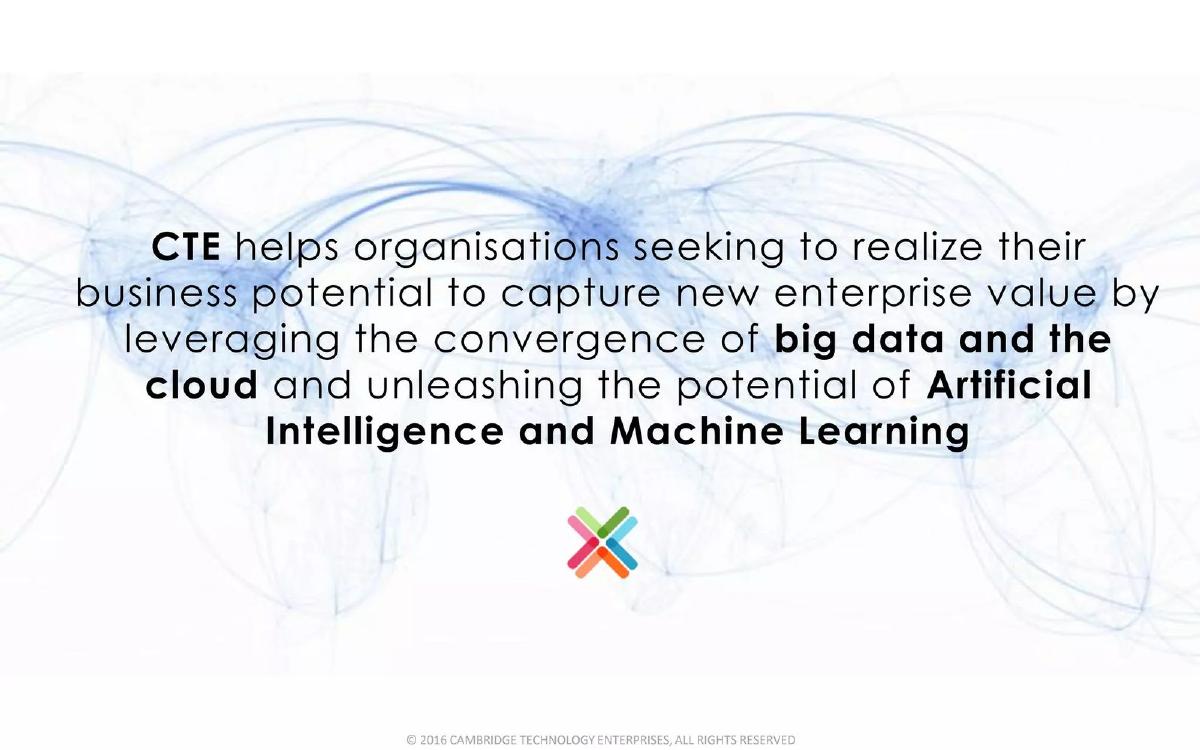
Slide 2 defines the company's core value proposition. It states that CTE helps organisations seeking to realise their business potential to capture new enterprise value . The slide highlights four key pillars: big data , the cloud , Artificial Intelligence , and Machine Learning . By positioning itself at the intersection of these high-growth sectors, CTE attempts to move away from being viewed as a commodity IT service provider.
Slide 3: The 2-Year Business Plan
This is the most critical slide for setting investor expectations. It contains a single, bold objective: USD 2 Million in revenue/month by March 2017 . By putting a specific number and date on a standalone slide, the management team is signaling extreme confidence in their pipeline and execution capabilities. It provides a clear yardstick for measuring future performance.
Slide 4: Partner Ecosystem
Slide 4, titled 'Partners for growth & differentiation,' lists the company's strategic alliances. This is a 'who's who' of the enterprise tech world, including:
ETL & Analytics: Pentaho (A Hitachi Group Company) · Enterprise Solutions: Oracle (Platinum Partner) · Cloud Computing: Amazon Web Services · Load Testing & Monitoring: Apica · Identity Management: ForgeRock · Software Analytics: New Relic · Managed Cloud: Rackspace · Data Visualization: Tableau
This slide serves as social proof, suggesting that CTE has the technical depth required to maintain high-level partnerships with industry leaders.
Slide 5: Innovation Initiative
This slide introduces Cambridge Innovations (CI) , launched in Q3FY16. The goal of this division is to partner with 'innovative new U.S. startups' leveraging big data and the cloud. This suggests a dual-track business model: serving established enterprises while simultaneously acting as a technology partner (and potentially an incubator) for high-growth startups. This initiative likely serves as a lead generation tool and a way to keep the company's talent pool engaged with the latest technologies.
Slide 6 & 7: Financial Performance
Slide 6 acts as a transition to the financial section. Slide 7 provides the 'Performance so far,' showing a revenue bar chart in INR Mn . The growth is consistent:
Q1 FY16: 140 · Q2 FY16: 154 · Q3 FY16: 167 · Q4 FY16: 197 · Q1 FY17: 244
The slide highlights a 74% growth rate from Q1 FY16 to Q1 FY17. The visual representation uses an upward-curving arrow to emphasize the accelerating nature of the revenue growth.
Slide 8: Takeaways and Outlook
Slide 8 summarizes the current state of the business. It reiterates the >$1 trillion market opportunity and confirms the company is 'on plan' to reach the USD 2M monthly revenue target. Notably, it admits that 'recruiting remains a challenge,' which adds a layer of credibility to the deck by acknowledging a real operational hurdle. It also mentions that growth plans for March 2019 will be announced once the 2017 scale is achieved.
Slide 9: Management Team
The final slide in this selection introduces the leadership team. It is a heavy-hitting group with significant experience:
Rajesh Krishnamoorthy: 20 years of experience, specializing in Big Data. · Radha Raghupathy: Focuses on global operations and process management. · Alexis Kopikis: A founder of five startups, leading the CI initiative. · Hanumant Bhansali: Heads Investor Relations with an MBA from JNTU. · Sundar Subramaniam: MIT and Harvard-MIT alumni with experience in energy and biotech. · Alan Roth: General Counsel with a JD from Stanford Law School.
The diversity of backgrounds—from deep technical architecture to Ivy League legal and financial training—suggests a well-rounded executive layer capable of handling international expansion.
What Works in the CTE Deck
The deck is exceptionally disciplined. By focusing on a single, measurable goal (USD 2M/month revenue), it gives investors a clear 'success' or 'failure' metric. The inclusion of the 'Partners' slide (Slide 4) is also highly effective; for a service-based business, your reputation is often tied to the companies that trust you, and CTE lists several market leaders. Finally, the honesty regarding recruitment challenges (Slide 8) is a refreshing change from typical pitch decks that claim everything is perfect, building trust with sophisticated investors.
What is Missing from the CTE Deck
While the deck is strong on top-line growth, it is silent on profitability and margins. We see revenue in INR Millions, but there is no mention of EBITDA, net income, or customer acquisition costs. Furthermore, the 'Cambridge Innovations' initiative is mentioned as a partnership model, but the deck does not explain the commercial terms of these partnerships—are they taking equity, charging fees, or both? Finally, there is no competitive landscape analysis. While they mention a $1 trillion market, they do not explain how they win against larger global SIs (System Integrators) or smaller boutique firms.
Founder Takeaways
Set a North Star Metric: Founders should emulate Slide 3. Having one clear, time-bound financial goal makes the rest of the deck feel like a logical path toward that destination. Leverage Partner Logos: If you are a service or platform business, your partner ecosystem is your moat. CTE uses these logos to borrow authority from AWS and Oracle. Be Transparent About Bottlenecks: Acknowledging that recruiting is hard doesn't make you look weak; it makes you look like a realist who understands their operational constraints. Investors appreciate knowing that you know where the risks lie.
Frequently asked questions
- What is the primary business model of Cambridge Technology Enterprises?
- Based on the slides, CTE is an IT services and consulting firm specializing in helping organizations leverage Big Data, Cloud, AI, and Machine Learning. They operate through a mix of enterprise solutions, managed cloud services, and a dedicated innovation arm called Cambridge Innovations that partners with startups to drive adoption of disruptive technologies.
- How does CTE differentiate itself from other IT service providers?
- CTE differentiates through its 'Partners for growth' strategy, maintaining high-level certifications with major vendors like Oracle (Platinum Partner) and AWS. Additionally, their 'Cambridge Innovations' initiative allows them to work with cutting-edge U.S. startups, potentially giving them earlier access to emerging tech trends compared to traditional service firms.
- What are the key financial metrics disclosed in this deck?
- The deck focuses on top-line revenue growth. It shows a steady quarterly increase from 140 Million INR in Q1 FY16 to 244 Million INR in Q1 FY17. The company is aiming for a specific run rate of USD 2 Million per month by March 2017, which serves as their primary success metric for the period.
- Who are the key members of the management team?
- The team includes Rajesh Krishnamoorthy (Head of IT), Radha Raghupathy (Director - Cambridge BizServe), and Alexis Kopikis (VP - Cambridge Innovations). The leadership group brings experience from firms like PureTech Health, TCS, and Thomson Reuters, with academic backgrounds from institutions like MIT and Stanford Law.
- What challenges does the company openly acknowledge?
- In a rare moment of transparency for a pitch deck, Slide 8 explicitly states that 'recruiting remains a challenge.' This indicates that while the demand and revenue growth are present, the company's ability to scale is currently constrained by the competitive market for technical talent.