qeep.ai presents a vision for the future of technical documentation, moving away from static PDFs toward an interactive, AI-driven speech interface. The deck leans heavily on the problem of human error, citing that 50% of flight delays are caused by such mistakes, resulting in a $22 billion impact (Slide 7). While the deck effectively establishes a high-stakes problem in sectors like aviation and consumer assembly, it is notably light on business mechanics. There are no slides dedicated to unit economics, competitive landscape, or a specific financial ask. The presentation serves more as a co…
Key takeaways
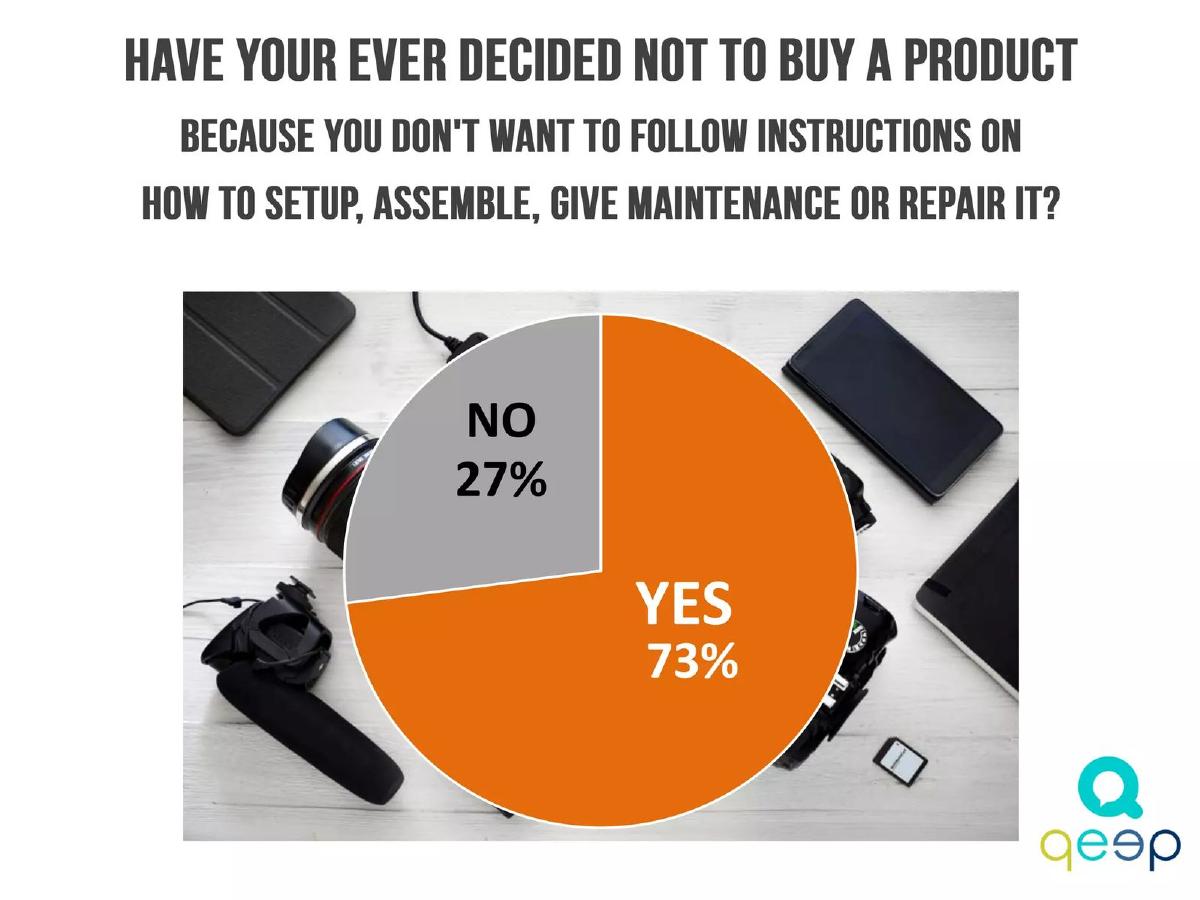
- The company identifies a significant consumer pain point, stating that 73% of people have decided not to buy a product due to complex instructions (Slide 3).
- Human error is framed as a $22 billion problem in the aviation industry, accounting for 50% of flight delays (Slide 7).
- The core product is defined as a 'Smart Speech Interface' utilizing Natural Language Understanding and Dialogue Management (Slide 10).
- qeep.ai targets two distinct markets: B2B for industrial maintenance and B2B4C for consumer product assembly (Slides 11-12).
- The deck highlights the limitations of current 'Interactive E-Technical Manuals,' labeling them as lacking intelligence and hands-free capabilities (Slide 9).
- The leadership team consists of Yu Seo (CEO), Matthias Denecke (CTO), and Matthew Nacier (Strategy Director) (Slide 13).
- The deck completely omits a financial ask, revenue model, and roadmap for product development.
- The company was based in Brooklyn, NY, as of the 2016 copyright date on the title slide.
Slide-by-Slide Analysis
Slide 1: Title Slide
The deck opens with the qeep logo and the tagline 'Interactive Instructions with Smart Speech Interface.' A copyright notice for 2016 by QEEP, LLC is present at the bottom. The branding is clean, utilizing a speech bubble motif within the 'Q' of the logo.
Slide 2 & 3: The Consumer Pain Point
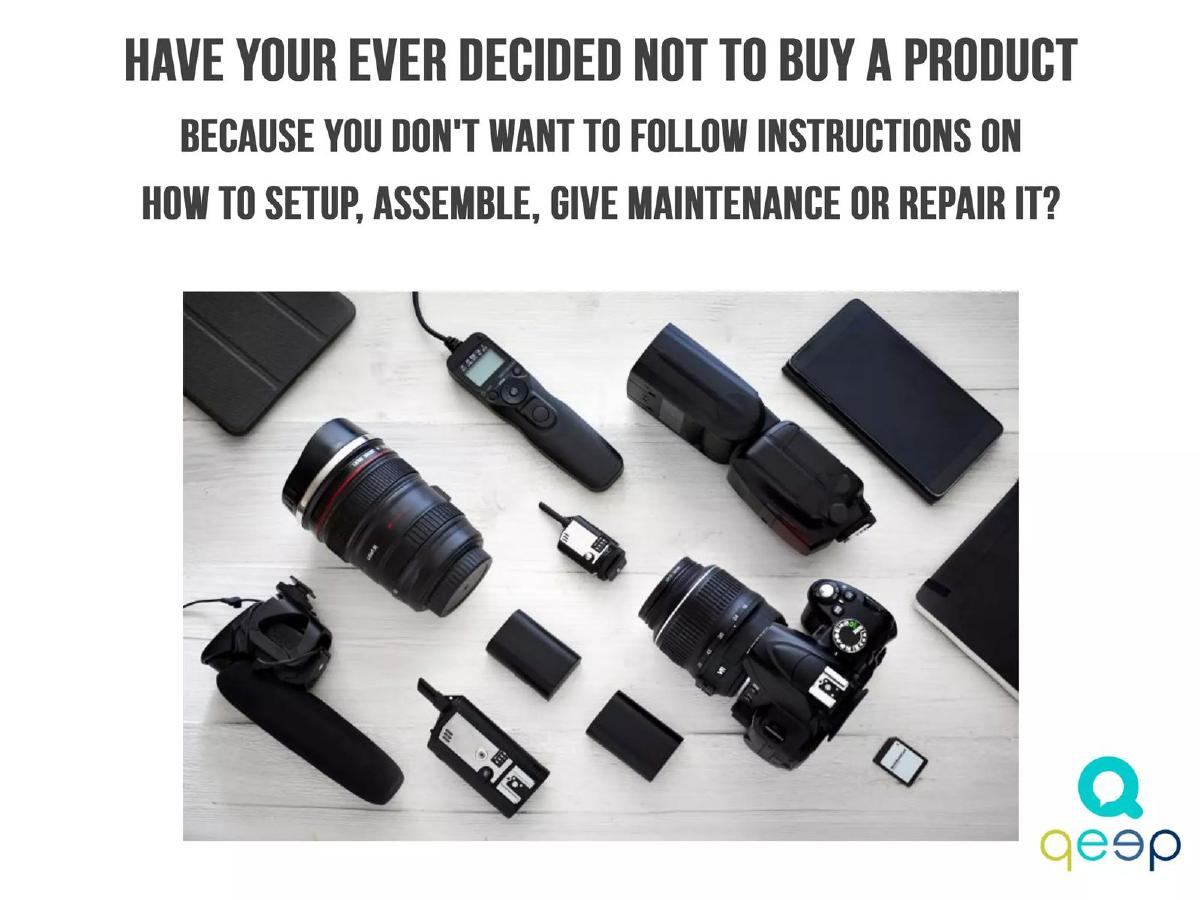
Slide 2 poses a rhetorical question: 'Have your ever decided not to buy a product because you don't want to follow instructions on how to setup, assemble, give maintenance or repair it?' Slide 3 provides the data point, claiming 73% of respondents said 'Yes' while 27% said 'No.' The source of this data is not cited on the slide.
Slide 4 & 5: The IKEA Effect
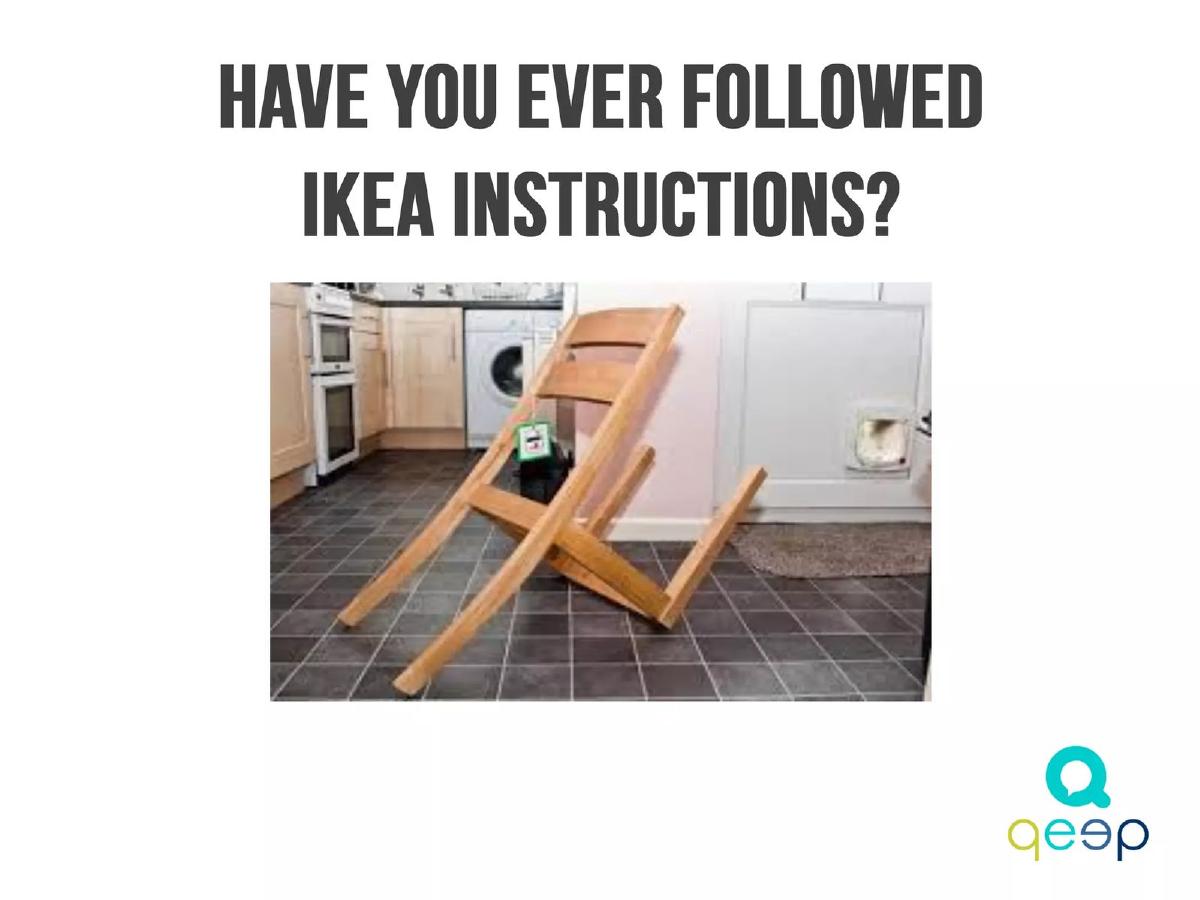
These slides use a relatable example of complex assembly. Slide 4 asks if the reader has ever followed IKEA instructions, and Slide 5 shows a photo of a wooden chair that has been assembled incorrectly, resulting in a non-functional, twisted structure. This serves as a visual metaphor for the failure of current instructional methods.
Slide 6: Industrial Human Error
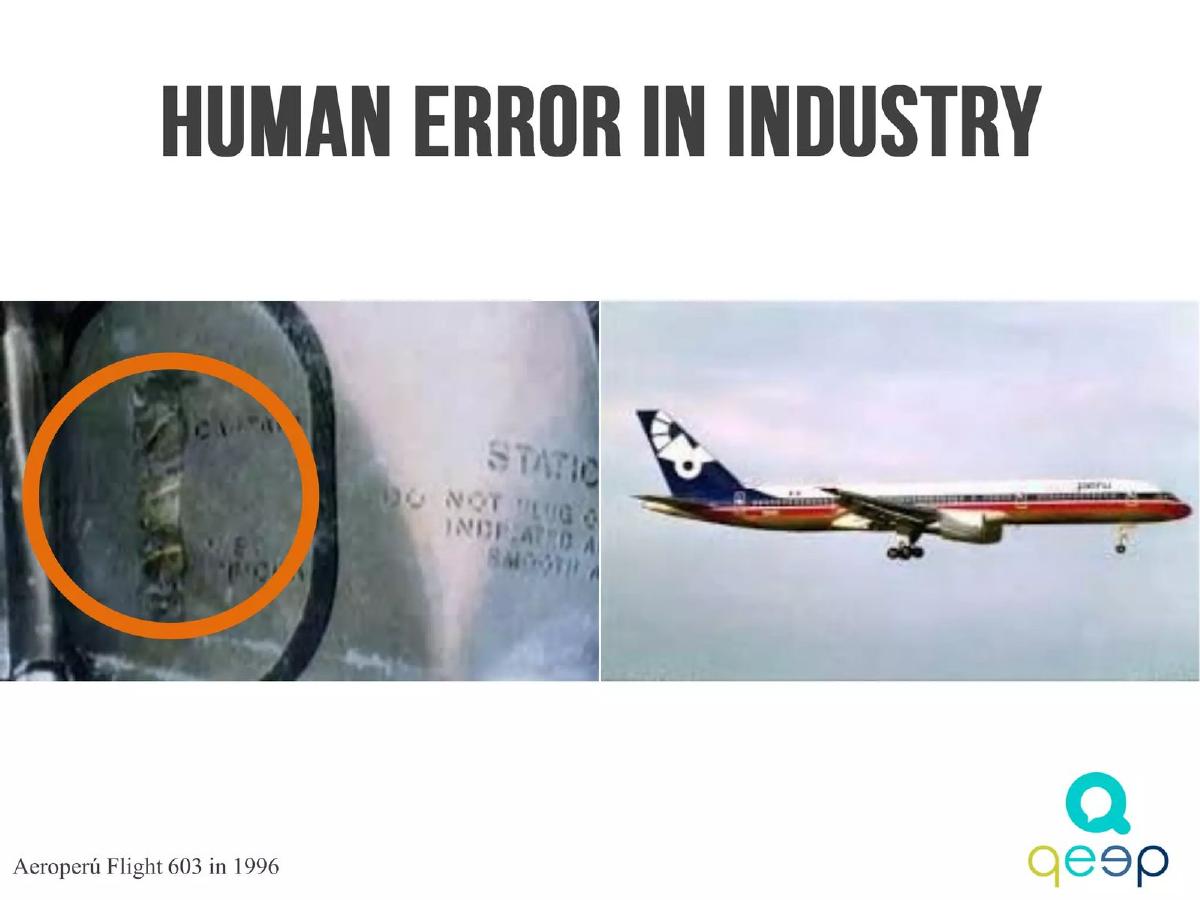
The deck shifts from consumer annoyance to industrial tragedy. Slide 6 references 'Aeroperú Flight 603 in 1996,' showing a photo of the aircraft and a close-up of a static port covered by tape. This implies that improper maintenance—specifically failing to follow or understand technical procedures—has fatal consequences.
Slide 7: Economic Impact
Slide 7 quantifies the problem in the aviation sector. It states that 50% of flight delays are caused by 'Human Error,' contributing to a total cost of $22 billion . Weather is cited as responsible for 12%, with 'Other' making up the remainder. This slide effectively establishes the 'Total Addressable Problem' in monetary terms.
Slide 8 & 9: The Current Solution's Failure
Slide 8 shows a military jet alongside a PDF icon, labeled 'Interactive E-Technical Manual.' Slide 9 then overlays the text 'NO HANDS-FREE, NO INTELLIGENCE' across the image. This identifies the gap in the market: current digital manuals are just static documents that require manual navigation, which is impractical for technicians with their hands full.
Slide 10: The qeep.ai Solution
This slide lists the technical pillars of the company: Artificial Intelligence, Machine Learning, Natural Language Understanding, and Dialogue Management. It describes the 'Smart Speech Interface' as providing 'Deep Knowledge,' being 'Hands-Free Eyes-Free,' and 'Interactive and Dynamic.' This is the core value proposition of the startup.
Slide 11 & 12: Target Markets
Slide 11 shows a technician working on a helicopter engine with the text 'B2B.' Slide 12 shows a consumer using a power tool to upholster a chair with the text 'B2B4C.' These slides indicate that the technology is applicable to both high-end industrial maintenance and mass-market consumer support.
Slide 13: The Team
The team slide features three individuals: Yu Seo (CEO) , Matthias Denecke (CTO) , and Matthew Nacier (Strategy Director) . The slide includes headshots but lacks any biographical information, past successes, or educational background, which is a significant omission for an AI startup where technical pedigree is highly valued by investors.
Slide 14 & 15: Conclusion and Contact
Slide 14 summarizes the company identity: 'Speech Dialogue + AI = QEEP.AI' set against a New York City skyline. Slide 15 provides contact information, including a website, social media handles, and a base of operations in Brooklyn, NY.
What qeep.ai Does Well
The deck is exceptionally strong at problem identification . By transitioning from the relatable frustration of a broken IKEA chair to a $22 billion aviation crisis, the founders successfully demonstrate that their solution isn't just a 'nice-to-have' gadget, but a potential necessity for safety and efficiency. The use of the Aeroperú crash is a sobering and effective way to raise the stakes of the pitch.
The visual clarity of the deck is also a plus. It avoids cluttered slides and uses large, bold text to convey single ideas. This format is ideal for a live presentation where the speaker provides the nuance while the audience absorbs the high-level data points.
What is Missing from the Deck
The most glaring omission is the Business Model . There is no explanation of how qeep.ai intends to make money. Is it a per-manual licensing fee? A per-user SaaS subscription? A percentage of the savings generated by reduced errors? Without this, it is impossible for an investor to evaluate the scalability of the venture.
Furthermore, there is a total lack of Traction and Roadmap . The deck does not mention if they have a prototype, any pilot programs with airlines or manufacturers, or a timeline for product release. In the competitive field of AI, 'vaporware' is a constant concern; providing evidence of a working beta or even a technical white paper would have strengthened the pitch significantly.
Finally, the Competitive Landscape is ignored. In 2016, voice assistants like Alexa and Siri were already in the market, and companies like Upskill (formerly APX Labs) were already working on AR-based industrial instructions. qeep.ai fails to explain why a speech-only interface is superior to or more feasible than the emerging augmented reality solutions of the time.
Founder Takeaways
Bridge the Gap: If you use a dramatic, high-stakes example like a plane crash to illustrate a problem, you must follow it up with specific details on how your technology would have prevented that specific event. · Quantify the Team: Don't just list names and titles. For an AI company, investors need to see 'PhD in NLP' or 'Ex-Boeing Maintenance Lead.' Pedigree is a proxy for de-risking the technical execution. · Define the 'Ask': Every pitch deck intended for fundraising must include a slide stating how much capital is being raised and, more importantly, what milestones that capital will achieve (e.g., 'Raising $1.5M to complete FAA certification and launch 2 pilots'). · Address the 'Why Now?': The deck mentions AI and Machine Learning as buzzwords but doesn't explain what recent technical breakthroughs make this solution possible today when it wasn't possible five years ago.
Frequently asked questions
- What is the primary problem qeep.ai is trying to solve?
- qeep.ai addresses the inefficiency and danger of static technical instructions. They argue that traditional manuals (PDFs) are difficult to follow, leading to consumer frustration and catastrophic industrial accidents. By citing Aeroperú Flight 603 and the $22 billion cost of flight delays, they position their speech-based AI as a critical safety and efficiency tool for high-stakes environments.
- Does the deck provide evidence of a working product?
- No. The deck is conceptual and lacks screenshots, demos, or case studies of the software in action. It lists technical components like 'Machine Learning' and 'Deep Knowledge' on Slide 10, but does not show how these are implemented or provide any validation of the technology's accuracy in noisy industrial settings.
- Who is the target customer for this technology?
- The company pursues a dual-track strategy. The B2B segment targets heavy industry and aviation maintenance, where hands-free operation is vital. The B2B4C segment targets manufacturers of consumer goods (like IKEA-style furniture or electronics) to improve the end-user setup experience and reduce product returns caused by assembly frustration.
- What are the biggest missing elements in this pitch deck?
- The deck is missing almost all standard venture metrics. There is no mention of the business model (SaaS, licensing, etc.), no competitive analysis against existing AR or voice-assistant players, and no financial 'ask.' It functions more as a product vision deck than a fundraising document designed to close a seed or Series A round.
- How does qeep.ai differentiate itself from a standard PDF manual?
- According to Slide 9, standard electronic manuals are 'No Hands-Free, No Intelligence.' qeep.ai differentiates by offering a 'Smart Speech Interface' that is 'Eyes-Free' and 'Interactive.' This implies a dynamic dialogue where the system can answer questions and guide a technician step-by-step without requiring them to stop work to look at a screen.