Qonsent's 2021 Seed deck is a highly technical, product-focused presentation that successfully secured $5M in funding. Spanning just nine slides, the deck ignores standard components like team bios, financial projections, and market sizing. Instead, it leans heavily into the mechanics of its 'patent pending' SaaS platform, emphasizing real-time ID validation and 'Smart Qontracts.' By positioning itself as a consumer-facing 'consent wallet' that integrates with enterprise giants like TransUnion and Ketch, Qonsent framed its value proposition around solving the compliance friction created by GD…
Key takeaways
- The deck completely omits a team slide, financial projections, and a specific funding ask, which is unconventional for a $5M Seed round.
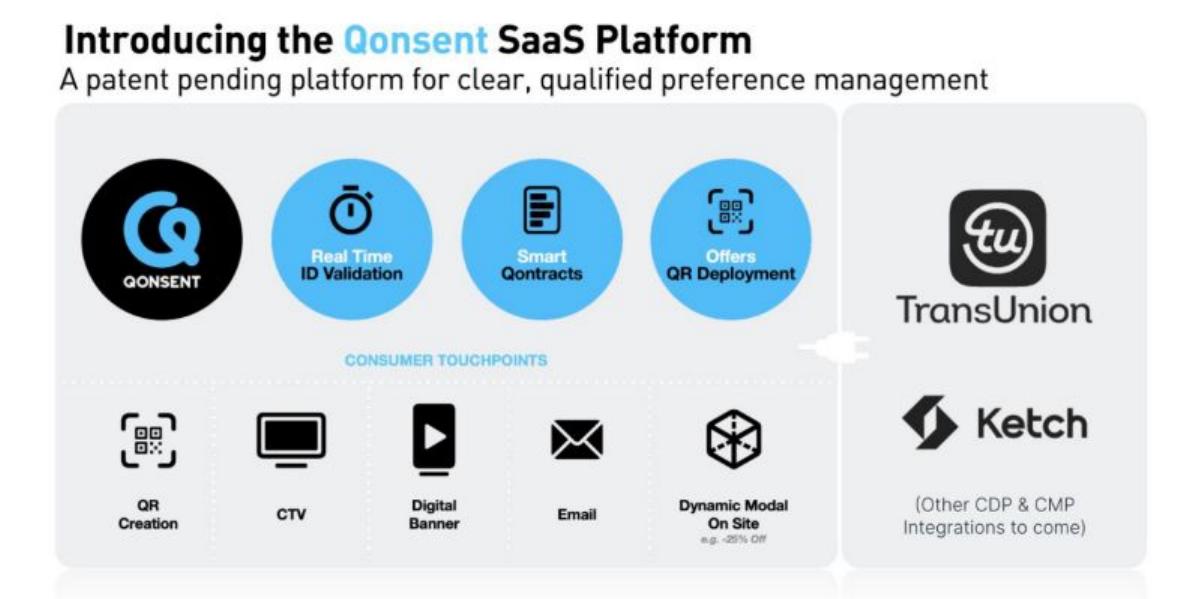
- Qonsent positions its platform as 'patent pending' to establish defensibility in the crowded data management sector (Slide 3).
- Strategic partnerships are central to the pitch, specifically highlighting integrations with TransUnion for ID validation and Ketch for consent management (Slides 3, 4, and 5).
- The product is framed as a 'consumer wallet' that allows users to turn data sharing on and off with a simple tap (Slide 7).
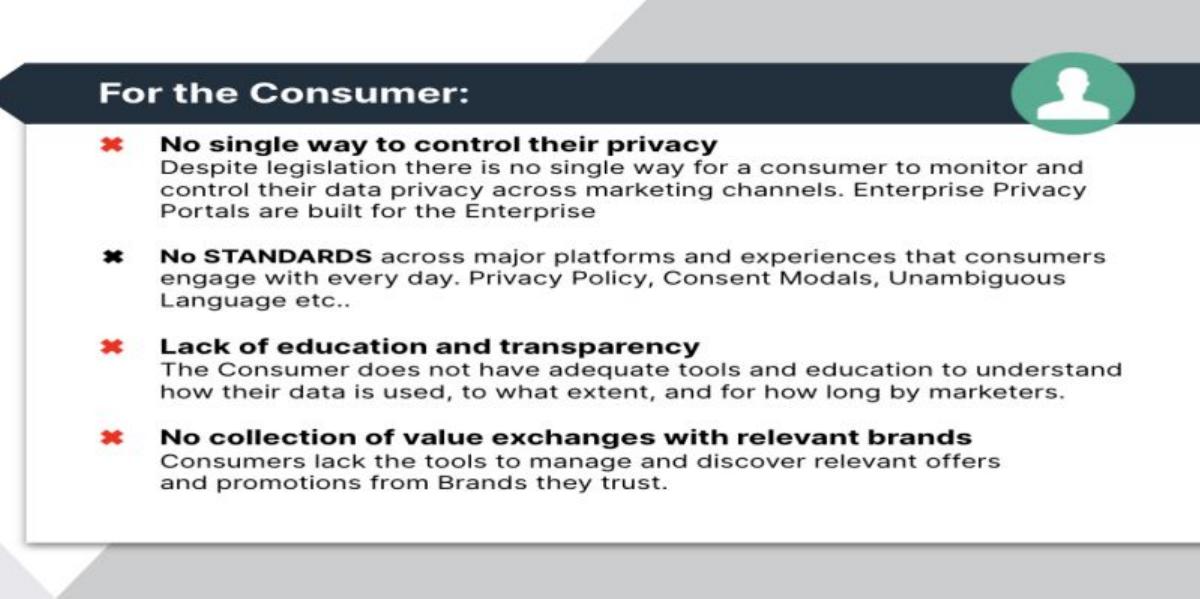
- The problem statement focuses on the lack of standards for consumers to monitor and control data privacy across marketing channels (Slide 1).
- Technological infrastructure is highlighted through a 'ledger based smart contract system' that is described as 'Web3 enabled' (Slide 7).
- The deck emphasizes cross-channel deployment, including Connected TV (CTV), digital banners, and physical QR codes (Slide 3).
- Compliance is a core pillar, with the platform explicitly designed to maintain records across CCPA, GDPR, and CPRA (Slide 5).
The Product-First Approach to Data Privacy
Qonsent’s 2021 Seed deck is an anomaly in the world of fundraising. At only nine slides, it skips the narrative storytelling and financial forecasting typical of a $5M round. Instead, it functions as a technical brief. The company, operating in the data management sector, focuses entirely on how its platform bridges the gap between consumer privacy and brand marketing. The catalogue facts confirm a $5M raise in 2021, suggesting that for this specific investor group, the technical solution and partnership ecosystem were more important than the standard pitch deck checklist.
Slide 1: The Consumer Problem
The deck opens by identifying four specific pain points for the consumer. It notes there is 'No single way to control their privacy' and that 'Enterprise Privacy Portals are built for the Enterprise,' not the individual. It also highlights a 'Lack of education and transparency' regarding how data is used by marketers. Crucially, it mentions the 'No collection of value exchanges,' suggesting that consumers currently lack tools to manage offers from brands they trust. This slide sets the stage for a consumer-centric solution rather than a purely back-end enterprise tool.
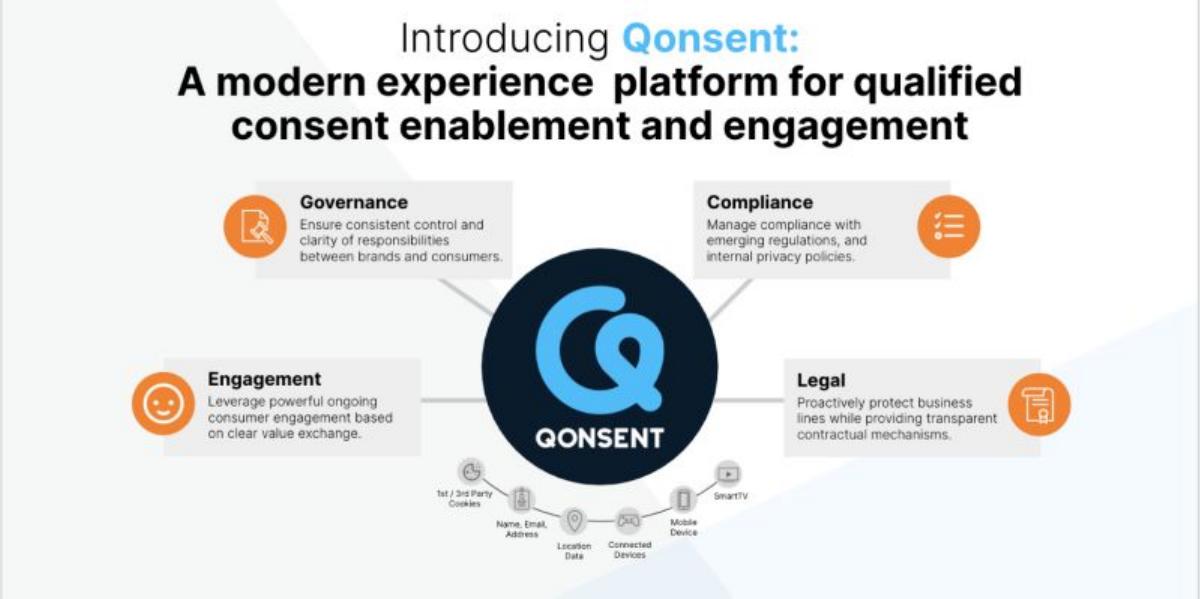
Slide 2: The Qonsent Solution
Slide 2 introduces Qonsent as a 'modern experience platform for qualified consent enablement and engagement.' It breaks the solution into four pillars: Governance, Compliance, Engagement, and Legal. The graphic shows the Qonsent logo at the center of various data points, including 1st/3rd Party Cookies, Location Data, and Connected Devices. This slide is designed to show the breadth of the platform's reach across the digital ecosystem.
Slide 3: The SaaS Platform and Integrations
This slide is the most information-dense in the deck. It labels the platform as 'patent pending' and introduces the 'Qonsent SaaS Platform.' It lists four core capabilities: Real Time ID Validation, Smart Qontracts, and Offers QR Deployment. The right side of the slide is dedicated to integrations, prominently featuring the logos of TransUnion and Ketch . It notes that 'Other CDP & CMP Integrations' are to come. By placing partner logos on the third slide, Qonsent uses external validation to compensate for the lack of a traction slide.
Slide 4: Real Time ID Validation
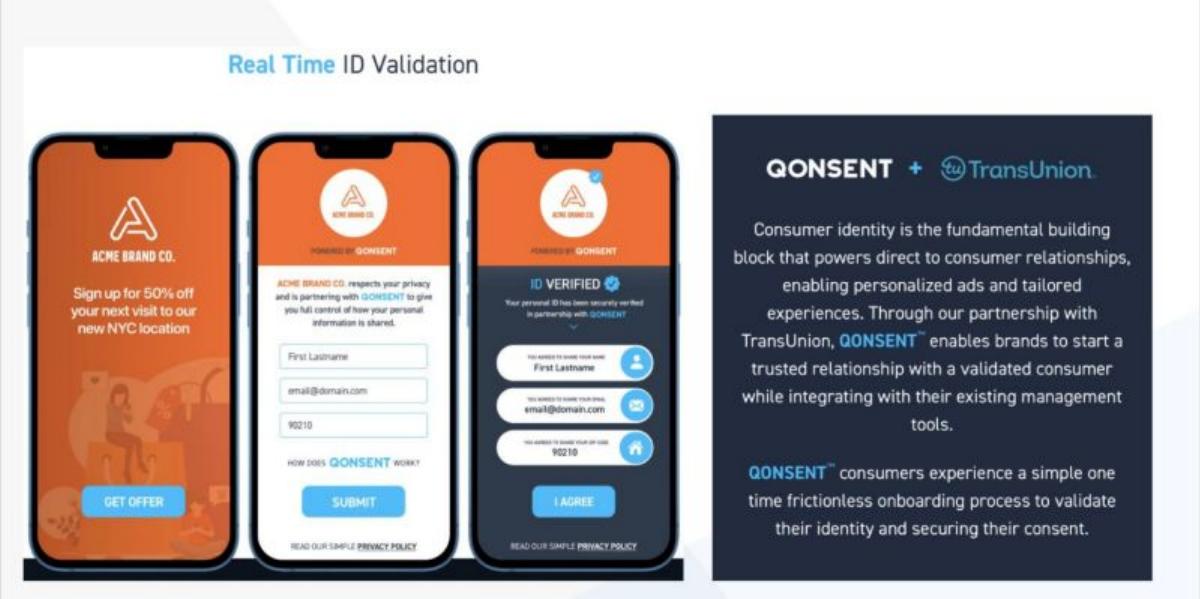
Slide 4 focuses on the partnership with TransUnion. It shows a mobile UI for 'Acme Brand Co.' where a user signs up for an offer and has their identity verified. The text states that 'Consumer identity is the fundamental building block' for direct-to-consumer relationships. The goal here is to show a 'frictionless onboarding process' that validates identity while securing consent, a major hurdle for marketers in a post-cookie world.
Slide 5: The Smart Qontract
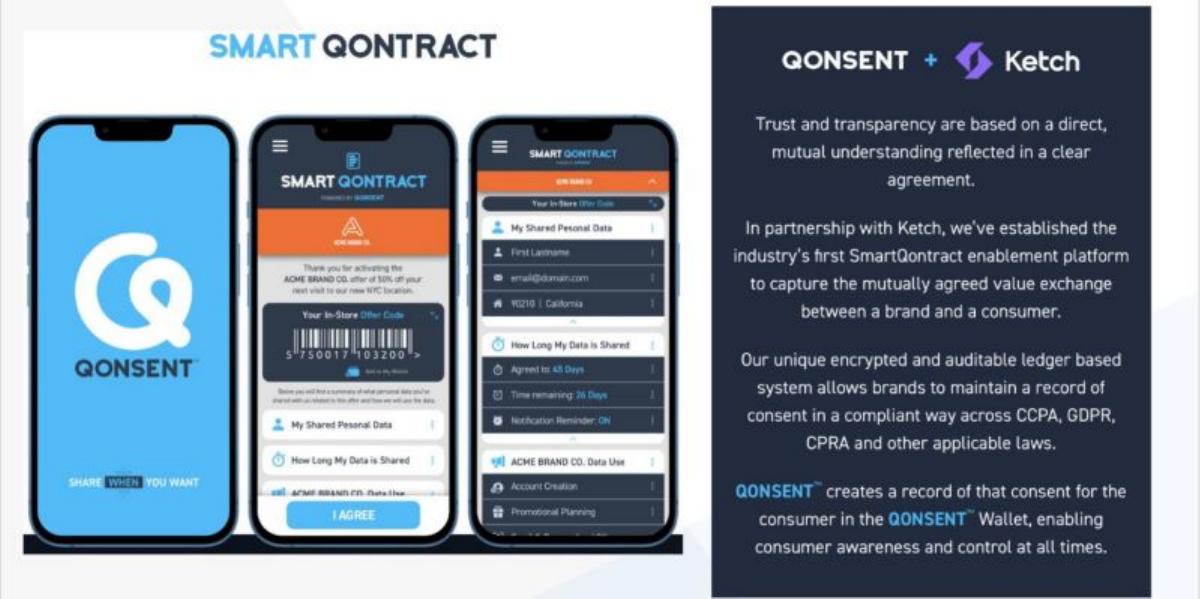
This slide introduces the 'Smart Qontract' in partnership with Ketch. It describes an 'encrypted and auditable ledger based system' that allows brands to maintain a record of consent across CCPA, GDPR, and CPRA. The UI mockups show a 'Qonsent Wallet' where a user can see exactly what data is shared, for how long (e.g., 'Agreed to: 45 Days'), and for what purpose (e.g., 'Account Creation'). This is the 'how it works' slide that justifies the technical complexity of the raise.
Slide 6: The Qonsent Reader
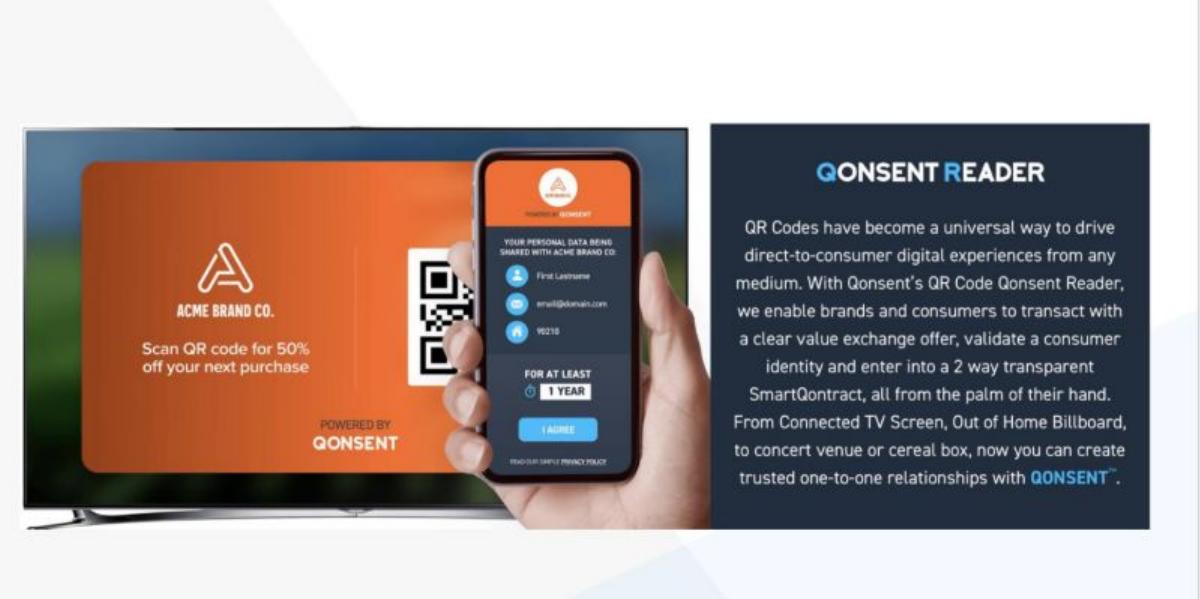
Slide 6 addresses the 'where it works' question. It showcases a 'Qonsent Reader' that uses QR codes to drive digital experiences from any medium. The example shows a television screen with a QR code for '50% off your next purchase.' The text emphasizes that this works for Connected TV (CTV), billboards, concert venues, and even cereal boxes. This expands the use case from web-only to the physical world.
Slide 7: The Consumer App
Slide 7 provides more detail on the 'Consumer App,' described as a 'powerful consent wallet.' It introduces the term 'Dynamic Qonsent,' which allows users to turn data sharing on and off with a tap. It also mentions that the system is 'Web3 enabled.' The slide lists integration examples like OneTrust and Salesforce, positioning Qonsent as the 'Consent Custodian' that sits between the consumer and these massive enterprise databases.
Slide 8: Value Proposition for Causes
Slide 8 is a text-heavy summary of the 'Qonsent Impact.' It repeats the 'Dynamic Qonsent' and 'Real-time PII encryption' points but adds a new angle: leveraging consumer data for 'causes and CSR initiatives.' This appears to be a secondary use case intended to show the versatility of the platform beyond standard retail marketing.
Slide 9: Closing Slide
The final slide is a generic promotional slide for the platform where the deck was hosted (bestpitchdeck.com). It contains no company-specific information, contact details, or a 'thank you' message from the founders.
What Works in the Qonsent Deck
Specific Partnerships: The most effective part of this deck is the explicit naming of TransUnion and Ketch. In the privacy and identity space, building from scratch is difficult; showing that you are integrated with the industry's data giants provides immediate credibility that a 'Team' slide might not achieve alone.
Product Visualization: The deck uses high-quality mobile mockups to explain a very abstract concept (data consent). By showing the 'Qonsent Wallet' and the 'Smart Qontract' interface, the founders make the 'value exchange' tangible for investors.
Regulatory Alignment: The deck explicitly mentions CCPA, GDPR, and CPRA. By tying the product directly to these legal frameworks, Qonsent positions itself as a 'must-have' compliance tool rather than a 'nice-to-have' marketing tool.
What is Missing from the Qonsent Deck
The Team: There is no mention of who is building this. In a Seed round, the 'who' is usually as important as the 'what.' The omission suggests a founder with a significant track record who perhaps didn't feel the need to include a bio slide, or a deck that was intended to be accompanied by a heavy verbal presentation.
Business Model: The deck identifies as a 'SaaS Platform' but provides no information on pricing, contract sizes, or how they make money. Is it per-user, per-transaction, or a flat enterprise fee? This is a major gap.
Market Size and Traction: There is no TAM/SAM/SOM analysis and no mention of current revenue, user numbers, or pilot programs. While the integrations are impressive, the deck doesn't state if these integrations are live or merely 'in development.'
The Ask: The deck ends without a call to action. There is no mention of how much money is being raised (though we know it was $5M) or what those funds will be used for (hiring, R&D, sales expansion).
Founder Takeaways
Focus on the 'How': If you are building in a complex technical or regulatory space, spend your slides showing the mechanics of the solution. Qonsent’s use of 'Smart Qontracts' and 'Ledger-based systems' provides a clear technical narrative.
Leverage Ecosystem Partners: If you have a partnership with a major player, make it the centerpiece of your deck. Qonsent used TransUnion to solve the 'identity' problem, which allowed them to focus their pitch entirely on the 'consent' problem.
Visualizing the Invisible: Data privacy is invisible. Qonsent turned it into a 'Wallet' with 'On/Off' switches. Founders building back-end tools should always look for ways to visualize the end-user experience to make the product more relatable to non-technical investors.
Don't Skip the Basics: Unless you are a serial founder with a direct line to VCs, do not omit the Team, Traction, and Ask slides. Qonsent raised $5M despite these omissions, but for most startups, these are the slides that determine whether an investor takes a second meeting.
Company: Qonsent · Stage: Seed ($5M Raised) · Year: 2021 · Key Focus: Consumer-driven data privacy and identity validation.
Frequently asked questions
- How did Qonsent raise $5M without a team slide?
- While the deck omits a team slide, the catalogue listing indicates the company raised $5M in 2021. In high-conviction Seed rounds, investors often have prior relationships with founders or deep knowledge of the technical architecture. Qonsent likely relied on the strength of its 'patent pending' status and its existing integrations with major players like TransUnion to prove credibility without needing a dedicated bio slide.
- What is the core technology behind the Qonsent platform?
- According to Slide 5 and Slide 7, the platform uses an 'encrypted and auditable ledger based system' to manage consent. It is described as a 'Web3 enabled' smart contract system. This allows the company to create a permanent, compliant record of the 'value exchange' between a brand and a consumer, which is critical for meeting regulatory requirements like GDPR and CCPA.
- Who are Qonsent's primary competitors according to the deck?
- The deck does not include a traditional competitor matrix. However, Slide 7 and Slide 8 mention 'Consent Management Platforms' (CMPs) such as OneTrust and Salesforce as examples of where Qonsent transfers data. This suggests Qonsent views itself as a complementary 'consumer-facing' layer that sits on top of or feeds into these existing enterprise privacy tools.
- What specific industries is Qonsent targeting?
- The deck highlights 'Brands' and 'Marketers' as the primary users. Slide 6 specifically mentions 'Connected TV Screen, Out of Home Billboard, to concert venue or cereal box.' This indicates a broad target market across retail, media, and consumer packaged goods (CPG) where direct-to-consumer engagement is currently hindered by privacy regulations.
- What is missing from this deck that a typical founder should include?
- This deck is missing almost all 'business' slides: Market Size (TAM/SAM/SOM), Business Model (pricing), Go-to-Market strategy, Traction/Metrics, Team, and the Ask. Founders should generally not omit these unless they have a significant technical moat or pre-existing investor interest. Qonsent’s deck is strictly a product and partnership overview.