Qashops' 2016 pitch deck is a focused presentation on solving the technical friction between manufacturers and online marketplaces. By positioning themselves as the 'most advanced' connector, they demonstrate significant early traction, managing 2 million products across 82 countries. The deck excels at showcasing a blue-chip customer list including GAP and Huawei, while providing a clear, tiered customer acquisition strategy. However, the version analyzed has several key financial figures redacted, which obscures the true efficiency of their burn rate. Despite this, the roadmap for internati…
Key takeaways
- The platform manages a massive catalog of 2M products from 500 different brands (Slide 15).
- Qashops claims the largest number of marketplace connectors in the industry, totaling 66 channels (Slide 5).
- The company successfully tested its business model with 20 large customers in 2015 before scaling (Slide 8).
- Traction is demonstrated by a sharp monthly transaction increase, peaking at 16,526 in December (Slide 9).
- The customer acquisition strategy is clearly segmented into four tiers, from international sales teams for top brands to online marketing for the long tail (Slide 7).
- The team consists of 22 people with deep roots in retail and e-commerce, including former CEOs of Hummel Spain and BariVIP (Slide 16).
- The deck identifies four main competitors, explicitly calling out their weaknesses such as 'lack of functionality' or being 'slow and expensive' (Slide 11).
- The fundraising ask is specific: 1M€ for a co-investment to lead international expansion (Slide 19).
Executive Summary and Mission
Slides 1-2: The Hook
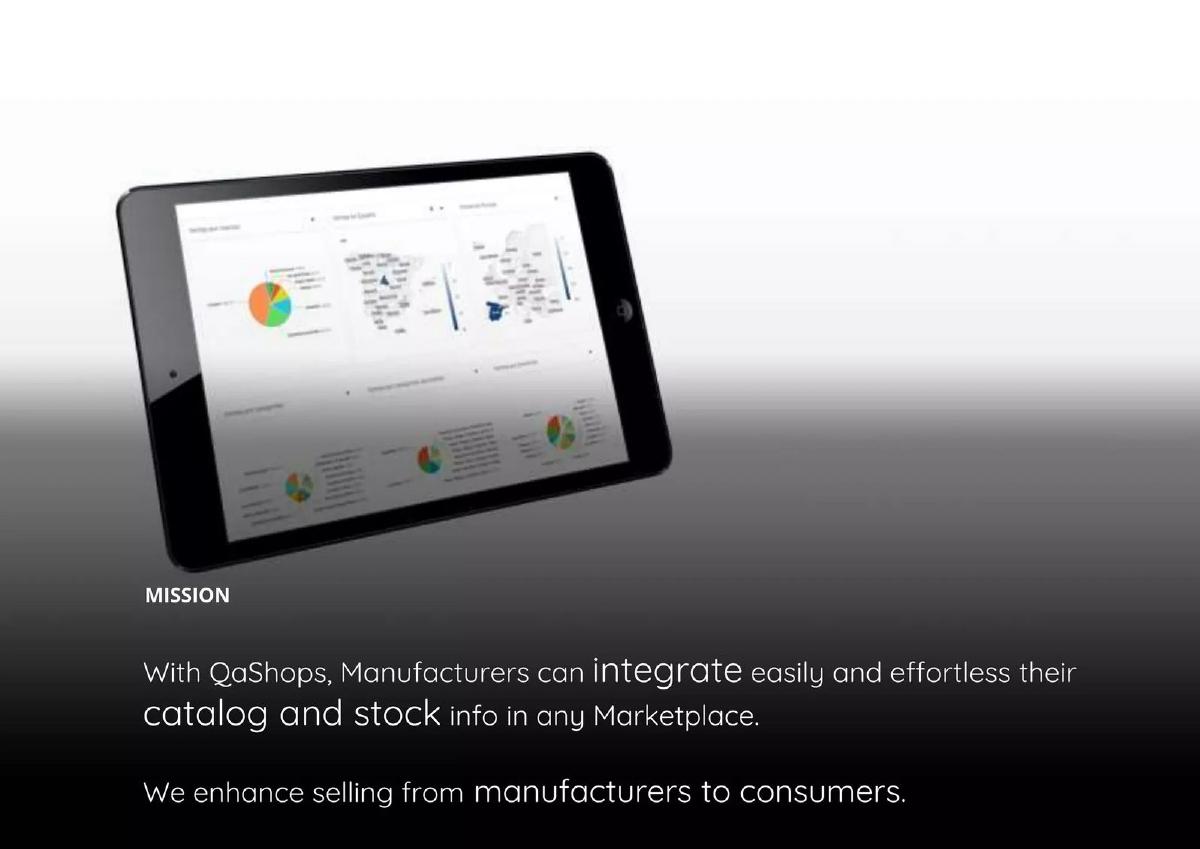
The deck opens with a clear, minimalist title slide (Slide 1) that defines the company's value proposition in five words: "Connecting Manufacturers with Online Marketplaces." This is a strong start, as it immediately identifies the target user (manufacturers) and the environment (marketplaces). Slide 2 follows up with a mission statement, emphasizing that the integration of catalog and stock info is "easy and effortless." The use of a tablet mockup showing a dashboard suggests a finished, user-ready product rather than a conceptual one.
Slide 3: The Platform Architecture
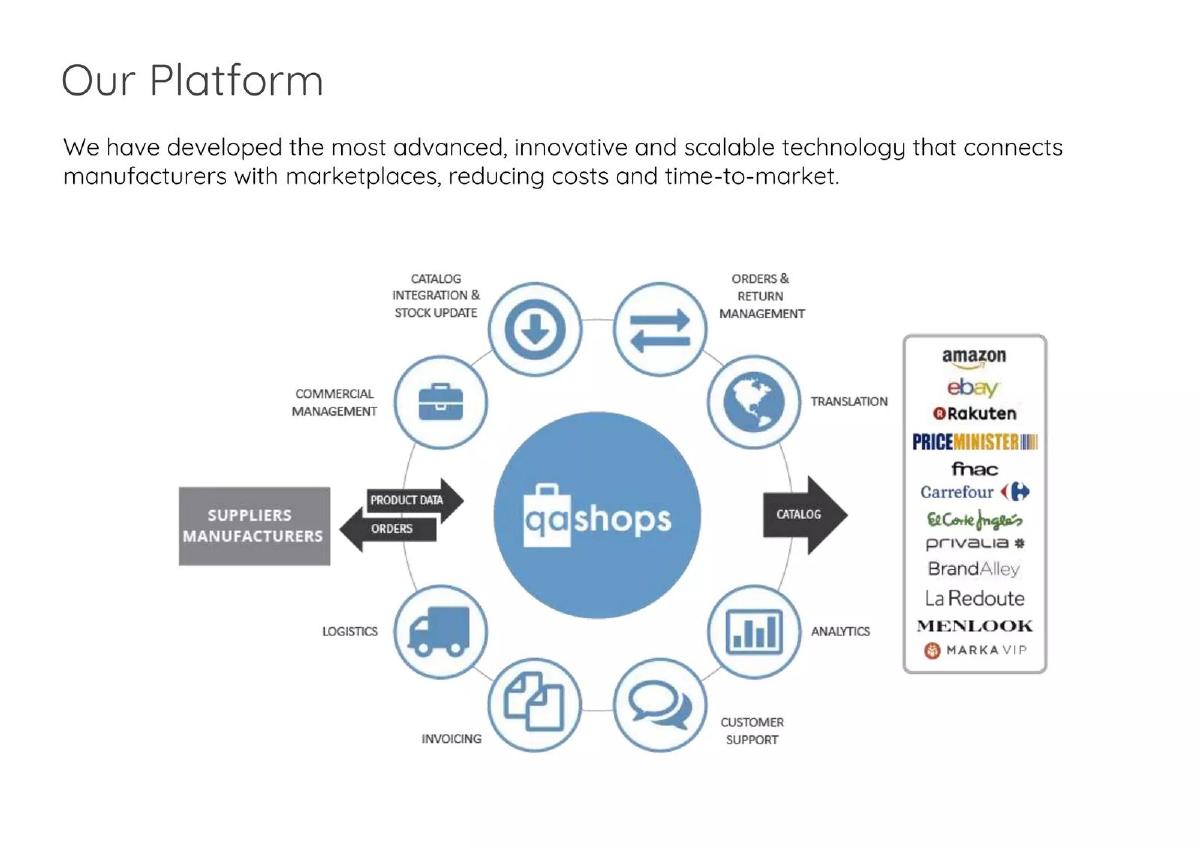
Slide 3 is perhaps the most important technical slide in the deck. It uses a circular flow diagram to show Qashops at the center of an ecosystem. It details eight specific functions: Catalog Integration, Orders & Return Management, Translation, Analytics, Customer Support, Invoicing, Logistics, and Commercial Management. To the right, it lists logos of major partners like Amazon, eBay, Rakuten, and Fnac. This slide successfully communicates that Qashops is not just a data uploader, but a full-stack operations partner for e-commerce.
Product and Market Position
Slides 4-5: The Product Edge
After a simple transition (Slide 4), Slide 5 makes a bold claim: Qashops is the company with the "largest number of marketplace connectors right now," citing 66 marketplaces globally. This is a classic 'moat' argument—in the world of API integrations, the company with the most pre-built connections often wins because they offer the fastest time-to-market for new customers.
Slides 6-7: The Business Model and Sales Strategy
Slide 6 is a filler transition ("Let's make Money"), but Slide 7 provides a very professional breakdown of their Go-To-Market (GTM) strategy. By segmenting their sales approach into a four-tier pyramid, they demonstrate to investors that they aren't just 'hoping' for customers. They have a specific resource allocation for every type of lead, from high-touch direct sales for GAP-sized brands to low-touch digital marketing for the long tail.
Traction and Performance
Slides 8-9: 2015 Retrospective
Slide 8 highlights that 2015 was the year of validation, where they tested the model with 20 large customers and made 2M products available to 82 countries. Slide 9 provides the hard data to back this up. A pie chart shows a heavy concentration in Spain (51%), but significant footprints in France and the UK. More importantly, the bar chart of "Transactions/month" shows exponential growth, jumping from 4,151 in October to 16,526 in December. This 'hockey stick' graph is exactly what venture capitalists look for in a growth-stage deck.
Slides 10-11: Competitive Landscape
Slide 11 is a refreshingly honest look at the competition. Rather than a generic feature-comparison grid, Qashops lists four competitors (names redacted in this version) and provides a status update on each. They claim to be "acquiring most of their main customers" from one competitor and dismiss another as a "dinosaur" that is "slow, expensive but famous." This narrative positioning suggests Qashops is the agile, modern alternative to legacy systems.
Social Proof and Team
Slides 12-15: Customer Stories and Logos
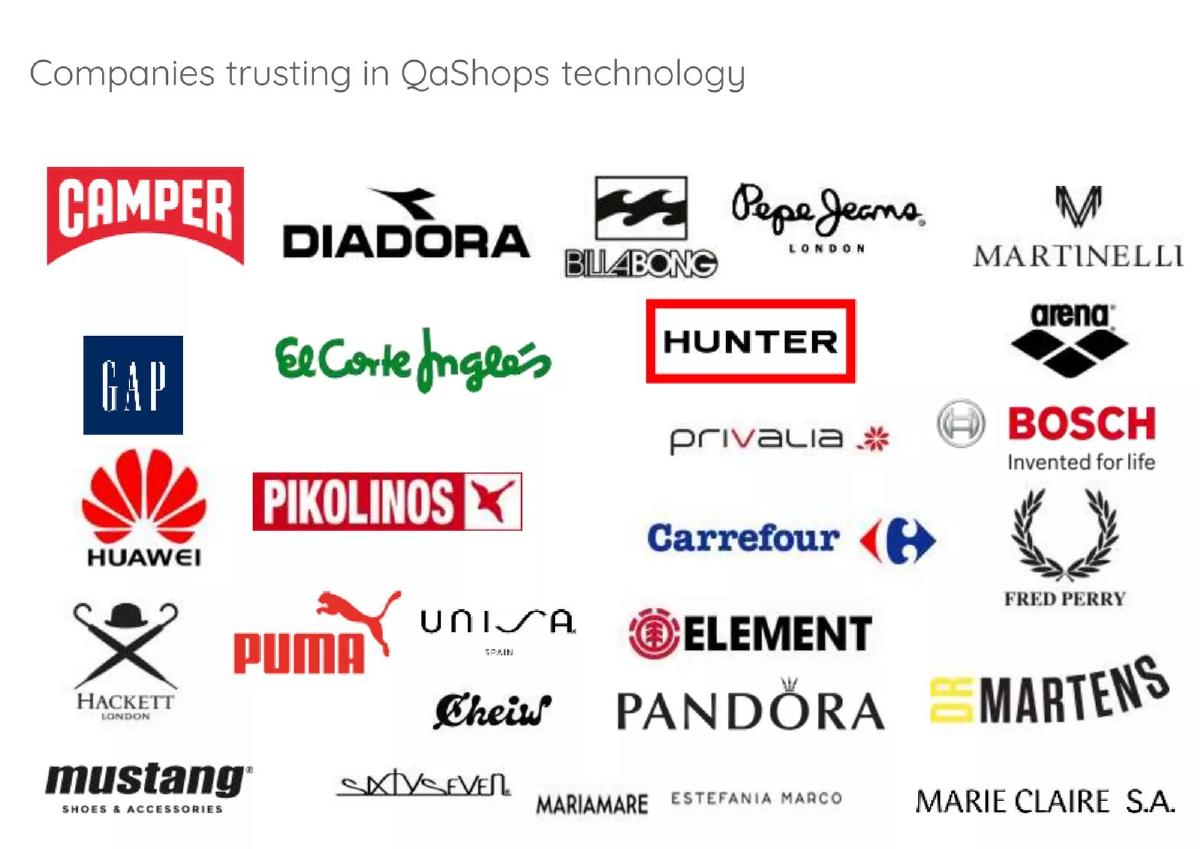
Slide 13 uses Billabong as a primary case study, noting that Qashops is their "solely partner for multichannel operations in Europe." This is high-quality social proof. Slide 15 expands this with a wall of logos including Huawei, GAP, and Carrefour. Stating that they are adding "10 brands/month" gives the investor a sense of momentum.
Slide 16: The Team
The team slide is robust, showing 22 employees with a leadership core of six. The bios are focused on relevant experience: Juan Macias (CEO) is a serial entrepreneur with 15 years in retail; Manuel Recio (Sales Director) was a former CEO of Hummel Spain; and Jose A. Jimenez (COO) was the CEO of BariVIP. This is a "heavyweight" team for a 1M€ round, which likely gave investors significant confidence in their execution capability.
Future Outlook and The Ask
Slides 17-19: Roadmap and Funding
Slide 18 maps out a global expansion plan, targeting LATAM and Europe in 2016, and North America/Asia in 2017. Finally, Slide 19 delivers the ask: 1M€ to lead a co-investment. They mention burning less than a certain amount (redacted) while maintaining 25 employees, suggesting they have been capital efficient to date. The goal is clear: "become international and take the business globally."
What Works in This Deck
Specific Traction: Citing 2 million products and 66 connectors provides tangible proof of scale that is hard to fake. · Tiered GTM: The pyramid strategy for customer acquisition shows they understand their unit economics and how to scale sales. · Logo Density: The inclusion of global brands like GAP and Huawei immediately elevates the company's perceived value. · Clear Functionality: The circular diagram on Slide 3 explains a complex technical product in a way that a non-technical investor can understand.
What Is Missing
Unit Economics: While they mention burn rate and GMV, the deck lacks specific details on LTV (Lifetime Value) and CAC (Customer Acquisition Cost). · Revenue Model: The deck says "Let's make Money" but doesn't explicitly state if they take a percentage of GMV, a SaaS subscription fee, or a per-listing fee. · Market Size (TAM): There is no slide detailing the Total Addressable Market for marketplace connectors, which is a standard requirement for VC decks.
Founder's Playbook: What to Copy
The "Status" Competitor Slide: Instead of a checkmark grid, use Slide 11's approach. Explain why you are winning against specific rivals (e.g., "We are acquiring their customers"). · The Traction Graph: Slide 9's month-over-month transaction growth is the most compelling slide in the deck. If you have a 'hockey stick' metric, make it a full-page focus. · The Partner Ecosystem: If your product relies on integrations, show them as a circle of influence as seen on Slide 3. It makes your company look like the center of an industry, not just a tool.
Frequently asked questions
- What exactly does the Qashops platform do?
- As described on Slide 3, Qashops acts as a central hub for manufacturers. It integrates product data and orders between the supplier and various marketplaces. The platform handles catalog integration, stock updates, order and return management, translation for international markets, logistics, invoicing, and customer support. It essentially removes the technical burden for a brand wanting to sell on Amazon, eBay, or Rakuten.
- Who are Qashops' primary customers?
- According to Slide 15, they work with over 500 brands across different sectors. Notable examples cited include GAP, Camper, Hunter, Pepe Jeans, Huawei, and Bosch. They also partner directly with sales channels like El Corte Inglés and Carrefour as a 'preferred integrator.' This dual-sided approach allows them to capture both the supply (brands) and the demand (marketplaces).
- How does Qashops plan to grow its customer base?
- Slide 7 outlines a four-tier 'pyramid' strategy. Tier 1 (International Brands) is handled via direct negotiation by an international sales team. Tier 2 (Local Brands) relies on referrals from marketplaces. Tier 3 (Mid-size Brands) uses a local sales team, and Tier 4 (Small Brands/Long Tail) is targeted through automated online marketing. This shows a sophisticated understanding of CAC (Customer Acquisition Cost) relative to account size.
- What is the company's current geographic reach?
- Slide 9 shows that Spain is their largest market, accounting for 51% of transactions, followed by France at 21% and the UK at 10%. However, they have a presence in 82 countries. Their 'International RoadMap' on Slide 18 indicates a heavy push into Latin America and broader Europe for 2016, followed by North America and Asia in 2017.
- What are the terms of the investment they are seeking?
- Slide 19 states they are looking for a Venture Capital Fund to lead a 1M€ co-investment alongside their existing main investors. The funds are earmarked for overseas expansion and scaling the business globally. The slide also notes they have 25 employees across three cities, though the specific burn rate and GMV figures are redacted in this version of the deck.