Dame's Series A pitch deck is a sophisticated example of how to pitch a 'taboo' product by framing it through the lens of medical wellness and massive retail validation. The deck successfully pivots from a niche adult product to a broad consumer health play, citing a $60B market opportunity and a significant 'pleasure gap' where only 39% of women usually orgasm during sex compared to 91% of men. By showcasing a management team with pedigrees from Glossier and Casper, alongside a clinical board of MDs and PhDs, Dame de-risks the category for institutional capital. The inclusion of high-tier wh…
Key takeaways
- The deck identifies a $60B market with 'no leader,' positioning Dame as the primary incumbent in a fragmented space (Slide 3).
- Dame uses a 'Clinical Board' featuring MDs and PhDs to provide medical legitimacy to a consumer pleasure product (Slide 7).
- The management team features experience from high-growth D2C brands like Glossier, Casper, and Curology, signaling operational maturity (Slide 5).
- Wholesale traction is a core pillar of their growth story, listing major retailers like Sephora, Nordstrom, and Amazon as active partners (Slide 11).
- The brand strategy focuses on 'life moments' such as pregnancy, menopause, and cancer to expand the use case beyond simple recreation (Slide 13).
- Cohort data shows increasing units per customer from 2019 to 2021, suggesting strong brand loyalty and a multi-product ecosystem (Slide 9).
- The deck explicitly highlights the 'pleasure gap' (39% vs 91% orgasm rates) to establish a mission-driven problem statement (Slide 3).
- Investor testimonials from Amboy St Ventures and Listen are used to validate the company's ability to dismantle industry-wide stigma (Slide 15).
The Strategic Rebranding of Pleasure
Dame’s Series A deck is a masterclass in category design. In a sector often relegated to the fringes of the 'adult' industry, Dame successfully pitches itself as a mainstream consumer wellness powerhouse. The deck, which supported a $7M raise in 2024 as reported by Business Insider, focuses heavily on institutionalizing a previously fragmented market. By the time an investor reaches the final slide, the company has successfully transitioned from a 'sex toy startup' to a 'clinical wellness brand' with massive retail distribution.
Slide 1-2: Visual Identity and Brand Positioning
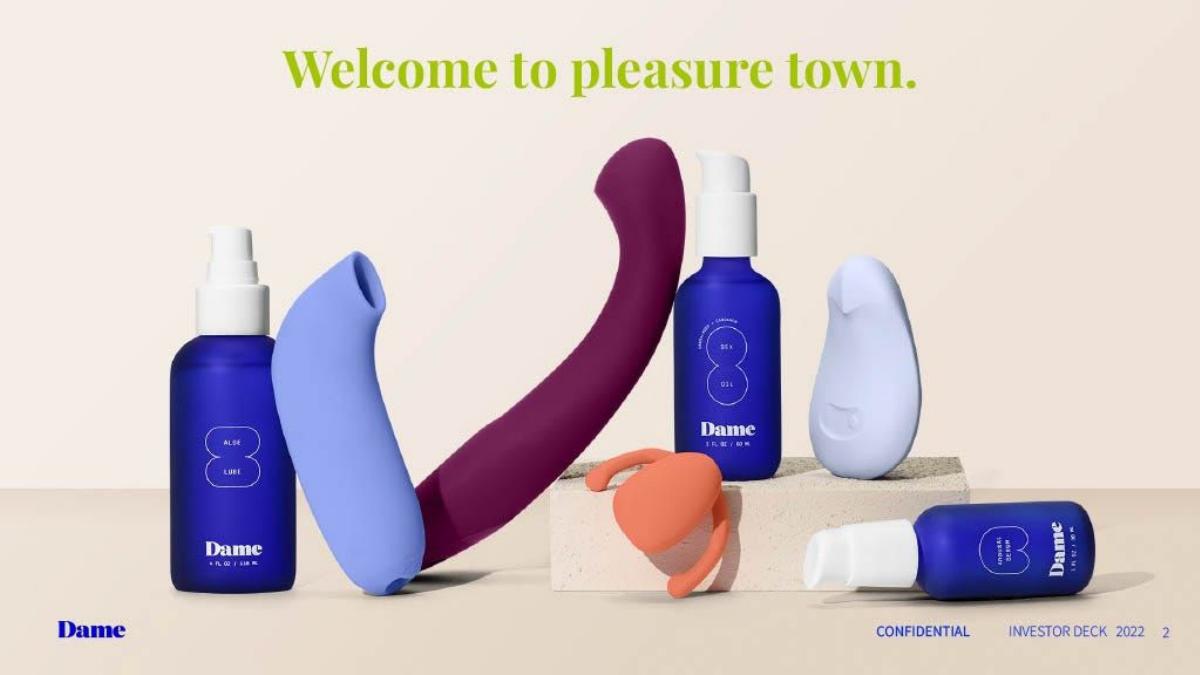
The opening slides are minimalist, focusing on high-quality lifestyle photography. The imagery is intimate but professional, setting a tone that is sophisticated rather than provocative. This is a deliberate choice to immediately distance the brand from the aesthetic of traditional 'adult' shops. The logo is prominent, establishing brand equity from the first second.
Slide 3: The Problem and The Gap
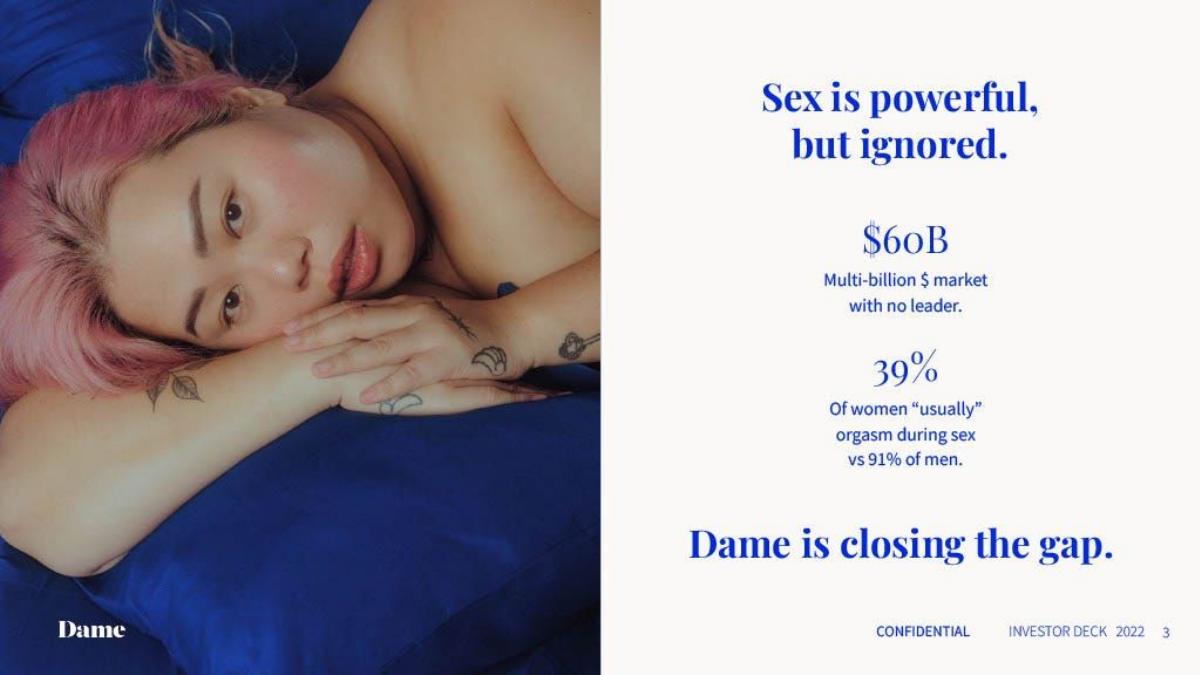
Slide 3 introduces the core thesis: 'Sex is powerful, but ignored.' Dame quantifies the opportunity with two striking figures. First, a $60B multi-billion dollar market with no leader . This suggests a 'land grab' opportunity for a brand that can achieve household-name status. Second, they highlight the 'pleasure gap': 39% of women 'usually' orgasm during sex vs 91% of men . This frames Dame’s mission not just as a business, but as a solution to a systemic inequality in wellness.
Slide 5: Management and Traction
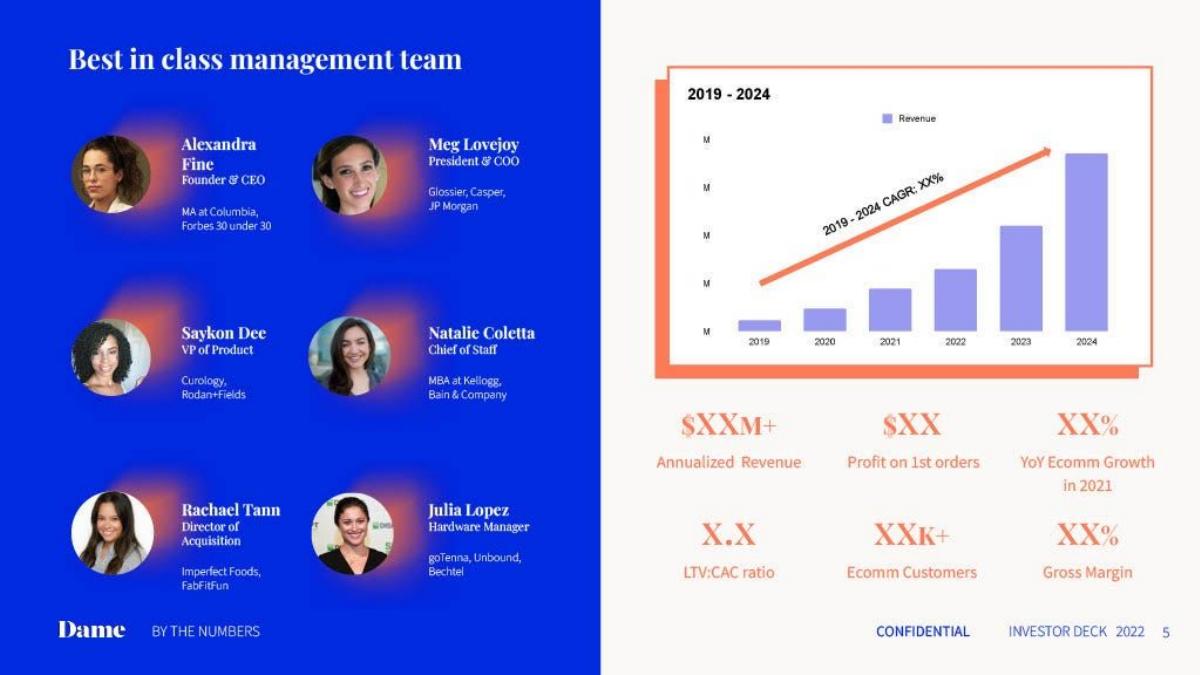
This slide is a 'heavy hitter' for the Series A stage. It splits the screen between a high-pedigree management team and a growth chart. The team includes Alexandra Fine (CEO, Forbes 30 under 30) and Meg Lovejoy (COO, formerly of Glossier and Casper) . The inclusion of names like Bain & Company, JP Morgan, and Curology under the executive headshots tells investors that this is a 'grown-up' company capable of handling institutional capital. The right side of the slide shows a revenue bar chart from 2019 to 2024 with a clear upward trajectory, though specific figures are redacted as '$XXM+'. They also list key KPIs such as LTV:CAC ratio and Gross Margin , signaling a focus on unit economics.
Slide 7: Clinical Validation
To further de-risk the investment, Slide 7 introduces 'Community & Expert Led Product Development.' They highlight Dame Labs , a research arm, and a Clinical Board . The board features four professionals with titles like MD, FACOG, and PhD . This is a critical slide for a femtech company; it moves the product from the 'novelty' category into the 'health and science' category, which is essential for winning over conservative VC funds and medical-grade retail partners.
Slide 9: Customer Retention and LTV
Slide 9 addresses the 'one-and-done' concern common in hardware startups. Through 'LTV Cohorts' and 'Units per customer' charts, Dame demonstrates that their customers are repeat buyers. The 'Units per customer' bar chart shows a visible increase in customers owning 2, 3, 4, and 5+ products between 2019 and 2021. This proves that Dame is building a brand ecosystem, not just selling a single gadget.
Slide 11: The Wholesale Moat
Perhaps the most impressive slide in the deck is Slide 11, 'Investment in Wholesale.' It lists three distinct categories: Beauty/Wellness (Sephora, Nordstrom, Goop, Revolve, Anthropologie), Adult (Eropartner, Entrenue), and Amazon . Seeing Sephora and Nordstrom logos next to sexual wellness products is a massive validation of Dame’s ability to break through retail barriers. It indicates that the 'stigma' has already been defeated at the buyer level, which is a major hurdle for scaling.
Slide 13: Lifecycle Expansion
Slide 13, 'With You As Intimacy Evolves,' shows the long-term vision. They map out life moments where Dame provides support: Sexual Exploration, Relationships, Pregnancy, Cancer, and Menopause . This is a strategic move to show that their TAM (Total Addressable Market) is not just 'sexually active young adults,' but literally every woman at every stage of life. This significantly increases the perceived ceiling for the company’s growth.
Slide 15: Investor Testimonials
The deck concludes with social proof from existing investors. Carli Sapir of Amboy St Ventures and Rick Desai of Listen provide quotes. Sapir notes that Dame is 'plowing through industry-wide hurdles' and 'dismantling shame.' These testimonials serve as a final nudge to new investors, confirming that the company has already been vetted by specialists in the wellness and consumer sectors.
What Dame's Deck Does Well
1. Professionalization of a Taboo Category: By using a 'Clinical Board' and hiring executives from 'clean' D2C brands like Glossier, Dame makes it safe for institutional investors to say 'yes.' They treat their product with the same analytical rigor as a SaaS company or a medical device firm.
2. Proof of Mainstream Adoption: The wholesale slide is the 'smoking gun' of the deck. It is one thing to sell vibrators on your own website; it is another thing entirely to have them stocked at Nordstrom. This proves the brand has 'crossed the chasm.'
3. Mission-Driven Narrative: The 'pleasure gap' is a compelling hook. It gives the company a 'Why' that goes beyond just selling hardware. It positions the brand as a participant in the broader movement for women's health and empowerment.
What is Missing from the Dame Deck
1. Specific Unit Economics: While the deck mentions LTV:CAC and Gross Margin on Slide 5, the actual numbers are redacted or represented as placeholders ($XX). For a Series A, investors would need to see if the CAC is sustainable as they move away from organic 'hype' and into paid acquisition.
2. Competitive Landscape: The deck claims there is 'no leader' in the $60B market (Slide 3), but it does not mention competitors like Lelo, Maude, or Smile Makers. A slide addressing how Dame differentiates itself from these other 'modern' wellness brands would have been useful.
3. The 'Ask' and Use of Funds: The provided slides do not include a final 'Ask' slide detailing how much they are raising (though we know it was $7M) or exactly how that capital will be deployed (e.g., R&D, international expansion, or marketing).
Founder's Playbook: Lessons from Dame
Use 'Expert' Boards to De-Risk: If you are building in a category that is misunderstood or stigmatized, surround yourself with MDs and PhDs. Dame’s Clinical Board (Slide 7) is a shield against the 'frivolous' label.
Focus on the 'Second Purchase': Investors fear hardware because of the lack of recurring revenue. Dame fought this by showing 'Units per customer' growth (Slide 9). If you sell a physical product, you must prove you are a brand, not a SKU.
Leverage 'Halo' Logos: If you have one high-tier partner, put them front and center. Dame’s use of the Sephora and Nordstrom logos (Slide 11) does more to prove their market viability than a dozen charts ever could. It shows that the most discerning buyers in the world have already said 'yes' to the brand.
Frequently asked questions
- How does Dame handle the stigma associated with sex toys in a professional pitch?
- Dame reframes the product category as 'sexual wellness' and 'intimacy support.' By using clinical terminology, citing a 'Clinical Board' of medical professionals on Slide 7, and focusing on the 'pleasure gap' as a health disparity, they move the conversation from adult entertainment to consumer healthcare and wellness.
- What is the significance of the management team's background?
- The team (Slide 5) includes veterans from Glossier, Casper, and Curology. This is a strategic signal to investors that the founders know how to build 'unicorn' style D2C brands. It suggests they have the playbook for customer acquisition, brand identity, and scaling logistics already in place.
- Why does the deck emphasize wholesale over D2C?
- While D2C is likely a large part of their revenue, Slide 11 highlights 'Investment in Wholesale' with logos like Sephora and Nordstrom. This proves that the brand is 'retail-ready' and has overcome the gatekeeping of major distributors, which is a massive hurdle for sexual wellness companies.
- What metrics does Dame use to show product-market fit?
- On Slide 9, they show 'Units per customer' increasing year-over-year from 2019 to 2021. This indicates that customers aren't just buying one vibrator and leaving; they are returning to buy second, third, and fourth products, proving a 'sticky' brand ecosystem.
- How does Dame plan to expand its market reach?
- Slide 13 outlines a lifecycle approach. Instead of just targeting 'sexual exploration,' they position Dame as a partner for 'Pregnancy,' 'Menopause,' and even 'Cancer' recovery. This broadens the Total Addressable Market (TAM) to include every stage of a woman's life.