Daseke's 2018 presentation serves as a masterclass in articulating a 'roll-up' strategy within a fragmented industrial sector. By positioning itself as the leading consolidator in the specialized flatbed trucking market, Daseke demonstrates how scale addresses regulatory hurdles, insurance liabilities, and national customer demands that smaller players cannot meet. The deck reveals a rapid expansion fueled by eight integrated acquisitions, resulting in a market share increase from less than 1% to approximately 3% in just one year. Financially, the company showcases a shift toward an asset-lig…
Key takeaways
- Daseke identifies as the largest pure-play flatbed and specialized logistics carrier in North America (Slide 1).
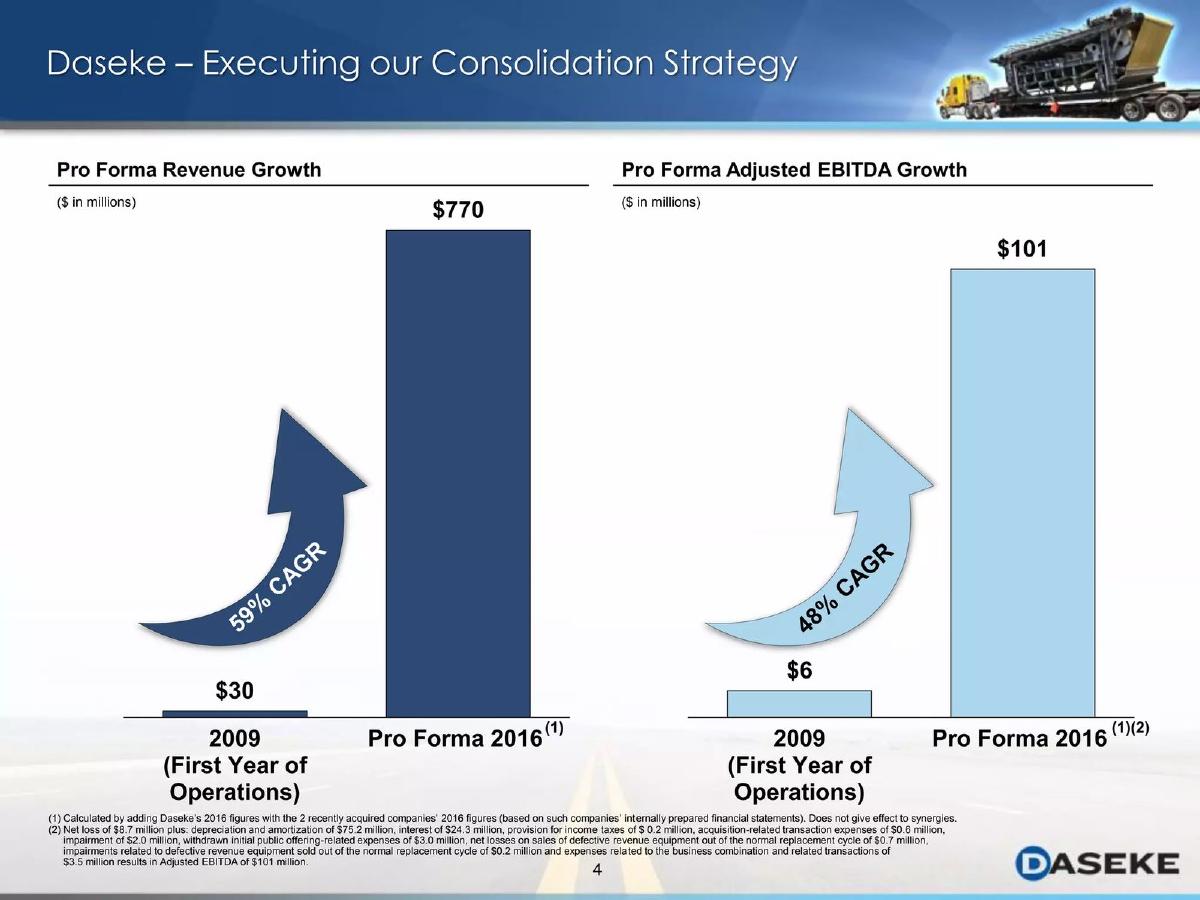
- The company grew revenue from $652 million in 2016 to an acquisition-adjusted $1.5 billion for the LTM ending 3/31/18 (Slide 8).
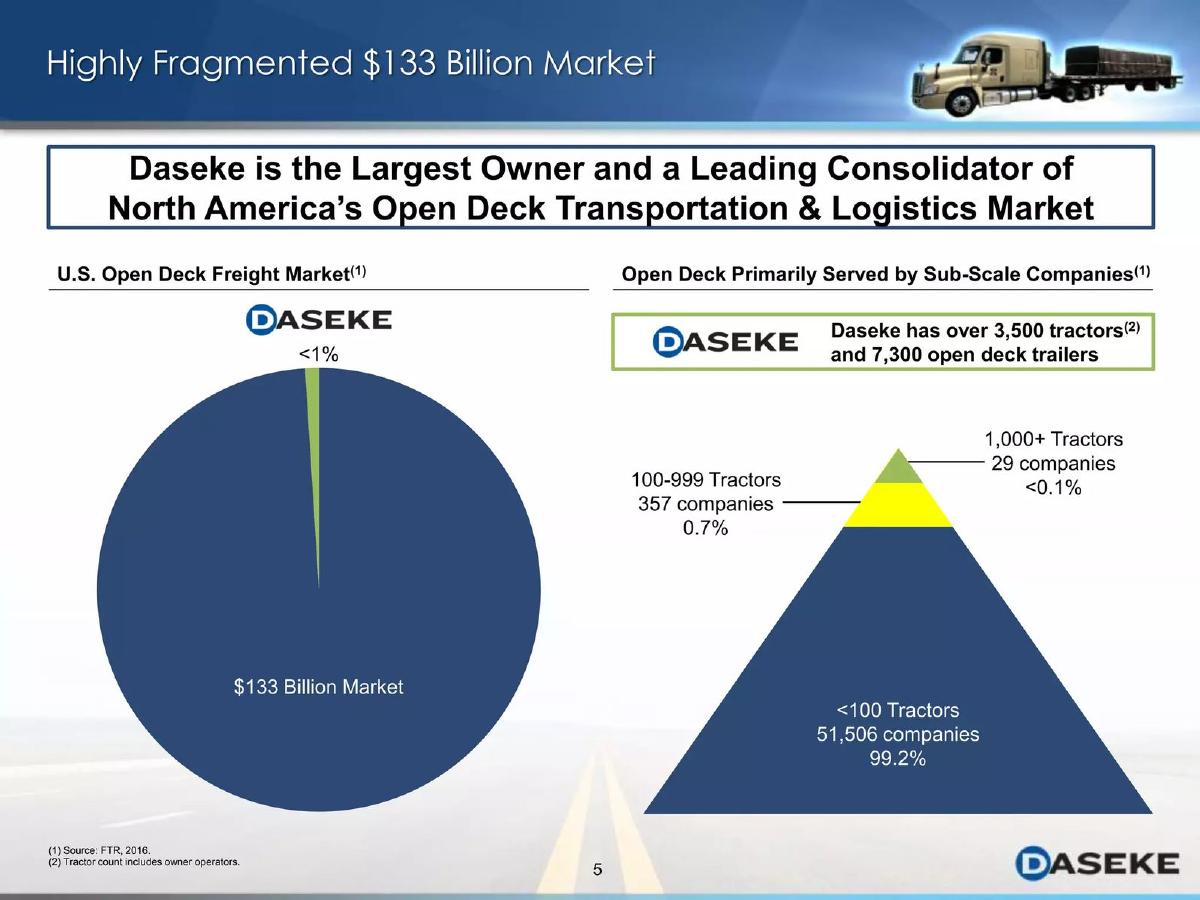
- Market share increased from less than 1% to approximately 3.0% in 2017 following eight integrated acquisitions (Slide 8).
- Scale is presented as a competitive moat, providing advantages in insurance coverage, regulatory compliance, and purchasing power (Slide 12).
- Acquired companies show an average of ~20% organic Adjusted EBITDA growth within 24 months post-acquisition (Slide 16).
- The business model is shifting toward asset-light operations, which grew from 34% of revenue in 2016 to 46% in 2017 (Slide 8).
- Specialized logistics includes high-complexity niches like commercial glass, super heavy haul, and high-security cargo (Slide 4).
- The leadership structure is decentralized, retaining experienced management from acquired regional carriers like Bulldog Hiway Express and Lone Star Transportation (Slide 28).
Executive Summary: The Industrial Roll-Up Playbook
Daseke’s June 2018 investor presentation is a definitive example of a 'roll-up' strategy deck. At the time of this presentation, Daseke was positioning itself as the dominant force in a highly fragmented market: specialized flatbed trucking. Unlike standard logistics, specialized hauling requires expensive equipment and rigorous safety standards, which Daseke uses as a justification for its aggressive consolidation model. The deck focuses heavily on the transition from a $600 million company to a $1.5 billion enterprise, primarily through the acquisition of eight companies in a single year.
Slide 1: Title and Market Positioning
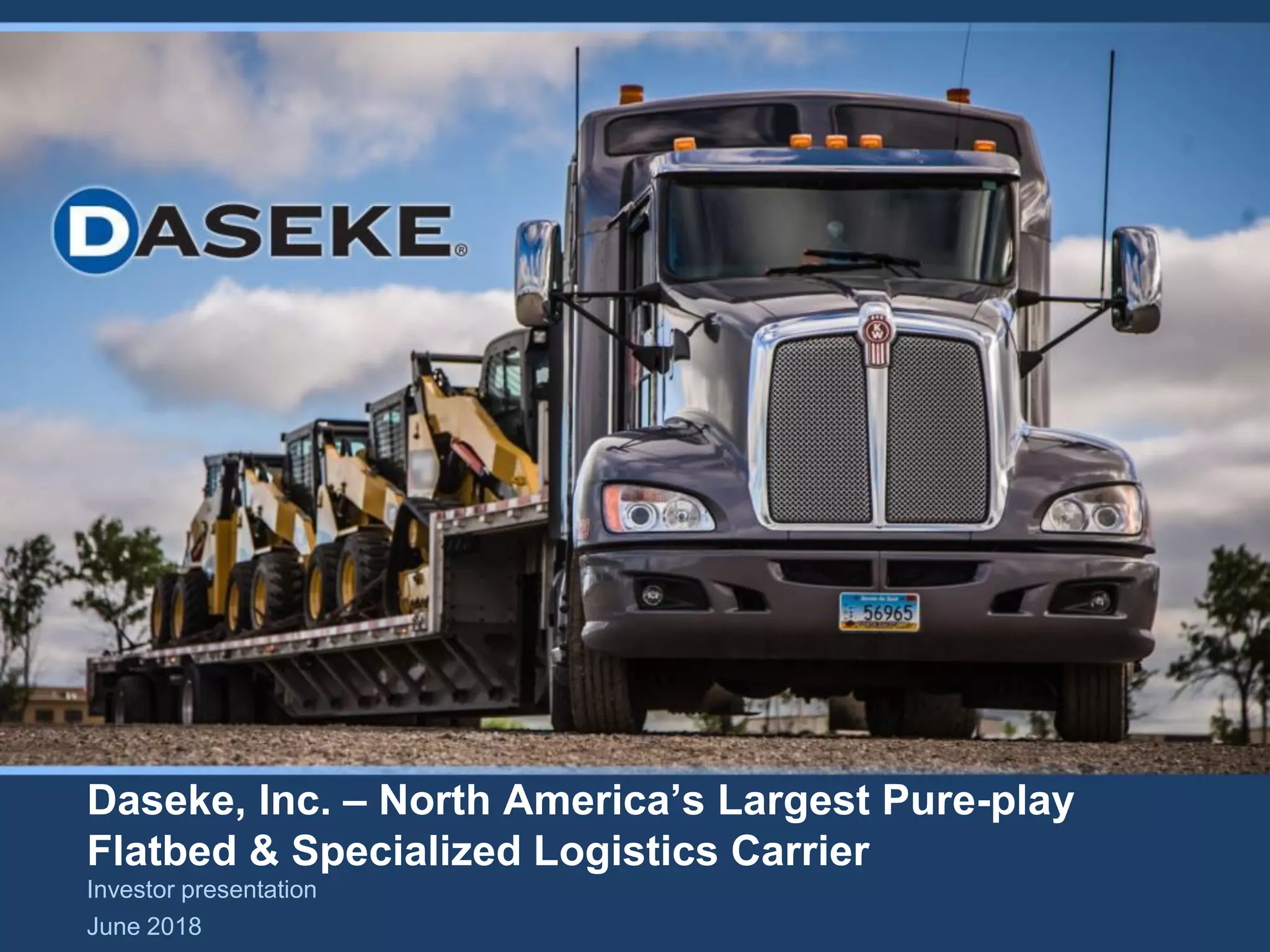
The cover slide establishes Daseke’s primary value proposition: 'North America’s Largest Pure-play Flatbed & Specialized Logistics Carrier.' By using the term 'pure-play,' they distinguish themselves from larger, diversified logistics giants, suggesting a deeper expertise and focus in their specific niche. The imagery of a Kenworth truck hauling heavy machinery immediately grounds the presentation in the industrial sector.
Slide 4: Defining the Niche
This slide serves as an educational tool for investors who may not understand the nuances of the trucking industry. It defines 'Flatbed & Specialized' through six visual categories: Flatbed, Commercial Glass, Over Dimensional, Super Heavy Haul, High Value Customized, and High Security. This is a crucial slide because it justifies why Daseke can command better margins and face less competition than 'dry van' (standard box truck) carriers. Each of these categories requires specialized trailers and highly trained drivers, creating a natural moat.
Slide 8: Post-Listing Accomplishments
Slide 8 is the 'traction' slide, detailing the company's performance since its public listing. The metrics are aggressive: revenue grew from $652 million in 2016 to an acquisition-adjusted $1.5 billion by March 2018. Adjusted EBITDA followed a similar trajectory, rising from $88 million to $159 million. Most notably, the company highlights a market share increase from less than 1% to ~3.0%. While 3% sounds small, in the fragmented trucking industry, it represents significant market power. The slide also notes a shift toward 'asset-light' revenue (46% in 2017), which is generally viewed more favorably by investors due to lower capital expenditure requirements.
Slide 12: The Moat of Scale
Daseke uses this slide to explain why being big matters in a field of small players. They categorize the advantages of scale into four areas: Customer Demands (national customers want one vendor), Operations (purchasing power for fuel and equipment), Regulatory Compliance (the ability to handle increasing safety costs), and Capital Requirements (access to public markets). This slide is a direct argument against the thousands of small 'mom and pop' carriers that currently dominate the market, suggesting they will eventually be forced to sell or fold under regulatory pressure.
Slide 16: M&A Strategy and Synergies
This slide details how Daseke selects and integrates its targets. They claim to target 'not for sale' carriers—high-quality businesses that aren't actively looking for a buyer but see the value in the Daseke platform. The most impressive claim on this slide is the '~20%' organic Adjusted EBITDA growth within 24 months post-acquisition. They attribute this to 'Daseke Fleet Services,' purchasing consolidation, and rate optimization. This is the core of the investment thesis: Daseke doesn't just buy revenue; they improve the profitability of the companies they buy.
Slide 20: Financial Performance Deep Dive
Slide 20 provides the hard numbers. The revenue bar chart shows a clear upward trend, but the 'Acquisition Adjusted' bars for FY17 ($1,440 million) and LTM 3/31/18 ($1,486 million) show how much of that growth is inorganic. The 'Consolidated Financial Metrics' table reveals a potential red flag: while revenue doubled year-over-year for Q1, the company still posted a Net Loss of $0.8 million. This highlights the high cost of their growth-by-acquisition strategy, though they counter this by showing that Adjusted EBITDA doubled to $35.2 million in the same period.
Slide 28: Regional Leadership Structure
One of the risks of a roll-up is losing the 'secret sauce' of the acquired companies. Daseke addresses this by showcasing their regional leaders. These aren't new corporate hires; they are the veterans of the companies Daseke bought. For instance, Phil Byrd has 33 years at Bulldog Hiway Express, and Tex Robbins has 25 years at Lone Star Transportation. This slide reassures investors that the operational expertise remains intact despite the change in corporate ownership.
Slide 32: Free Cash Flow Reconciliation
The appendix includes a detailed Free Cash Flow (FCF) reconciliation. This is a dense, technical slide that is essential for institutional investors. It shows that for the 12 months ended March 31, 2018, the company generated $71.9 million in Free Cash Flow. This is a critical metric because it proves that despite the net losses shown on Slide 20, the business is generating significant cash after accounting for the capital expenditures ($37.5 million) required to maintain the fleet.
What Works in This Deck
Clear Niche Definition: By visually showing what 'specialized' means, they immediately separate themselves from generic logistics companies. · Scale as a Moat: The 'Advantages of Scale' slide (Slide 12) is a very strong logical argument for why a consolidator will win in this specific industry. · Management Retention: Highlighting the decades of experience within the acquired companies (Slide 28) mitigates the 'integration risk' often associated with roll-ups. · Transparency on Adjusted Metrics: They are very clear about what is GAAP and what is 'Acquisition-Adjusted,' which builds trust with sophisticated investors.
What Is Missing
Debt Profile: While the deck mentions 'favorable terms for capital,' it does not explicitly detail the company's debt load or leverage ratios. In a high-interest-rate environment or a trucking downturn, a roll-up's debt can become a major liability. · Driver Retention Data: The trucking industry faces a chronic driver shortage. The deck mentions 'experienced management' but provides no data on driver turnover rates, which is a primary cost driver in logistics. · Technology Roadmap: While they mention 'sophisticated technology systems' as a scale advantage, there is no detail on what their proprietary tech actually does or how it provides a competitive edge over third-party logistics software.
Founder Lessons: The Roll-Up Strategy
Founders looking to execute a consolidation strategy should study Daseke’s approach to post-acquisition growth . The most compelling part of their pitch isn't just that they are buying companies, but that they have a repeatable process (Slide 16) to increase the EBITDA of those companies by 20% through 'Fleet Services' and 'Purchasing Consolidation.' If you are pitching a roll-up, you must prove that 1+1 equals 2.2, not just 2. Daseke does this by showing exactly where the synergies come from—insurance, fuel, and equipment purchasing.
Additionally, the use of regional leadership is a vital lesson. In industries built on long-term relationships (like trucking, construction, or manufacturing), removing the local founder can destroy the value of the acquisition. Daseke’s decision to keep those leaders front and center in their investor deck shows a deep understanding of their industry's culture.
Frequently asked questions
- What is Daseke's primary growth lever according to the deck?
- Daseke relies on a 'disciplined acquisition strategy' focused on 'not for sale' carriers. As shown on Slide 16, they target well-run, high-quality businesses with experienced management and top-tier safety scores. They then drive ~20% organic growth post-acquisition through rate optimization, consolidated purchasing, and sharing best practices across their platform.
- How does Daseke define 'Specialized Logistics'?
- Slide 4 illustrates that specialized logistics goes beyond standard flatbed shipping. It includes Commercial Glass, Over Dimensional loads, Super Heavy Haul, High Value Customized freight, and High Security cargo. These niches typically require specialized equipment and higher driver expertise, creating higher barriers to entry than standard dry van trucking.
- What are the specific benefits of scale mentioned in the presentation?
- Slide 12 breaks down scale advantages into four quadrants: Customer Demands (national presence and tech systems), Operations (purchasing power and service levels), Regulatory Compliance (safety and environmental resources), and Capital Requirements (access to public markets and favorable terms). Daseke argues that small carriers are increasingly challenged by these factors.
- What do the financial trends indicate about Daseke's profitability?
- Slide 20 shows massive revenue growth, but net income remains volatile. For the three months ended March 31, 2018, the company reported a net loss of $0.8 million despite $327.6 million in revenue. However, Adjusted EBITDA doubled year-over-year for that same period, reaching $35.2 million, suggesting high non-cash expenses or one-time acquisition costs.
- Who leads the different divisions of the company?
- Slide 28 highlights a regional leadership structure. While Scott Wheeler is President, the company retains the heads of its acquired brands. For example, Phil Byrd leads the Southeast (33 years at Bulldog Hiway Express) and Tex Robbins leads Texas/Midwest (25 years at Lone Star Transportation), emphasizing a strategy of retaining local expertise.