Jebelz.com's 13-slide November 2018 deck asks for $3 million a month after launch, on AED 181,000 of trading. Structurally it is a complete investor deck with a live product, sourced market statistics and an honest competitor list that includes Amazon-owned Souq. Beneath the headlines there is no model: a 4%-24% commission range with no blended rate, free 60-to-120-minute van delivery with no cost, a 21x sales jump in ninety days with no funnel, a $3 million ask with no valuation or use-of-funds split, and a projection where 130,000 customers and 3,600 monthly orders over three years are the…
Key takeaways
- Jebelz.com's 13-slide November 2018 deck asks for $3 million one month after launching, on AED 181,000 of trading to date.
- The deck's plan to reach AED 3.8 million in monthly sales within three months is a 21x increase presented with no funnel, cohort or monthly build behind it.
- Jebelz projects 130,000 customers and 3,600 orders per month over 2-3 years, which are the same number - the model implicitly assumes no customer ever buys twice.
- A commission range of 4% to 24% with no category mix and no blended take rate makes the revenue line impossible to model, with a 6x spread between the ends.
- The deck names Souq (Amazon), Noon, Wadi and Namshi as competitors on one slide and never mentions any of them again - there is no differentiation table anywhere.
- Free 60-to-120-minute delivery from stocked vans is listed as a growth hack, so the largest operating cost in the plan appears in the deck with no number attached.
- The $3 million ask carries no valuation, no equity, no instrument, no runway and a use of funds that is three words: marketing, talent, technology.
- The strongest slide is the live product screenshot, where four named sellers price the same phone 8.6% apart - evidence for the problem slide that the deck never quotes.
What this deck actually is
Thirteen slides, dated 4 November 2018, from Jebelz.com — a price-comparison marketplace in the United Arab Emirates that had gone live one month earlier. The deck asks for $3 million. It is a genuine investor deck: it has a problem, a solution, a product screenshot, a market, a competitor list, a business model, a go-to-market plan, KPIs, an ask, a founder slide and a team slide, in that order. Almost nothing structural is missing.
What is missing is arithmetic. Jebelz had been trading for roughly four weeks and had done AED 181,000 in sales. The deck asks for $3 million on a plan to reach AED 3.8 million of monthly sales "in 3 months time" — a twenty-one-fold increase — and it never shows a single line of the maths that would make that number reachable. There is no unit economics slide, no gross margin, no delivery cost, no CAC, no valuation, no equity, and no breakdown of how the $3 million is spent beyond three words: marketing, talent, technology.
It is also a deck that names Amazon as its competitor on slide 6 and then never mentions Amazon again. That is the central problem here, and the reason this deck is worth studying: it is well-formed, honest about its numbers, and completely silent on the only question a UAE e-commerce investor would have asked in late 2018.
Slide-by-slide walkthrough
Slide 1 — Cover
"JEBELZ" over the tagline "Online Shopping Redefined". No date on the slide, no round name, no presenter, no contact details. The PDF metadata carries the date — 4 November 2018 — but a reader who prints the deck loses it.
"Online Shopping Redefined" is the most generic sentence available to an e-commerce company. The deck's actual differentiator, which appears two slides later, is delivery in 60 to 120 minutes from stocked vans. That is a specific, testable, memorable claim, and it is not on the cover.
Slide 2 — Problem
Three bullets: price matters to shoppers; malls do not let you see prices from different shops in one place; quick delivery is not available from current online shopping sites in the region.
The second bullet is the interesting one and the deck does not defend it. Comparing prices across shops is precisely what a marketplace does, and by November 2018 Souq (Amazon) and Noon were both live in the UAE with multiple sellers per listing. The problem as stated was already being solved by the companies listed on slide 6. There is no data on this slide at all — no survey, no price-spread example, no delivery-time benchmark — so all three claims stand as assertions in a market where the reader can check them from a phone in the room.
Slide 3 — Solution
Sellers compete on the marketplace to list at the lowest price; customers search more products in fewer clicks; and "Move with Jebelz" is location-based shopping for top-selling items, with orders arriving in 60 to 120 minutes.
The third bullet is the business. Sub-two-hour delivery in Dubai in 2018 was a real wedge, and the deck states it plainly. But it also introduces a fact the rest of the deck never accounts for: to deliver in 60 minutes you must already be holding the stock. Slide 8 confirms it — "top selling items kept in delivery vans". That is inventory, vehicles, drivers and working capital sitting inside a document that otherwise describes an asset-light commission marketplace. The two models have completely different cost structures and the deck never reconciles them.
Slide 4 — Product
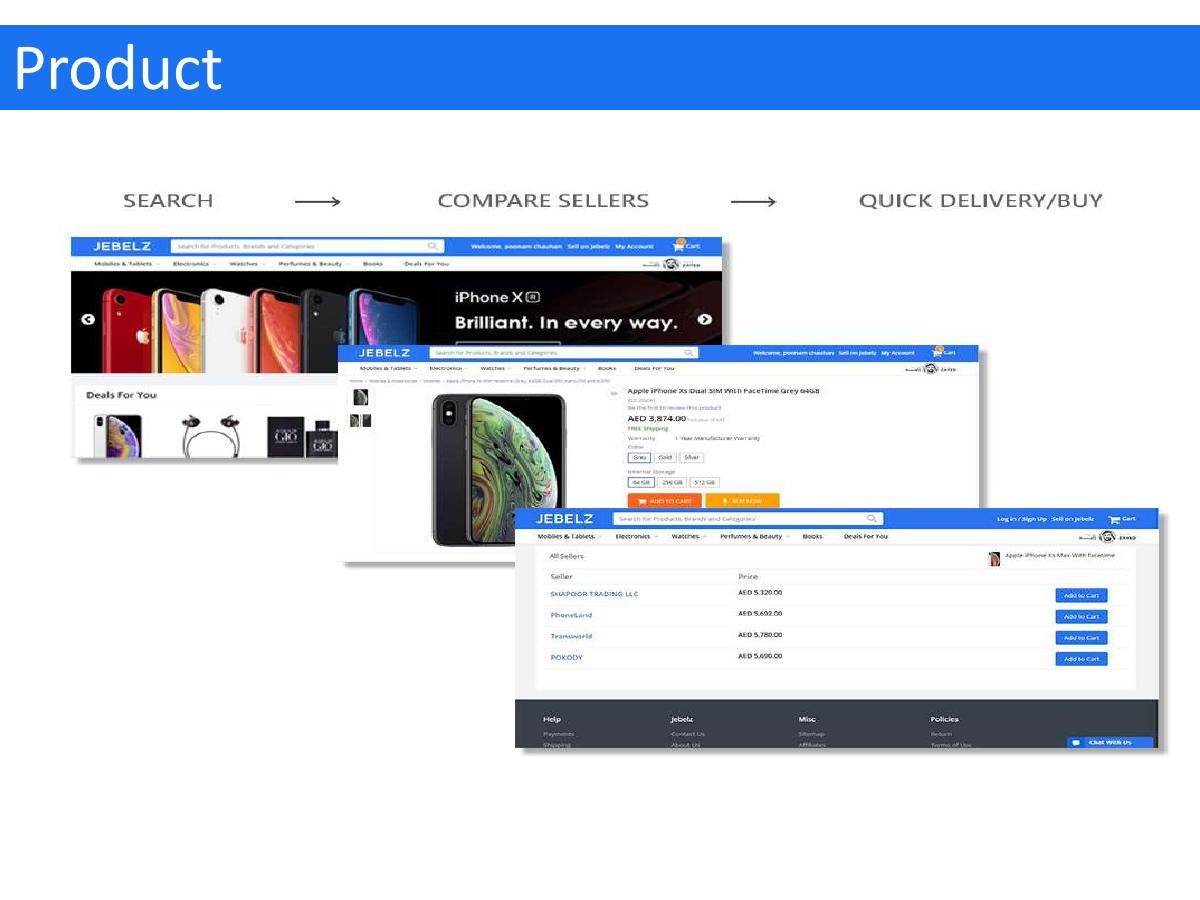
Three labels — Search, Compare Sellers, Quick Delivery/Buy — over real screenshots of the live site. The comparison panel shows an iPhone with four named sellers and their prices: Shapoor Trading LLC at AED 5,320, Pokody at AED 5,690, PhoneLand at AED 5,692, and Transworld at AED 5,780.
This is the strongest slide in the deck, and it is strong because it is real. Named sellers, real dirham prices, a working interface, a product that clearly exists. The spread between the cheapest and most expensive seller is AED 460, about 8.6% — which is the proof of the problem the deck asserted two slides earlier, and it is sitting here as decoration rather than as evidence. Nobody has pulled it out and written "the same phone costs 8.6% more depending on which seller you land on".
The screenshot also quietly sets the commission problem up. If a typical order looks like a AED 5,320 phone, and electronics sit at the bottom of the 4%–24% commission range on slide 7, then Jebelz earns roughly AED 210 on a AED 5,320 order — before paying for a van, a driver and a 60-minute delivery.
Slide 5 — Market
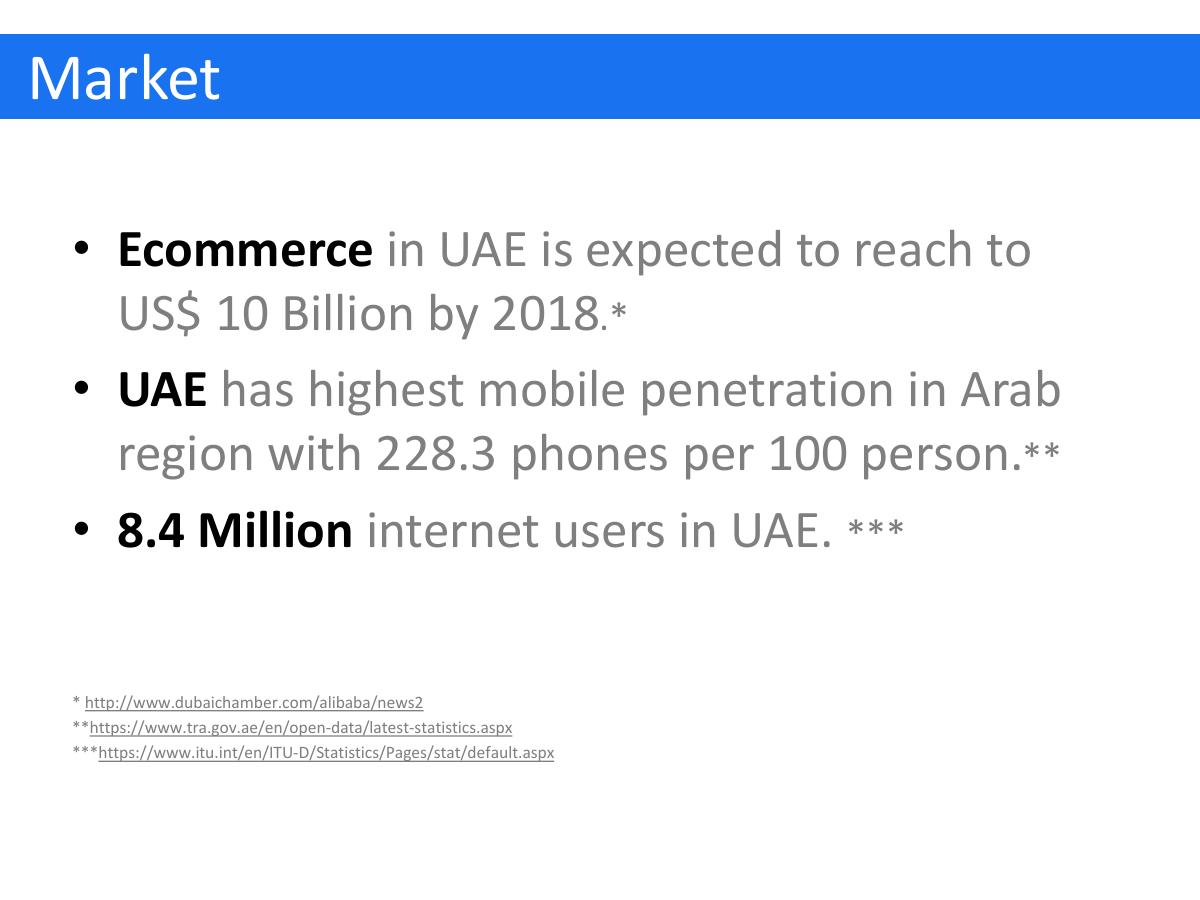
Three cited statistics: UAE e-commerce "expected to reach US$10 Billion by 2018", sourced to Dubai Chamber; 228.3 mobile phones per 100 people, sourced to the UAE Telecommunications Regulatory Authority; and 8.4 million internet users in the UAE, sourced to the ITU.
Citing three sources with footnotes on a market slide is better practice than most decks manage, and it deserves credit. The problem is the tense. The deck is dated November 2018 and the headline market number is a forecast for 2018 — the year the deck was written. A projection that has already arrived is not a growth story; the natural question, "did it actually hit $10 billion, and what is the 2021 number?", is left for the investor to ask.
The other two statistics do no work. Mobile penetration of 228.3 handsets per 100 people counts SIM cards, not shoppers, and every competitor on the next slide has access to exactly the same phones. 8.4 million internet users is a population, not a market. And nowhere does the deck convert any of this into a number Jebelz could plausibly own: no SAM, no SOM, no share assumption, no path from $10 billion to the AED 3.8 million a month it says it wants.
Slide 6 — Competition
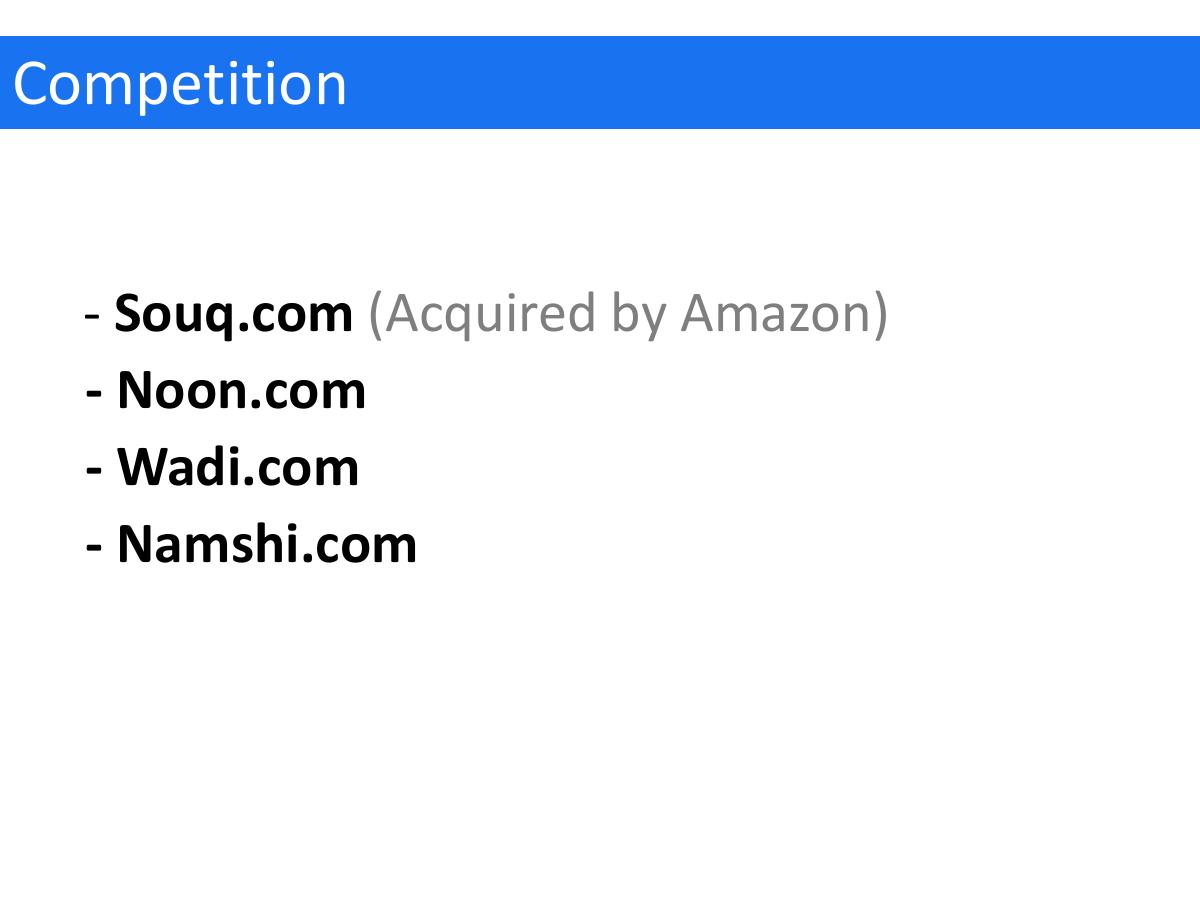
Four names, no columns, no analysis: Souq.com (with "Acquired by Amazon" in brackets), Noon.com, Wadi.com, Namshi.com.
This is where the deck loses the room. Listing your competitors honestly is the right instinct — the deck does not pretend Amazon is absent — but naming Amazon and then saying nothing about it is worse than omitting the slide. By late 2018 Souq was Amazon-owned and being folded into Amazon.ae; Noon had been launched by Mohamed Alabbar with a widely reported $1 billion commitment; Wadi was backed by Al Tayyar; Namshi had been majority-acquired by Emaar Malls. Every name on this list had more capital than the $3 million being requested four slides later, and two of them had more than a hundred times as much.
There is no differentiation table. No column for delivery time, seller count, price comparison, category focus or geography. The one thing Jebelz claims that none of these four claimed at the time — 60-to-120-minute delivery — is not set against them anywhere. The deck had a defensible answer available and did not put it on the competition slide.
Slide 7 — Business Model
Commission of 4% to 24% per item sold, plus three items "in pipeline": seller ads for top placement, official brand stores, and paid customer memberships for premium features.
A 4%–24% range is a six-fold spread, and the deck never says which categories sit where or what the blended rate is. That single missing number makes the entire revenue side unmodellable. At the low end, AED 3.8 million of monthly sales produces AED 152,000 of revenue; at the high end, AED 912,000. An investor cannot value a business whose revenue line has a 6x range in it, and the deck gives no category mix to narrow it — even though slide 4 makes clear the shop-window product is high-value electronics, which is the lowest-commission category in any marketplace.
The three pipeline items are all sensible and all unbuilt. None has a date, a price or a revenue estimate attached.
Slide 8 — Go to Market
Seven channels: growth hacking via free 60-to-120-minute delivery from stocked vans, search engine marketing, price-comparison and affiliate sites (with four named live partners — Pricena, DCM Network, NDTV Gadgets, Fragrantica), social media, email, influencers and PR.
The named affiliate partnerships are real and checkable, and listing them beats the usual generic channel grid. But the first bullet is not a marketing channel, it is a cost centre described as one. "Free delivery in 60 to 120 minutes for top selling items kept in delivery vans" means Jebelz pays for vehicles, drivers, fuel, parking and held inventory, and charges the customer nothing for it. That is the single largest operating cost in the plan and it appears as a growth tactic with no number beside it.
The remaining six channels have no budget split, no channel-level CAC, and no indication of which one is expected to deliver the 352,400 monthly users promised on the next slide.
Slide 9 — KPIs for Growth Measurement
Seven figures. Traction to date: AED 181,000, launched October 2018. Products listed: 7,300+. Sellers: 160+. Then, all marked "post fund": target monthly traffic of 352,400+ users, 3,600+ monthly orders, average order value of AED 900 to 1,200, and monthly sales of AED 3.8 million "in 3 months time".
Two of these numbers are real achievements and are underplayed. Signing 160 sellers and listing 7,300 products in the weeks before launch is genuine supply-side execution, and it is the hardest part of starting a marketplace. It gets one bullet each.
The forward numbers do not survive contact with a calculator. 3,600 orders at AED 900–1,200 gives AED 3.24m–4.32m, so the AED 3.8m target is internally consistent — that part checks out. But 3,600 orders against 352,400 monthly users is a conversion rate of 1.02%, stated nowhere and defended nowhere, and it is the number the entire plan rests on. AED 181,000 in month one becomes AED 3.8 million in month four: a 21x increase in ninety days, presented as a bullet with no funnel, no cohort, no monthly build and no assumption behind it.
And the AED 900–1,200 average order value contradicts the shop window. The comparison screenshot on slide 4 sells AED 5,320 phones. Either the AOV assumption excludes the flagship category, or the category mix is very different from the product the deck chose to show, and neither is explained.
Slide 10 — Fund Raising & Deployment
Four bullets: $3 million required to scale in the region; funds deployed for "aggressive marketing, onboarding key talent & technology enhancement"; GMV of $36 million clocked in 2–3 years; 130,000+ customers acquired with the money.
This is the slide that has to carry the deck, and it is four lines long. No valuation, no equity offered, no instrument, no runway, no monthly burn, and a use of funds that is three nouns with no percentages. An investor cannot tell whether $3 million is eighteen months or six.
The two outcome numbers also fight each other. 130,000 customers for $3 million is $23 per customer — an aggressive but not impossible CAC in a paid-search market, except that every one of those customers is also being given a free sub-two-hour van delivery whose cost appears nowhere. And put the two figures side by side: 3,600 orders a month over 36 months is 129,600 orders, which lands on the 130,000 "customers" almost exactly. So the plan's customer count and its order count are the same number, meaning the model assumes every customer buys exactly once and never returns. For a business whose entire pitch is convenience and speed — the two properties that produce repeat purchase — a model with zero repeat rate is the most damaging thing in the deck, and it is implicit rather than stated.
Finally, $36 million of GMV over 2–3 years at a mid-range commission is roughly $4–5 million of cumulative revenue against a $3 million raise. The deck never does that division, so it never has to answer what the $3 million buys.
Slide 11 — Founder
Zeeshan Anwar: seven years purely in e-commerce, previously marketplace manager at Letstango.com in Dubai, and before moving to Dubai, part of Flipkart in India "during its early days which has been recently acquired by Walmart for $16B".
This is a real founder-market fit story and the deck tells it well: a marketplace manager building a marketplace, in the same city, in the same categories. Naming Letstango — a UAE e-commerce company an Emirati investor would know — is far more persuasive than the Flipkart line.
The Flipkart sentence, though, is doing something the rest of the deck does not do anywhere else: it borrows someone else's outcome. Walmart's $16 billion acquisition of Flipkart has no bearing on Jebelz, and attaching it to "part of Flipkart during its early days" invites the follow-up question — which team, which year, which role — that the slide does not pre-empt. One line of specificity would convert the strongest claim in the deck from borrowed to earned.
Slide 12 — Team Members
Twelve people including the founder: three in the UAE, nine in India. Three are named — Moonis Waqar, head of India team and categories, five years of e-commerce experience; Satish Kumar, CTO, seven years in IT, leading three engineers in Noida; Prince Ranjan, digital marketing head, five years in online marketing.
Giving the geographic split is honest and unusual, and a Noida engineering team supporting a Dubai marketplace is a completely reasonable structure. But the split also states a fact the deck does not address: nine of twelve people, including all of engineering, sit in a different country from the customers, the sellers and the delivery vans. An investor funding sub-two-hour delivery in Dubai will ask who operates it, and the answer is three people.
There is also no logistics or operations lead anywhere on the slide — no one who has run a fleet, a warehouse or a last-mile route — in a company whose differentiator is last-mile speed.
Slide 13 — Thanks
"Team Jebelz.com", the URL, and the founder's email. The deck ends politely, with contact details finally present, and with no repeat of the ask, no milestone list and no next step.
What this deck does better than most startup pitch decks
The product is real and shown. Live screenshots with four named sellers and four real dirham prices, not a mockup. · It names its competitors, including Amazon. "Souq.com (Acquired by Amazon)" is written in the deck's own words rather than hidden. · The market slide is sourced. Three statistics with three footnoted URLs — Dubai Chamber, the UAE TRA and the ITU. · Traction is stated at true size. AED 181,000 since an October 2018 launch, with no attempt to annualise it into a bigger-looking number. · Supply-side execution is quantified. 7,300+ products and 160+ sellers is the hard half of a marketplace, and both figures are specific. · Named distribution partners. Pricena, DCM Network, NDTV Gadgets and Fragrantica are checkable, live affiliate relationships. · Founder-market fit is direct. A marketplace manager at a UAE e-commerce company building a UAE marketplace, stated in one line. · The revenue projection is internally consistent. 3,600 orders × AED 900–1,200 does produce the AED 3.8m target — the multiplication holds.
Where this deck would fail in an investor meeting
No valuation, no equity, no instrument. The $3 million ask has no terms attached to it at all. · Use of funds is three words. "Marketing, key talent & technology enhancement" with no percentages, no hiring plan and no runway. · No unit economics anywhere. No contribution margin, no delivery cost per order, no CAC, no payback period, no burn rate. · A 6x range on the revenue rate. 4%–24% commission with no category mix and no blended figure makes the revenue line unmodellable. · 21x in ninety days, unbridged. AED 181,000 to AED 3.8 million a month with no funnel, no monthly build and no cohort behind it. · The customer count equals the order count. 130,000 customers and 3,600 orders a month over three years are the same number, so the model assumes nobody ever buys twice. · A 1.02% conversion assumption is never stated. 3,600 orders from 352,400 users is the load-bearing figure and it appears only as a by-product of two other bullets. · The delivery promise has no cost. Free 60-to-120-minute delivery from stocked vans is presented as a growth hack with no vehicles, drivers, inventory or working capital priced in. · Inventory contradicts the marketplace model. Holding top sellers in vans is a stocked model wearing a commission model's cost structure. · The competition slide has no analysis. Four names, no differentiation table, no answer to Amazon or to Noon's reported billion-dollar backing. · The market forecast is for the year the deck was written. "$10 billion by 2018", dated November 2018. · Mobile penetration proves nothing. 228.3 handsets per 100 people is available to every competitor on the previous slide. · AOV contradicts the shop window. AED 900–1,200 average order value against AED 5,320 phones on the product slide. · No operations or logistics hire on the team slide — in a company selling last-mile speed. · Nine of twelve staff are in another country from the market, the sellers and the vans, with no comment on how UAE operations scale. · The price-spread evidence is left in a screenshot. The 8.6% gap between the cheapest and dearest seller proves the problem slide and is never quoted. · No milestones. Nothing on what the $3 million proves or what the next round would look like.
What the deck has vs what a $3M marketplace round needs
Ask "$3 Million is required to scale up" Amount, instrument, valuation, equity, runway in months
Use of funds Marketing, talent, technology Percentage split, hiring plan, milestone each tranche buys
Revenue rate Commission 4% to 24% Blended take rate with category mix behind it
Unit economics Absent AOV, take rate, delivery cost, CAC, contribution margin per order
Growth plan AED 181k to AED 3.8m in 3 months Monthly build from today's number with conversion and repeat rates
Repeat purchase Implicitly zero Cohort retention and orders per customer per year
Competition Four names, one of them Amazon Differentiation table on the axis you actually win
Market $10bn forecast for the current year SAM, target share, and the revenue that share implies
Logistics Vans mentioned in a marketing bullet Fleet cost, coverage radius, cost per drop, who runs it
How you would rebuild this deck without changing the business
Put the wedge on the cover. Replace "Online Shopping Redefined" with the claim nobody else in the market could make in 2018: shopping delivered in 60 to 120 minutes, with sellers competing on price. · Turn the screenshot into evidence. Pull the AED 5,320 to AED 5,780 spread out of slide 4 and make it the problem slide: the same phone, four sellers, 8.6% apart. Add ten more products and show the average spread. · Give the competition slide columns. Delivery time, seller count per listing, price comparison, category depth. Put Souq, Noon, Wadi and Namshi in the rows and let the delivery column carry the argument. · Answer Amazon out loud. One slide, one paragraph: why a sub-two-hour, price-comparison marketplace survives next to Amazon.ae, and which categories and neighbourhoods it wins first. · Replace the commission range with a blended take rate. Show category mix, the rate in each, and the weighted average you actually earn on AED 1,000 of GMV. · Build one unit economics slide. Average order value, take rate, delivery cost per drop, packaging, payment fees, contribution margin per order, and the order volume at which the van pays for itself. · Replace the 21x bullet with a monthly build. Twelve rows: orders, new customers, repeat customers, AOV, GMV, revenue. Start on the real October number and show the assumption in each column. · State the repeat rate. Even four weeks of data gives a first repeat-purchase figure; a convenience business that cannot show repeat is selling a discount, not a habit. · Break the $3 million into buckets. Marketing, fleet and inventory, engineering, seller onboarding, working capital — with a percentage each and the runway they buy. · Add terms and milestones. Instrument, valuation, months of runway, and the three numbers that will be true when the money is gone. · Hire visibly for the promise. If last-mile speed is the differentiator, the team slide needs someone who has run last-mile, or the plan needs to say who will be hired first. · Refresh the market slide. Drop mobile penetration, drop the expired forecast, and size the specific slice: UAE online electronics and beauty GMV, the share Jebelz targets, and the revenue that produces.
The transferable lesson
The Jebelz deck is not a badly built deck. It has every section a seed deck is supposed to have, it shows a working product, it cites its sources, and it reports a small traction number honestly instead of inflating it. On structure alone it beats a large share of the decks that get funded.
It fails on a narrower thing: every important number in it is a headline with no model underneath. AED 3.8 million a month, $36 million of GMV, 130,000 customers, 4%–24% commission, $3 million required. Each one is stated once and defended nowhere, and when you put two of them side by side — 130,000 customers and 3,600 orders a month — they turn out to describe a business where no customer ever buys twice. The deck never put those two bullets next to each other. An investor does that in the first sixty seconds.
The test is simple and it applies to your deck too: take any two forward-looking numbers on different slides, divide one by the other, and see whether the result is a number you would say out loud. Orders divided by users is your conversion rate. Customers divided by spend is your CAC. Revenue divided by GMV is your take rate. If a division you never intended produces a figure you cannot defend, the deck is already contradicting itself — and the person doing that division will be the one deciding whether to fund you.
Frequently asked questions
- What is Jebelz.com?
- Jebelz.com was a United Arab Emirates online marketplace that let multiple sellers list the same product so shoppers could compare prices in one place, with a promise of delivery in 60 to 120 minutes for top-selling items held in delivery vans. It launched in October 2018 and by the date of this deck had 160+ sellers, 7,300+ products listed and AED 181,000 in sales.
- Is the Jebelz deck a real investor pitch deck?
- Yes. Unlike many decks circulated as examples, this one is built for fundraising: it contains a problem, solution, product, market, competition, business model, go-to-market, KPIs, a $3 million ask and a team slide across 13 pages. What it lacks is the detail beneath the ask - no valuation, no equity, no instrument, no runway and no percentage breakdown of how the money is spent.
- What is the biggest weakness in the Jebelz pitch deck?
- The absence of unit economics. The deck promises free delivery in 60 to 120 minutes from stocked vans while earning a commission of somewhere between 4% and 24%, and never states the delivery cost per order, the blended take rate, the customer acquisition cost or the contribution margin. Without those, the $3 million ask cannot be evaluated against the AED 3.8 million monthly sales target.
- Why do the Jebelz projections contradict each other?
- Slide 10 says $3 million would acquire 130,000+ customers over two to three years. Slide 9 says the business would run 3,600+ orders per month. Over 36 months that is 129,600 orders - effectively the same figure as the customer count, which means the plan assumes each customer places exactly one order and never returns. For a business whose pitch is convenience and speed, a model with zero repeat purchase undermines the entire thesis.
- How should a marketplace deck handle competing with Amazon?
- Name the competitor, then answer it on the axis you win. Jebelz had a real answer available - sub-two-hour delivery and multi-seller price comparison - and left it off the competition slide entirely. A differentiation table with delivery time, sellers per listing and category depth as rows, plus one slide explaining which categories and neighbourhoods you take first, converts an unanswerable objection into a defensible wedge.
- Which Jebelz slides should founders copy?
- The product slide, for showing the live interface with four named sellers and real prices rather than a mockup. The KPI slide, for reporting AED 181,000 of first-month revenue at true size instead of annualising it. The market slide, for footnoting all three statistics to their sources. And the go-to-market slide, for naming the affiliate partners that were actually live rather than listing generic channels.