The JIG pitch deck is a classic regional arbitrage play, positioning Jerusalem as an overlooked tech hub compared to Tel Aviv. By citing a 3.9x growth in money invested between 2012 and 2014, the deck builds a narrative of momentum. The fund targets a $50M raise with standard 2/20 terms, focusing 80% of its capital on early-stage startups. While the deck successfully highlights the 'untapped' nature of the market—noting only 7 VC funds in Jerusalem versus 71 in Tel Aviv—it relies heavily on a single massive success story, Mobileye, to validate the ecosystem's potential. The management team sl…
Key takeaways
- Jerusalem-based startup investment grew 3.9x from $58.1M in 2012 to $227.1M in 2014 (Slide 2).
- The ecosystem saw a 2.2x increase in startups founded, rising from 26 in 2012 to 58 in 2014 (Slide 2).
- Jerusalem is positioned as an 'untapped' market with only 7 VC funds compared to 71 in Tel Aviv (Slide 3).
- The fund's '80/20 Strategy' allocates 80% of capital to early-stage startups (Slide 5).
- Sector allocation targets 40% Technology, 30% Digital Health, 20% Chemistry/Materials/Environment, and 10% Agriculture (Slide 5).
- The deck uses Mobileye's $5.3B market cap IPO as the primary evidence of Jerusalem's academic commercialization potential (Slide 6).
- Fund terms include a 20% carried interest, 2.5% management fee, and a target size of up to $50M (Slide 7).
- The fund structure is a 10-year term, split into 5 years active and 5 years inactive (Slide 7).
Executive Summary: The Jerusalem Arbitrage
The Jerusalem Investor Group (JIG) pitch deck is a focused, geographically-driven investment proposal. It seeks to capitalize on the disparity between Jerusalem's burgeoning startup activity and its relative lack of local venture capital infrastructure. By positioning Jerusalem as the "#1 Emerging Tech hub in the world" (citing TIME 2015), the deck attempts to convince Limited Partners (LPs) that there is a high-alpha opportunity in a market overshadowed by Tel Aviv. The deck is structured to move from macro ecosystem growth to specific fund strategy, ending with a clear set of economic terms.
Slide 1: Title and Vision
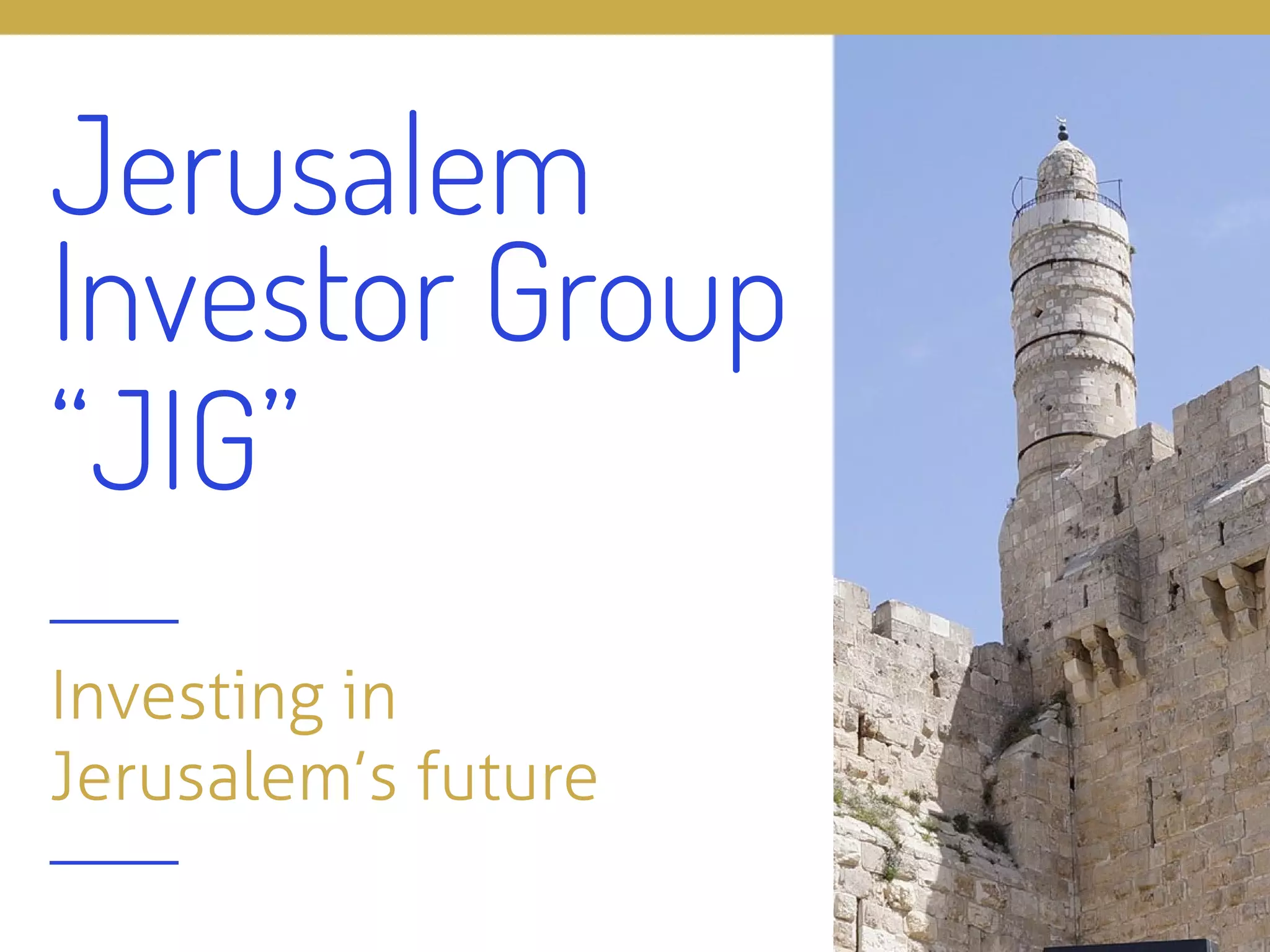
The cover slide introduces the "Jerusalem Investor Group" or "JIG." The subtitle, "Investing in Jerusalem’s future," establishes the fund's mission immediately. The imagery of the Tower of David reinforces the geographic focus, signaling to investors that this is a place-based fund. There are no metrics on this slide, but it sets a professional, institutional tone using a clean blue and gold color palette.
Slide 2: Ecosystem Growth Metrics
This is arguably the most important slide in the deck for establishing market urgency. It presents two key growth metrics for Jerusalem-based startups between 2012 and 2014. First, it shows a 2.2x growth in startups founded , moving from 26 in 2012 to 58 in 2014. Second, it highlights a 3.9x growth in money invested , which rose from $58.1 million in 2012 to $227.1 million in 2014. The slide also references external validation, citing TIME 2015 for the "#1 Emerging Tech hub" claim and the Global Startup Ecosystem Ranking 2015. A map on the right side compares exit growth across regions, showing Europe at 314% and Latin America at 209%, though the connection between these global figures and Jerusalem's specific exit data is not explicitly quantified on this slide.
Slide 3: The Untapped Market Opportunity
Slide 3 visualizes the "arbitrage" opportunity. It features a map of Israel with the number of VC funds in various cities. The contrast is stark: Tel Aviv-Yafo has 71 VC funds , while Jerusalem has only 7 . Other regions like Haifa (4) and Be'er Sheva (1) are also noted. The headline, "Jerusalem Is a Relatively Untapped Market For Investors," uses this data to suggest that competition for deals in Jerusalem is lower than in Tel Aviv, potentially leading to better entry valuations for JIG.
Slide 4: Management Team
The management slide features Robby Hilkowitz and Oren Gez. Rather than providing detailed biographies, the deck uses a "logo wall" approach to establish credibility. Robby Hilkowitz is associated with a "Track Record" including logos for Driveway Software, Moven, MyPermissions, BodeTree, Nutmeg, Credorax, Stonehage, and Trialpha. Oren Gez is credited with a "Local, international investors and C level network," featuring logos for Barclays, Oscar Truss, ING, and Excellence. While these logos are impressive, the slide omits the specific roles these individuals held at these companies, which is a common weakness in fund decks where LPs want to know if the managers were founders, investors, or employees.
Slide 5: The 80/20 Strategy
This slide outlines the fund's deployment strategy. The "80%" figure refers to the portion of the fund dedicated to early-stage startups . A circular infographic breaks down the sector focus: 40% Technology , 30% Digital Health , 20% Chemistry, Material & Environment , and 10% Agriculture . This diversification suggests the fund is looking to tap into the diverse research output of Jerusalem's academic institutions rather than just focusing on pure-play software.
Slide 6: Academia Potential - The Mobileye Success Story
To prove that Jerusalem can produce world-class exits, the deck uses Mobileye as a case study. It notes that founder Amnon Shashua was a researcher at the Hebrew University of Jerusalem. The slide provides a timeline of Mobileye's growth: founded in 1999, raising $100M in 2007, $37M in 2010, and culminating in a 2014 IPO on the NYSE . The deck states this was the "biggest Israeli IPO ever in the US raising approx. $1B at a market cap of $5.3B." This slide serves as a "proof of concept" for the fund's strategy of investing in university-linked innovation.
Slide 7: Fund Terms
The penultimate slide provides the economic structure of the fund. The terms are clearly stated in gold circles: 20% Carried Interest , 2.5% Management Fee , and a fund size of "Up to $50M." The lifecycle of the fund is described as 5 Years Active and 5 Years Inactive , totaling a 10-year fund life. The 2.5% management fee is slightly higher than the industry standard 2%, which is sometimes seen in smaller, specialized, or first-time funds to cover higher operational overhead relative to the total AUM (Assets Under Management).
Slide 8: Disclaimer
The final slide is a standard legal disclaimer. It covers forward-looking statements, the risks of investment, and the fact that the securities have not been recommended by any regulatory authority. It explicitly mentions the Securities Act of 1933 , indicating that the fund was likely targeting U.S. investors under specific exemptions. The text is dense and serves as the necessary legal "fine print" for a private placement memorandum.
What the Deck Omissions Reveal
While the JIG deck is effective at selling a region, it omits several critical pieces of information that sophisticated LPs would require. First, there is no mention of a current pipeline . For a $50M fund, investors want to see 5-10 specific companies the managers are already tracking or have soft-circled. Second, the management team biographies are thin . Listing logos is a good start, but it doesn't explain the team's actual experience in sourcing, winning, and exiting deals. Third, there is no mention of the General Partner (GP) commitment . LPs typically want to see the managers putting their own capital at risk to align interests. Finally, the deck lacks a detailed budget for how the 2.5% management fee will be used, which is particularly relevant for a smaller $50M fund where every dollar of overhead counts.
What Founders and Fund Managers Can Copy
The JIG deck excels at narrative-driven data visualization . Slide 3, which compares the number of VC funds in Tel Aviv versus Jerusalem, is a masterclass in using a single data point to create a sense of "unfair advantage." It takes a perceived weakness (lack of capital in the city) and flips it into a strength (lack of competition for deals). Fund managers should also emulate the clear sector allocation on Slide 5. By pre-defining their "80/20" strategy and sector buckets, JIG makes it easy for LPs to understand exactly how their capital will be diversified. Lastly, the use of a landmark success story like Mobileye (Slide 6) is essential for regional funds; it provides the "ceiling" for what is possible in that specific ecosystem, effectively de-risking the geographic bet.
Frequently asked questions
- What is the primary investment thesis of JIG?
- JIG operates on a regional arbitrage thesis. It argues that while Jerusalem is the '#1 Emerging Tech hub in the world' according to TIME 2015, it is significantly under-capitalized. With only 7 VC funds compared to 71 in nearby Tel Aviv, JIG aims to capture early-stage opportunities at lower valuations before they attract broader national or international attention.
- How does JIG plan to allocate its $50M fund?
- According to slide 5, the fund follows an '80/20 Strategy,' where 80% of the capital is dedicated to early-stage startups. The sector breakdown is diversified across four main pillars: Technology (40%), Digital Health (30%), Chemistry, Materials & Environment (20%), and Agriculture (10%). This suggests a focus on hard sciences and deep tech often associated with university research.
- What evidence does the deck provide for Jerusalem's growth?
- Slide 2 provides specific growth metrics from 2012 to 2014. It shows that the number of startups founded annually increased from 26 to 58. More significantly, the total amount invested in Jerusalem-based startups jumped from $58.1 million to $227.1 million over the same three-year period, representing a 3.9x increase in capital inflow.
- Who are the key people behind the fund?
- The fund is led by Robby Hilkowitz and Oren Gez. Hilkowitz is presented as having a 'Track Record' with logos from companies like Nutmeg, Moven, and Credorax. Gez is positioned as the bridge to 'Local, international investors and C level network,' featuring logos from Barclays, ING, and Excellence. However, the deck does not provide specific titles or past achievements for either individual.
- What are the specific fund terms offered to LPs?
- Slide 7 outlines a standard venture capital structure but with a slightly higher management fee. The terms include a 20% carried interest and a 2.5% management fee. The fund has a 10-year lifecycle, described as 5 years 'Active' (likely the investment period) and 5 years 'Inactive' (likely the harvest or divestment period), with a total target size of $50M.