The January 2017 investor presentation for Joey New York (OTC: JOEY) outlines a strategic pivot toward the medical aesthetics market following the acquisition of The LABB Aesthetic Beauty Bar in August 2016. The company positions itself as a portfolio builder in the beauty and wellness space, leveraging a $9.2 billion market opportunity in facial aesthetics. With three initial locations in Florida, the deck projects a rapid expansion to 17 additional sites by 2018 and the launch of a franchise program in 2019. While the deck provides specific unit-level economics, such as $2 million to $5 mil…
Key takeaways
- The company is publicly traded on the OTC market under the ticker JOEY as of January 2017 (Slide 1).
- Joey New York acquired The LABB Aesthetic Beauty Bar in August 2016 to enter the injectable services market (Slide 3).
- Unit economics for The LABB claim $2 million to $5 million in revenue per chair with 30% average gross margins (Slide 3).
- The business model relies heavily on repeat customers, citing an 85% repeat business rate (Slide 3).
- The facial aesthetics market was projected to grow to $9.2 billion by 2020, representing an 18% CAGR from 2018 (Slide 7).
- Expansion plans include opening 17 additional locations across Florida, California, Las Vegas, and NY/CT by 2018 (Slide 9).
- The company planned to launch a franchise program in 2019 to further scale the brand (Slide 9).
- The deck omits a specific financial 'Ask' or use of proceeds slide, despite the aggressive expansion goals (General Observation).
Joey New York: A Pivot to Medical Aesthetics
The Joey New York investor presentation from January 2017 represents a company in transition. Originally established in 1993 as a skincare brand, the company utilized this deck to communicate its new direction as a publicly traded holding company (OTC: JOEY) focused on high-margin medical aesthetics. The centerpiece of this strategy is the acquisition of The LABB, a specialized beauty bar for injectables. The deck is characterized by bold market projections and specific unit-level performance claims, though it remains light on corporate governance and specific financial requirements.
Slide 1: Title and Public Status
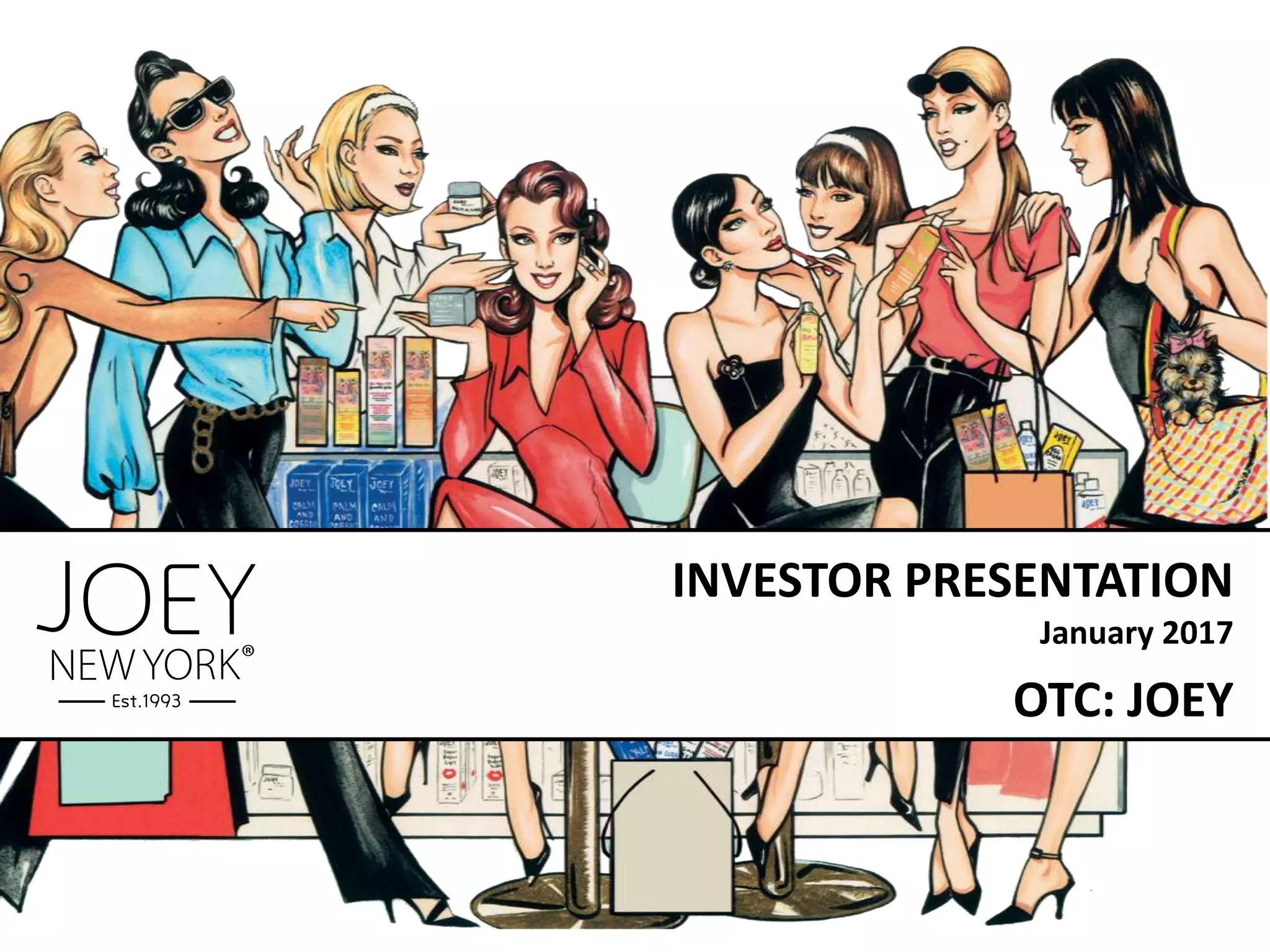
The cover slide establishes the brand identity using stylized fashion illustrations that evoke a high-end, New York aesthetic. Crucially, it identifies the company as OTC: JOEY , signaling to investors that this is a micro-cap public entity rather than a private startup. The date is clearly marked as January 2017, and the logo notes the brand was established in 1993, providing a sense of longevity despite the new business model.
Slide 3: Investment Highlights
This slide serves as the executive summary. It focuses entirely on the acquisition of The Labb Aesthetic Beauty Bar (LABB) , which was completed in August 2016. The key data points provided here are designed to attract investors looking for high-yield retail models:
Revenue per chair: $2 million - $5 million. · Gross margins: 30% average. · Repeat business: 85%.
The slide also notes that there were three locations open at the time: Miami (flagship), Ft. Lauderdale, and Daytona Beach. By listing Allergan and Galderma logos, the company aligns itself with the industry's largest pharmaceutical suppliers.
Slide 5: Corporate Overview
Slide 5 defines the company's broader mission: to build a portfolio of Beauty, Wellness, and Lifestyle businesses. The strategy is described as identifying, acquiring, and enhancing existing businesses with 'revolutionary concepts.' A photo of a seven-person team is included, though no names or specific titles are listed on this slide. The text mentions that the rollout of The LABB was facilitated through the acquisition of Reflex Productions, Inc. , providing a glimpse into the corporate structure used to facilitate the expansion.
Slide 7: $9.2 Billion Market Opportunity
This slide presents the macro-economic justification for the business. It features an area chart showing the growth of the Facial Aesthetics Market . The data points indicate the market was $2.1 billion in 2011 and is projected to reach $9.2 billion by 2020 . The chart shows a significant inflection point starting in 2018, where the growth curve steepens dramatically. This is a classic 'hockey stick' projection intended to create a sense of urgency for investors.
Slide 9: Rapid Near-Term Expansion
The expansion roadmap is visualized through a map of the United States with star icons indicating target markets. The company sets a goal of 17 additional locations by 2018 , broken down as:
California: 7 locations · Florida: 6 locations · NY/CT: 3 locations · Las Vegas: 1 location
The slide also introduces the 2019 goal of launching a franchise program and expanding into Texas and other West Coast locations. This indicates a shift from a capital-heavy corporate ownership model to a lighter, royalty-based model for long-term scaling.
Slide 13: Contact Information
The final slide repeats the cover art and provides the company's headquarters address at Trump Tower I in Sunny Isles Beach, FL . It includes a phone number, fax, and email address. The repetition of the OTC ticker reinforces the liquidity (or at least the public nature) of the investment opportunity.
What Works in This Deck
The deck is highly effective at communicating unit economics . By stating a specific revenue range per chair ($2M-$5M) and a repeat business percentage (85%), the company gives investors a clear 'money-in, money-out' framework for the retail locations. The focus on 'injectables' rather than general spa services is a smart strategic move, as these are high-frequency, high-margin medical procedures that create customer 'stickiness.'
The market timing slide (Slide 7) is also well-executed. It doesn't just show a large number; it shows a growth trend that justifies why the company is pivoting into this specific niche at this specific time. The alignment with major brands like Allergan provides a layer of third-party credibility to a relatively small public company.
What is Missing
The most glaring omission is a detailed management slide . While Slide 5 shows a group photo and mentions '25+ years of beauty industry experience,' it does not name the executives or detail their specific track records. In micro-cap public companies, the 'who' is often as important as the 'what,' and the lack of individual bios is a significant gap.
Furthermore, there is no financial 'Ask' . For a company planning to open 17 locations in two years—a capital-intensive endeavor—the deck fails to explain how much capital is being raised, at what valuation (or share price), and how that money will be allocated between construction, marketing, and corporate overhead. There is also no mention of the existing balance sheet or burn rate.
Finally, the competitive landscape is ignored. The med-spa and injectable market is highly fragmented but competitive. The deck does not explain what makes 'The LABB' superior to a local dermatologist or a competing national chain like SkinSpirit or LaserAway.
Founders: What to Copy and What to Avoid
Copy the clarity of unit economics. If you have a retail or service-based model, being able to say exactly what one 'unit' (a chair, a store, a van) produces in revenue and margin is incredibly persuasive. It allows investors to build their own mental models of your growth.
Avoid the 'anonymous team' approach. Never use a group photo as a substitute for individual credentials. Investors need to know who is responsible for the P&L. List names, previous exits, and specific industry wins.
Avoid the lack of a clear 'Ask'. An investor presentation is a sales tool. If you don't tell the audience what you need from them to achieve the roadmap you just showed, the presentation loses its momentum. Always include a slide detailing the funding requirement and the milestones that capital will unlock.
Frequently asked questions
- What is the primary business model of Joey New York according to the deck?
- Joey New York operates as a portfolio company that identifies and acquires existing beauty and wellness businesses. As of the 2017 deck, their primary focus was 'The LABB,' a luxury beauty suite specializing in FDA-approved injectable services like Botox and soft tissue fillers. They aim to enhance these businesses through quality management and strategic marketing talent.
- What are the reported unit economics for The LABB locations?
- Slide 3 reports that The LABB locations generate between $2 million and $5 million in revenue per chair. The company claims to operate with 'low overhead,' resulting in average gross margins of 30%. Additionally, the model is supported by a high customer retention rate, stated as 85% repeat business.
- How does the company plan to scale its operations?
- The scaling strategy is two-fold: corporate expansion and franchising. Slide 9 details a plan to open 17 additional corporate locations by 2018, targeting high-traffic markets in California, Florida, and Nevada. Following this, the company intended to launch a formal franchise program in 2019 to accelerate growth without the capital intensity of corporate-owned stores.
- Who are the key partners mentioned in the presentation?
- The deck highlights relationships with major manufacturers in the facial aesthetics space. Specifically, it names Allergan (the maker of Botox) and Galderma as the providers of the FDA-approved injectable fillers used at The LABB locations. This is intended to validate the medical legitimacy of their service offerings.
- What information is missing from this investor deck?
- The deck is missing several critical components for a comprehensive investment analysis. There is no detailed 'Team' slide listing individual names, titles, or specific past successes. It also lacks a clear 'Use of Proceeds' slide, a detailed P&L statement, and a competitive landscape analysis comparing The LABB to other med-spa chains or independent practitioners.