Jobox's Series B deck is a study in clarity and vertical focus. By positioning itself as the 'operating system' for home service professionals, the company addresses a highly fragmented market with a multi-layered solution. The deck effectively uses a 'Problem-Solution' framework that highlights the financial leakage in current lead-generation models, where middlemen keep 70% of the value (Slide 4). Jobox counters this with a unified platform combining CRM workflow, integrated fintech for faster payments, and a managed marketplace. With $1B in processed transactions across 39 states (Slide 12…
Key takeaways
- Jobox positions itself as the first operating system for home service professionals, combining workflow tools with a managed marketplace (Slide 1).
- The deck identifies a massive inefficiency where service pros are left with only 30% of job value after lead generators and middlemen take their cut (Slide 4).
- The product is built on three pillars: Workflow Tools, Integrated Fintech, and a Managed Marketplace (Slides 5, 7, 9).
- Workflow automation is demonstrated by converting unstructured SMS job requests into a single source of truth CRM (Slide 6).
- Fintech integration focuses on seamless entry and automation for reports, invoices, and inventory tracking (Slide 8).
- The managed marketplace provides pros with 'quality jobs' and the 'ability to decide,' while ensuring customer transparency (Slides 10, 11).
- Traction is significant, with over $1B in transactions processed across 39 states and 5,000+ active pros (Slide 12).
- A job is matched on the Jobox platform every 3 minutes, indicating high liquidity and frequency (Slide 12).
The Operating System for the Blue-Collar Economy
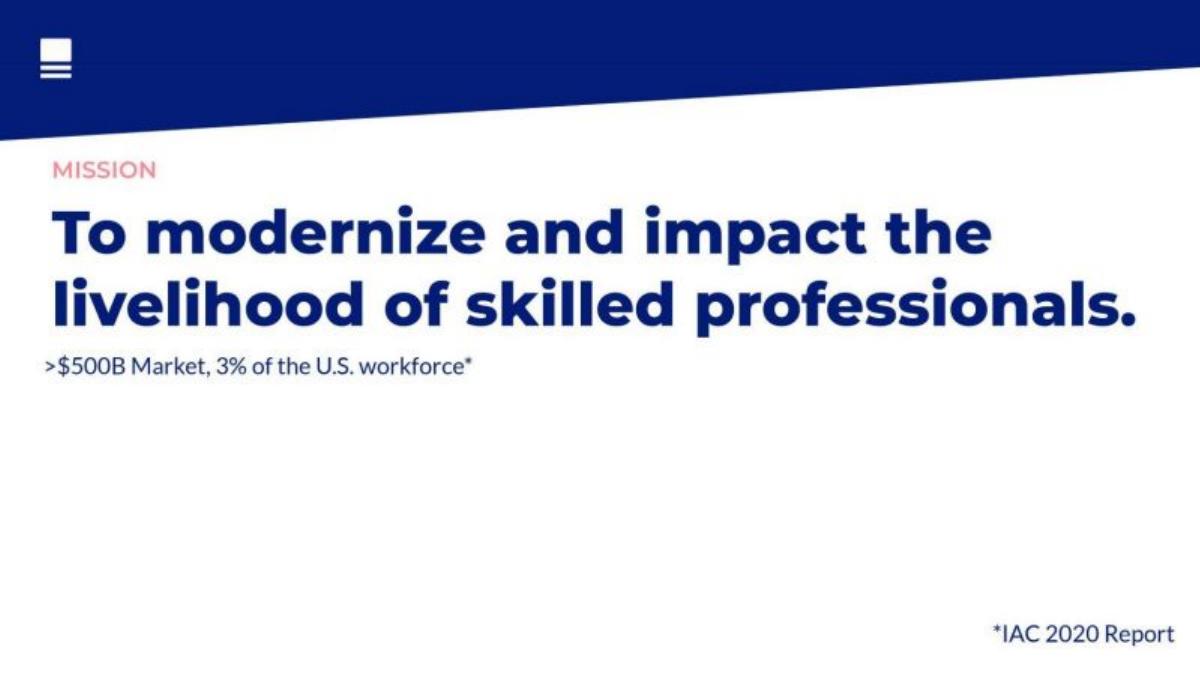
Jobox’s Series B pitch deck is a masterclass in vertical SaaS and fintech integration. The company, which raised $42M in 2022, targets the home service industry—a sector traditionally underserved by modern technology and plagued by predatory lead-generation fees. The deck’s primary narrative is the empowerment of the 'Jobox Pro,' moving them from manual, fragmented processes to a streamlined, digital-first operation.
Slides 1-2: Defining the Audience and the Mission
Slide 1 sets the stage immediately. Jobox is not just an app; it is 'The future of work for the home service industry.' The subtitle defines the product architecture: an operating system for Pros with a managed marketplace. This is a crucial distinction for Series B investors, as it suggests a platform play rather than a simple tool.
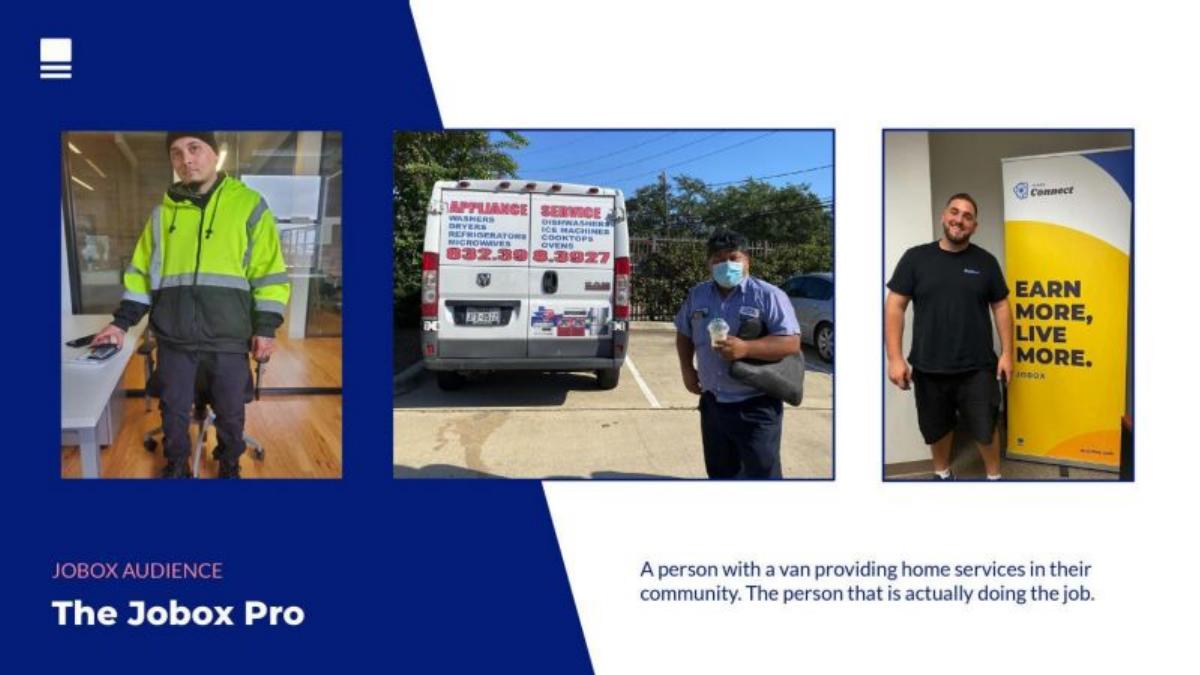
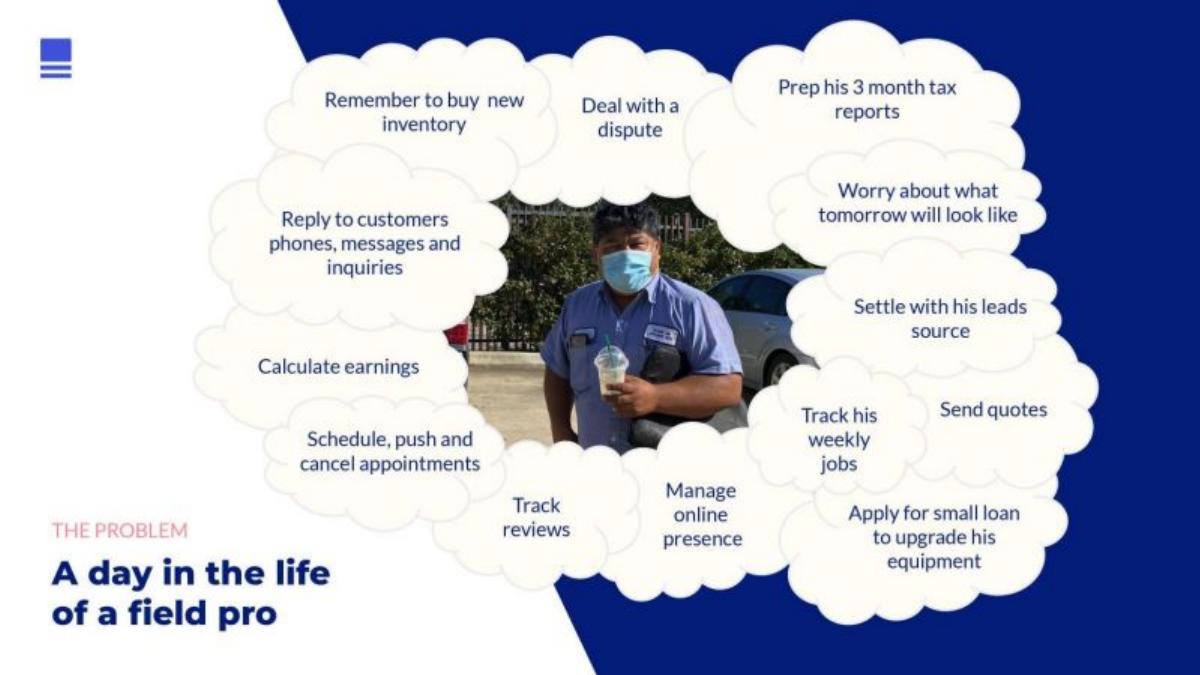
Slide 2 humanizes the target market. By showing real photos of 'The Jobox Pro'—people with vans providing services in their communities—the deck grounds the high-level 'operating system' talk in reality. It identifies the user as 'The person that is actually doing the job,' signaling that Jobox is a bottom-up solution designed for the field, not just the back office.
Slides 3-4: The Problem of Financial Leakage
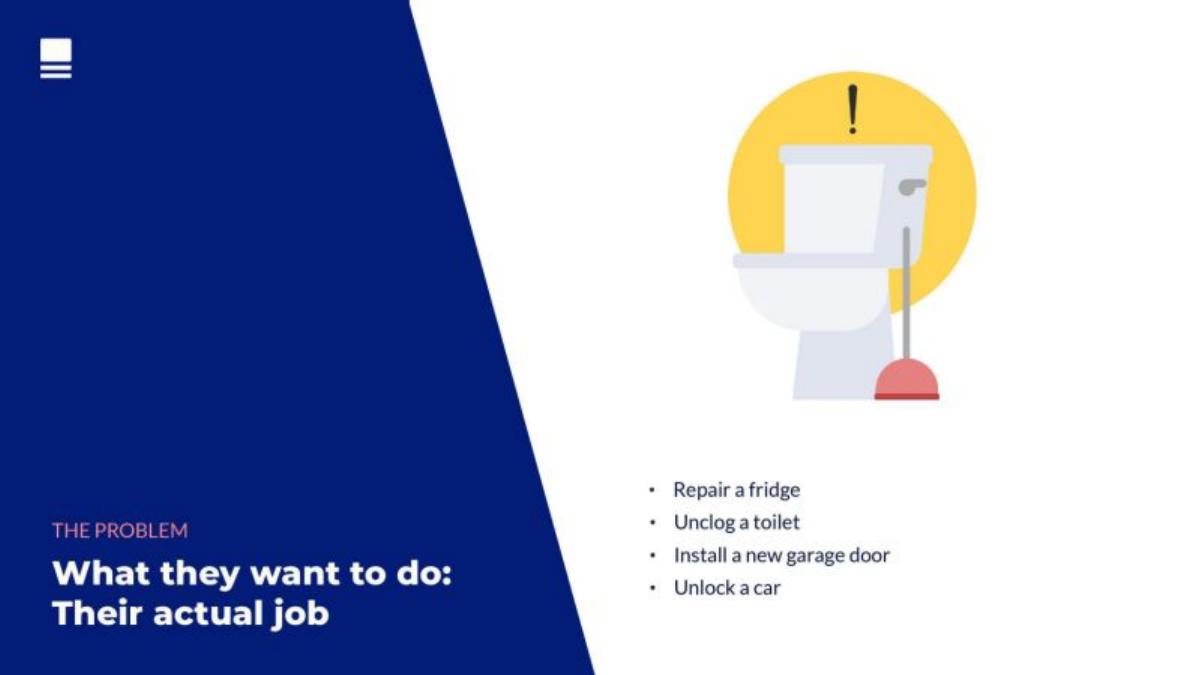
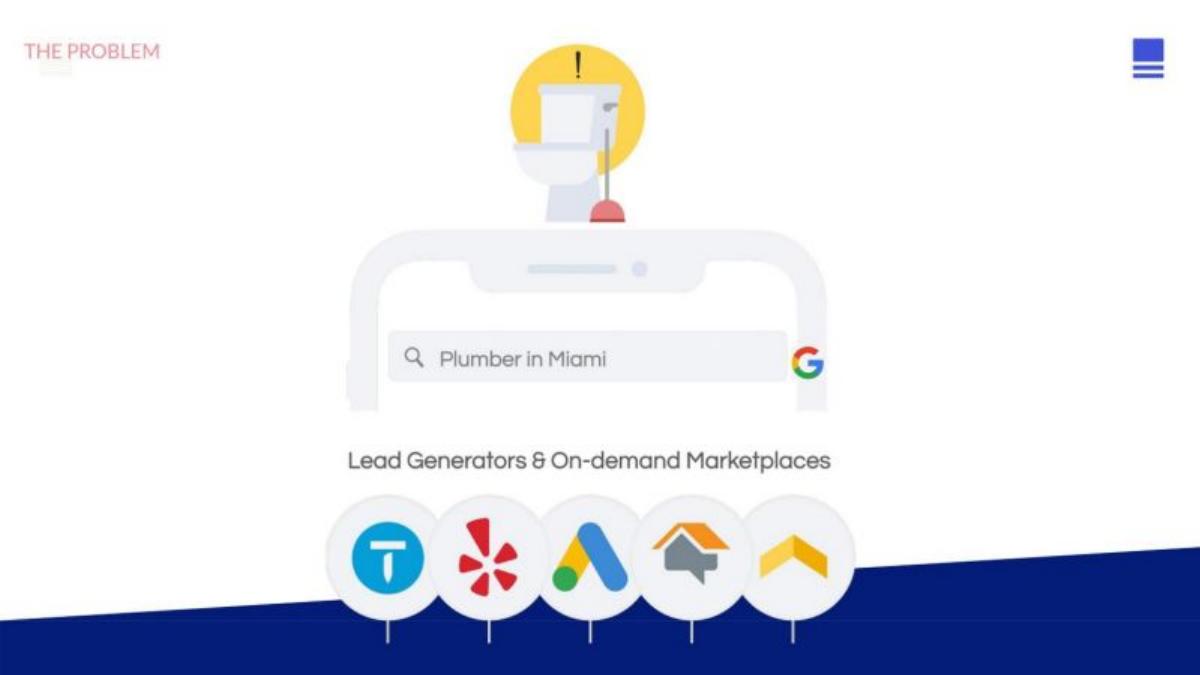
Slide 3 uses a simple graphic of a toilet to illustrate the 'actual job' (repairing a fridge, unclogging a toilet, etc.). This sets up the contrast for Slide 4 , which is the most critical 'Problem' slide in the deck. It visualizes the current industry pain point: 'Pros pay high fees whether or not a job is closed.' The diagram shows a flow where lead generators and middlemen keep 70% of the value, leaving the pro with only 30%. This '70/30' split is a powerful motivator for any investor looking for a disruptive business model that can return value to the service provider.
Slides 5-8: The Three Pillars—Workflow and Fintech
Slide 5 introduces the solution framework, highlighting the first pillar: Workflow Tools . This is followed by Slide 6 , which provides a concrete product example. It shows an unstructured SMS job request being transformed into a structured CRM entry. This 'one source of truth' is the hook that gets pros to adopt the software, as it solves the immediate headache of manual data entry and scheduling.
Slide 7 shifts the focus to the second pillar: Integrated Fintech . Slide 8 elaborates on this, listing 'Reports, Invoices, and Inventory Tracking' as the core features. The UI mockups show a clear breakdown of earnings ('My Cut') and tips. For a Series B company, fintech integration is a massive valuation driver, as it moves the company from a SaaS subscription model (SaaS) to a transaction-based model (Fintech), which often carries higher expansion potential.
Slides 9-11: The Managed Marketplace and Experience
Slide 9 highlights the final pillar: Managed Marketplace . Slide 10 explains 'The Pro Experience' within this marketplace. It emphasizes three things: matching to quality jobs, the ability to decide (autonomy), and getting paid fast with branded receipts. This addresses the 'middleman' problem mentioned earlier by ensuring the pro is in control of their workflow and cash flow.
Slide 11 focuses on the 'Customer Experience.' It shows the end-to-end journey from the consumer's perspective: Pro info, live ETA, invoice approval, and rating. By managing both sides of the transaction, Jobox ensures 'quality of service and transparency,' which is essential for maintaining a high-quality marketplace and reducing churn.
Slide 12: Traction and Scale
The deck concludes its narrative with Slide 12 , a heavy-hitting traction slide. The headline '5,000+ pros use Jobox to find and manage jobs in the US' is supported by a staggering figure: 'over $1B of transactions in 39 states.' The claim that a job is matched 'every 3 minutes' provides a sense of velocity and liquidity. The map visualization shows that while Jobox has a national footprint, it has significant density in key markets like California and Florida, which is a positive signal for regional network effects.
What Jobox Does Exceptionally Well
The Jobox deck excels at vertical clarity . It doesn't try to be everything to everyone; it is laser-focused on the 'Pro with a van.' By breaking the product down into three distinct pillars (Workflow, Fintech, Marketplace), the founders make a complex platform easy to understand. They also successfully frame the 'Middleman' as the antagonist, positioning Jobox as the hero that saves the Pro's margins.
The use of actual UI mockups (Slides 6, 8, 10, 11) is another strength. It proves the product is built and functional, showing exactly how a user interacts with the system. This reduces 'technical risk' in the eyes of investors and shifts the conversation toward 'execution risk' and 'scaling.'
What is Missing from the Deck
In this 13-slide subset of the 25-slide deck, several standard Series B components are absent:
Team Slide: There is no mention of the founders' backgrounds or the leadership team's expertise in home services or fintech. · Unit Economics: While the deck mentions $1B in processed transactions, it does not disclose Jobox's take rate, Customer Acquisition Cost (CAC), or Lifetime Value (LTV). · Competition: There is no slide addressing competitors like Housecall Pro, Jobber, or Thumbtack, and how Jobox differentiates from them beyond the 'middleman' argument. · The Ask: The deck does not explicitly state the $42M funding goal or how the capital will be allocated (e.g., sales expansion, R&D, new markets). · Financial Projections: There is no forward-looking revenue guidance or path to profitability.
Founder Takeaways: How to Copy the Jobox Strategy
Founders building in fragmented industries should take note of Jobox's 'Trojan Horse' strategy . They lead with a 'Workflow Tool' (the CRM) that solves a daily pain point for the user, then layer on 'Integrated Fintech' to capture transaction data and revenue, and finally build a 'Managed Marketplace' on top of that established user base. This sequence is much easier to execute than trying to build a marketplace from scratch without a captive supply of pros.
Additionally, the visual storytelling of the 'Problem' on Slide 4 is something every founder should emulate. Instead of using bullet points to describe high fees, Jobox uses a flow chart to show exactly where the money is leaking. It makes the need for their solution feel urgent and mathematically obvious.
Final Verdict: This deck is a high-signal, low-noise presentation that relies on massive traction ($1B GMV) and a clear product vision to justify a Series B valuation. It successfully bridges the gap between a blue-collar service and a high-tech fintech platform.
Frequently asked questions
- What is Jobox's core value proposition to service professionals?
- Jobox aims to increase the take-home pay of home service professionals by reducing the fees paid to middlemen. According to Slide 4, traditional lead generators and middlemen can keep up to 70% of a job's value. Jobox provides the infrastructure—workflow, fintech, and marketplace—to help these pros manage their business more efficiently and retain a larger share of their earnings.
- How does Jobox handle job dispatching and CRM?
- Jobox uses workflow tools to digitize manual processes. Slide 6 shows how the platform takes a text-based job request—containing the customer name, address, and job type—and automatically populates it into a mobile CRM. This creates a 'one source of truth' for the pro, allowing them to navigate to the job and charge the customer directly from the app.
- What role does fintech play in the Jobox ecosystem?
- Fintech is one of the three core pillars of the platform. As shown on Slide 8, it enables 'Seamless entry & Automation' for reporting, invoicing, and inventory tracking. By integrating payments, Jobox allows pros to get paid faster and issue branded receipts (Slide 10), while providing the platform with high-margin transaction revenue and deep visibility into the pro's business health.
- What is the scale of Jobox's operations as of the Series B?
- Jobox demonstrated significant scale in its 2022 deck. Slide 12 states that the company has processed over $1B in transactions across 39 U.S. states. They have a network of over 5,000 pros and achieve a job match on the platform every 3 minutes. The map on Slide 12 shows high concentrations of users in California, Texas, and the Northeast.
- How does the 'Managed Marketplace' differ from traditional lead gen?
- Unlike traditional lead generators that may charge for leads regardless of whether a job is closed (Slide 4), Jobox's managed marketplace focuses on 'quality jobs' and gives the pro the 'ability to decide' which jobs to accept (Slide 10). It also manages the end-to-end customer experience, including live ETAs and rating systems, to ensure quality and transparency (Slide 11).