Jeeva AI's 10-slide Seed deck is a lean, metric-heavy presentation that focuses on the transition from point-solution sales tools to a unified 'agentic' platform. By showcasing 100% month-over-month user growth and a 13-day average sales cycle, the company demonstrates significant market pull. The deck emphasizes technical defensibility through a proprietary data graph and a self-learning flywheel, rather than just relying on LLM wrappers. While it lacks a traditional 'Ask' slide or detailed financial projections, the traction data—including 300 enterprise customers and 35,000 organic users—p…
Key takeaways
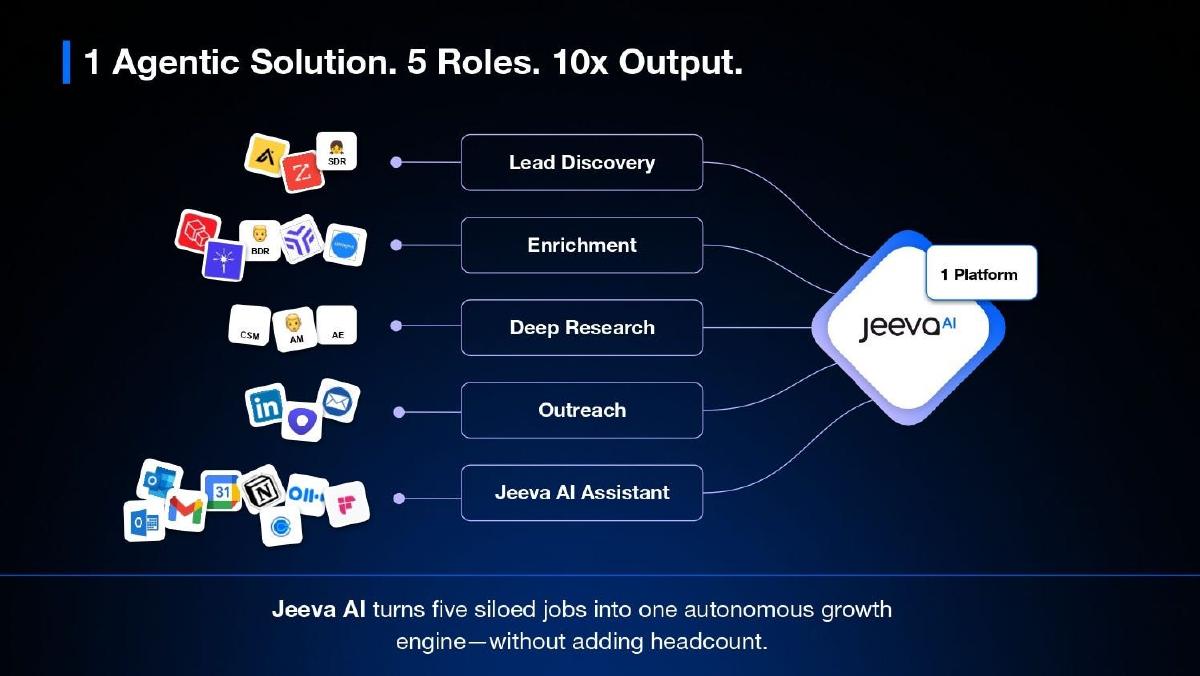
- The company positions itself as an 'Agentic AI' solution that replaces five siloed sales roles, including SDRs and BDRs (Slide 3).
- Jeeva AI reports a 13-day average sales cycle, which is exceptionally fast for enterprise sales tech (Slide 7).
- Traction is split between two motions: 300 enterprise customers and 35,000 organic PLG users (Slides 7 and 8).
- The platform claims to automate 55% of a user's week, allowing them to focus entirely on closing deals (Slide 6).
- Defensibility is built on a 'Waterfall' data graph with 100+ real-time sources, claiming 98% verified contacts (Slide 9).
- The team emphasizes an 'in-office' culture and a high density of ex-founders to drive development velocity (Slide 10).
- The deck omits a formal 'Ask' slide, cap table details, or a specific breakdown of the $9M round usage.
- Product-led growth is a core pillar, with a reported 2-minute activation time for new users (Slide 8).
The Agentic Pivot: Jeeva AI's 10-Slide Seed Deck
Jeeva AI entered the 2024 fundraising market with a clear thesis: the era of fragmented sales tools is over, and the era of the 'Agentic AI' orchestrator has begun. Raising $9M in a Seed round is a significant feat, especially in a crowded sales tech category. This teardown examines the 10 slides that convinced investors that Jeeva AI isn't just another wrapper, but a fundamental shift in how businesses grow.
Slide 1: The Hook
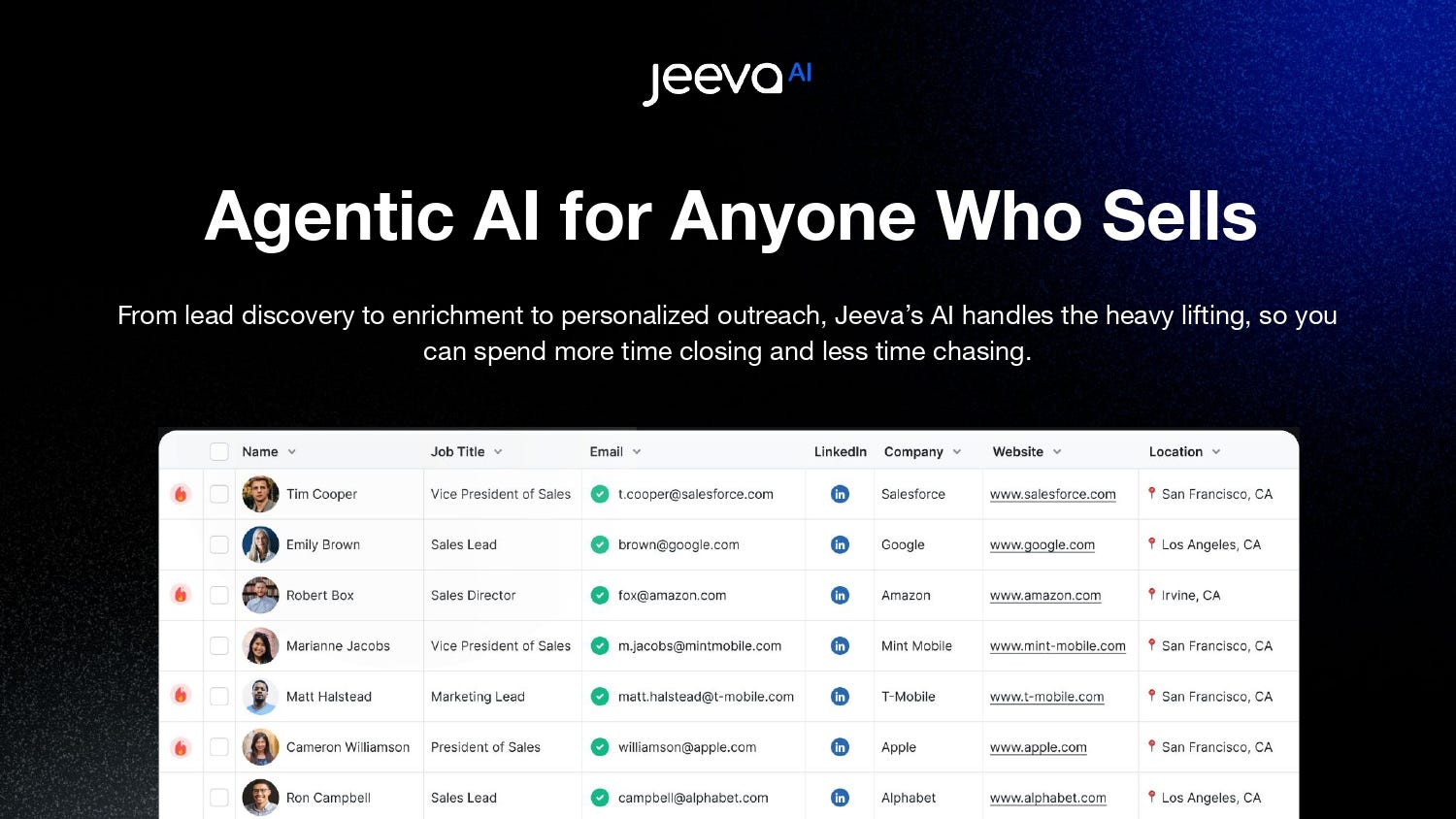
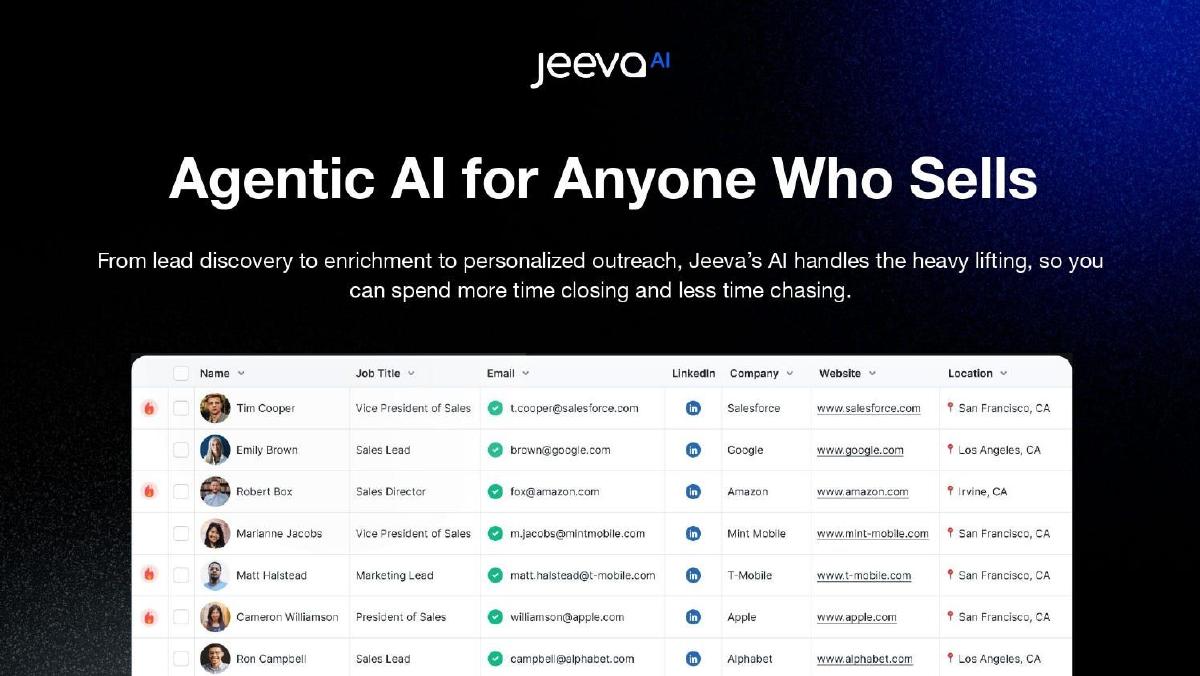
The cover slide wastes no time with fluff. The headline, "Agentic AI for Anyone Who Sells," immediately identifies the target market and the technology category. The sub-headline promises to handle the "heavy lifting" of lead discovery, enrichment, and personalized outreach. Visually, the slide includes a product UI snippet showing a lead list with names like Tim Cooper (VP of Sales at Salesforce) and Emily Brown (Sales Lead at Google), signaling that the tool is designed for high-level enterprise prospecting.
Slide 2: Vision and Mission
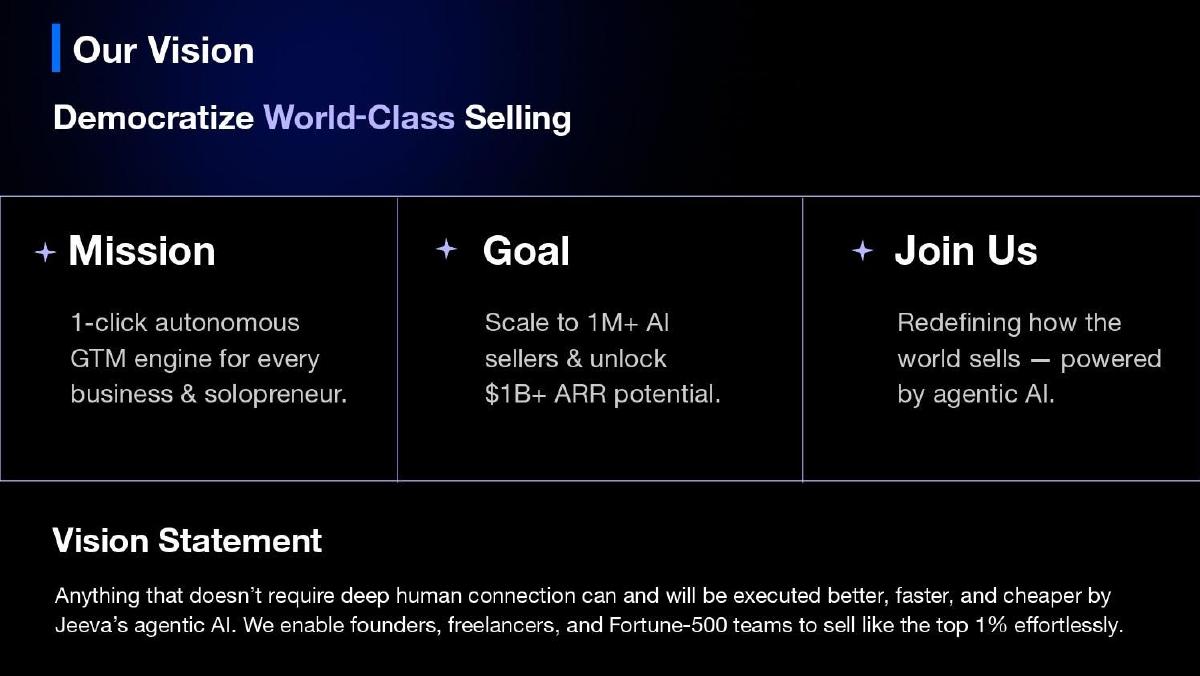
Slide 2 outlines a bold vision: "Democratize World-Class Selling." The company sets a goal to scale to 1M+ AI sellers and unlock $1B+ in ARR potential. The vision statement is particularly aggressive, claiming that anything not requiring "deep human connection" will be executed better and cheaper by their AI. This sets the stage for a massive TAM (Total Addressable Market) by suggesting they can serve everyone from solopreneurs to Fortune 500 teams.
Slide 3: The Platform Play
This is the 'Problem/Solution' slide reimagined as a consolidation play. It lists five roles—Lead Discovery, Enrichment, Deep Research, Outreach, and AI Assistant—and shows a graveyard of logos (ZoomInfo, LinkedIn, Calendly, etc.) being funneled into the "1 Platform" of Jeeva AI. The tagline at the bottom is the clincher: "Jeeva AI turns five siloed jobs into one autonomous growth engine—without adding headcount." This is a direct appeal to CFOs and GTM leaders looking to increase efficiency without increasing burn.
Slide 4: Real-Time Enrichment
Slide 4 focuses on the "Enrichment" pillar. It promises "Zero manual work" and the ability to get LinkedIn URLs, emails, and buying signals instantly. The UI shows a "Waterfall Enrichment" feature, where users can prioritize data providers like LeadMagic, Hunter, and Datagma. This suggests that Jeeva acts as a smart middleware that optimizes for the best data source in real-time, a key technical differentiator.
Slide 5: Personalization at Scale
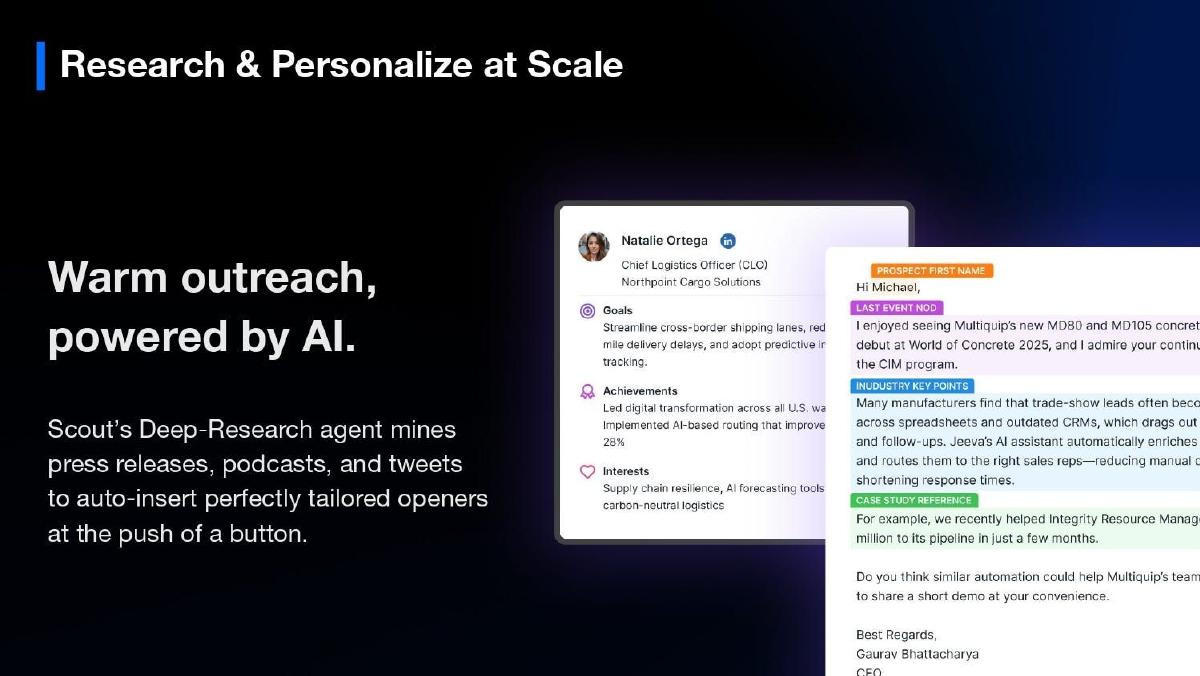
The deck moves into the "Deep Research" agent, named Scout . According to the slide, Scout mines press releases, podcasts, and tweets to auto-insert tailored openers. The visual shows a sample email to a "Natalie Ortega" (CLO at Northpoint Cargo Solutions) with specific tags for "Last Event Nod" and "Industry Key Points." This addresses the primary complaint about AI outreach: that it sounds robotic. By citing specific sources like podcasts, Jeeva claims a higher level of personalization than standard LLM templates.
Slide 6: The AI Assistant
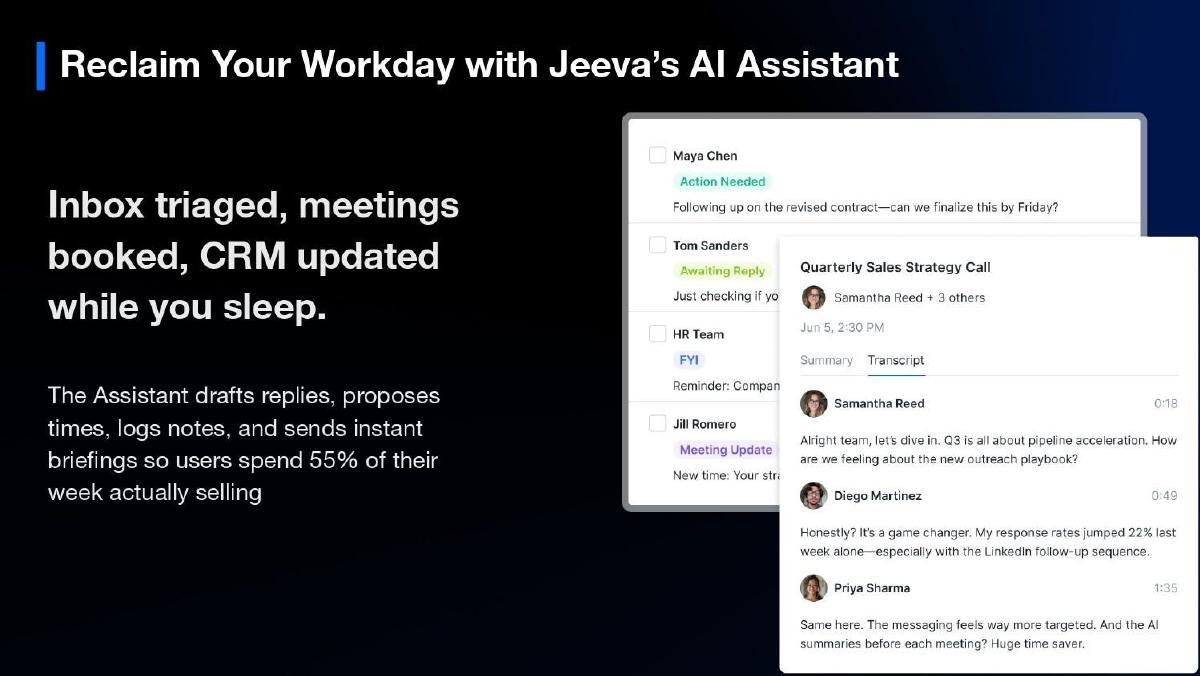
Slide 6 introduces the Jeeva AI Assistant , which handles inbox triaging, meeting booking, and CRM updates. The slide claims that users spend 55% of their week actually selling because the assistant handles the administrative overhead. The UI mock-up shows a Slack-like or email-like interface where the AI summarizes meetings and tracks response rates, including a testimonial-style quote about response rates jumping 22%.
Slide 7: Enterprise Traction
The traction slide is where the deck gains serious momentum. It reports 300 enterprise customers signed up in "a few months." The metrics are impressive: 60% MoM revenue growth and a 13-day average sales cycle . For enterprise software, a sub-two-week sales cycle is an indicator of extreme product-market fit or a very frictionless entry point. The slide features logos like JLL, Cotopaxi, and NSBA, proving they can sell into diverse industries.
Slide 8: PLG Growth
Complementing the enterprise sales motion is a Product-Led Growth (PLG) engine. Slide 8 reports 35,000 users growing organically. The key metrics here are 100% MoM PLG user growth and a 2-minute activation time . This slide is crucial because it shows the company isn't just reliant on a heavy sales force; the product can sell itself. Logos like Blackbaud and Assurant are listed as users, further validating the tool's reach.
Slide 9: Defensibility
Investors often worry that AI startups are just "wrappers" on OpenAI. Slide 9 addresses this head-on. It lists five pillars of defensibility:
Live "Waterfall" Data Graph: 100+ sources powering 98% verified contacts. · True Agentic Architecture: A single orchestrator rather than stitched point tools. · Self-Learning Flywheel: Models that train on every email and click. · 2-Minute Onboarding: Viral adoption that beats rivals to the punch. · Dev Velocity: Running their own models at half the cost and shipping weekly.
This slide aims to prove that Jeeva has a structural advantage that is difficult for incumbents to replicate quickly.
Slide 10: The Team
The final slide introduces the leadership. CEO Gaurav Bhattacharya and Head of GTM Ryan Loughlin are joined by AI Leads Swapnil and Anubhav. The slide emphasizes that 50% of the team are ex-founders and they are a "lean, fully in-person team." This "in-office" mention is a growing trend in 2024 pitch decks, signaling to investors a commitment to high-intensity collaboration and development speed.
What Jeeva AI Does Exceptionally Well
The Jeeva AI deck is a masterclass in momentum-based storytelling . Instead of spending five slides on why sales is hard (a problem every investor already understands), it spends the majority of its time on how the product works and the explosive growth it is experiencing. The use of specific, high-velocity metrics—like the 13-day sales cycle and 100% MoM user growth—creates a sense of urgency for the investor. If they don't get in now, the company might be twice as large by the time the next meeting happens.
Furthermore, the consolidation narrative is very timely. In a market where companies are looking to reduce their SaaS sprawl, a tool that claims to replace five other subscriptions is an easy sell to both customers and VCs. By naming the specific tools they replace (Slide 3), they make the ROI calculation simple for the viewer.
What is Missing from the Deck
Despite the strong traction, there are notable omissions that a more conservative investor might flag. First, there is no financial detail beyond growth percentages. We don't know the actual ARR, the burn rate, or the unit economics (LTV/CAC). While 60% MoM growth is great, starting from $1,000 is very different from starting from $100,000.
Second, the competitive landscape is largely ignored. While Slide 9 mentions "rivals" and "clones," it doesn't name them or provide a feature-by-feature comparison. In a space occupied by giants like Salesforce and well-funded startups like Apollo.io or Clay, a more detailed competitive positioning would have been beneficial.
Finally, the "Ask" is missing . The deck ends on the team slide without specifying how much they are raising, the valuation they are seeking, or what the milestones for the next 18 months look like. While this information is often shared in a separate document or during the pitch, its absence in the deck makes the conclusion feel slightly abrupt.
Lessons for Founders
Founders can learn three key lessons from Jeeva AI's approach: 1. Lead with Traction: If your growth numbers are in the triple digits, don't bury them at the end. Jeeva puts their 100% MoM growth front and center. 2. Define Your Category: By using the term "Agentic AI," Jeeva hit a 2024 buzzword that carries a higher valuation multiple than "Sales Automation." 3. Show, Don't Just Tell: Every slide includes a UI snippet or a concrete example of the AI's output. This grounds the high-level vision in technical reality, making the "agentic" claims feel believable rather than like science fiction.
Frequently asked questions
- What is the core value proposition of Jeeva AI?
- Jeeva AI positions itself as an autonomous growth engine that handles lead discovery, enrichment, deep research, and outreach. According to Slide 3, it aims to replace the need for multiple siloed tools and additional headcount by consolidating the functions of SDRs, BDRs, and AEs into a single agentic platform.
- How does Jeeva AI claim to be different from other AI sales tools?
- The deck highlights 'Defensibility' on Slide 9, citing a proprietary 'Waterfall' data graph with 100+ sources and a self-learning flywheel. They claim their data engine is 'years ahead' of competitors who rely on stale CSVs, and they emphasize that they run their own models to reduce costs by half.
- What specific traction metrics did Jeeva AI share?
- Jeeva AI shared several high-growth metrics: 60% month-over-month revenue growth (Slide 7), 100% month-over-month PLG user growth (Slide 8), and a total of 35,000 users. They also noted a very short 13-day average sales cycle for their 300 enterprise customers.
- Who is the team behind Jeeva AI?
- The team is led by CEO & Founder Gaurav Bhattacharya and Head of GTM Ryan Loughlin. The technical leadership includes AI Leads Swapnil and Anubhav, who are former AI researchers at USC. Slide 10 notes that 50% of the team are ex-founders and they operate as a lean, fully in-person team.
- Does the deck mention how the $9M will be used?
- No, the 10-slide deck provided does not include a 'Use of Funds' or 'The Ask' slide. It focuses entirely on the vision, product capabilities, traction, and team. The $9M figure and Seed round status are reported by external publishers rather than stated within these specific slides.