Alyce’s 12-slide pitch deck is a masterclass in narrative-driven problem framing. It spends the majority of its slides diagnosing the "Digital Noise" epidemic—where 34 touches are now required for a single response—and the "Physical Waste" problem, where $120 billion is spent annually on corporate gifts that are 90% trashed. By the time the deck introduces the solution on Slide 9, it has successfully framed the current B2B outreach landscape as fundamentally broken. The platform positions itself as a 'Personal' experience layer that integrates with major CRMs (Salesforce, HubSpot) to offer re…
Key takeaways
- The deck spends 60% of its time on problem diagnosis, using a '$120B Waste' hook to frame corporate gifting as a financial optimization problem.
- It identifies a massive increase in digital friction, noting that it now takes 34 'touches' to get a single response in B2B sales.
- The platform differentiates itself by focusing on the 'Person' (interests and intent) rather than the 'Persona' (titles and demographics).
- The 'Power of choice' is the primary product lever used to reduce the $9-of-$10 waste ratio in physical gifting.
- Strategic integrations with CRM and Marketing Automation tools (Salesforce, Marketo) are presented as a core technical requirement.
- The deck is missing standard fundraising components like a team slide, financial traction, product screenshots, and a specific funding request.
What this deck actually is
The Alyce deck is a 12-slide vision-led narrative, likely intended for a Seed or early Series A round, focused on redefining the corporate gifting and "direct mail" category as "Personal Experience." It is a classic "Change the Way You Think" deck that spends over 60% of its real estate (Slides 2 through 8) diagnosing a broken market before introducing a product or vision. This specific narrative structure is designed to build a sense of inevitability around the solution by making the current state of B2B sales look not just inefficient, but fundamentally absurd.
The single most important finding in this deck is its hyper-focus on market inefficiency as a wedge for disruption. By quantifying a $120 billion "waste" metric and contrasting it with the rising cost of digital attention (increasing from 15 touches to 34 touches for a response), Alyce frames itself not as a gifting company, but as a performance marketing solution for the "noisy" B2B landscape. It positions the $120B spend as a pool of capital that is currently being set on fire, suggesting that Alyce acts as the extinguisher that redirects that capital toward ROI.
However, the deck is notably absent of any specific product screenshots, revenue metrics, team bios, or traction data. There is no mention of monthly recurring revenue (MRR), the number of active customers, or the founders' names. This suggests it may have served as a teaser deck or a preliminary conversation starter rather than a comprehensive investment memorandum. It sells the "Why" and the "What" with high intensity, but leaves the "How" and "Who" entirely to the follow-up meeting.
Slide-by-slide walkthrough
Slide 1: Title Slide
The title slide features the Alyce logo, a multi-colored geometric bird icon, and the brand name "alyce" in lowercase white text against a dark-to-light blue gradient. The bird icon, composed of various triangles in shades of pink, yellow, and blue, is the only decorative element. There is no tagline, no date, and no specific mention of the round or the founders' names. It is a minimalist entry point that leans heavily on brand aesthetics to establish a professional, "modern SaaS" feel from the first second.
From an investor's perspective, this slide establishes a modern, tech-forward visual identity. The bird icon suggests agility or "sending" (highly relevant to a gifting platform), but the lack of a "One Sentence Pitch" means the investor is walking into Slide 2 with no context for what Alyce actually does. In a high-volume deal flow environment, this minimalism can be risky; if an investor is skimming, they may not immediately realize if this is a logistics play, a marketing tool, or a consumer app. It forces the subsequent slides to work significantly harder to define the business model quickly.
The strongest version of this slide would include a sub-headline that defines the category Alyce intends to lead. A phrase like "The AI-powered platform for personal B2B relationships" or "Ending the $120B waste in corporate gifting" would provide immediate mental anchoring. Additionally, including the presenter's contact information or the specific fund name shows a level of preparedness and personalization that mirrors the company's own philosophy of "personal" touches. Without these, it remains a pretty but functionally silent introductory slide.
Slide 2: The Situation
This slide introduces the narrative hook: "THE SITUATION It's exponentially harder for businesses to grow..." The design is extremely sparse, using large pastel abstract shapes in the background to keep the focus on the centered bold heading. It serves as a psychological transition from the brand identity to the problem statement, setting a somber tone for the current state of the market. It is the first beat in a "Problem/Solution" arc, framing growth not just as a challenge, but as a condition that is getting worse at an "exponential" rate.
Investors read this as the "Macro Trend" slide. By starting with the difficulty of growth, Alyce is positioning its solution as a necessity rather than a luxury. The logic is: if growth is hard, the tools that enable it are high-value and non-discretionary. However, at this point, the slide is purely rhetorical; it offers no data yet to support the claim of "exponential" difficulty. It relies entirely on the investor's presumed agreement with the premise—which is a safe bet in B2B SaaS, but lacks the "punch" of a data-backed assertion.
The strongest version of this slide would pair the headline with a singular, shocking graph showing the decline in Customer Acquisition Cost (CAC) efficiency or the saturation of digital channels over the last decade. A "Situation" slide is only as strong as the evidence backing it; without data, it is just an opinion. A specific citation of rising CAC across the SaaS industry or the declining effectiveness of traditional digital ads would ground this "exponential" claim in reality and make the subsequent "Noise" slide feel like a logical extension of a proven fact.
Slide 3: More Noise + Noise-Makers
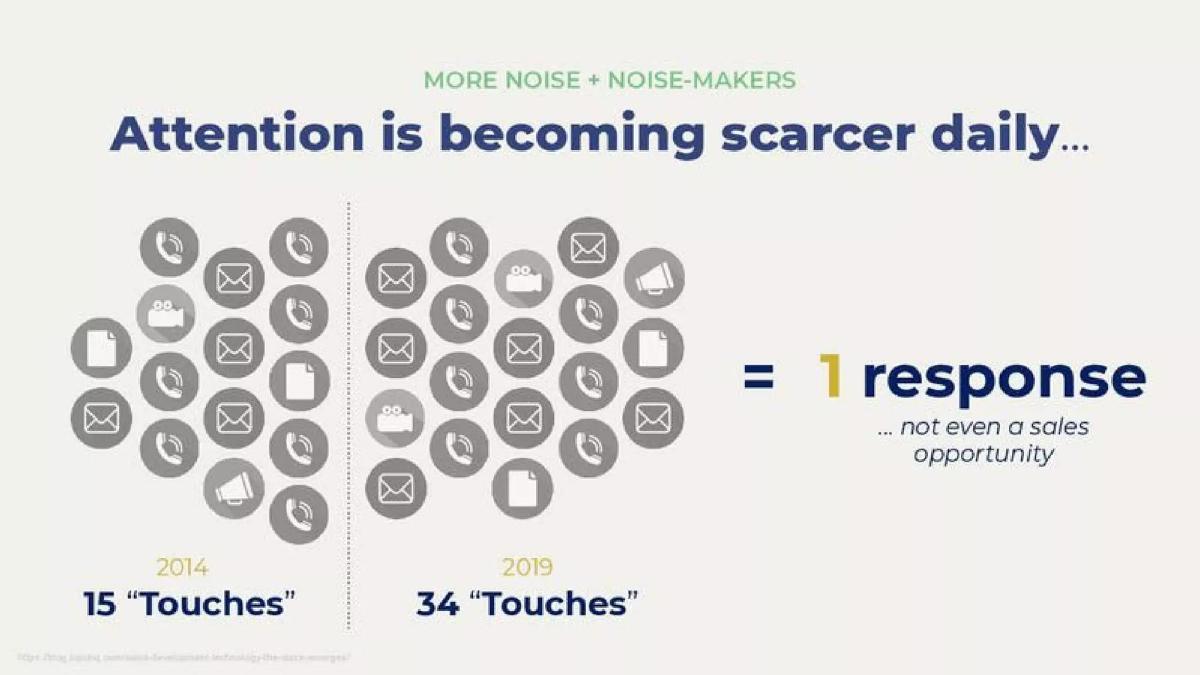
This slide quantifies the "noise" problem with specific comparative figures. It compares 2014, where it took 15 "Touches" to get a response, to 2019, where it takes 34 "Touches." The visual uses clusters of grey communication icons—including phones, mail envelopes, and chat bubbles—separated by a dotted line. The flow leads to a large "= 1 response" graphic on the right, which is followed by the clarifying note: "... not even a sales opportunity." This distinction is vital, as it highlights that the 34 touches only buy you a "hello," not a "yes."
This is a highly effective slide because it identifies the "why now." Investors see a clear 2.2x increase in the effort required to get a prospect's attention in just five years. By specifying that a response is not even an "opportunity," Alyce highlights a secondary problem: even when you get through the noise, the quality of engagement is low. This creates a vacuum for a high-quality, high-signal solution to fill. It suggests that the current "sales stack" is essentially a volume-based machine that has reached its physical limits.
To improve this, the deck should cite the source of these specific numbers ("15 vs 34 touches"). Mentioning a reputable source like Forrester, Gartner, or a proprietary study gives the math authority. Furthermore, the slide could be strengthened by clarifying the definition of a "touch"—does this include automated emails, LinkedIn ads, cold calls, or a mix of all three? The more specific the pain, the more valuable the relief. Defining what constitutes a "touch" would also help set the stage for how Alyce's "Personal" approach differs from these 34 automated attempts.
Slide 4: Their Solution (The "Facepalm" Slide)
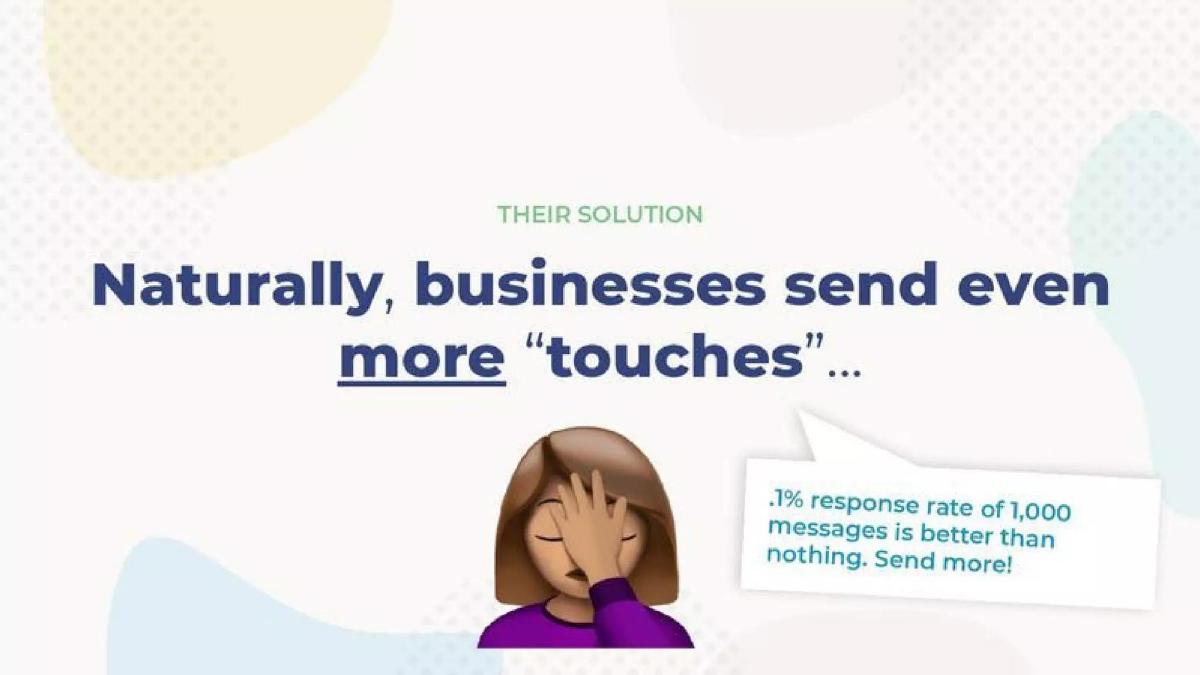
Alyce mocks the current industry standard with a slide titled "THEIR SOLUTION." The text reads: "Naturally, businesses send even more 'touches'... .1% response rate of 1,000 messages is better than nothing. Send more!" The layout features a large facepalm emoji and a speech bubble containing small teal text, set against a cluttered abstract background. It is a satirical look at the "quantity over quality" mindset that dominates modern B2B outbound marketing, where a 0.1% response rate is seen as an acceptable trade-off for volume.
This slide identifies the "Enemy." In pitch deck narrative structure, the enemy is usually the legacy way of doing things—in this case, high-volume, low-personalization automation. Investors understand that this "spray and pray" model is reaching a point of diminishing returns. By ridiculing the .1% response rate, Alyce is implicitly promising a significantly higher conversion rate for their own (yet to be revealed) method. It effectively frames the current market behavior as a form of insanity: doing the same thing more times and expecting a different result.
The strongest version of this slide would transition from mockery to a more technical critique. Instead of just saying "Send more!" is bad, it could highlight the collateral damage of this strategy, such as brand erosion, domain blacklisting (which kills email deliverability), or the "unsubscribe" epidemic. This would move the argument from "this is annoying" to "this is a strategic risk for the enterprise." Adding a metric on the rising cost of those 1,000 messages versus the decreasing value of the resulting lead would turn the facepalm into a financial calculation.
Slide 5: Physical "Touches"
The deck pivots to the physical realm with the question: "Well... what about direct mail, swag, meals and tickets?" This is a dark-to-light blue gradient slide that serves as the bridge between the digital noise problem and the physical gifting solution. By listing these four categories—direct mail, swag, meals, and tickets—Alyce introduces the specific market segment they intend to disrupt. It represents the transition from the "Digital Noise" problem to the "Physical Waste" problem.
For an investor, this slide narrows the focus and clarifies the product category. Up until now, the deck could have been for a new CRM, a better email sequencer, or an AI-driven LinkedIn bot. Now, the deck is clearly about the physical side of sales and marketing. It poses a question that the next three slides will answer by showing why the current physical options are also failing, despite being a logical alternative to digital noise. It sets a trap: if digital is too noisy, you go physical—but as the next slide shows, the physical world is currently a mess of waste.
The strongest version of this slide would include a small visual preview or icons of the categories mentioned (a gift box, a dinner plate, a ticket) to break up the text. It should also hint at why these physical touches are the right answer—perhaps a tagline like "The last remaining high-signal channel"—before Slide 6 pivots to how they are currently being mismanaged. This would frame the physical world as the "Gold Mine" and the current management of it as the "Broken Tool."
Slide 6: The Waste ($120B)
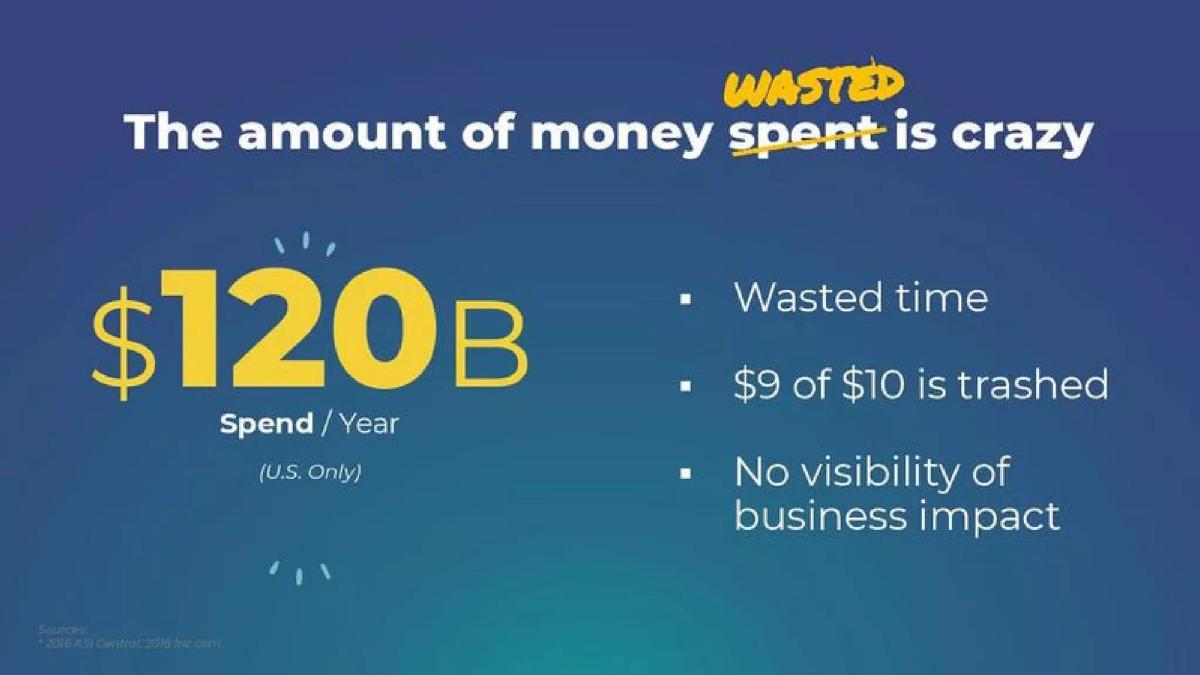
This slide is the core "Problem" slide, presenting the scale of the inefficiency. It claims "$120B Spend / Year (U.S. Only)" but the word "spent" is crossed out and "WASTED" is handwritten over it in yellow script. It lists three primary drivers of this waste: "Wasted time," "$9 of $10 is trashed," and "No visibility of business impact." The sources cited at the bottom are "2016 ASI Central" and "2016 inc.com." The large yellow $120B graphic is intended to be the "anchor" number for the entire investment thesis.
Investors look for "leakage" in a market, and a "$9 out of $10 trashed" statistic is a massive red flag that signals opportunity. If Alyce can prove it captures even a fraction of that $120B by making it efficient, the TAM (Total Addressable Market) is enormous. The mention of "No visibility" is a key pain point for CMOs and CFOs who want to track ROI on every dollar; in modern marketing, if you can't measure it, you shouldn't be spending it. This slide effectively turns corporate gifting from a "soft" HR/Sales task into a "hard" financial optimization problem.
The biggest issue here is the age and specificity of the data. The deck cites 2016 sources for what appears to be a 2019-2020 narrative. In a fast-moving tech environment, four-year-old data can feel stale and raises questions about whether the waste has already been addressed by competitors. The strongest version would provide more recent figures or a CAGR (Compound Annual Growth Rate) to show that this $120B waste is actually growing alongside the digital noise mentioned earlier. Furthermore, a breakdown of why $9 of $10 is trashed (e.g., "Wrong size, unwanted item, never received") would make the problem feel more solvable.
Slide 7: Duplicate of Slide 6
This slide is an exact duplicate of Slide 6. It includes the same "$120B" yellow graphic, the same list of waste drivers ("Wasted time," "$9 of $10 is trashed," "No visibility"), and the same 2016 sources. In a professional deck, this is typically a formatting error, a technical glitch during the export, or a placeholder that was not removed before the final version was sent to investors.
Investors will see this as a lack of attention to detail, which can be a red flag for founders seeking millions of dollars. In a 12-slide deck, losing 8% of your real estate to a duplicate slide is a significant missed opportunity to provide more depth or evidence. It breaks the momentum of the "The Budget Breakdown" narrative that follows on Slide 8 and suggests that the deck was not thoroughly proofread before distribution.
The fix is obvious: remove the duplicate. In its place, Alyce could have included a "Why Now?" slide focused on the rise of Account Based Marketing (ABM) or the impact of GDPR/CCPA regulations that make digital tracking harder, thus making physical gifting more attractive. Alternatively, this would have been an ideal spot for a "Voice of the Customer" quote describing the frustration of sending expensive swag that ends up in a landfill. Any additional data point would have been better than a repetition of the previous slide.
Slide 8: The Budget Breakdown
This slide provides the arithmetic behind the $120B waste claim. It breaks it down into four categories connected by a large bracket: "$10.6B Holiday Gifts" ($1,860 / Company X 5.7M Companies), "$23.5B Swag + Promotional Gifts" ($4,122 / Company X 5.7M Companies), "$42.9B Employee Incentives" ($376 / Employee X 5.7M Companies X 20 Employees), and "$43B Customer Incentives" ($7,545 / Company X 5.7M Companies). The list includes "Tickets, Meals, Trips, Loyalty Programs, Rewards, Spifs" as examples of Customer Incentives. The total of these figures ($10.6 + $23.5 + $42.9 + 43) actually sums to $120B, showing consistent internal logic.
Investors value this kind of "bottom-up" market sizing logic because it reveals the company's assumptions. However, the calculation for "Employee Incentives" ($376 / Employee X 5.7M Companies X 20 Employees) implies a workforce of 114 million people (5.7M 20), which aligns with U.S. employment stats, but the "Customer Incentives" math ($7,545 / Company X 5.7M Companies) is incredibly broad. It assumes every single company in America—from ExxonMobil to a local three-person dry cleaner—spends $7,545 on customer incentives annually. This makes the $120B figure feel "pushed" to reach a round number rather than being a precise reflection of Alyce's addressable market.
The strongest version of this slide would segment the 5.7M companies into a "Target Market" vs. "Total Market." Not all 5.7M companies are potential Alyce customers. If Alyce targets mid-market and enterprise B2B tech firms, the "Waste" figure within that specific niche would be more compelling and realistic than trying to claim the entire U.S. economy's gifting budget. Showing that 80% of the spend comes from the top 10% of companies would create a much clearer "Ideal Customer Profile" (ICP) for the investor to grasp.
Slide 9: The Solution
On Slide 9, Alyce finally introduces the platform. It is described as "THE SOLUTION The ultimate gifting platform for ROI." The slide is divided into three sections: a gift box icon, a circular collage of gift items (including headphones, watches, and bags), and a cloud of corporate logos. The text highlights three value propositions: "What to send," "Power of choice," and "Fully integrated." The integration cloud includes Salesforce, Zendesk, HubSpot, Marketo, Workday, and Microsoft Dynamics.
This slide tells the investor that Alyce is a "Platform," not just a service or a catalog. The "Power of choice" is a crucial differentiator—it suggests that recipients can choose what they want, which directly addresses the "$9 of $10 trashed" problem mentioned on Slide 6. The integration list is a "must-have" for enterprise software; it proves Alyce can fit into an existing sales and marketing stack (Salesforce, Marketo, HubSpot) without creating a new silo. It positions Alyce as the "connective tissue" between the CRM and the physical gift.
Despite these strengths, the slide is incredibly weak on product demonstration. There are no screenshots, no dashboard views, and no explanation of how the "Power of choice" actually works. Is it a link in an email? A physical card? A web portal? The strongest version would show a "Before and After" user experience: the old way (sending a random mug the prospect doesn't want) vs. the Alyce way (the recipient receiving a notification and selecting a high-end item they actually value). Without a UI/UX visual, the "platform" remains an abstract concept.
Slide 10: "A" Is Not For Automation
This slide contrasts two philosophical approaches to marketing. On the left, "Person a" is represented by a black silhouette and described as "Groups of general demographics." On the right, "Person" is represented by a high-resolution photo of a smiling woman and described as "Individual interests and intent." The headline, "'A' IS NOT FOR AUTOMATION," is a direct jab at Marketing Automation platforms that treat prospects as entries in a database rather than humans. It emphasizes the "Alyce way" of focusing on the individual.
Investors interpret this as Alyce's AI/Machine Learning play, even though those terms aren't explicitly used. The focus on "intent" and "interests" suggests that Alyce is scraping social data, professional profiles, or behavioral cues to suggest gifts. It’s a compelling philosophical stance: moving from "Persona-based marketing" to "Person-based marketing." In a world where buyers are increasingly resistant to automated spam, this "human-first" positioning is highly attractive to VCs looking for the next generation of MarTech.
The slide is high on fluff and low on mechanics. How does Alyce discover these interests? Is it privacy-compliant under GDPR? Does the salesperson have to enter the data, or does the platform find it automatically? The strongest version would show a mock-up of a "Person Profile" Alyce has built, highlighting specific, non-obvious interests (e.g., "Loves hiking in the Pacific Northwest, drinks dark roast coffee, supports animal shelters") to show the depth and accuracy of the data the platform provides to the salesperson.
Slide 11: The Alyce Differentiator
This slide presents a competitive landscape through a "Professional vs. Personal" lens. It pits a massive list of "Professional" platforms (Salesforce, LinkedIn, Engagio, Marketo, Outreach, SalesLoft, Oracle, and "6,900 more") against Alyce's "Personal" focus. The "Professional" side is defined as "Focus on 'touching' a persona (title, industry, company)," while Alyce is defined as "Focus on investing in the person (interests, life outside work)." The tagline is: "Building and investing in relationships at the right time is where deals are won."
This is a classic "Blue Ocean" strategy slide. Alyce isn't trying to compete with Salesforce or Marketo; it's trying to be the essential layer that sits alongside them. By listing 6,900 other platforms, Alyce highlights the saturated "Professional" market and positions itself as the only player in the "Personal" space. It’s a bold claim of category ownership. It tells the investor that while every other tool is making the "34 touches" louder, Alyce is the only one making them more meaningful.
The comparison is slightly lopsided, however. Many of the platforms listed (like Outreach or SalesLoft) have "personalization" tokens and tools designed to make outreach feel human. To be more convincing, Alyce needs to explain why their "Personal" focus is a moat that these multi-billion dollar companies can't easily replicate. Is it the proprietary interest data? The logistics network? The psychology of the "choice" model? The "Why can't Salesforce just add a 'Send Gift' button?" question needs a clearer answer on this slide.
Slide 12: Our Vision
The final slide states the company's ultimate goal: "OUR VISION Make every professional relationship more human." It uses a pink font for the word "human" and a red heart icon with stars for emphasis. Below this, it links the vision to business results: "Trust, respect, and loyalty = consistent business growth." It is a minimalist, emotional closing designed to leave the investor with a sense of the company's "North Star."
This is a "Soft" ending to a deck that started with "Hard" numbers like $120B and 34 touches. It aims to leave the investor with a feeling of purpose, framing Alyce as a "mission-driven" company. While vision is important for long-term alignment, ending a deck without a "Call to Action" or a "The Ask" slide is a tactical error in a fundraising context. The investor is left with a warm feeling but no idea how much money the company is raising, what the valuation expectations are, or what the specific milestones for the next round will be.
The strongest version of this slide would keep the vision but add a second half: "The Path to Human Growth." This section would outline the next 18-24 months of growth, the funding target (e.g., "$10M Series A"), and the expected outcomes (e.g., "Triple revenue, expand to EMEA"). A pitch deck is a request for partnership, and that request should be explicit. Ending on a heart icon without a dollar sign leaves the business side of the conversation unfinished.
Concrete fixes in priority order
Eliminate the Duplicate: Remove Slide 7 immediately. Replace it with a "Traction" slide showing actual user growth, gift redemption rates, or revenue to prove the platform is already being used in the real world. · Add Product Screenshots: The deck is entirely conceptual. It needs at least two slides showing the Alyce interface—one showing how a salesperson selects a "Personal" gift, and one showing the recipient's "Power of Choice" landing page. · Include "The Ask": Add a slide detailing the current fundraising round, the total amount sought, and how the funds will be deployed (e.g., "60% Engineering, 30% Sales, 10% Operations"). · Update Data Citations: Replace the 2016 citations with modern metrics. In the B2B tech space, data that is 3-4 years old can make a problem look like it has already been solved or is no longer relevant. · Clarify the Logistics: Investors will wonder who handles the physical shipping, inventory, and returns. A "How it Works" slide explaining the logistics backbone would remove a major "operation risk" concern. · Add a Team Slide: Introduce the founders and key leadership. A pitch is an investment in the people executing the vision; the current deck provides zero information on who is behind the bird logo. · Define the ICP: Refine the $120B math to focus on the "Serviceable Addressable Market" (SAM)—the B2B companies that actually use Salesforce/Marketo—rather than every business in the U.S.
Frequently asked questions
- How does Alyce calculate the $120 billion market size?
- The deck calculates a total of $120 billion spent annually on physical touches in the U.S. alone, encompassing Holiday Gifts ($10.6B), Swag ($23.5B), Employee Incentives ($42.9B), and Customer Incentives ($43B).
- How does the platform address gifting waste?
- Alyce uses the 'Power of choice' to ensure recipients get something they actually want, which directly targets the statistic that $9 of every $10 spent on corporate gifting is currently trashed.
- What integrations does Alyce support?
- The deck mentions integrations with Salesforce, Zendesk, HubSpot, Marketo, Workday, and Microsoft Dynamics, positioning the platform as a fully integrated layer within existing sales and marketing stacks.
- What is the 'Alyce Differentiator'?
- Alyce distinguishes between 'Professional' touches (focused on title, industry, and company) and 'Personal' investments (focused on individual interests and life outside work), claiming the latter is where deals are won.
- What data does the deck use to show digital noise?
- The deck identifies that between 2014 and 2019, the number of 'touches' required to get a response grew from 15 to 34, and even then, that response rarely results in a sales opportunity.