One Space VR presents a specialized case for VR in industrial safety, specifically targeting Global Wind Organisation (GWO) licensed training for renewable power plants. The deck is structured around the transition of intellectual property from a previous venture, VIRMODE, which reportedly spent $193,652 over four years developing similar applications for the hydro sector. By virtualizing the training environment, the company aims to eliminate high setup costs associated with physical facilities and travel. The $650,000 ask is directed toward US market entry and the development of a 'Wind Spa…
Key takeaways
- The company is requesting $650,000 to enter the US market and launch the Wind Space product (Slide 17).
- One Space VR claims to transfer four years of 'know-how' from a previous hydro VR application to the new US-based entity for $0 (Slide 9).
- The business model is based on a Pay-per-use (PPU) system, charging trainees per session and per module (Slide 13).
- A competitive analysis identifies 'collaboratively remote training' as a key market gap that competitors like vinci-vr and simulwind do not address (Slide 11).
- Past financials for the predecessor entity, VIRMODE, show total expenses of $193,652, with 74% allocated to personnel (Slide 23).
- The product roadmap plans to expand from wind operation modules into shipyard, solar power, and petrochemistry training (Slide 25).
- The first module targeted for development is 'Working with hand & power tools' (BTT), based on GWO safety standards (Slide 27).
- The deck omits a dedicated team slide, leaving the specific expertise of the founders and engineers unverified within the presentation.
Executive Summary: The Pivot to Renewable Training
One Space VR is a specialized technology play targeting the renewable energy sector. The deck positions the company as an evolution of a previous project, VIRMODE, which focused on hydroelectric power training. The core value proposition is the reduction of overhead in industrial safety training by moving from physical simulators and classrooms to a collaborative, multiplayer VR environment. With a $650,000 funding goal, the company intends to localize its existing intellectual property for the US market and achieve Global Wind Organisation (GWO) licensing.
Slide 1: Title and Vision
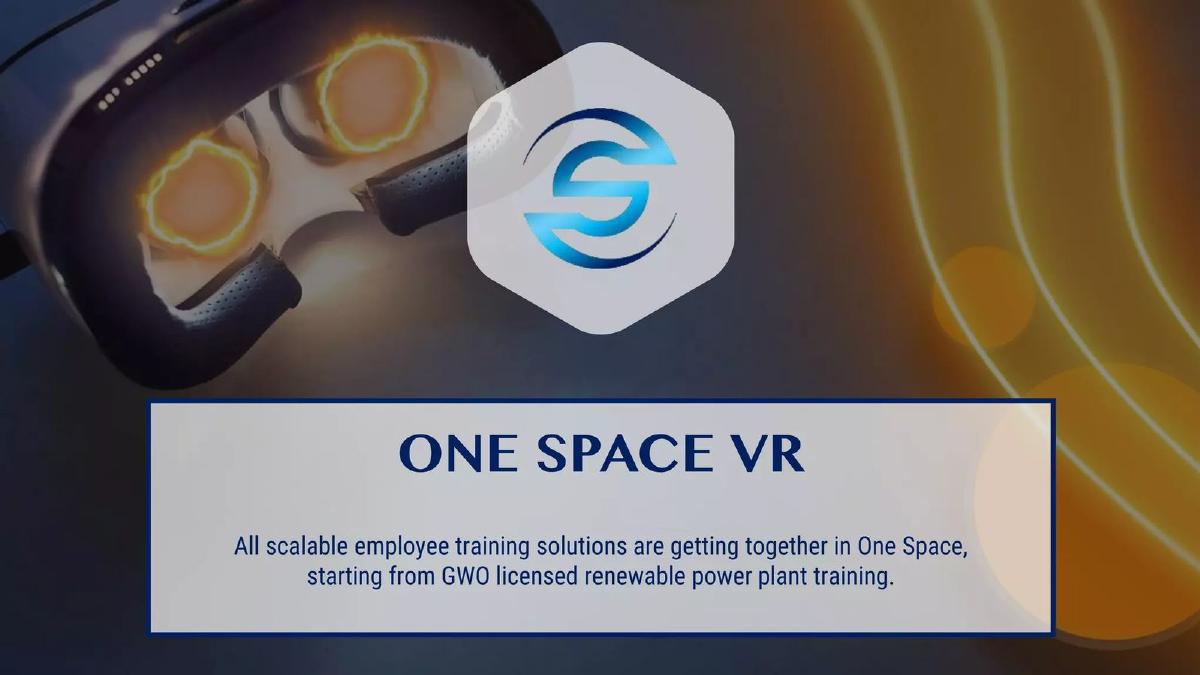
The cover slide introduces One Space VR with the tagline: "All scalable employee training solutions are getting together in One Space, starting from GWO licensed renewable power plant training." The visual focus is on a VR headset, immediately establishing the sector. The mention of GWO (Global Wind Organisation) is a critical industry-specific signal, indicating the company is targeting regulated safety standards rather than generic corporate training.
Slide 3: The Evolution of Training
Titled "Training Eras," this slide uses a timeline to contextualize the product. It moves from 1980s "Classroom" to 2000s "Computer-Based" and 2020 "Physical Simulators." A question mark at the end of the timeline suggests that VR is the inevitable next step. The slide uses imagery of bored students in a classroom to contrast with the high-tech future they are proposing.
Slide 5: The Current Training Bottleneck
This slide breaks down the "Current Training Process" into a linear timeline. It identifies two major pain points: "Enormous setup cost" (buying land, laying out facilities, buying physical equipment) and "Time consuming costly operations" (assigning trainers, convoking trainees, and manual evaluation). This slide serves as the "Problem" slide, highlighting the capital-intensive nature of traditional industrial training.
Slide 7: The VR Solution Methodology
Slide 7 mirrors the previous slide but applies the One Space VR solution. Red "X" marks are placed over land acquisition, facility layout, and physical equipment. The text highlights "Just VR Headset," "No travel and accommodation costs," and "Full automated" evaluation. This is a classic "Before and After" comparison designed to show immediate ROI for potential enterprise clients.
Slide 9: Proven Track Record (VIRMODE)
To mitigate the risk of being a pre-product startup, the founders highlight their previous work. They state that a "similar VR training application for hydro was developed" and that "4 years of know-how will be transferred for $0 to the US company." Screenshots of the previous application, branded with "Enerjisa Uretim," provide visual proof of a working prototype and previous corporate partnerships.
Slide 11: Competitive Landscape
The "Missing Point in the Market" slide is a standard checkmark matrix. It compares One Space VR against six competitors: vinci-vr, simulwind, Duke Energy's XR Lab, Serious Games by Indra, Fife College, and IBEWL 98. One Space VR claims to be the only entity that is a commercial VR company offering collaborative remote training that is also GWO licensable. This slide attempts to carve out a niche in multiplayer, remote industrial training.
Slide 13: Revenue Generation
The business model is described as "Pay-per-use (PPU)," specifically "Charging trainee per session per module." The target customers are identified as "Providers of training for renewables personnel" and "Renewable power plant companies." This suggests a B2B2C or B2B model where the platform acts as a utility for existing training centers or a direct solution for plant owners.
Slide 15: Customer Validation
This slide features testimonials from Fatih Cay (Academy Group Manager at Enerjisa Uretim Inc.) and F. Mert Yildiz (Technical Training Team Leader at Enerjisa Ayedas Inc.). They cite specific benefits such as simulating explosions and showing non-conforming elements that are hard to find in real life. These quotes provide social proof from mid-level decision-makers in the energy sector.
Slide 17: The $650K Ask and Growth Roadmap
The funding slide specifies a "Raise $650K" goal. The roadmap for these funds includes: "Enter the US market," "Add the Wind Space Product," and "Meet 100+ lead." The visual uses a staircase of blocks leading to "Growth," though it lacks a specific timeline (e.g., 12-18 months) for these milestones.
Slide 19: Advisory and Contact
This slide is unusually sparse, featuring a generic illustration of three people and a call to "meet people who are interested in such a business." It provides an email address for Esad Akoz. Notably, this is not a team slide; it does not list the background, education, or specific roles of the founders.
Slide 23: Historical Financials
Included in the "Backup Slides" section, this slide provides a detailed look at the predecessor's finances from 2018-2021. Total expenses (Debit) were $193,652, while total credits (Capital stock, Investment, and Government supports) were $196,865. The pie chart shows that 74% of spending went to personnel, which is typical for a software development startup. This transparency regarding past spending adds a layer of financial credibility.
Slide 25: Long-Term Market Expansion
A bar chart titled "Long-Term Growth" shows the projected increase in the number of annual trainees. The growth is driven by adding new sectors: Wind (Basic and Intermediate), Shipyard, Solar Power, and Petrochemistry. This slide illustrates the company's ambition to move beyond a single-niche product into a broader industrial training platform.
Slide 27: Product Specification (GWO Standards)
This slide displays the "Top 25 hazards and risks" as defined by the GWO. It highlights "Working with hand & power tools" (BTT) as "The First Module." By aligning directly with established safety icons and standards, the company demonstrates a deep understanding of the regulatory environment they are entering.
Slide 29: Target User Pyramid
The final content slide shows a pyramid of "Juniors," "Seniors," and "Experts." A bracket indicates that "Physical Training" currently covers all three. The implication, though not explicitly stated in text on this slide, is that VR can either augment or replace segments of this pyramid to increase efficiency.
What One Space VR Does Well
The deck excels at identifying a highly specific, high-value niche: GWO-licensed renewable energy training. By focusing on a regulated industry where safety is non-negotiable and training is mandatory, they bypass the "nice-to-have" problem that plagues many VR startups. The inclusion of past financials from their previous entity (Slide 23) is a rare and welcome level of transparency that shows they know how to manage a small budget over a multi-year period. Furthermore, the competitive matrix (Slide 11) makes a strong case for "collaborative remote training" as a unique selling point, which is particularly relevant in a post-pandemic industrial landscape.
What is Missing from the Deck
The most glaring omission is a dedicated Team Slide. While an email address is provided on Slide 19, there is no information regarding the founders' technical expertise, pedagogical background, or previous exits. In a seed-stage raise, the team is often more important than the product. Additionally, the deck lacks specific unit economics. While they mention a "Pay-per-use" model (Slide 13), they do not provide the actual dollar amounts they intend to charge or the projected margins. Finally, the "US Market Entry" plan is vague; there is no mention of specific US-based partners, regulatory hurdles, or a sales strategy beyond "meeting 100+ leads."
Founder's Guide: What to Copy
Founders should emulate the way One Space VR uses a predecessor's success to validate a new venture. If you are pivoting or starting a new company based on IP from a previous one, Slide 9 ("We've done this before") and Slide 23 ("Past Financials") are excellent templates for building trust. The use of industry-standard icons (Slide 27) is also a smart move; it shows the founders are not just "tech people" but are deeply embedded in the specific safety culture of their target market. This alignment with existing regulatory bodies (GWO) makes the product feel like an inevitable industry upgrade rather than a risky experiment.
Frequently asked questions
- What is the primary problem One Space VR is solving?
- According to Slide 5, the current training process for industrial workers involves 'enormous setup costs' such as buying or renting land and physical equipment, followed by 'time-consuming costly operations' like convoking trainees and assigning trainers. One Space VR aims to replace this with a virtualized digital environment that requires only a VR headset, eliminating travel and accommodation costs.
- How does One Space VR differentiate itself from other VR training providers?
- Slide 11 features a competitive matrix where One Space VR claims to be the only provider offering 'Collaboratively remote training (online & multiplayer)' while also being 'GWO Licensable' and independent from equipment producers. Other listed competitors, such as Fife College and IBEWL 98, are noted as lacking full mobility or commercial VR company status.
- What is the relationship between One Space VR and VIRMODE?
- Slide 9 and Slide 23 explain that the founders previously developed a similar VR application for the hydro sector under the name VIRMODE. They state that four years of technical know-how will be transferred to the new US company, One Space VR, at no cost. The deck includes VIRMODE's historical financial data to demonstrate previous execution capability.
- What are the specific use cases for this technology?
- Slide 15 provides testimonials from managers at Enerjisa Uretim Inc. and Enerjisa Ayedas Inc. The technology has been used for simulating explosions, monitoring learning progression, single-line literacy, and showing 'non-conforming elements' that inspectors might encounter in the field but are difficult to replicate in physical training.
- What is the long-term growth strategy?
- Slide 25 outlines a vertical expansion strategy. After establishing basic and intermediate wind operation modules, the company plans to add shipyard training, followed by solar power modules, and eventually petrochemistry training. This suggests a goal to become a horizontal safety training platform for all high-risk industrial sectors.