Ongil.ai is an enterprise AI startup positioning itself as a bridge to advanced AI integration, specifically targeting the problem of making decisions with limited data. The deck emphasizes the technical pedigree of its leadership, featuring a CEO with a PhD in Computational Neuroscience and a CTO with experience at Freshworks and Yahoo!. Their primary product, Synapse.green, utilizes Graph RAG (Retrieval-Augmented Generation) to provide sustainability solutions and CSRD-compliant reporting. While the deck excels at establishing technical credibility and showcasing enterprise interest from br…
Key takeaways
- The company focuses on helping enterprises make data-driven decisions even when data is limited (Slide 1).
- Leadership includes a CEO with a PhD in Computational Neuroscience and a CTO with experience at Freshworks and eBay (Slide 7).
- The team maintains high retention, with an average tenure of 3 to 3.5 years across data science and engineering roles (Slide 10).
- Ongil.ai has secured a Microsoft-sponsored marketplace listing including $150k in credits (Slide 13).
- The technical stack includes Hadoop-like systems for parallel data collection and GraphDB for insights generation (Slide 16).
- The product Synapse.green is specifically designed for CSRD reporting and ESG metrics benchmarking (Slide 25).
- The company claims to have been selected as a top 3 startup for AB InBev's procurement solutions (Slide 13).
- The deck omits a specific investment ask, valuation, or revenue growth metrics in the provided slides.
The Ongil.ai Deck Analysis
Ongil.ai presents a deck that is heavily weighted toward technical credibility and enterprise validation. In an era where 'AI' is often used as a buzzword, this deck attempts to differentiate itself by highlighting a team with deep academic roots and a specific focus on the 'limited data' problem. The visual style is consistent, utilizing a high-contrast yellow and charcoal palette, which gives it a modern, professional feel.
Slide 1: Title and Value Proposition
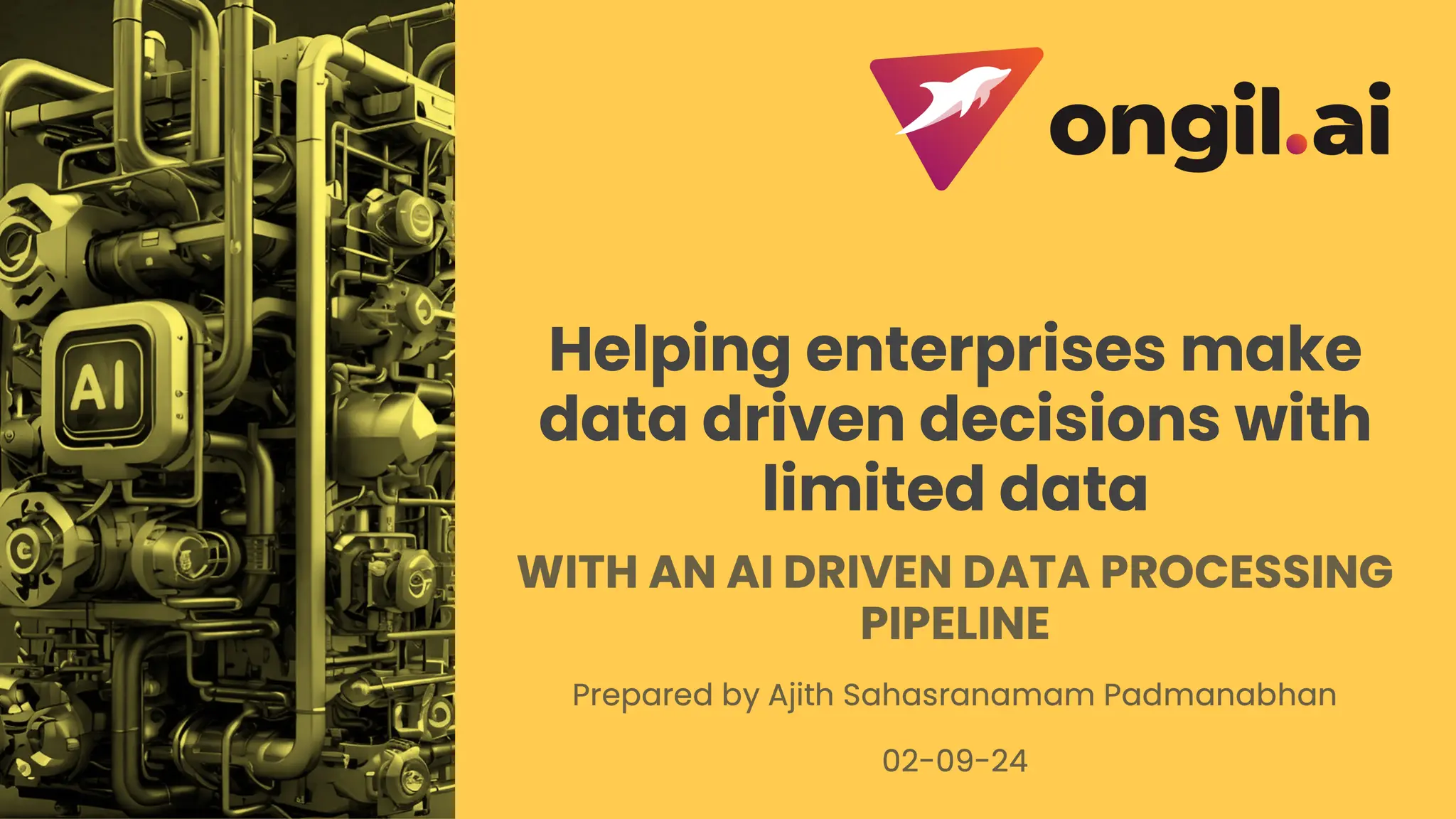
The cover slide establishes the company's primary mission: 'Helping enterprises make data driven decisions with limited data.' This is a specific and compelling hook, as most AI solutions assume a surplus of clean data. The subtitle mentions an 'AI driven data processing pipeline.' The deck is dated 02-09-24 and was prepared by the CEO, Ajith Sahasranamam Padmanabhan. The imagery of complex industrial piping on the left reinforces the 'pipeline' metaphor.
Slide 4: Enterprise Trust Signals
Titled 'Trusted by industry leaders,' this slide is a standard logo wall. It includes major global brands: Unilever, 3M, Wells Fargo, Microsoft, Wipro, Capgemini, PepsiCo, and Salesforce. It also includes the Indian Institute of Technology Madras. While the slide does not specify if these are paying clients, pilots, or partners, the inclusion of these names early in the deck is intended to establish immediate enterprise-grade credibility.
Slide 7: Leadership Pedigree
The leadership slide focuses on academic and professional history. CEO Ajith Sahasranamam is highlighted for his PhD in Computational Neuroscience from Bernstein Center Freiburg and his status as an invited keynote speaker for major corporations. CTO Srinivasan Rengarajan is positioned as an architect of enterprise-grade applications with a resume featuring Freshworks, Yahoo!, eBay, and Thoughtworks. His Master’s degree from the Indian Institute of Science (IISc) adds significant weight for investors familiar with the Indian tech ecosystem.
Slide 10: Team Retention and Quality
This slide is unique in that it emphasizes 'Team Highlights' regarding retention. It claims an average tenure of 3.5 years for Data Science and 3 years for Data Engineering. In a high-churn industry like AI development, these figures are meant to signal stability. The slide also notes that their Data Science team includes PhDs in neuroscience, ecology, and theoretical physics, suggesting a multidisciplinary approach to original AI development.
Slide 13: Accolades and Partnerships
Slide 13 serves as a 'traction' slide, though it focuses on awards rather than revenue. Key achievements listed include:
Top 30 TechStartup in India (selected from 1500 applicants). · Microsoft sponsored marketplace listing with $150k in credits. · Top 3 startup selected for AB InBev's procurement solutions. · Selection for the Wipro Accelerator (10 of 107 applicants). · Brussels-backed EU expansion with financial aid.
This slide also introduces 'Synapse.green,' identifying it as an Ongil Private Limited product that leverages Graph RAG for sustainability solutions.
Slide 16: The Technical Stack
Under 'AI centred engineering,' the company breaks down its infrastructure into four quadrants:
Data Collection: A Hadoop-like system for parallel collection from thousands of sources with integrated anomaly detection. · Containerized Apps: Conversational agents deployed via Docker, including custom bot flows. · Frontend: Real-time streaming and big data visualization tools. · Database Management: Use of Elasticsearch and GraphDB for generating insights.
This slide is designed to satisfy the technical due diligence of a VC's engineering partner, showing that the 'pipeline' mentioned on Slide 1 is a built reality.
Slide 22: The Bridge to Integration
This slide summarizes the service offering. It positions Ongil.ai as a 'Bridge to Advanced AI Integration.' The five points listed—tailored assistants, rapid deployment, data analysis beyond text, specific knowledge integration, and scalability—suggest a consultative or platform-as-a-service (PaaS) model rather than a simple out-of-the-box SaaS tool.
Slide 25: Product Deep Dive: Synapse.green
The final content slide focuses on the specific benefits of the Synapse.green product. It highlights 'Regulatory-aware conversational interface' for CSRD (Corporate Sustainability Reporting Directive) reporting. It also mentions 'Complex scenario modelling for what-if analysis' and 'ESG metrics benchmarking.' This indicates that Ongil.ai is leaning heavily into the ESG (Environmental, Social, and Governance) sector as its primary market entry point.
What Ongil.ai Does Well
The deck is exceptionally strong at establishing technical authority . By highlighting PhDs in computational neuroscience and specific database technologies like GraphDB, they move past the 'wrapper' stigma that plagues many current AI startups. The focus on limited data is a brilliant strategic choice; it addresses a real enterprise pain point where data is often siloed, messy, or insufficient for standard LLM training.
The social proof is also handled well. Instead of just listing logos, Slide 13 provides context for their achievements, such as the specific number of applicants they were selected from for various accelerators. This provides a sense of relative scale and competitiveness.
What is Missing from the Deck
The most glaring omission in the provided slides is financial data . There is no mention of Annual Recurring Revenue (ARR), growth rates, or customer acquisition costs (CAC). While the logo wall is impressive, it is unclear how many of these are multi-year contracts versus one-off pilots.
Furthermore, there is no market sizing (TAM/SAM/SOM) slide. While ESG reporting is a growing field, the deck does not quantify the opportunity. There is also no competitive landscape analysis. The ESG reporting space is crowded with incumbents and new AI entrants; Ongil.ai does not explicitly state why their Graph RAG approach is superior to existing ESG platforms.
Finally, there is no Ask slide . A fundraising deck must eventually tell the investor how much money is being raised, what the valuation is, and specifically how the funds will be deployed to reach the next milestone.
Founder Takeaways
Highlight Tenure: If you have a team that stays together, use it as a metric. Ongil.ai’s Slide 10 is a great example of how to turn 'team' into a 'traction' metric by showing average tenure.
Solve for Scarcity: Most AI decks talk about 'Big Data.' Positioning your solution to work with 'Limited Data' (Slide 1) creates a unique niche that appeals to legacy enterprises that haven't modernized their data stacks yet.
Specific Use Cases: Don't just say you 'do AI.' Ongil.ai connects their tech to a specific regulatory burden (CSRD reporting on Slide 25). This makes the ROI much easier for a corporate buyer to calculate.
Frequently asked questions
- What is the core problem Ongil.ai solves?
- According to Slide 1, Ongil.ai helps enterprises make data-driven decisions specifically in environments where they have limited data. They achieve this through an AI-driven data processing pipeline that goes beyond simple text responses to include complex data analysis and content generation, as noted on Slide 22.
- What is Synapse.green?
- Synapse.green is a specific product under the Ongil.ai umbrella, described on Slide 13 as leveraging Graph RAG (Retrieval-Augmented Generation). Slide 25 clarifies its utility as a regulatory-aware conversational interface for ESG reporting, specifically targeting CSRD compliance and precise ESG metrics benchmarking.
- How does the company validate its enterprise readiness?
- The deck uses Slide 4 to display logos of 'industry leaders' including Unilever, 3M, Wells Fargo, Microsoft, and PepsiCo. Furthermore, Slide 13 lists accolades such as being a Top 30 TechStartup in India and being selected for the Wipro Accelerator from over 100 applicants.
- What are the technical capabilities of their AI engineering?
- Slide 16 details an 'AI centred engineering' approach. This includes a Hadoop-like system for parallel data collection from thousands of sources, containerized applications using Docker, real-time AI content streaming, and the use of Elasticsearch and GraphDB for database management and insights generation.
- What is the background of the founding team?
- The leadership (Slide 7) consists of CEO Ajith Sahasranamam, who holds a PhD in Computational Neuroscience and has spoken at Wells Fargo and Salesforce, and CTO Srinivasan Rengarajan, a Master of Mechanical Engineering from the Indian Institute of Science with a career history at Yahoo!, eBay, and Thoughtworks.