OnStump presents a hybrid business model that combines digital campaign services with a civic engagement platform. The company identifies core problems in the political landscape, such as insufficient fundraising support for PACs and a lack of public opinion insights. Their solution involves 'The Sheel' for campaign management and 'LookRep,' a patent-pending system utilizing a wide array of emerging technologies including AI, Blockchain, and Quantum Computing. While the deck outlines a broad target market ranging from individual citizens to international political campaigns, it lacks specific…
Key takeaways
- The company is seeking $2 million in funding for talent acquisition, infrastructure, marketing, and R&D (Slide 9).
- OnStump claims a patent-pending technology titled 'An Advanced Multidisciplinary System for Enhanced Civic Engagement and Selected Representative Accountability' filed in June 2023 (Slide 4).
- Revenue is projected to reach $5,411,691 by 2028 with a net profit of $2,209,641 (Slide 9).
- The product suite is split between 'The Sheel' for campaign services and 'LookRep' for citizen-representative interaction (Slides 3 and 4).
- The business model includes five revenue streams: advertising, premium features, partnerships, sponsorships, and a percentage of donations (Slide 6).
- The deck lists a massive range of technologies for its platform, including AI, ML, IoT, AR, Blockchain, Edge Computing, and Quantum Computing (Slide 4).
- Target markets are highly diverse, encompassing advocacy groups, non-profits, international campaigns, corporate engagement, and individual citizens (Slide 5).
- The deck lacks a team slide, current traction metrics, or a specific breakdown of the competitive landscape beyond general categories (Slides 1-9).
OnStump Pitch Deck Analysis
The OnStump pitch deck presents a vision for a technology-driven overhaul of the political and civic engagement landscape. By positioning itself as both a service provider for political organizations and a platform for citizens, the company attempts to bridge the gap between elected officials and the public. The deck is structured to highlight systemic problems in modern politics and offer a high-tech solution backed by pending intellectual property.
Slide 1: Title Slide
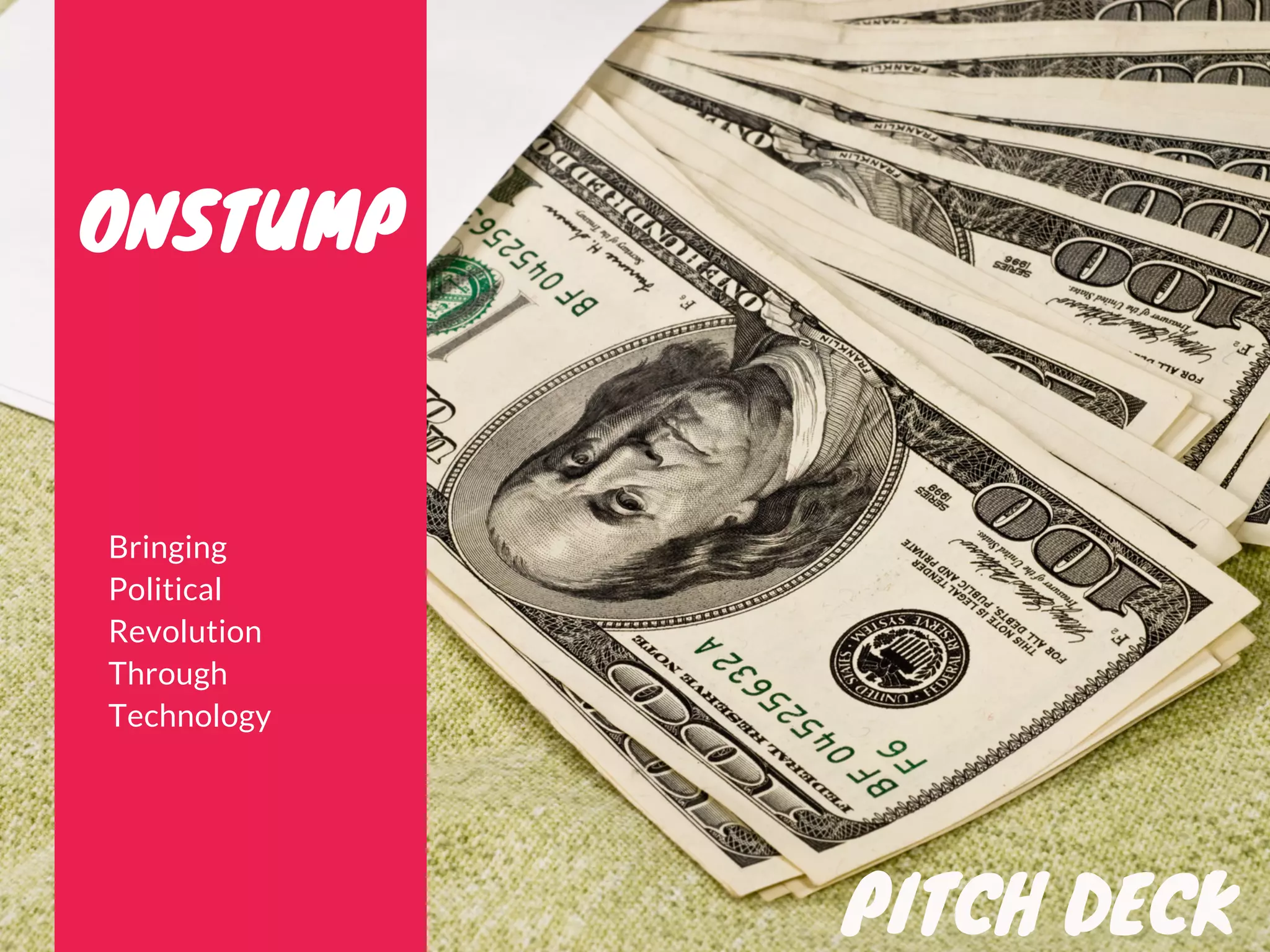
The cover slide features the company name 'ONSTUMP' in a bold, stylized font. The tagline 'Bringing Political Revolution Through Technology' sets a high-level mission statement. The background image of a stack of $100 bills is a literal representation of the fundraising focus mentioned later in the deck, though it is a bold choice for a civic-tech company aiming for 'revolution.'
Slide 2: The Problem Statement
Slide 2 identifies four core pain points in the current political environment: Insufficient Fundraising Support for PACs, Targeted Messaging Challenges , Inadequate Government Outreach , and Limited Public Opinion Insights . By listing these, the company establishes that the market suffers from both a lack of technical tools for campaigners and a lack of engagement tools for the governed.
Slide 3: The Sheel - Campaign Solutions
This slide introduces 'The Sheel,' which appears to be the B2B or service-oriented arm of the company. It offers 'comprehensive data-driven digital campaign solutions.' The services listed include targeted digital marketing, social media management, online reputation maintenance, and support for corporate lobbying efforts. This slide positions OnStump as a digital agency powered by proprietary data insights.
Slide 4: Patent Pending LookRep
Slide 4 focuses on the citizen-facing platform, 'LookRep.' The slide explicitly cites a patent application (No: 6352218) filed on June 21, 2023. The most striking element of this slide is the list of technologies claimed to be in use: AI, ML, IoT, AR, Blockchain, Edge Computing, Generative AI, and Quantum Computing. The platform aims to provide information on elected officials, a 'Responsiveness Score,' and secure voting decision support.
Slide 5: Target Market
The target market slide uses a hub-and-spoke diagram to show six distinct segments. These include Advocacy Groups , Non-profit organizations , International Political Campaigns , Corporate Political Engagement , Individual citizens , and Donors . This wide net suggests a 'platform play' where the company intends to be the central node for all political interactions.
Slide 6: Revenue Sources
OnStump outlines five revenue streams in a funnel graphic: In-app advertising , Premium features , Partnership , Sponsorships , and a Percentage of donations . The inclusion of a percentage of donations is a common model in the political tech space (similar to ActBlue or WinRed), providing a potentially scalable transaction-based revenue model.
Slide 7: Direct Competitors
Rather than naming specific companies like NGP VAN or Quorum, slide 7 lists categories of competitors: Online reputation management firms , Digital campaign solutions companies , Web development agencies , Political consulting firms , and Data analytics companies . While this identifies the types of firms they are up against, it lacks a specific competitive matrix showing how OnStump's technology is superior to existing incumbents.
Slide 8: Marketing and Sales Strategy
The go-to-market strategy is divided into four quadrants: Content Marketing (thought leadership), Strategic Partnerships (referrals from political consultants), Digital Advertising (targeted social media), and Thought Leadership Events (webinars and conferences). This is a standard B2B marketing mix, though the 'Strategic Partnerships' with consultants is likely the most critical for the political sector.
Slide 9: Financial Projections and The Ask
The final slide provides the hard numbers. OnStump is seeking $2 million in funding . The slide notes they are open to equity or structured loan agreements. The funds are earmarked for talent, infrastructure, marketing, and R&D. The financial projections show revenue growing to $5,411,691 by 2028 , with a projected net profit of $2,209,641 in the same year.
What Works in the OnStump Deck
Clear Problem/Solution Mapping: The deck does a good job of identifying specific frustrations in the political sector (like the difficulty of sentiment analysis) and mapping them to specific product features. · Intellectual Property: Citing a specific patent application number and date (Slide 4) adds a layer of credibility to their technical claims, suggesting they have at least formalised their 'secret sauce.' · Diversified Revenue: By listing five different revenue streams, the company shows it isn't reliant solely on cyclical election-year spending, which is a common pitfall for political startups. · Visual Clarity: The slides are clean, use consistent iconography, and are not overcrowded with text, making the deck easy to skim.
What is Missing from the OnStump Deck
The Team Slide: In the provided 9 slides, there is no mention of the founders or their backgrounds. In civic tech, the founders' political connections and technical pedigree are often the most important factors for investors. · Traction and Validation: There are no metrics regarding current users, pilot programs, or revenue to date. Without this, the $5.4M projection for 2028 feels purely speculative. · Technical Specificity: Slide 4 lists almost every 'buzzword' technology available, including Quantum Computing. Without explaining how Quantum Computing or IoT applies to civic engagement, this risks looking like a list of buzzwords rather than a technical roadmap. · Specific Competitors: By only listing categories of competitors (Slide 7), the founders avoid acknowledging the massive incumbents already dominating the space, which investors will certainly know.
Founder's Guide: What to Copy and What to Avoid
Copy the IP citation: If you have a patent pending, follow OnStump's lead on Slide 4. Providing the application number and filing date gives investors something concrete to verify during due diligence.
Avoid the 'Buzzword Soup': While it is tempting to list every modern technology your platform might use, listing AI, Blockchain, and Quantum Computing on a single slide without context can trigger skepticism. Focus on the one or two technologies that are actually core to your MVP.
Copy the Revenue Funnel: Slide 6 is a strong way to visualize how a company can monetize a single platform through multiple channels. It shows a sophisticated understanding of how to extract value from different user types (citizens vs. campaigns).
Avoid the 'Stack of Cash' Imagery: The title slide's use of hundred-dollar bills is jarring for a company claiming to bring 'Political Revolution.' Founders should ensure their imagery aligns with their mission; for civic tech, images of people, voting booths, or data visualizations are generally more appropriate than raw currency.
Frequently asked questions
- What is the primary product OnStump is building?
- OnStump is building two distinct but related solutions. 'The Sheel' is a suite of data-driven digital campaign services for PACs and political organizations, including social media management and reputation maintenance. 'LookRep' is a patent-pending platform designed for individual citizens to interact with elected officials, featuring a 'Responsiveness Score' and secure voting decision support.
- How does OnStump plan to generate revenue?
- The company outlines a multi-channel monetization strategy on slide 6. This includes traditional digital models like in-app advertising and premium features, alongside industry-specific streams such as taking a percentage of donations processed through the platform. They also plan to utilize partnerships and sponsorships to diversify their income.
- What is the status of their technology and intellectual property?
- According to slide 4, OnStump has a patent pending for their 'LookRep' system (Application No: 6352218, dated June 21, 2023). The deck claims the platform will integrate a highly ambitious stack of technologies, including AI, Machine Learning, Blockchain, and even Quantum Computing, though it does not specify how these are currently implemented.
- Who are the target customers for this platform?
- The target market is exceptionally broad. Slide 5 identifies six key segments: Advocacy Groups, Non-profit organizations, International Political Campaigns, Corporate Political Engagement, Individual citizens, and Donors for responsible governance. This suggests the company views itself as a comprehensive infrastructure layer for the entire political ecosystem.
- What are the financial goals stated in the deck?
- On slide 9, the company projects significant growth over a five-year horizon. They expect revenue to reach $5.4 million by 2028, resulting in a net profit of approximately $2.2 million. To reach these milestones, they are seeking $2 million in capital, which they are open to receiving via equity or structured loan agreements.