Patents on a Pitch Deck: Granted, Pending or Just Filed?
How founders show patents on a pitch deck: granted versus pending, filings versus inventions, company versus founder ownership, and what each patent protects.
How to Show Patents on Your Pitch Deck Without Overstating Them
Thirteen slides from real pitch decks that mention patents. For each, we record what the slide says, what status the patents are actually at, whether the count is of inventions or of country filings, who owns them, and whether the slide says what they protect.
TL;DR
A patent line on a pitch deck is useful only when an investor can tell four things: the status of each patent (granted, allowed, published, pending or only filed), how many separate inventions sit behind the count, who owns them, and which part of the product they cover. "4 patents pending" answers the first question and none of the others. A filing table with status, country, priority date and application number answers all four.
In this set, OKYO Pharma's table is the clearest: ten rows that turn out to be three patent families, with none yet granted (two allowed, three published, five filed, our count). StradVision shows 310 issued patents and 456 pending across five countries (our totals), but counts each country separately. Buzzient separates one granted utility patent from three pending ones; CreatorDB separates two granted from seven "in process" and names the fields. At the other end, Sqeeqee bundles "over 30 patents pending, trademarks, & various I.P." into one line, and Hippokros credits its founder, not the company, with "10 patents pending".
Patent slides from real pitch decks
Each example records what the slide states, what status and structure its patents actually have, and what to copy or avoid. "Our count" and "our calculation" mark work we did; the slides do not show it.
OKYO Pharma technology slide — slide 24
Drug developer. "Strong Intellectual Property Portfolio" page of an investor deck (2019).
OKYO Pharma deck, slide 24. Exact stored slide matched to this analysis.
Our analysis: A complete, checkable filing table.
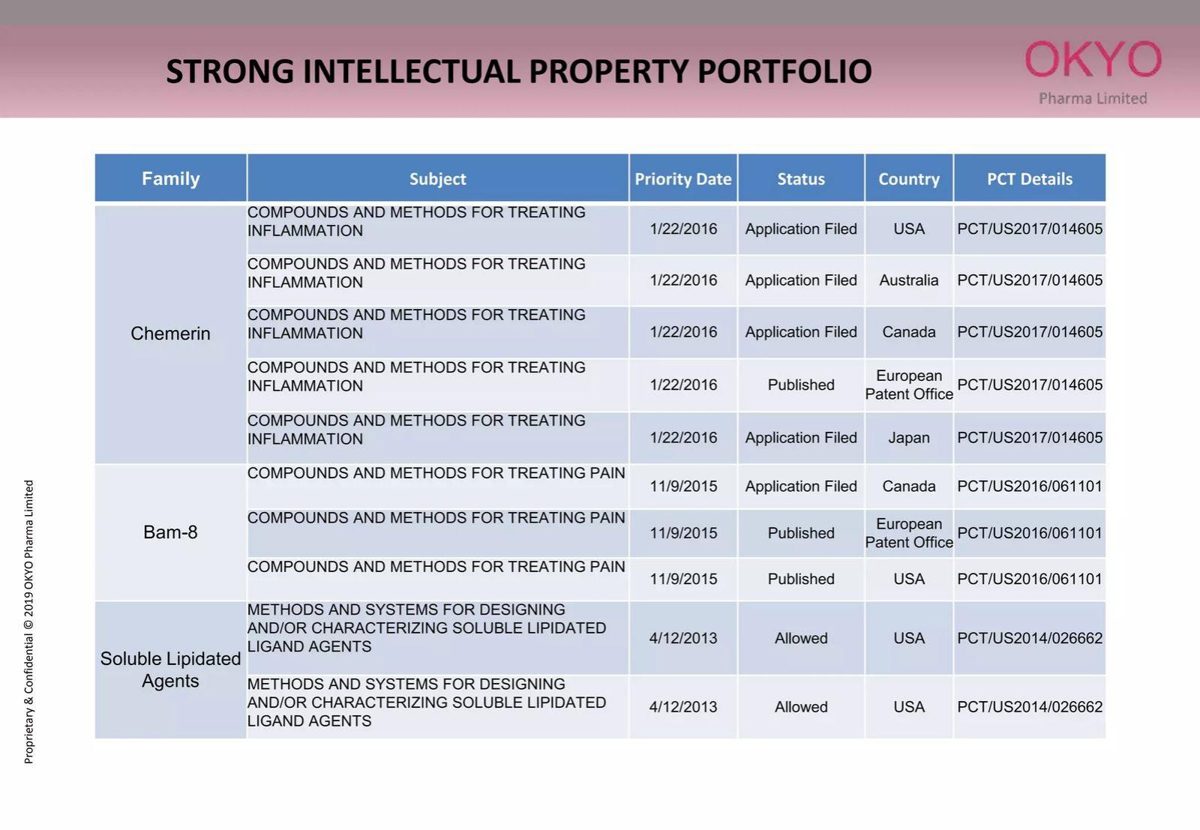
Evidence and limitation: Our count: 2 Allowed, 3 Published, 5 Application Filed; none granted. Ten filings, three inventions.
What a founder can adapt: Group filings by family and give status per country.
Supporting analysis
What the deck claims: A table of ten rows: family, subject, priority date, status, country, PCT details. Families: Chemerin (5 rows, priority 1/22/2016), Bam-8 (3 rows, 11/9/2015), Soluble Lipidated Ligand Agents (2 rows, 4/12/2013).
Presentation choice: Status, country, priority date and application number for every filing, grouped by invention.
When it does not fit: Don't head a table of applications "Strong".
Camera perception software for vehicles. "Patents" page (2019).
StradVision deck, slide 11. Exact stored slide matched to this analysis.
Our analysis: Precise status by country; inventions not counted.
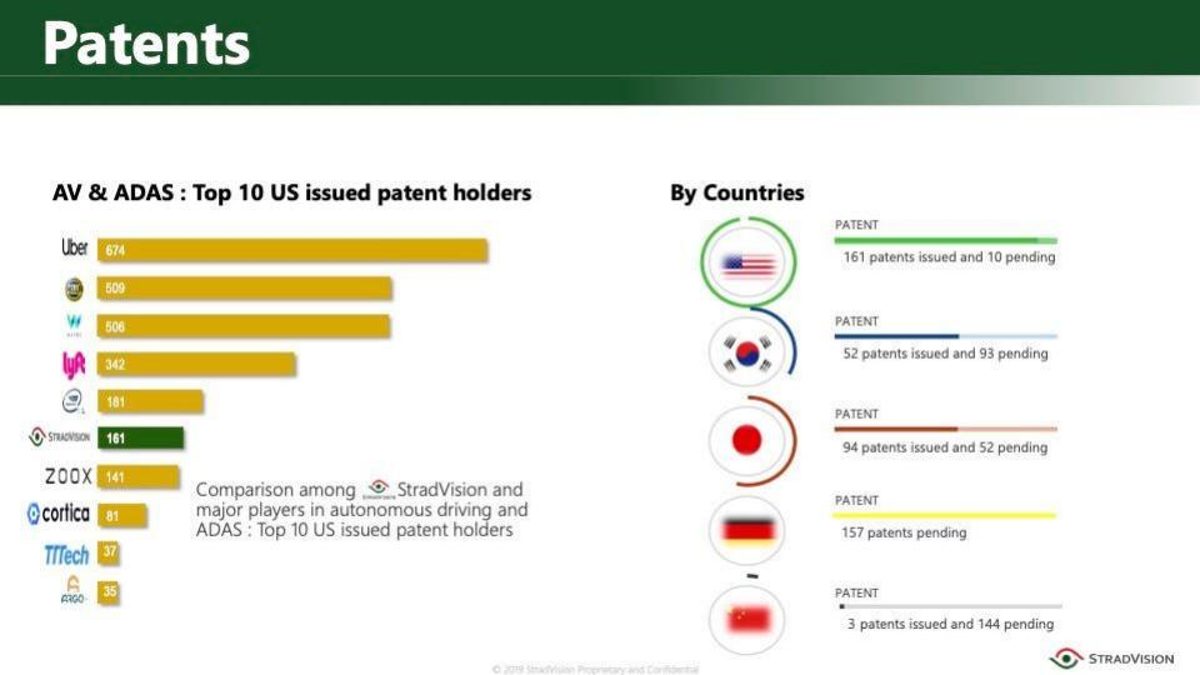
Evidence and limitation: Our totals: 310 issued, 456 pending, 766 filings. Families not stated.
What a founder can adapt: Add the number of families so investors know how many inventions sit behind the filings.
Supporting analysis
What the deck claims: "Top 10 US issued patent holders": StradVision 161, sixth after Uber 674. By country: US 161 issued/10 pending; Korea 52/93; Japan 94/52; Germany 157 pending; China 3/144.
Presentation choice: The benchmark compares like with like (US issued only) and every country shows issued and pending separately.
When it does not fit: Don't let country filings of one invention read as separate patents.
Medical device for constipation. "Protected Intellectual Property" page.
Mowoot deck, slide 16. Exact stored slide matched to this analysis.
Our analysis: A checkable application presented as protection.
Evidence and limitation: An international application number and title; no granted patent or national entries shown.
What a founder can adapt: Say which countries the application has entered and its status in each.
Supporting analysis
What the deck claims: "PCT/IB2015/001576"; "Method and apparatus for automated abdominal massage to relieve constipation"; European Patent Office and law-firm logos.
Presentation choice: The number and title let anyone look the filing up.
When it does not fit: Don't head a PCT application "Protected".
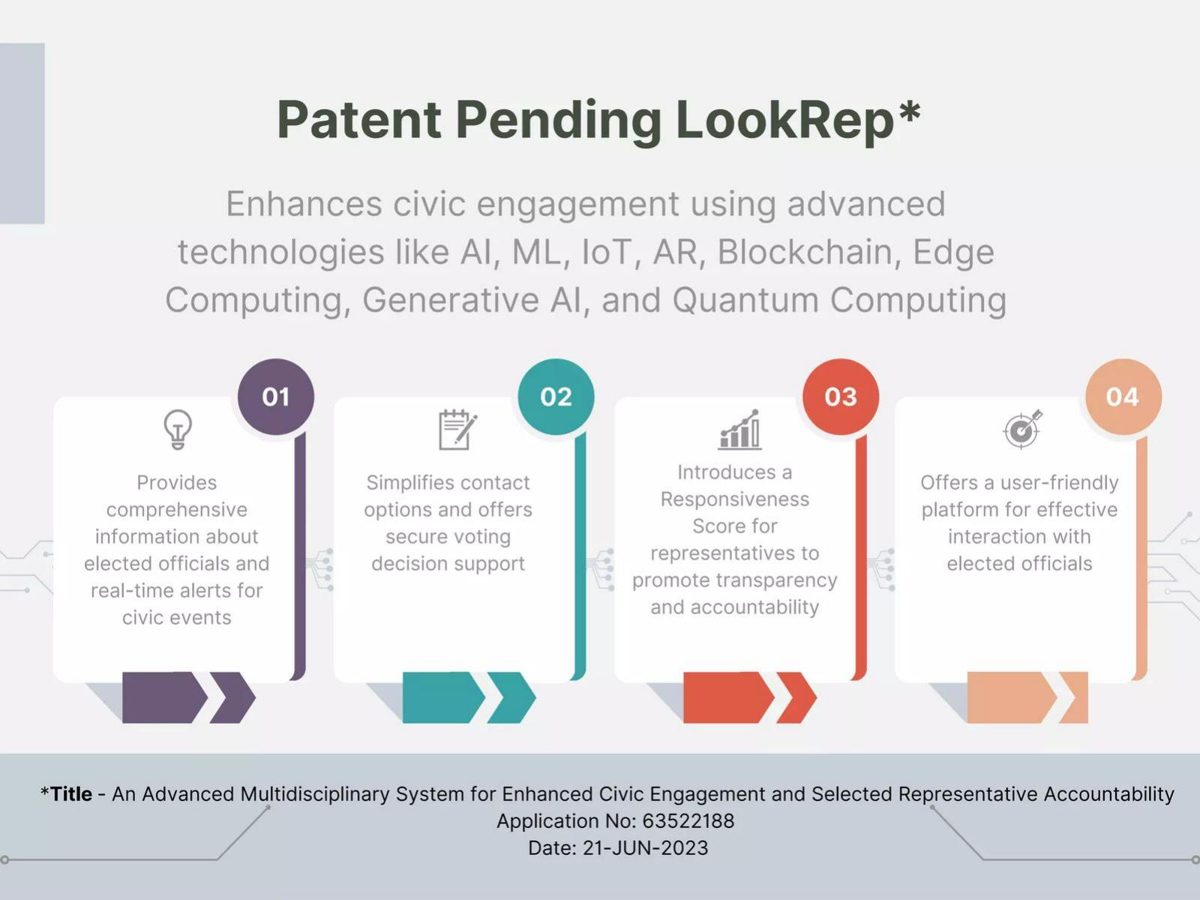
Onstump deck, slide 10. Exact stored slide matched to this analysis.
Our analysis: A dated application; stage unclear.
Evidence and limitation: A 63-series US number, the format used for provisional applications; follow-up filing not stated.
What a founder can adapt: Say whether a full application followed the provisional and what it covers.
Supporting analysis
What the deck claims: Title "An Advanced Multidisciplinary System for Enhanced Civic Engagement and Selected Representative Accountability"; "Application No: 63522188"; "Date: 21-JUN-2023".
Presentation choice: Gives title, number and date.
When it does not fit: Don't list a dozen technologies beside one application.
Columns report what each slide states or leaves out; totals are our counts.
Example
Stated
Status clear?
Inventions counted?
Coverage named?
OKYO Pharma
10 filings
Yes (2 allowed, 3 published, 5 filed)
Yes (3 families)
Yes
StradVision
310 issued, 456 pending (our totals)
Yes
No
Field only
Buzzient
1 granted, 3 pending
Yes
Implicitly
No
CreatorDB
2 granted, 7 in process
Mostly
Implicitly
Fields named
Sternum
3 pending
Yes
Implicitly
Yes (EIV)
ANYbotics
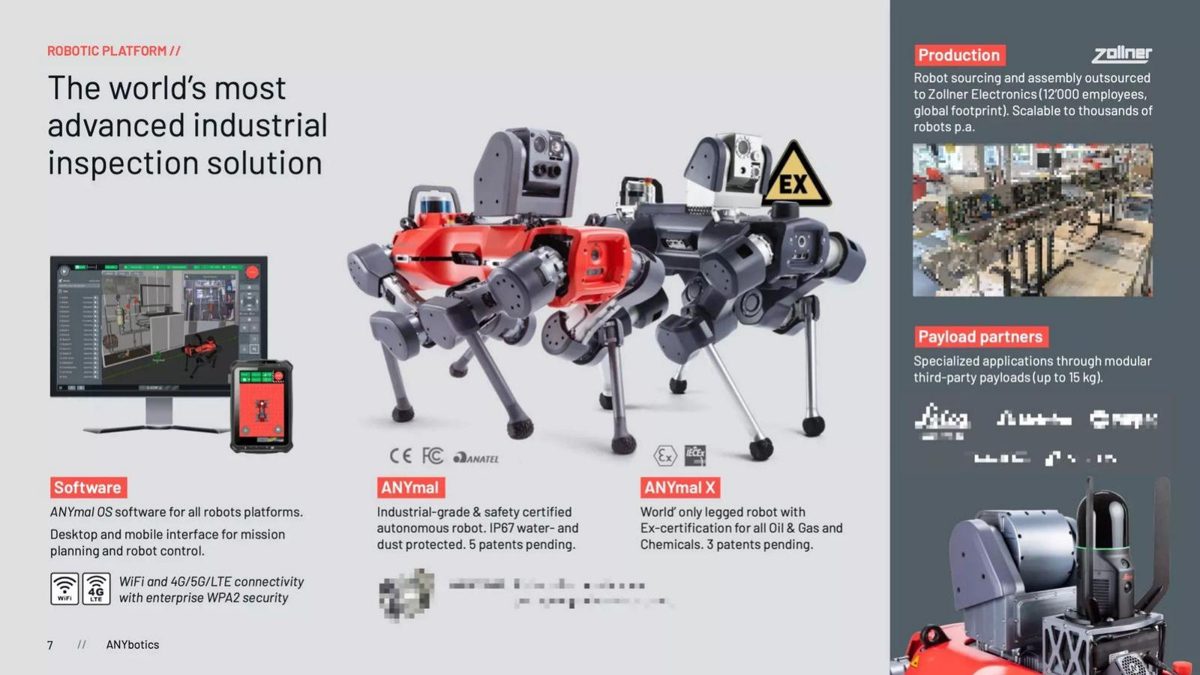
5 + 3 pending
Yes
Overlap unknown
By product
Mitte
Patent pending
Yes
No
Process named
Mowoot
1 PCT application
Implied as protected
Yes (1)
Yes (title)
Onstump
1 application (provisional format)
Stage unclear
Yes (1)
Title only
Magic Leap
120 filed
No
No
No
Sqeeqee
Over 30 pending plus other IP
Blended
No
No
Kaia Health
4 pending
Yes
Implicitly
No
Hippokros
Founder: 10 pending
Yes
No
No; ownership unclear
Key Takeaways
Say the status of each patent. Buzzient's "1 Utility Patent Granted, 3 Pending" tells investors more than a single count.
Count inventions, not filings. OKYO's ten rows are three families; StradVision's 766 country filings do not say how many inventions they cover (our counts).
Say who owns them. Hippokros credits "10 patents pending" to its founder; the slide does not say whether they are assigned to the company.
Name what they protect. Sternum ties its "3 Patents Pending" to its EIV technology; Kaia's "four patents pending" sit under a market-leadership claim with no link.
Don't blur patents with other IP. Sqeeqee counts "over 30 patents pending, trademarks, & various I.P." as one line.
Label an application as an application. Mowoot's PCT number and Onstump's application number are filings, not granted patents.
Write your patent line
Fill in one row per patent family. If a field is unknown, ask your patent attorney before the slide goes out.
Family. One-line description of the invention?
Covers. Which product feature does it protect?
Filings. Where filed (country, PCT, provisional) and priority date?
Status. Granted, allowed, published or pending in each place?
Owner. Company, founder or university; assigned or licensed?
Reference. Application or patent numbers an investor can look up?
Copyable framework: [N] patent families covering [feature 1], [feature 2]. [X] granted ([countries]), [Y] allowed, [Z] pending. All owned by [company] [or: assigned from founder/university]. Priority dates [years].
Illustrative example 1 — written by us
Before: Strong Intellectual Property Portfolio
After: 3 patent families (inflammation, pain, ligand design); 10 filings in 5 jurisdictions; 2 allowed in the US, none yet granted. Priority 2013-2016.
What improved: Uses OKYO's own table to summarise status and breadth in one line, without the adjective.
What a patent line tells an investor, and what it does not
Investors rarely fund a startup for its patents alone, but they do use a patent line to judge two things: how hard the product would be to copy, and how carefully the founders describe what they have. A precise patent line helps on both counts. An inflated one hurts on the second, and an experienced investor will usually check it.
The first thing to get right is status. A granted (or issued) patent has been examined and can be enforced. An allowed application has been approved by the examiner and will be granted once fees are paid. A published application has been made public, usually about 18 months after first filing, but has not been approved. A pending or filed application is waiting for examination. A provisional application in the United States holds a filing date for twelve months and lapses unless a full application follows. An international (PCT) application is a single filing that preserves the right to apply in many countries later; it does not itself grant a patent anywhere. All of these are real progress, but they are different claims, and "patents" on a slide often means applications.
The second is what the count counts. A single invention filed in five countries produces five applications. A slide that adds them up gives a bigger number that says nothing about how many ideas are protected. Patent professionals group these into families: one invention, all its country filings. Counting families is the honest way to describe breadth.
The third is ownership. Patents filed by a founder before the company existed, or by a university, belong to them unless assigned or licensed to the company. Investors will ask for the assignment during due diligence; saying so on the slide avoids a surprise.
The fourth is relevance. A patent that protects the core product is worth more to an investor than one that covers a side feature. The slide should say which part of the product each family covers, in one line.
Slides that show status and structure
OKYO Pharma's page 24, "Strong Intellectual Property Portfolio", is a table with columns for family, subject, priority date, status, country and PCT details. It lists ten rows in three families: Chemerin ("Compounds and methods for treating inflammation", priority 1/22/2016, five rows for the USA, Australia, Canada, the European Patent Office and Japan under one PCT number), Bam-8 ("Compounds and methods for treating pain", priority 11/9/2015, three rows) and Soluble Lipidated Ligand Agents (priority 4/12/2013, two US rows). Our count of the status column: two "Allowed", three "Published" and five "Application Filed"; none says granted. The table lets an investor see that ten filings are three inventions, that the oldest family is the furthest along, and that the two newer families are still at the application stage. The headline "Strong" is the only overstatement; the table itself is precise.
StradVision's page 11, "Patents", has two parts. On the left, a bar chart of the "Top 10 US issued patent holders" in autonomous driving and driver assistance places StradVision sixth with 161, after Uber (674) and ahead of Zoox (141). On the right, "By Countries" lists the United States (161 issued, 10 pending), Korea (52 issued, 93 pending), Japan (94 issued, 52 pending), Germany (157 pending) and China (3 issued, 144 pending). Our totals: 310 issued and 456 pending, 766 filings in all. The chart compares like with like (US issued patents only), which is fair. The country list is precise about status but does not say how many inventions the filings represent; the same invention filed in all five countries would appear five times.
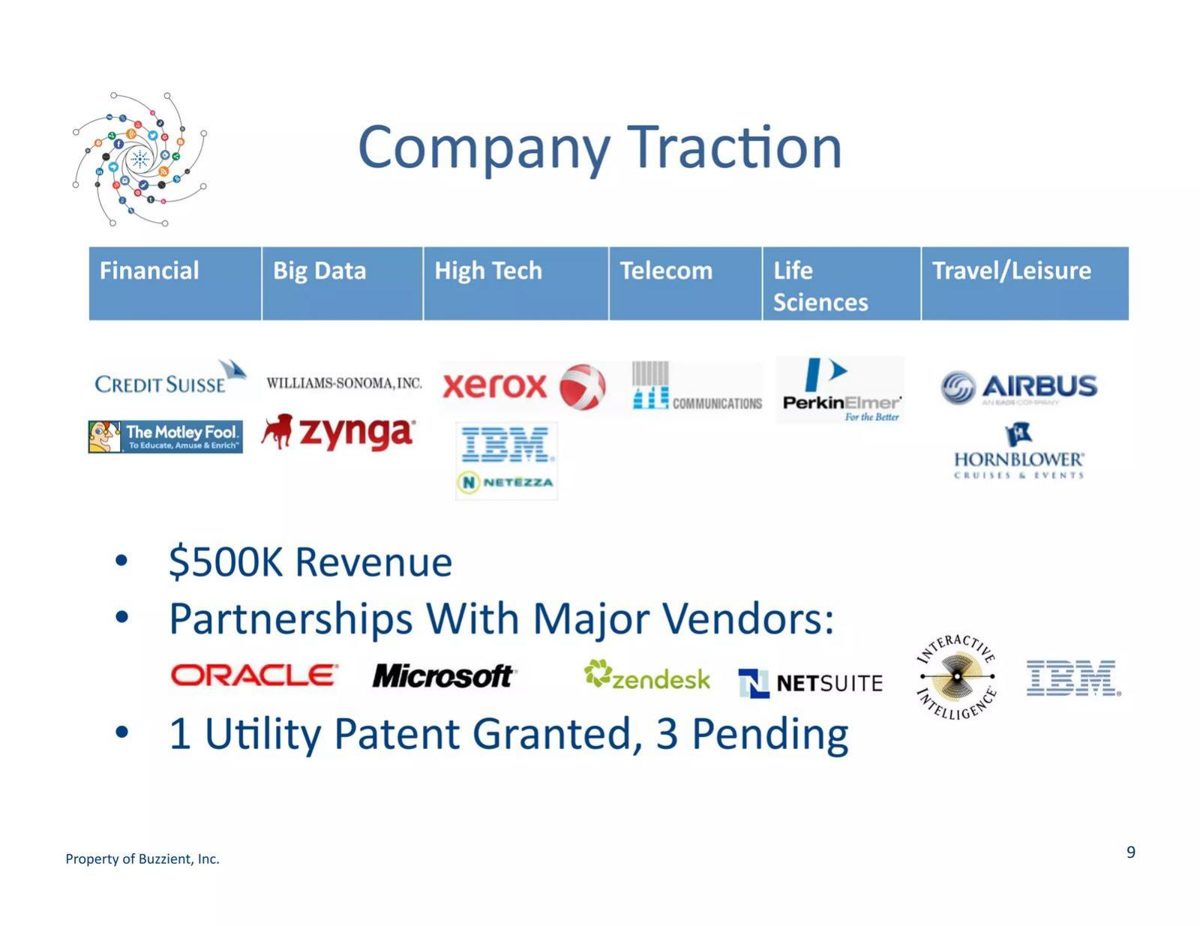
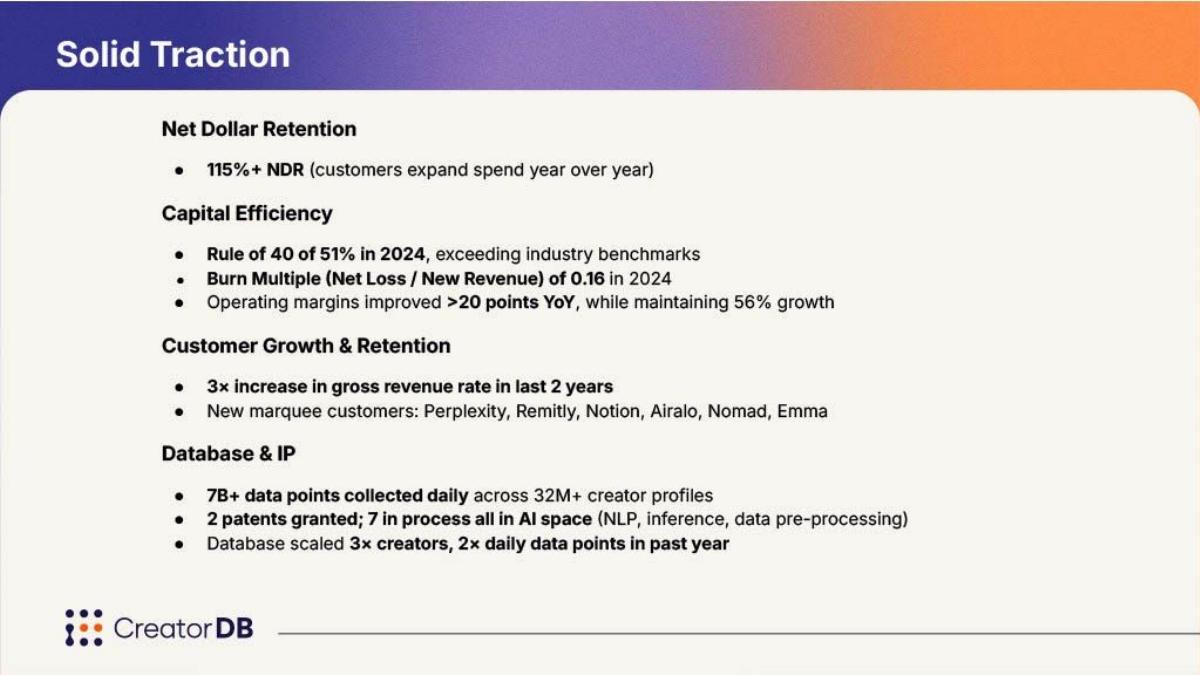
Buzzient's page 10, "Company Traction", ends with "1 Utility Patent Granted, 3 Pending". It is one line on a traction slide, but it gives the type (utility, meaning it covers how something works rather than how it looks) and separates granted from pending. CreatorDB's page 3, "Solid Traction", does the same under "Database & IP": "2 patents granted; 7 in process all in AI space (NLP, inference, data pre-processing)". It also names the fields the applications cover. Neither slide says who owns the patents or which product feature they protect, but both let an investor ask the right follow-up.
Slides that tie patents to a specific technology
Sternum's page 8, "Solution: Proprietary On-Device Real Time Protection & Monitoring", says "Using patent-pending EIV (3 Patents Pending)" and labels a chip graphic "Embedded Integrity Verification". The patents are attached to the named technology the rest of the slide describes. An investor knows what the applications are meant to protect, which is the question a bare count cannot answer.
ANYbotics' page 7, "The world's most advanced industrial inspection solution", attaches its patent counts to individual products: "ANYmal" with "5 patents pending" and "ANYmal X" with "3 patents pending". Our calculation: eight pending applications across two products. The slide does not say whether any are shared between the two robots, so eight is an upper bound on distinct inventions.
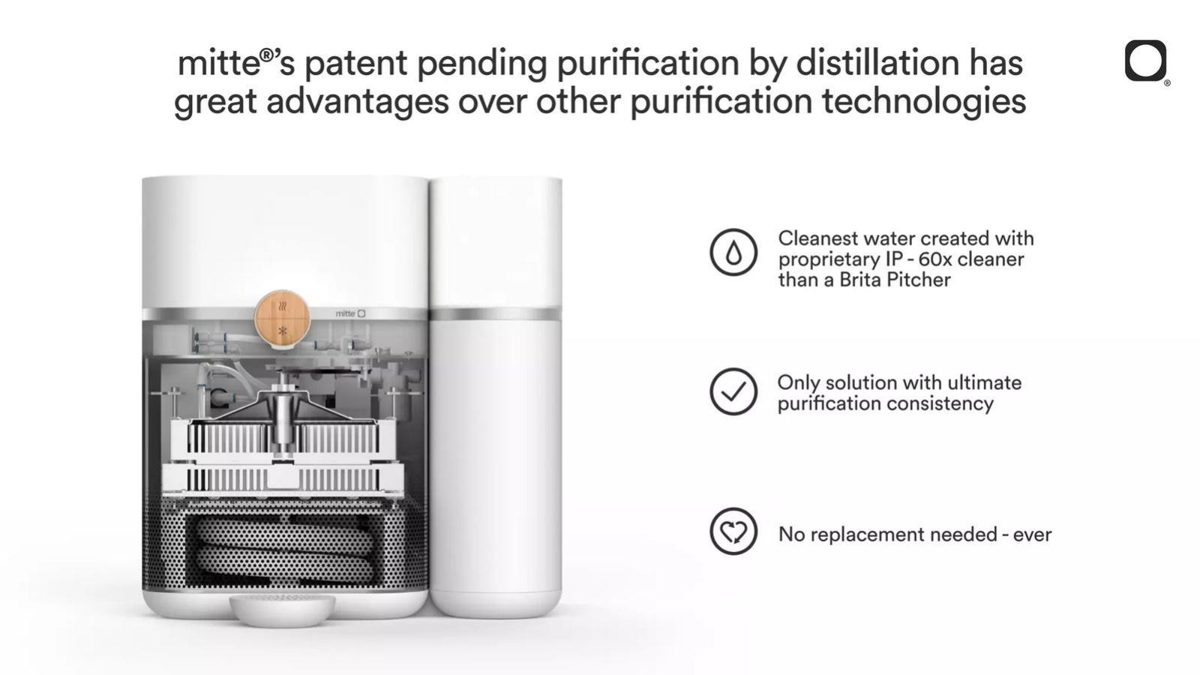
Mitte's page 8 opens with "mitte's patent pending purification by distillation has great advantages over other purification technologies" and claims "Cleanest water created with proprietary IP - 60x cleaner than a Brita Pitcher". The patent is tied to a named process, which is good; the slide does not say how many applications, where, or whether the 60x figure comes from a test.
Slides that show an application, not a patent
Mowoot's page 16, "Protected Intellectual Property", gives the international application number "PCT/IB2015/001576", the title "Method and apparatus for automated abdominal massage to relieve constipation", and logos for the European Patent Office and a patent law firm. The number and title let an investor look the application up, which is more than most slides allow. But a PCT filing is an application that preserves the right to seek patents in individual countries; it is not a granted patent, and the heading "Protected" suggests more than it shows. The slide does not say which countries the application has entered or whether any patent has been granted.
Onstump's page 10, "Patent Pending LookRep", gives the application title, "Application No: 63522188" and "Date: 21-JUN-2023". Numbers in that format (the 63 series) are used by the US patent office for provisional applications, which lapse after twelve months unless a full application is filed. The slide does not say whether a full application followed. Giving the number is a strength; saying what stage it has reached would complete it. The slide also lists a long run of technologies ("AI, ML, IoT, AR, Blockchain, Edge Computing, Generative AI, and Quantum Computing") without saying which the application covers.
Slides where the count is hard to interpret
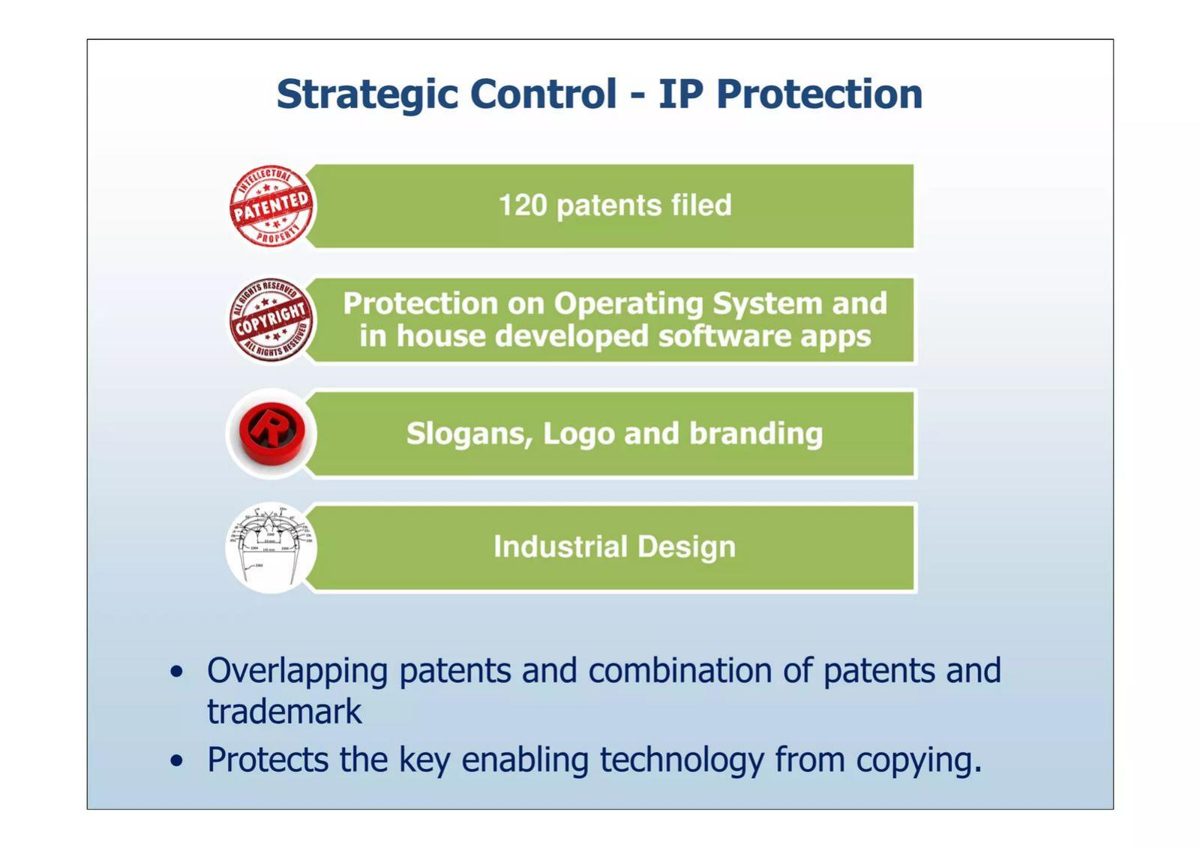
Magic Leap's page 49, "Strategic Control - IP Protection", says "120 patents filed" alongside copyright on its operating system and apps, trademarks on slogans and logos, and industrial design. It is useful to see all four types of IP listed separately. But "filed" covers applications at any stage, and the slide does not say how many are granted or how many inventions the 120 represent.
Sqeeqee's page 4, "Competitive Advantages", says "The Sqeeqee platform & many of its features are secured by over 30 patents pending, trademarks, & various I.P." Pending applications do not yet secure anything, and the sentence mixes them with trademarks and unspecified IP, so an investor cannot tell how many patent applications there are or what they cover.
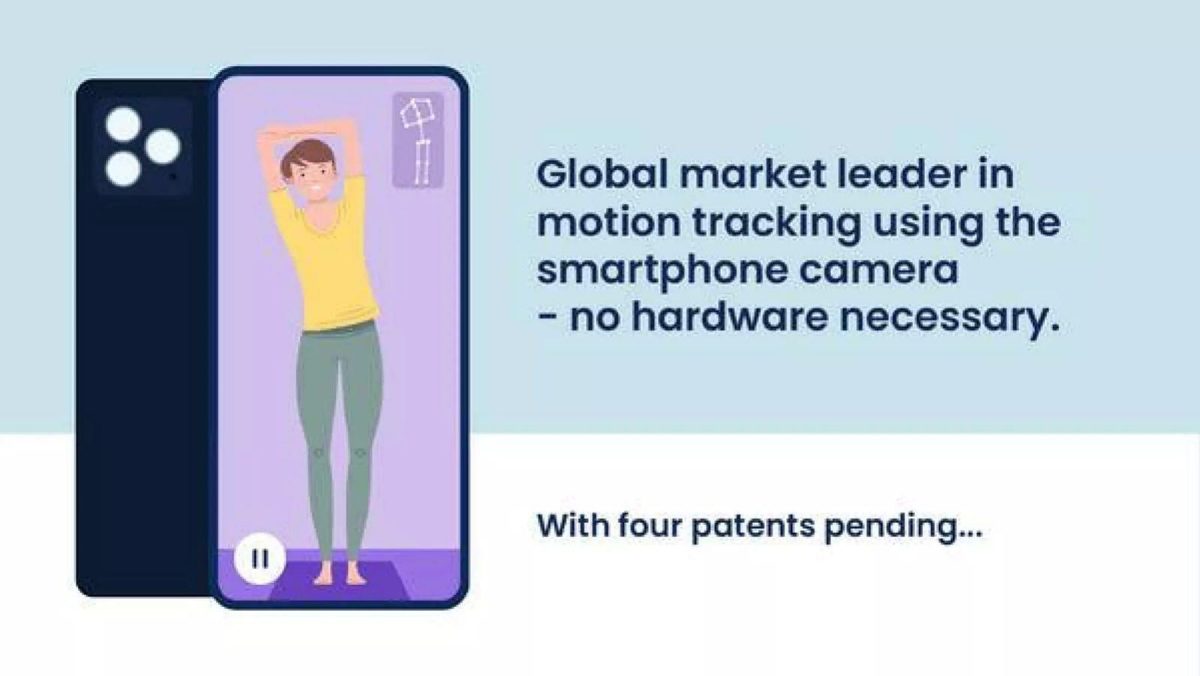
Kaia Health's page 14 says "Global market leader in motion tracking using the smartphone camera - no hardware necessary. With four patents pending...". The applications appear under a market-leadership claim that the slide does not support, and there is no link between them and the motion-tracking technology beyond placement on the page.
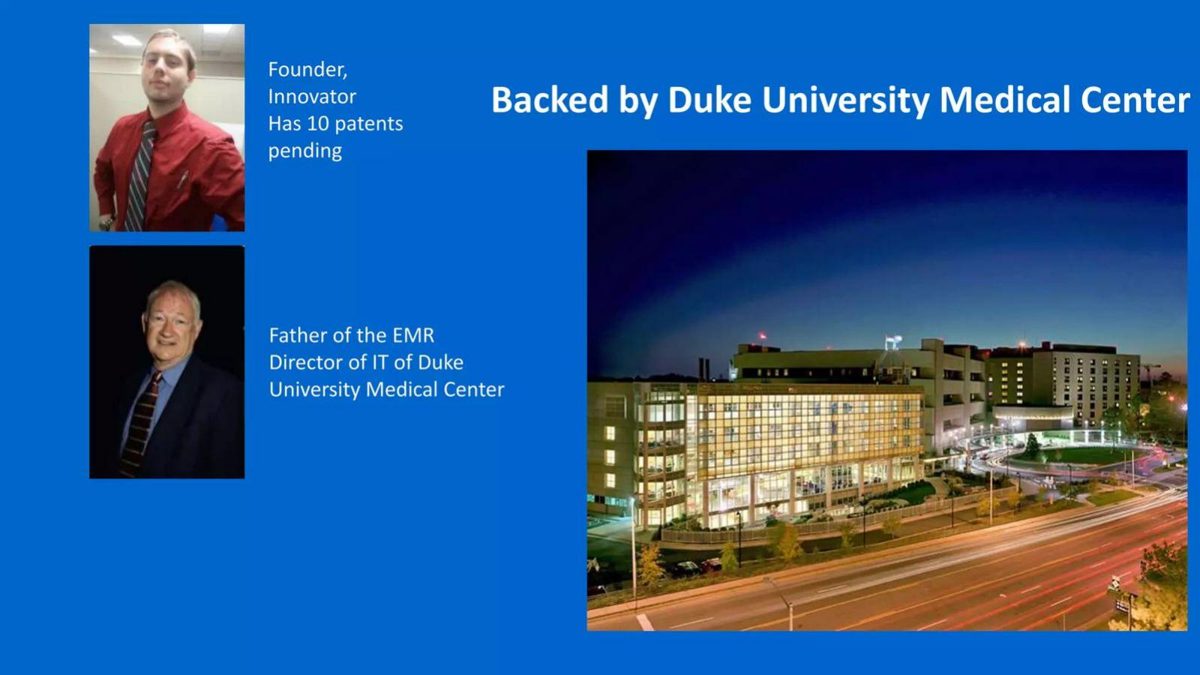
Hippokros' page 7, "Backed by Duke University Medical Center", describes its founder as "Founder, Innovator Has 10 patents pending". The applications are credited to a person. The slide does not say whether they relate to Hippokros' product or have been assigned to the company, which is what an investor needs to know.
How to write the patent line on your slide
Give status first. Separate granted, allowed and pending, as Buzzient and CreatorDB do. If everything is pending, say so plainly; investors expect early-stage companies to have applications, not patents.
Count families. Say how many inventions you have filed and where. "3 patent families; 10 filings in 5 jurisdictions; 2 allowed in the US" is more informative than "10 patents".
Say what each family protects in a few words, and tie it to the product feature on the slide, as Sternum does.
Say who owns them. If a founder or university filed before the company, state that they are assigned or licensed to the company, or that assignment is in progress.
Give the evidence. Application numbers and priority dates, as OKYO, Mowoot and Onstump show, let an investor check the claim in minutes.
Keep patents separate from trademarks, copyright and trade secrets. Each protects something different; Magic Leap's list shows how to separate them.
Keep adjectives off the heading. "Strong", "Protected" and "secured" invite a check; a precise table does not need them.
Common mistakes
Pending shown as protection. Say applications are applications; words like "secured" and "protected" belong to granted patents.
Filings counted as patents. Count families; give country filings separately.
Founder patents shown as company IP. State ownership and assignment.
No link to the product. Say which feature each family protects.
IP types blended. Separate patents, trademarks, copyright and trade secrets.
Patents used to prove something else. Pending applications don't show market leadership or performance.
Diagnostic checklist
Granted, allowed and pending are shown separately.
The number of patent families is stated.
Countries or international filings are named.
Each family is tied to a product feature.
Ownership (company, founder, university) is stated.
Application or patent numbers are available on request or on the slide.
Patents are not mixed with other types of IP.
Frequently asked questions
Should I say "patent pending" on my pitch deck?
Yes, if it is true, but say how many applications, where and when. Buzzient's "1 Utility Patent Granted, 3 Pending" is a good model for a single line.
What is the difference between a patent and a patent application?
A granted patent has been examined and can be enforced; an application is a request that may be granted, narrowed or refused. OKYO's table shows applications at filed, published and allowed stages, none granted.
Does a PCT application mean I'm protected internationally?
No. It is one filing that keeps open the option to apply in many countries; patents are granted country by country later. Mowoot shows a PCT number under the heading "Protected", which overstates it.
Should I count each country filing as a patent?
Give families first, then filings. StradVision's 766 country filings are precise on status but don't say how many inventions they cover.
Can I list my founder's patents?
Only with ownership stated. Hippokros credits "10 patents pending" to its founder without saying whether they belong to the company.
How we chose these examples
Search (2026-09-30): the durable corpus index (docs/seo/artifacts/corpus-search, 70,729 unique pages, deduplicated by deck-file sha256 + page) was searched for "patent(s) granted/pending/filed/issued", "provisional patent" and "PCT"; 200 pages matched.
Eighteen candidate pages were rendered from the original public deck files and read from the images; thirteen are used: OKYO Pharma 24, StradVision 11, Buzzient 10, CreatorDB 3, Sternum 8, ANYbotics 7, Mitte 8, Mowoot 16, Onstump 10, Magic Leap 49, Sqeeqee 4, Kaia Health 14 and Hippokros 7.
Left out after image review: Monotype ("type-august") 11 (public company), and Jiffy.ai 5, Aphelion Orbitals 8, Founders Embassy 9 and Fairmat 10 (each a bare count of pending or filed patents with no further detail, the same lesson as Kaia Health). Not rendered: public-company and SPAC patent pages (Latch, Interpace, Tiziana, Nutriband, Barfresh), and pages that mention a patent with no count or status.
Status labels are as printed on each slide; we did not look up the applications in patent databases, so a status may have changed since the deck was made. Descriptions of patent stages are general and not legal advice. How we built this: drafted and checked with AI assistance (editorial model review against the original slide images); no human editor has reviewed this guide.