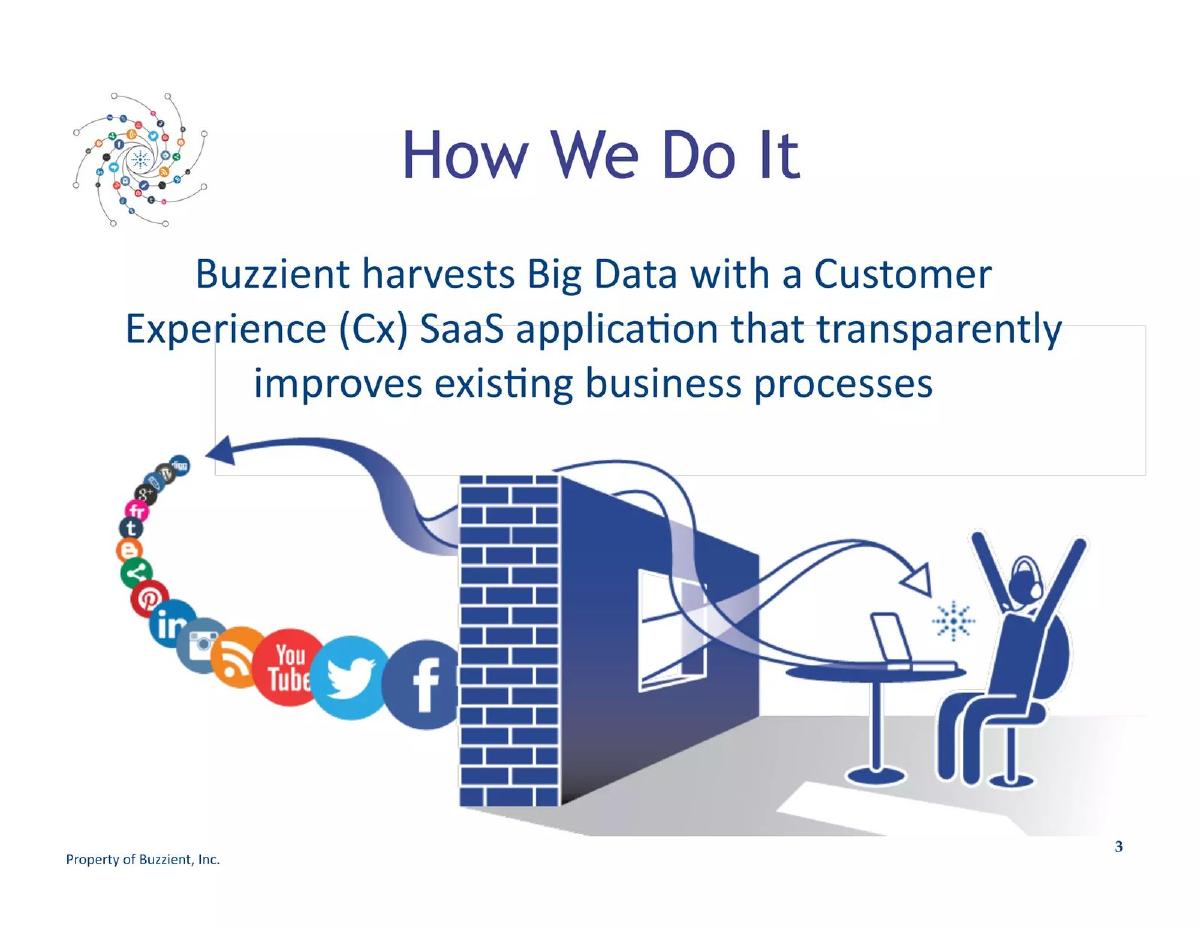
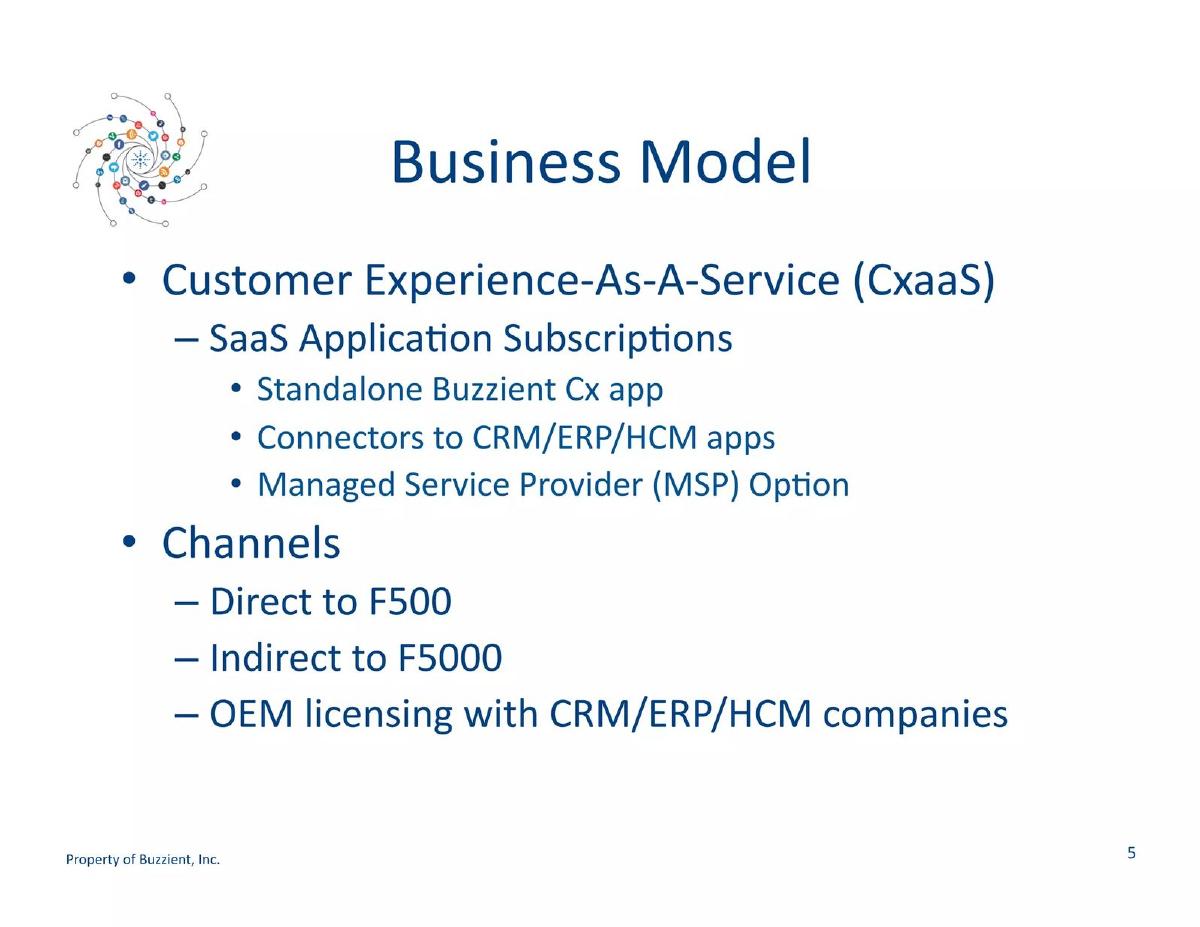
Buzzient’s 2012 pitch deck is a focused look at the early 'Social CRM' era. The company aimed to solve the fragmentation of customer data by integrating social media interactions directly into existing enterprise applications like Siebel and Salesforce. The deck leans heavily on the pedigree of its leadership, citing experience at Oracle, Sybase, and Veritas to build trust with enterprise buyers. While the product vision is clear—enabling companies to respond to social media posts within their current workflows—the financial projections are exceptionally aggressive, forecasting a jump from $1…
Key takeaways
- The company defines its value proposition as 'Customer Experience as a Service,' focusing on integrating Big Data into existing customer operations (Slide 1, 2).
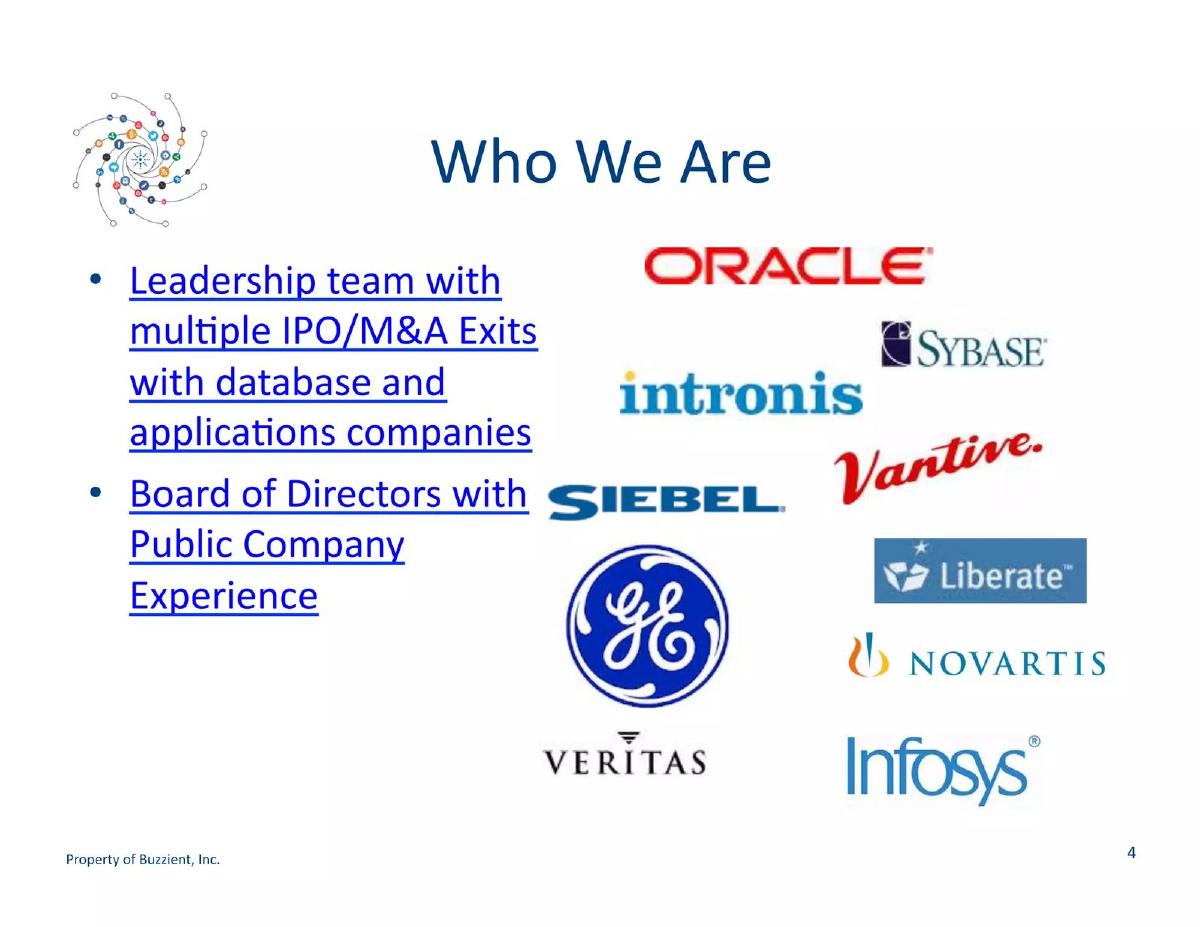
- Leadership emphasizes deep enterprise roots, listing past exits and experience at Oracle, Sybase, Siebel, and GE (Slide 4).
- The strategy relies on broad industry support across CRM, HCM, and ERP sectors, including partnerships or integrations with Salesforce, SAP, and Workday (Slide 6).
- A product demonstration slide shows a specific 'On-premises Example' using Siebel to handle social media service requests (Slide 8).
- Revenue projections are highly ambitious, starting at $1,140,000 in 2012 and scaling to $1,043,789,297 by 2022 (Slide 10).
- The company previously raised a $1.3M Series A from the CEO, Board, HNW Angels, and TiE Angels Boston (Slide 12).
- The current 'Ask' is for a $1M-$2M Series A-1 to ramp the sales team and establish a new headquarters (Slide 12).
- The deck lacks a dedicated competitor slide or a detailed breakdown of unit economics in the provided pages.
Introduction: The Bridge Between Social and Enterprise
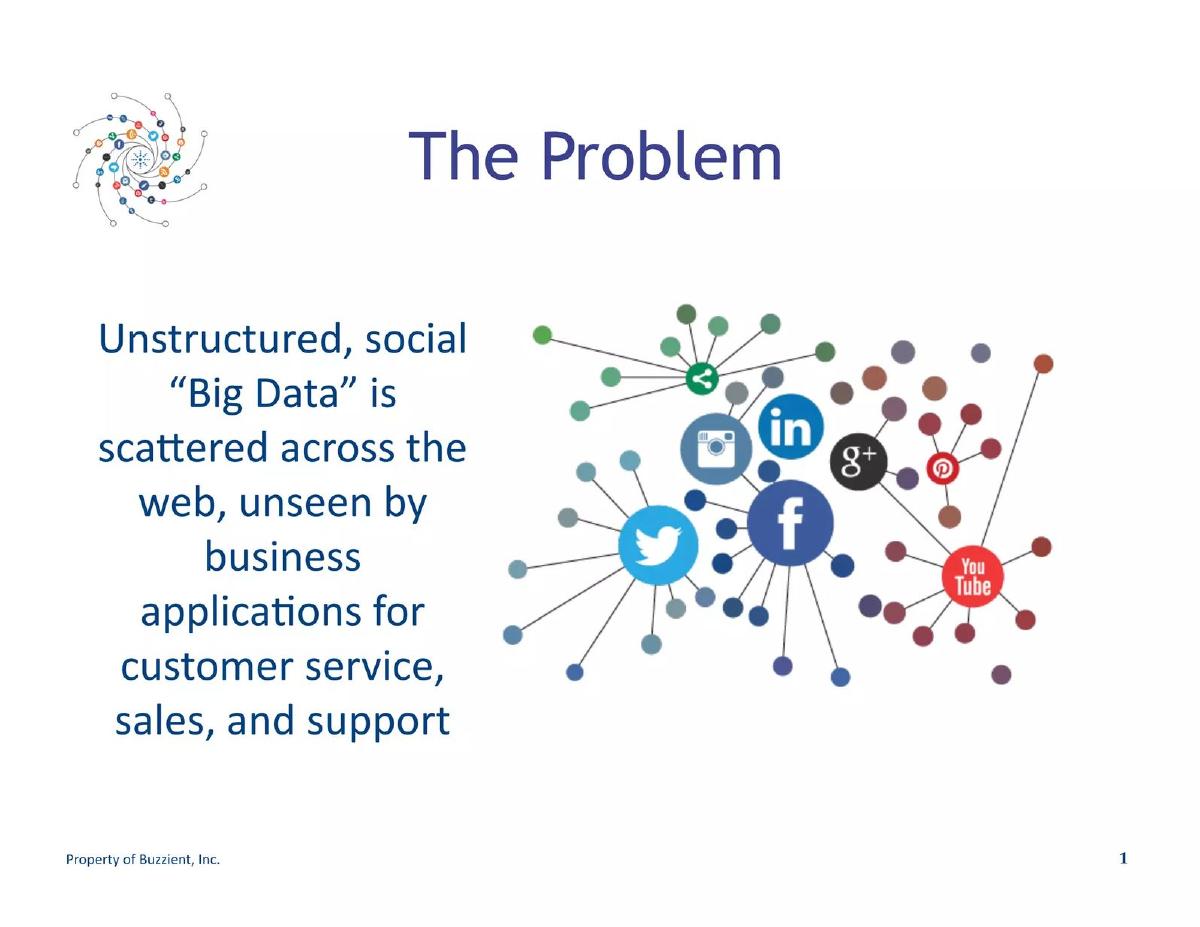
The Buzzient pitch deck from 2012 represents a specific moment in the evolution of enterprise software. At this time, 'Big Data' and 'Social Media' were the dominant buzzwords, but large corporations were struggling to integrate these new data streams into their legacy systems. Buzzient’s pitch is built entirely around solving this friction point. By positioning themselves as 'Customer Experience as a Service,' they aimed to be the middleware that made social media data useful for customer support and operations teams.
Slide 1: Title and Positioning
The cover slide introduces the company name, Buzzient , accompanied by a logo that resembles a network or a data cluster. The subtitle, 'Customer Experience as a Service,' is a play on the SaaS (Software as a Service) acronym, signaling their cloud-based delivery model. Timothy B. Jones is identified as the CEO. The visual motif of a spiral containing various social media icons (Facebook, Twitter, LinkedIn, YouTube, etc.) immediately communicates that the company deals with the fragmented social media landscape.
Slide 2: The Value Proposition
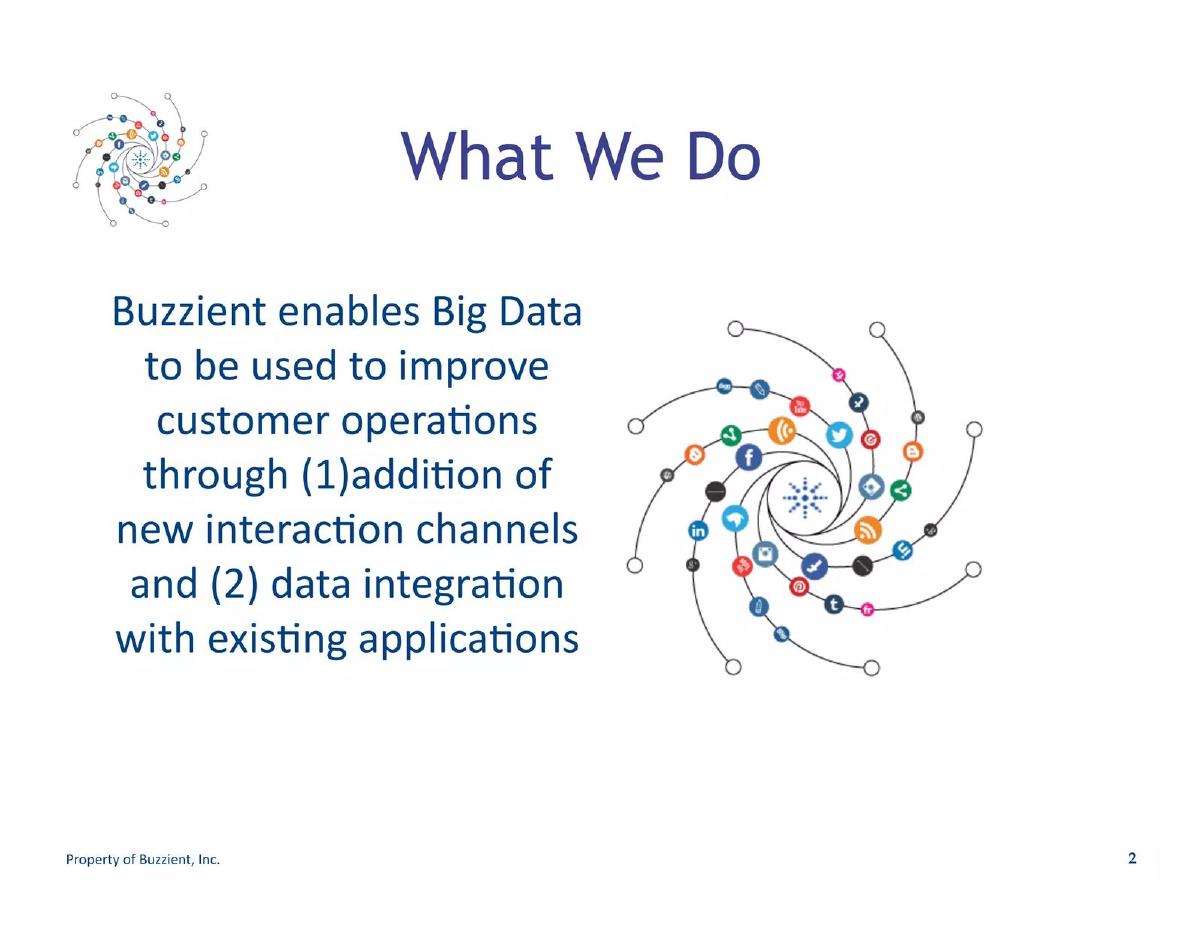
Slide 2, titled 'What We Do,' provides a concise two-part mission statement. Buzzient enables Big Data to improve customer operations through: (1) addition of new interaction channels and (2) data integration with existing applications. This is a crucial distinction. They aren't just a social listening tool; they are an integration layer. The slide repeats the social media spiral graphic, reinforcing the idea of pulling disparate threads into a central core.
Slide 4: Team and Pedigree
In enterprise sales, the 'who' is often as important as the 'what.' Slide 4, 'Who We Are,' relies heavily on corporate logos rather than individual headshots. The text highlights a 'Leadership team with multiple IPO/M&A Exits' specifically within the database and applications sectors. The logos displayed— Oracle, Sybase, Siebel, GE, Veritas, Novartis, and Infosys —are intended to signal to investors that this team understands the complexities of selling to and integrating with 'Big Iron' enterprise companies. This slide is designed to de-risk the investment by showing the founders have 'been there before.'
Slide 6: Ecosystem and Market Reach
Slide 6, 'Broad Industry Support,' uses a Venn diagram to show how Buzzient fits into the broader enterprise software stack. They categorize their integrations into three buckets: CRM & Contact Center (Salesforce, Zendesk, Microsoft), HCM (Workday, SuccessFactors), and ERP (SAP, Infor). By showing these logos, Buzzient is claiming compatibility with almost every major system a Fortune 500 company might use. This suggests a massive Total Addressable Market (TAM), as they can theoretically sell to any department using these platforms.
Slide 8: Product in Action
Slide 8 provides a concrete 'On-premises Example' using Siebel (an Oracle product). This is a high-value slide because it moves from abstract concepts to a functional UI. The screenshot shows a social media post from a user named 'Don Green' complaining about an iPad power supply. Red callouts highlight two key features: 'Transparent handoff into app workflows' and the ability to 'Respond via social media to clients within existing applications.' This proves the product's utility: a support agent doesn't have to leave their primary CRM to handle a tweet. This is a classic 'efficiency play' for call centers.
Slide 10: Financial Projections
Slide 10, 'High Revenue Potential,' is the most controversial slide in the deck. It features a bar chart showing Total Revenue growing from $1,140,000 in 2012 to $1,043,789,297 in 2022. The table at the bottom provides the exact figures for each year. While the 2012 and 2013 figures ($1.1M and $2.2M) seem grounded in reality, the jump to $138M in 2019 and over $1B in 2022 is a vertical 'hockey stick' that requires a massive leap of faith. There is no mention of the headcount or capital required to achieve a billion dollars in revenue within a decade.
Slide 12: The Fundraising Ask
The final slide in the provided set, 'Fundraising,' details the company's capital history and current needs. They note a previous $1.3M Series A funded by the CEO, Board, and Angel groups like TiE Angels Boston. They are currently 'Raising $1M-2M Series A-1.' The use of funds is clearly defined: 'Ramp sales team,' 'Establish new HQ and hire Cx service team,' and 'Extend integration development.' This is a standard 'bridge' or 'extension' round intended to fuel growth between major milestones.
What Works in This Deck
The Buzzient deck excels at contextualizing a new technology within an old framework. In 2012, social media was the 'new' thing, and Siebel/SAP were the 'old' things. By showing exactly how the new data flows into the old systems (Slide 8), the founders removed the mystery of how their product actually works. The team slide is also a strong point; by focusing on specific enterprise exits, they speak the language of the investors they are likely targeting: those who understand B2B software cycles.
What is Missing
The most glaring omission in the provided slides is a Competitor Analysis. By 2012, companies like Radian6 (acquired by Salesforce in 2011) and Buddy Media were already major players. Buzzient doesn't explain how their integration is superior to the native social tools being built by the very CRM companies they list on Slide 6. Additionally, there is no mention of unit economics —LTV (Lifetime Value), CAC (Customer Acquisition Cost), or churn rates. For a Series A-1 round, investors typically expect to see these metrics to prove the business model is repeatable.
Founder's Takeaway: The Integration Playbook
If you are building a 'middleware' or integration-heavy startup, the Buzzient deck offers a few lessons. First, use the logos of your partners/integrations to build 'borrowed authority.' Even if you don't have a formal partnership with SAP, showing that your product works with it makes you look like a peer. Second, show the UI. A single screenshot with clear arrows (Slide 8) is worth more than five slides of bullet points about 'synergy.' However, be wary of the billion-dollar slide. While you want to show a big vision, projecting a 1,000x revenue increase over ten years without a clear roadmap for how that scaling happens can make a founder look disconnected from the operational realities of the business.
Frequently asked questions
- What problem was Buzzient trying to solve in 2012?
- Buzzient addressed the disconnect between social media interactions and formal enterprise customer service. In 2012, social media was often handled by marketing teams in silos. Buzzient's solution allowed customer service agents to see social sentiment and respond to tweets or posts directly within their existing CRM tools, such as Siebel or Oracle, ensuring that social data became actionable enterprise data.
- How realistic were the revenue projections in this deck?
- The projections on Slide 10 are extremely aggressive. The company projected growing from $1.1M to over $1B in just ten years. While this 'hockey stick' graph is common in pitch decks, a 1,000x growth projection without detailed underlying assumptions regarding customer acquisition costs or churn is usually met with significant skepticism by institutional investors.
- Who were the primary investors in Buzzient's initial round?
- According to Slide 12, the initial $1.3M Series A was funded by an internal and angel-heavy group. This included the CEO, members of the Board of Directors, High Net Worth (HNW) individuals, and the TiE Angels Boston group. This suggests strong early support from the founders' immediate professional network.
- What was the primary use of funds for the Series A-1?
- The $1M to $2M Series A-1 was earmarked for three specific areas: ramping up the sales team, establishing a new headquarters and hiring a Customer Experience (Cx) service team, and extending their integration development. This indicates a shift from product development toward commercial scaling and infrastructure.
- Which enterprise platforms did Buzzient support?
- Buzzient positioned itself as a platform-agnostic layer. Slide 6 lists 'Broad Industry Support' across three categories: CRM & Contact Center (Oracle, Salesforce, Zendesk, NetSuite, SugarCRM, Microsoft), HCM (Workday, IBM, Kenexa, SuccessFactors), and ERP (SAP, Infor). This wide net was intended to show the massive addressable market of legacy enterprise users.