Wilco’s 20-slide Seed deck is a masterclass in founder-market fit. By positioning their product as a 'fantasy company' where developers solve real-world quests, they successfully differentiated themselves from the saturated MOOC market. The deck relies heavily on the team’s deep engineering background—featuring veterans from WeWork, Facebook, and Handy—to validate the 'ever-growing problem' of the senior mindset gap. While the version of the deck reviewed contains several redacted slides regarding traction and market validation, the narrative remains cohesive, moving from the failure of theor…
Key takeaways
- The 'Team' slide is placed second, highlighting the founders' high-profile backgrounds at WeWork, Facebook, and Handy as the primary hook (Slide 2).
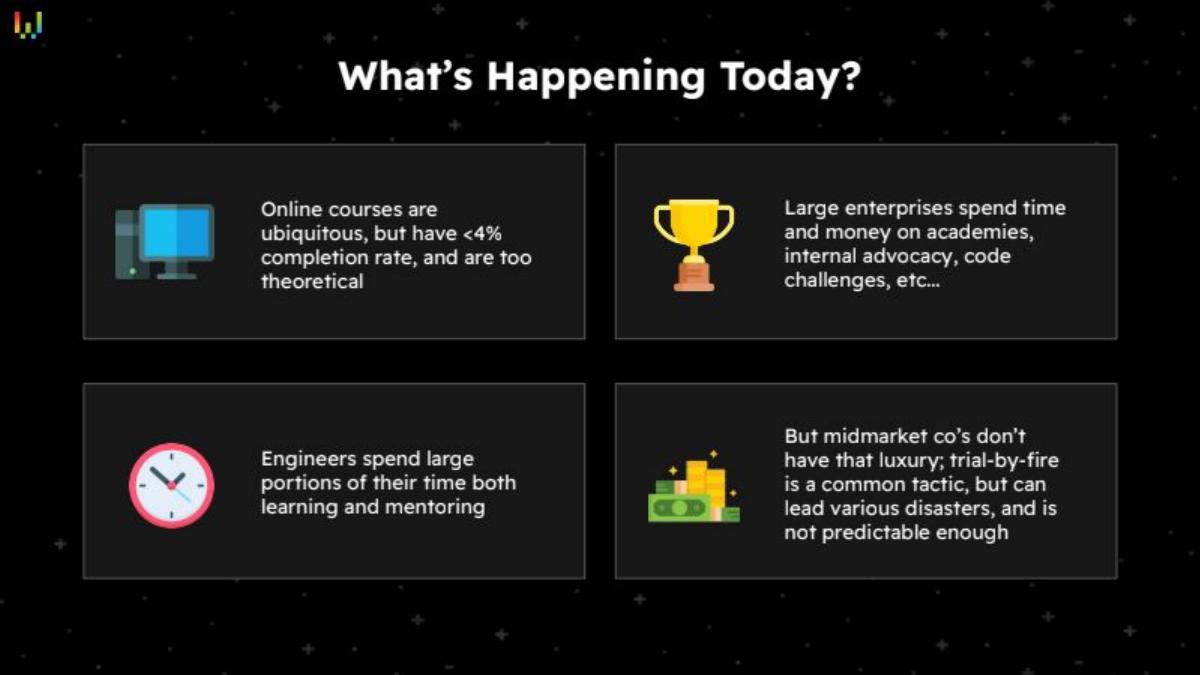
- Wilco identifies a specific market gap: online courses have a <4% completion rate and are too theoretical for professional growth (Slide 4).
- The product is framed as a 'fantasy company' where developers use their own IDE and real tools like GitHub and Slack (Slides 6-8).
- The business model relies on a three-pronged content strategy: quests built by Wilco, the community, and companies (Slide 9).
- The 'Wilco Effect' slide articulates value propositions for three distinct stakeholders: engineers, organizations, and the broader community (Slide 10).
- The competitive landscape uses a 2x2 matrix to position Wilco as the only 'High Scale' and 'In Depth' solution compared to MOOCs and bootcamps (Slide 17).
- The fundraising ask was specifically for $6M to reach undisclosed active user and quest-played milestones (Slide 18).
- The deck emphasizes a 'Community First' GTM strategy, utilizing viral triggers and influencer programs rather than traditional top-down sales (Slide 12).
Introduction: The Flight Simulator for Coders
Wilco’s 2022 pitch deck arrived at a time when the 'Great Resignation' and a massive shortage of senior engineering talent were peak concerns for VCs. The company, founded by a group of seasoned engineering leaders, proposed a solution that wasn't just another tutorial site. They pitched a 'flight simulator' for software engineers. This teardown looks at the $7M Seed round deck that successfully convinced Hetz Ventures, Vertex, and Flybridge to back a new category in EdTech.
Slide 1: Title and Mission
The deck opens with a retro, pixelated logo that leans into the 'gaming' aspect of the platform. The tagline is simple: "Accelerating software engineers’ growth." It is a functional, high-level value proposition that avoids jargon and focuses on the outcome (growth) rather than the mechanism (quests).
Slide 2: The Team as the Moat
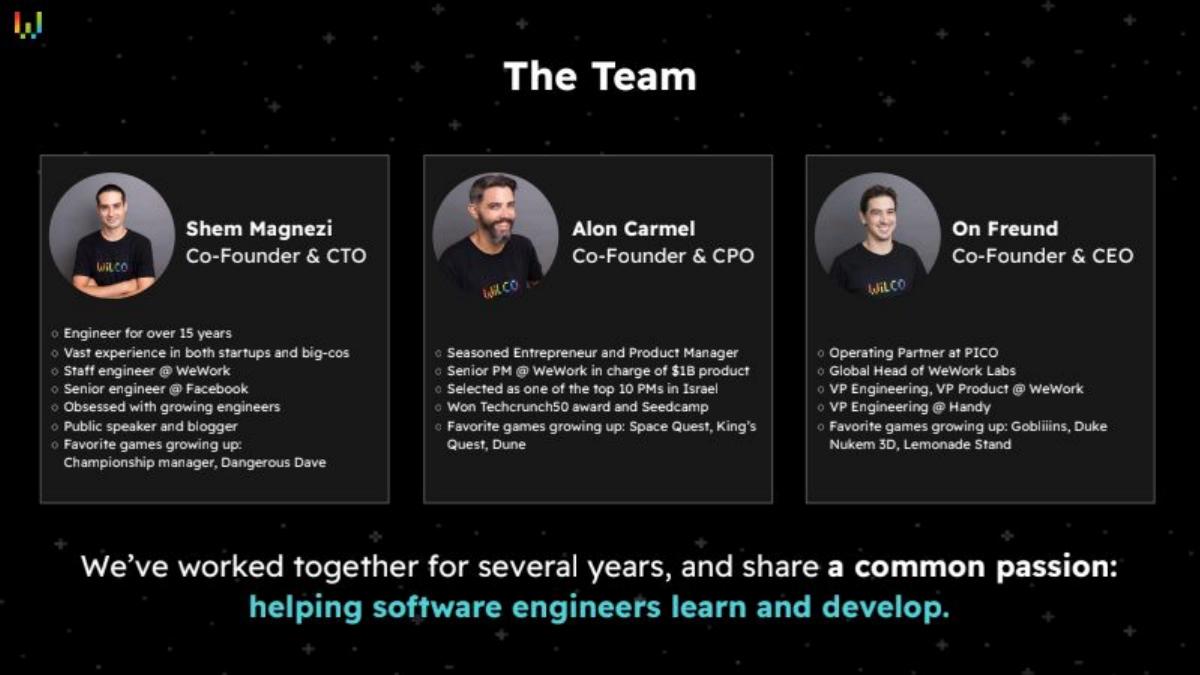
Wilco makes a strategic choice to put the team slide immediately after the cover. For a Seed round, the founders are the most important asset. On Freund (CEO) , Shem Magnezi (CTO) , and Alon Carmel (CPO) bring a combined pedigree of WeWork, Facebook, and Handy. The slide explicitly mentions that they have worked together for several years, reducing the 'founder conflict' risk for investors. Interestingly, they also list their favorite childhood games (e.g., Space Quest, Duke Nukem 3D), which reinforces the gamification theme of the product.
Slide 3 & 4: The Ever-Growing Problem
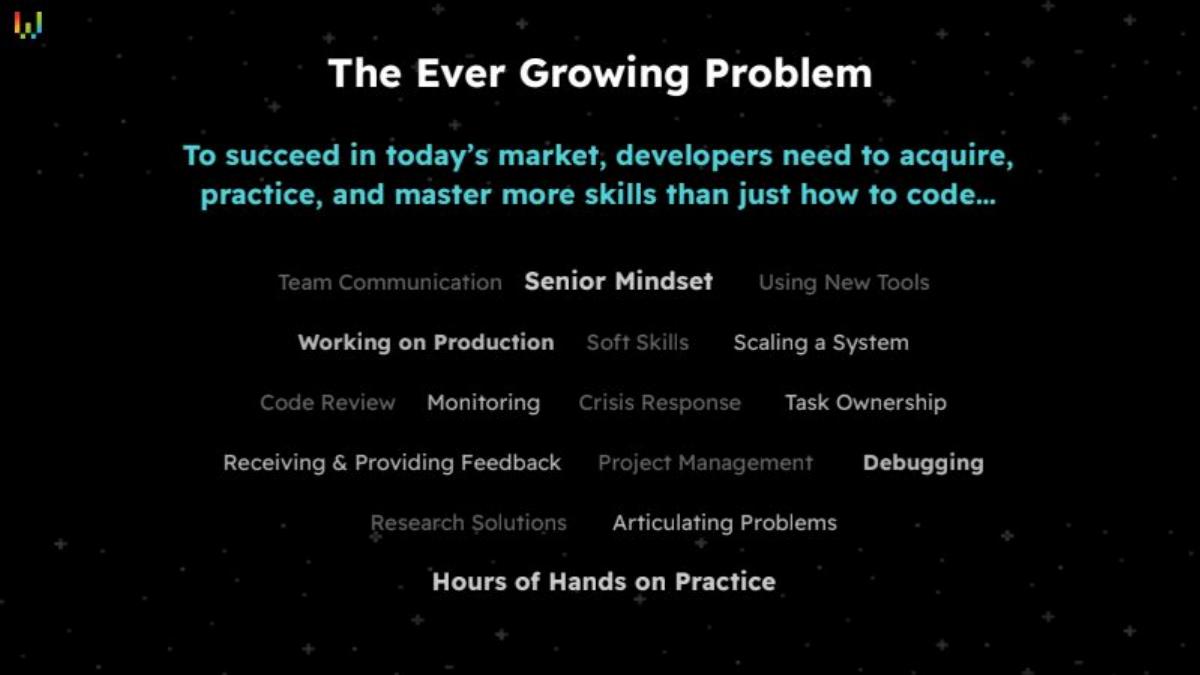
Slide 3 uses a word cloud to illustrate the complexity of modern engineering. It’s not just about 'coding'; it’s about 'Senior Mindset,' 'Crisis Response,' and 'Scaling a System.' Slide 4 then attacks the status quo. It notes that online courses have a "<4% completion rate" and are "too theoretical." It also points out that mid-market companies lack the 'luxury' of internal academies, leading to a 'trial-by-fire' approach that is unpredictable and dangerous for production environments.
Slide 5 & 6: The Mission and Identity
These are 'breather' slides. Slide 5 states the mission: "empower every developer... to unlock their full potential." Slide 6 defines Wilco as a platform for "hands-on skills" where developers join a "fantasy company" to embark on quests. This 'fantasy company' metaphor is the 'Aha!' moment of the deck, providing a clear mental model for how the product works.
Slide 7 & 8: The Solution and Technical Integration
Slide 7 breaks down the user journey into five steps, from joining the fantasy company to management viewing growth progress. Slide 8 is the 'How it Works' slide. It features the "Wilco’s Quest Orchestration Engine" at the center, connecting to a massive ecosystem of tools: VS Code, GitHub, Slack, Jira, MongoDB, and React. This slide is crucial because it proves Wilco isn't a walled garden; it lives where the developer already works.
Slide 9: Scale vs. Customization
This slide addresses the content bottleneck—a common concern for EdTech investors. How do you create enough quests for every tech stack? Wilco’s answer is a three-way split: Quests by Wilco (common stacks), Quests by the community (long-tail content), and Quests by companies (customized internal training). This suggests a platform play rather than a content-production treadmill.
Slide 10: The Wilco Effect
This slide maps the benefits to three stakeholders. For Engineering , it’s practical experience and reduced mentorship load. For Organizations , it’s visibility into growth. For the Community , it’s reducing the experience gap for underrepresented populations. This 'triple-win' narrative helps broaden the market appeal beyond just a B2B SaaS tool.
Slide 11: Product Experience
Wilco shows a clean, dashboard-style screenshot of the Homepage . It features 'Alex' (the user) and an 'Onboarding' quest with an estimated 4-hour completion time. The UI looks professional and reinforces the 'Quest' and 'XP' (experience points) gaming mechanics mentioned earlier.
Slide 12: GTM Strategy
The Go-To-Market (GTM) slide emphasizes a "Community First Approach." It lists five pillars: Content Marketing, Coverage (PR/Podcasts), Influencers, Guerilla Marketing, and PLG (Product-Led Growth). The focus on viral triggers and community champions suggests they are looking for a low-CAC (Customer Acquisition Cost) bottom-up adoption model.
Slide 13, 14, & 15: Market Validation (Redacted)
These slides in the public version of the deck are REDACTED . They covered Monthly Active Users, Beta users, and Content Partners. While we cannot see the numbers, the fact that three separate slides were dedicated to validation indicates that Wilco had significant early signal before raising the $7M.
Slide 16: Customer Testimonial
A quote from Jorge Garcia, CTO of Hello Iconic , validates the core value prop: "reduce the mentorship load on my senior team members." This is a major pain point for engineering managers and serves as a strong social proof signal.
Slide 17: Competitive Landscape
Wilco uses a standard 2x2 matrix. The axes are Theoretical vs. In Depth and Low Scale vs. High Scale . They place themselves in the top-right quadrant. Competitors like Coursera, Udemy, and Udacity are labeled as 'High Scale' but 'Theoretical.' ThoughtWorks and Pivotal Labs are 'In Depth' but 'Low Scale.' This effectively carves out a unique space for Wilco.
Slide 18: The Ask
The company was "Raising $6M" (though they eventually closed $7M). The slide lists four clear milestones: releasing the community edition, building the team, hitting specific (redacted) user targets, and securing content partnerships. This transparency about how the money will be spent is exactly what investors look for in a Seed deck.
Slide 19 & 20: Closing
The deck ends with a contact slide and a final pixelated logo. Slide 20 is a promotional slide for the source library and not part of the Wilco presentation.
What Works in This Deck
Founder-Market Fit: The team slide is the strongest part of the deck. They aren't just 'founders'; they are the exact people who have felt the pain of training junior engineers at scale. · The 'Flight Simulator' Analogy: By using terms like 'Fantasy Company' and 'Quests,' they make a boring topic (corporate training) feel exciting and modern. · Tool Integration: Showing the logos of GitHub, Slack, and Jira (Slide 8) immediately answers the technical question of how this integrates with a developer's workflow. · Clear Differentiation: The competitive matrix (Slide 17) is honest about the scale of MOOCs while highlighting their weakness (theoretical nature).
What is Missing
Unit Economics: There is no mention of the B2B pricing model or the expected LTV/CAC. While common in Seed decks, a slide on how they plan to charge companies would have been useful. · Traction Data: Due to the redactions on Slides 13-15, it is hard to judge the actual growth rate. However, for the purpose of a teardown, the omission of these numbers in the public version is a standard privacy measure. · Market Size (TAM): The deck assumes the investor already knows the engineering training market is huge. A slide quantifying the number of developers globally and the spend on corporate training would have strengthened the 'Why Now' argument.
What a Founder Should Copy
The 'Team First' Approach: If you have a high-pedigree team, don't hide it at the end. Put it upfront to build immediate credibility. · The Word Cloud Problem Slide: Slide 3 is a great way to visualize a complex problem space without using too much text. · Milestone-Based Ask: Don't just ask for money; tell the investors exactly what 'Level' that money gets you to (Slide 18). · Stakeholder Mapping: Use a slide like 'The Wilco Effect' (Slide 10) to show you understand the different personas involved in a B2B purchase.
Frequently asked questions
- What is Wilco's core product offering?
- Wilco is a platform where software engineers join a 'fantasy company' to complete hands-on 'quests.' Unlike theoretical courses, it integrates with a developer's actual workflow, including their IDE, GitHub, Slack, and monitoring tools, to simulate real-world production environments and crisis response.
- How does Wilco differentiate itself from platforms like Coursera or Udemy?
- Wilco argues that Massive Open Online Courses (MOOCs) are too theoretical and suffer from completion rates below 4%. Wilco positions itself as 'In Depth' and 'High Scale' by providing practical, game-like experiences that mirror actual job tasks rather than just video lectures.
- Who are the founders of Wilco?
- The founding team includes On Freund (CEO, formerly of WeWork and Handy), Shem Magnezi (CTO, formerly of WeWork and Facebook), and Alon Carmel (CPO, formerly of WeWork). Their collective experience in scaling engineering teams is a central pillar of the deck's credibility.
- What was the intended use of the $6M investment?
- According to slide 18, the funds were earmarked for four main goals: releasing a community edition for user-generated quests, building a cross-functional team (engineering, game design, growth), hitting specific active user targets, and securing top-tier content partnerships.
- What is the 'Quest Orchestration Engine' mentioned in the deck?
- It is the technical core of Wilco that connects custom-made skill quest scripts to common developer tools like VS Code, Jira, MongoDB, and Slack. This allows the platform to adapt to various tech stacks and provide a seamless, realistic simulation for the user.