How edtech founders show investors they understand learners, teachers and schools as well as software: education backgrounds, curriculum owners.
Edtech Team Slide: Show Who Knows Learning and Who Builds the Product
An edtech company needs two kinds of experience: people who know how learning works and how schools or employers buy, and people who can build and sell software. Investors look at the team slide to see whether both are covered. This guide compares seven real team slides from decks tagged edtech in our library, from a slide that ties each founder to the learners they serve to one that shows first names and job titles only.
TL;DR
Name who owns learning or curriculum, who builds the product, and what each has done before. Kibo gives its four leaders separate roles, including "Curriculum & Engineering" and "Learning", with Google for Education, Make School, ALX and African Leadership University logos, and lists five education advisors. Wilco's three co-founders share WeWork and Facebook engineering history and a stated passion for "helping software engineers learn and develop", its own learners. Amesite leads with a CEO who taught at the University of Michigan for 17 years and sold a previous company. Curious Hat and Fund Music Ed bring film and music-industry credits to children's and music education. Coursmos and AlgoWork are weaker: long bios with no education experience, and first names with no bios at all.
Edtech team slides from real pitch decks
Each example shows the exact stored slide above its analysis and links to the full teardown. The clearest slides come first; weaker ones follow for contrast. Claims are as shown on the slides; comments are ours.
Kibo team slide — slide 5
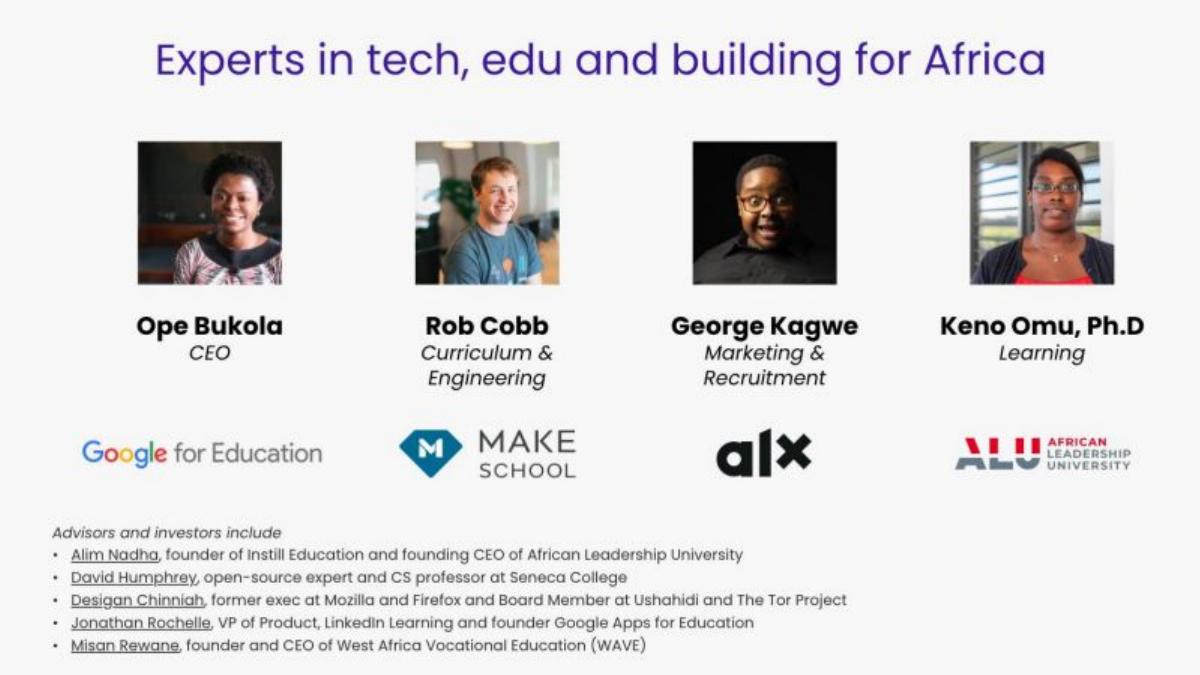
Online tech education for learners in Africa. Slide titled "Experts in tech, edu and building for Africa".
Kibo deck, slide 5. Exact stored slide matched to this analysis.
Our analysis: The headline names the three things the company needs (tech, education, Africa) and the slide covers each: a curriculum owner, a learning specialist and advisors who built education companies on the continent.
Evidence and limitation: Each leader has a role and one prior organisation shown as a logo; advisors have one line each.
What a founder can adapt: Add a few words to each logo saying what the person did there.
Supporting analysis
What the deck claims: Ope Bukola, "CEO"; Rob Cobb, "Curriculum & Engineering"; George Kagwe, "Marketing & Recruitment"; Keno Omu, Ph.D, "Learning". Logos under them: Google for Education, Make School, ALX, African Leadership University. "Advisors and investors include" five people, among them "Alim Nadha, founder of Instill Education and founding CEO of African Leadership University" and "Jonathan Rochelle, VP of Product, LinkedIn Learning and founder Google Apps for Education".
Presentation choice: Investors in edtech ask who designs the learning; Kibo gives it a named owner.
When it does not fit: Logos with no role at the company can mean anything from founder to intern.
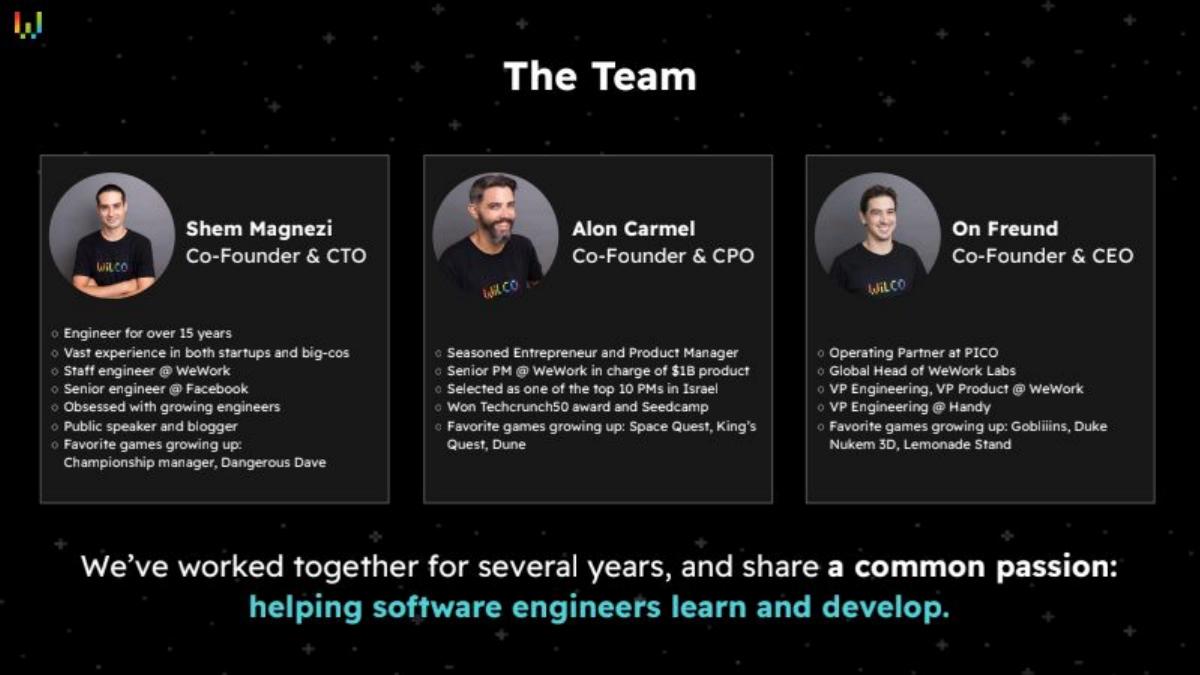
Skills practice for software engineers. Slide titled "The Team".
Wilco deck, slide 2. Exact stored slide matched to this analysis.
Our analysis: The founders are former engineering leaders selling to engineers, so their experience of training engineers stands in for classroom teaching.
Evidence and limitation: Named employers and roles for all three; a shared employer (WeWork) supports the claim they have worked together.
What a founder can adapt: Add one line on training or hiring results, such as how many engineers each person managed or onboarded.
Supporting analysis
What the deck claims: Shem Magnezi, "Co-Founder & CTO": "Engineer for over 15 years", "Staff engineer @ WeWork", "Senior engineer @ Facebook", "Obsessed with growing engineers". Alon Carmel, "Co-Founder & CPO": "Senior PM @ WeWork in charge of $1B product", "Selected as one of the top 10 PMs in Israel", "Won Techcrunch50 award and Seedcamp". On Freund, "Co-Founder & CEO": "Operating Partner at PICO", "Global Head of WeWork Labs", "VP Engineering, VP Product @ WeWork", "VP Engineering @ Handy". Each also lists favourite games. "We've worked together for several years, and share a common passion: helping software engineers learn and develop."
Presentation choice: When the learners are professionals, having been one of them and managed them is the relevant expertise.
When it does not fit: The favourite games fit a game-style product but take space a result could use.
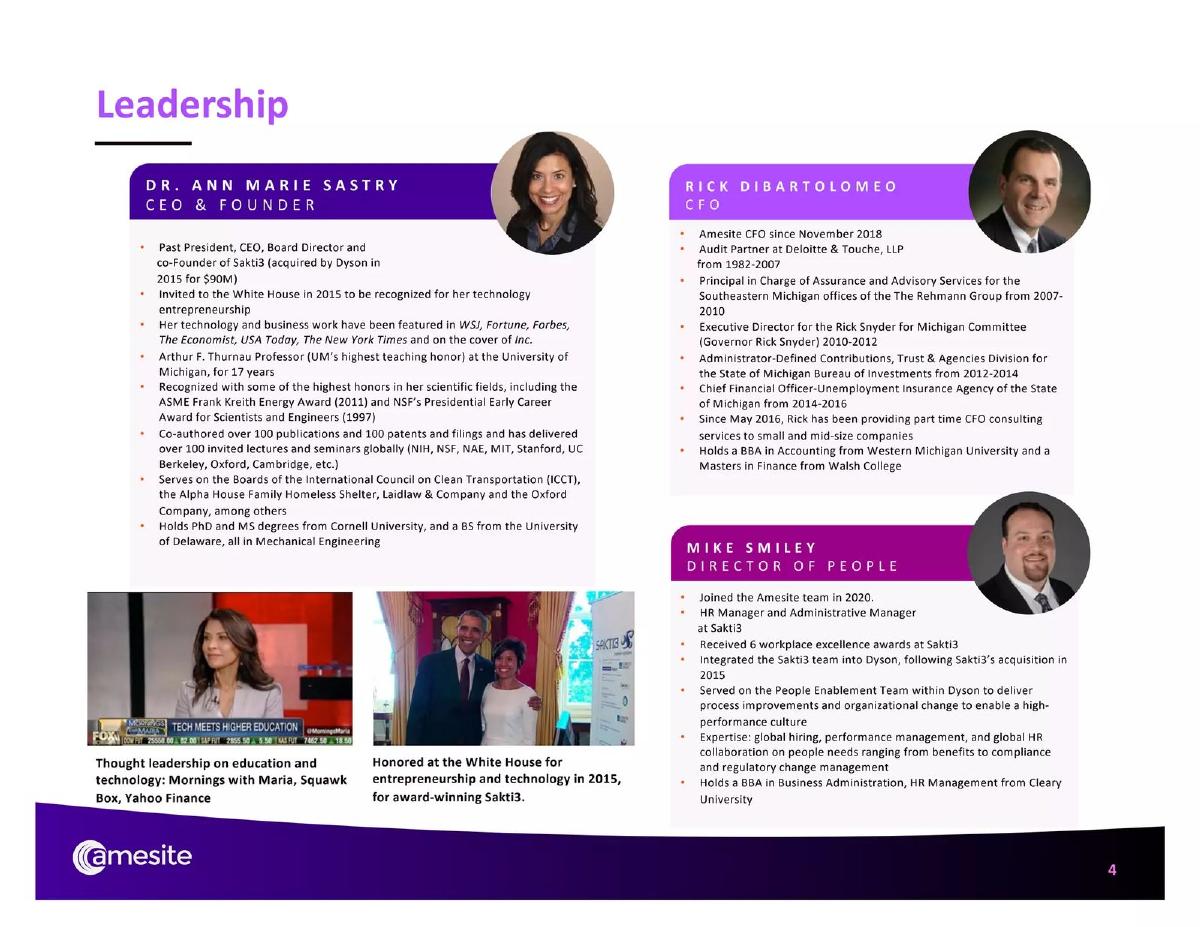
Online learning platform for universities, schools and businesses; a listed company. Slide titled "Leadership".
Amesite deck, slide 4. Exact stored slide matched to this analysis.
Our analysis: The CEO is both a proven company builder and a teacher at the kind of institution Amesite sells to, which answers both edtech questions in one person.
Evidence and limitation: A prior exit with a price, a long university teaching career and dated roles for the CFO.
What a founder can adapt: Cut to the three or four lines per person that matter to this company; the teaching award and exit are the strongest.
Supporting analysis
What the deck claims: Dr. Ann Marie Sastry, "CEO & Founder": "Past President, CEO, Board Director and co-Founder of Sakti3 (acquired by Dyson in 2015 for $90M)", "Arthur F. Thurnau Professor (UM's highest teaching honor) at the University of Michigan, for 17 years", "Co-authored over 100 publications and 100 patents and filings". Rick DiBartolomeo, "CFO": "Audit Partner at Deloitte & Touche, LLP from 1982-2007" and state finance roles. Mike Smiley, "Director of People": "HR Manager and Administrative Manager at Sakti3". Photos from TV appearances and the White House.
Presentation choice: Universities buy from people who understand them; a professor's record speaks to that buyer.
When it does not fit: Dense bios with board seats and publication counts bury the key facts.
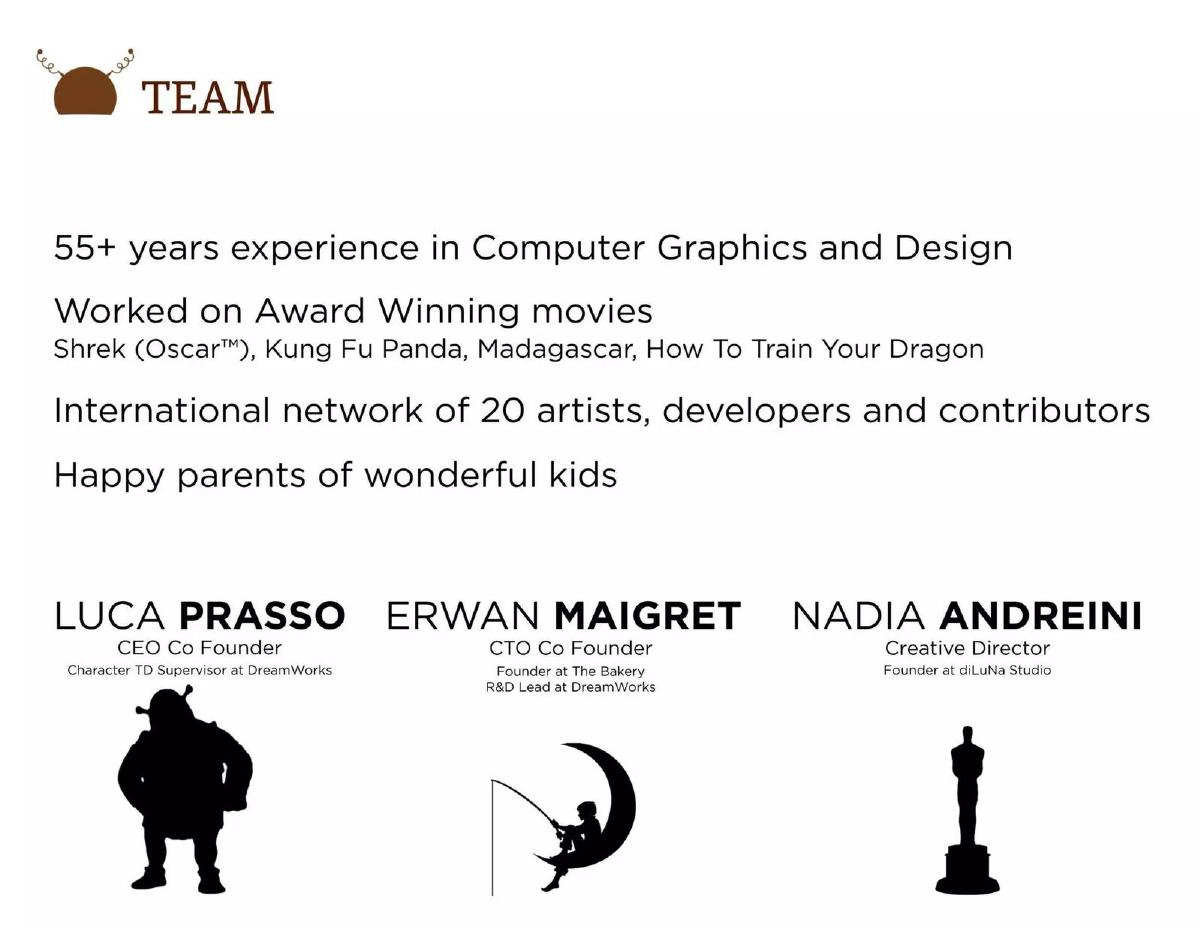
Learning apps for young children. Slide titled "Team".
Curious Hat deck, slide 3. Exact stored slide matched to this analysis.
Our analysis: It shows the team can make characters and animation children will want to watch. It does not show anyone with teaching or child-development experience.
Evidence and limitation: Named films and a named studio; the 55+ years is a combined total.
What a founder can adapt: Add an educator, child-development advisor or curriculum lead, even part time.
Supporting analysis
What the deck claims: "55+ years experience in Computer Graphics and Design", "Worked on Award Winning movies Shrek (Oscar™), Kung Fu Panda, Madagascar, How To Train Your Dragon", "International network of 20 artists, developers and contributors", "Happy parents of wonderful kids". Luca Prasso, "CEO Co Founder", "Character TD Supervisor at DreamWorks"; Erwan Maigret, "CTO Co Founder", "Founder at The Bakery", "R&D Lead at DreamWorks"; Nadia Andreini, "Creative Director", "Founder at diLuNa Studio".
Presentation choice: For children's learning apps, parents and schools ask whether the content teaches; entertainment credits answer only half of that.
When it does not fit: "Happy parents" is relatable but is not expertise.
Music education business. Slide titled "Founding Partners".
Fund Music Ed deck, slide 2. Exact stored slide matched to this analysis.
Our analysis: The CEO founded a music school, so someone on the team has run music teaching; the rest bring music-industry and media contacts.
Evidence and limitation: One prior role per person, a named employer and a public profile link.
What a founder can adapt: Lead with the music-school founder and say how many students it taught; mark advisors apart from operators.
Supporting analysis
What the deck claims: Rick Hack, "President", "Former VP Entertainment for CBS Radio"; Chris Purifoy, "CEO, Tech Lead", "Founder of Innovate School Music"; Marina Terteryan, "VP Marketing & PR", "Former PR Director for Alfred Music Publishing Co."; Kelli Richards, "Advisor", "Former Director of Music & Entertainment for Apple Inc."; Jimmy Steal, "Advisor", "VP Programming for Emmis Communications"; Cole Thornton, "SEO, Online Ads". Each has a LinkedIn link.
Presentation choice: One line per person with a checkable link is easy to scan and verify.
When it does not fit: Mixing advisors and staff in one grid makes the team look larger than it is.
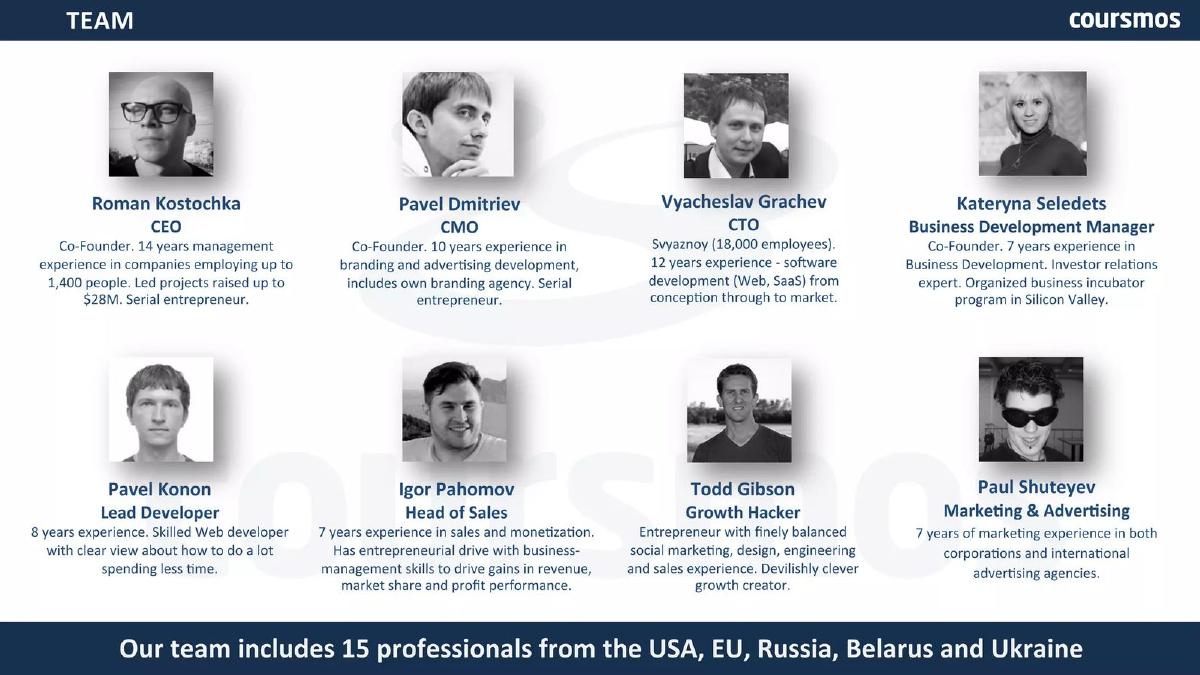
Coursmos deck, slide 3. Exact stored slide matched to this analysis.
Our analysis: Included for contrast: management, sales and marketing are covered, but no one is shown with course creation, teaching or instructor-marketplace experience.
Evidence and limitation: Years of experience and company sizes, but few named employers and no named results.
What a founder can adapt: Show four people with a named employer and one result each, and name who recruits instructors.
Supporting analysis
What the deck claims: Eight people with photos, including Roman Kostochka, "CEO": "Co-Founder. 14 years management experience in companies employing up to 1,400 people. Led projects raised up to $28M. Serial entrepreneur."; Vyacheslav Grachev, "CTO": "Svyaznoy (18,000 employees). 12 years experience - software development"; Todd Gibson, "Growth Hacker": "Devilishly clever growth creator." Footer: "Our team includes 15 professionals from the USA, EU, Russia, Belarus and Ukraine".
Presentation choice: A course marketplace depends on instructors and content quality; investors will look for someone who has built either.
When it does not fit: Adjectives such as "devilishly clever" and "skilled" in place of facts.
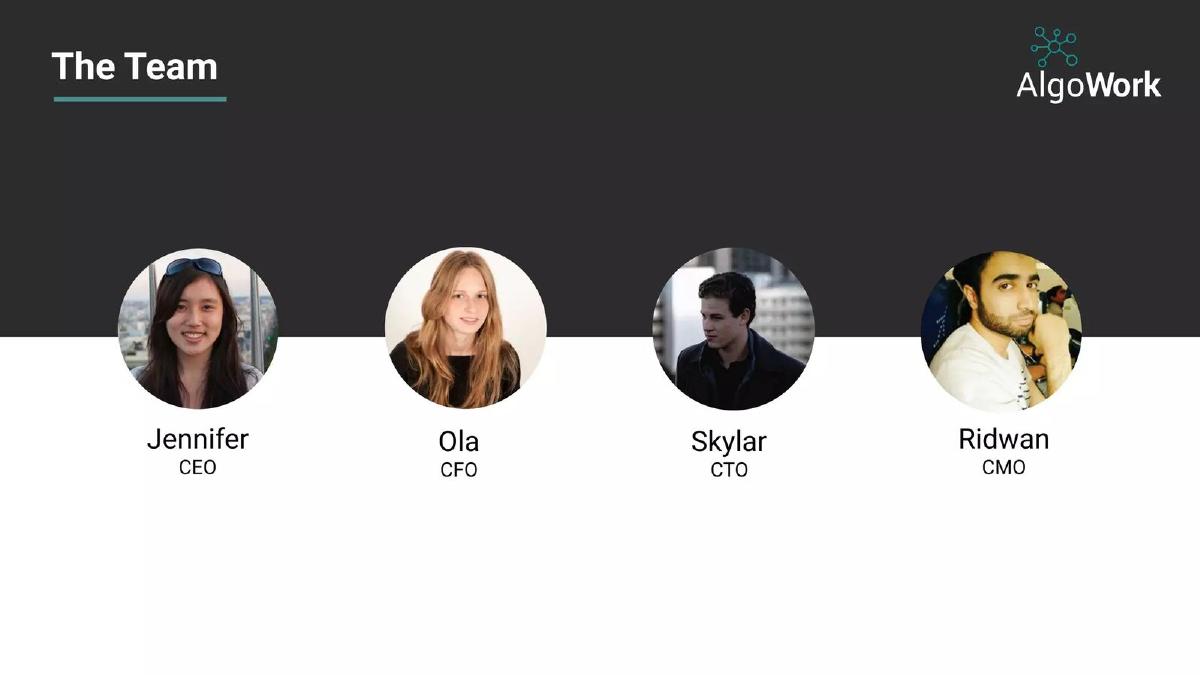
Before: Jennifer CEO. Ola CFO. Skylar CTO. Ridwan CMO.
After: Jennifer [surname], CEO: [years] teaching [subject] at [school]. Skylar [surname], CTO: built [product] at [company]. Curriculum advisor: [name], [role].
What improved: Our illustrative rewrite; the bracketed details are placeholders, not AlgoWork's facts. It adds surnames, a teaching background and a named curriculum owner.
What this guide adds
The general team slide guide covers any company. Edtech has a particular question: does anyone on the team understand teaching, learners or how schools, universities and employers buy? This guide looks at how real edtech slides answer it, or leave it out.
Our library's edtech tag is broad; it includes coding education, children's apps, music lessons, university platforms and online course marketplaces. We note each company's business in the examples.
How we read each slide
We quote the text on the stored slide images. We have not checked any employer, award, exit or other biography claim.
Common mistakes
No one owns learning. Name who designs the curriculum, even if it is an advisor.
Entertainment or sales credits only. Pair them with someone who has taught or built courses.
Adjectives, not facts. Replace "skilled" or "clever" with an employer and a result.
Advisors mixed with staff. Show operators first and label advisors.
Names with no background. First names and titles can't be checked.
Diagnostic checklist
A named learning or curriculum owner.
A named product or tech owner.
One employer and result per person.
Buyer experience (schools, universities or employers) shown.
Advisors labelled and listed after the team.
Frequently asked questions
What should an edtech team slide show?
Who owns learning or curriculum, who builds the product, and one checkable fact for each. Kibo names a "Curriculum & Engineering" lead and a "Learning" lead alongside its CEO.
Does an edtech team need a teacher on it?
It needs someone who understands the learners and buyers. Amesite's CEO taught at the University of Michigan for 17 years; Wilco's founders led engineering teams, the people its product trains.
Is industry experience enough for an education startup?
It helps with content but rarely covers teaching. Curious Hat shows DreamWorks film credits for a children's learning app, but no educator.
How we chose these examples
Corpus: published pitch deck teardowns on StartupFundraising.com. Founder-uploaded private decks are excluded.
Selection (2026-09-27): we searched extracted slide text in decks tagged edtech for team, founders, founding or leadership together with CEO, CTO, COO or co-founder. 27 slides matched; several were product, sales or timeline slides.
Kept seven team slides with stored images. Excluded for no stored image (no uploads requested): AceUp p7, ArcLab p8, Baby Sparks p9, CloudAcademy p14, Edurino p10, Genius Group p11-12, Gladiator Education p11, Handshake p7 and Kanonic p7. DataCamp p5 is used elsewhere. Chef Koochooloo p6, Labster p3, LearnXYZ p2 and Protrainy p2 were left out because their extracted text was too garbled to quote reliably.
Review: stored slide text and images were checked on 2026-09-27 and matched to company, deck and slide number (editorial model review). No person has yet completed an editorial review of this page.
Claims are as shown on the slides; we have not verified them. We make no claim that any slide caused a fundraising outcome.