Amesite’s Fall 2020 investor deck serves as a strategic roadmap for a company operating at the intersection of AI and education, specifically targeting the Nasdaq under the ticker AMST. The presentation emphasizes a robust, multi-stream business model including setup fees, annual licenses, and user fees, aimed at capturing a share of the $169B North American employee learning market. With approximately $28M invested by late 2020, the company showcases a rapid development cycle, moving from Gen 1 to Gen 3 technology in under two years. While the deck excels at outlining market opportunity and…
Key takeaways
- The company is publicly traded on Nasdaq under the ticker AMST as of the Fall 2020 deck (Slide 1).
- Amesite utilizes a five-pillar revenue model: Setup Fee, Annual License Fee, Course Creation Fee, Maintenance Fee, and User Fee (Slide 7).
- The platform targets three primary addressable markets: K-12 (56.6M learners), Higher Ed (16.6M learners), and Employee L&D ($169B market) (Slide 7).
- Technology development moved rapidly, with Gen 1 launching in October 2018 and Gen 3 launching in January 2020 (Slide 11).
- Approximately $28M had been invested in the company's technology and growth by the time of this presentation (Slide 11).
- The platform is built as a cloud-based, single-page application designed to integrate with thousands of existing tools (Slide 13).
- A specific scale-up case study highlights a partnership with Peru Central and BOCES to reach New York school districts (Slide 15).
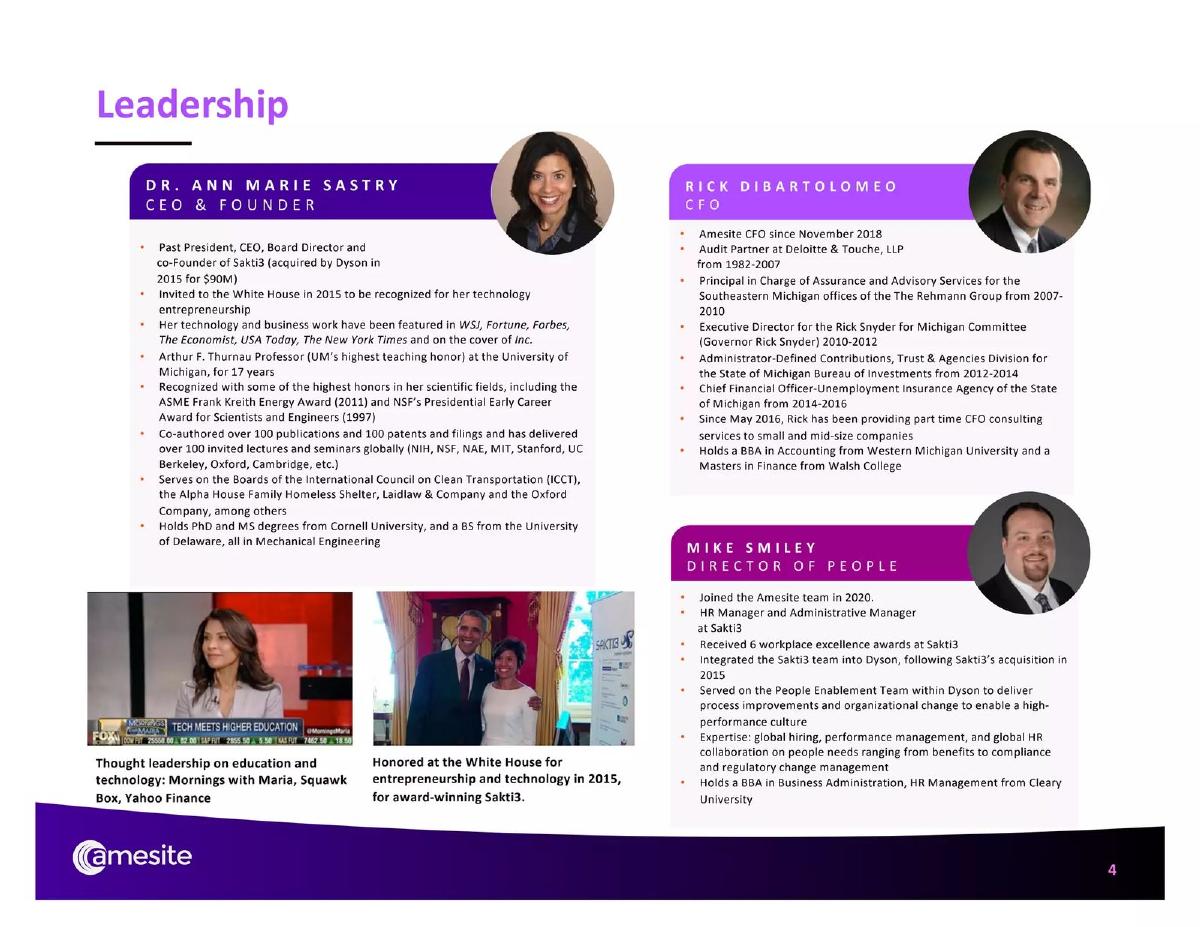
- The deck focuses heavily on the Board of Directors, featuring six members including CEO Dr. Ann Marie Sastry, but omits a traditional executive management slide (Slide 5).
Executive Summary: The Public Market Pivot
The Amesite Fall 2020 investor deck is a transitionary document. Unlike early-stage venture decks that focus on 'the dream,' this deck is designed for a company already listed on the Nasdaq (AMST). The tone is professional, structured, and focused on market size and technical scalability. With $28M already invested, the narrative shifts from 'can we build it?' to 'how fast can we scale it across these three massive verticals?'
Slide 1: Title and Public Identity
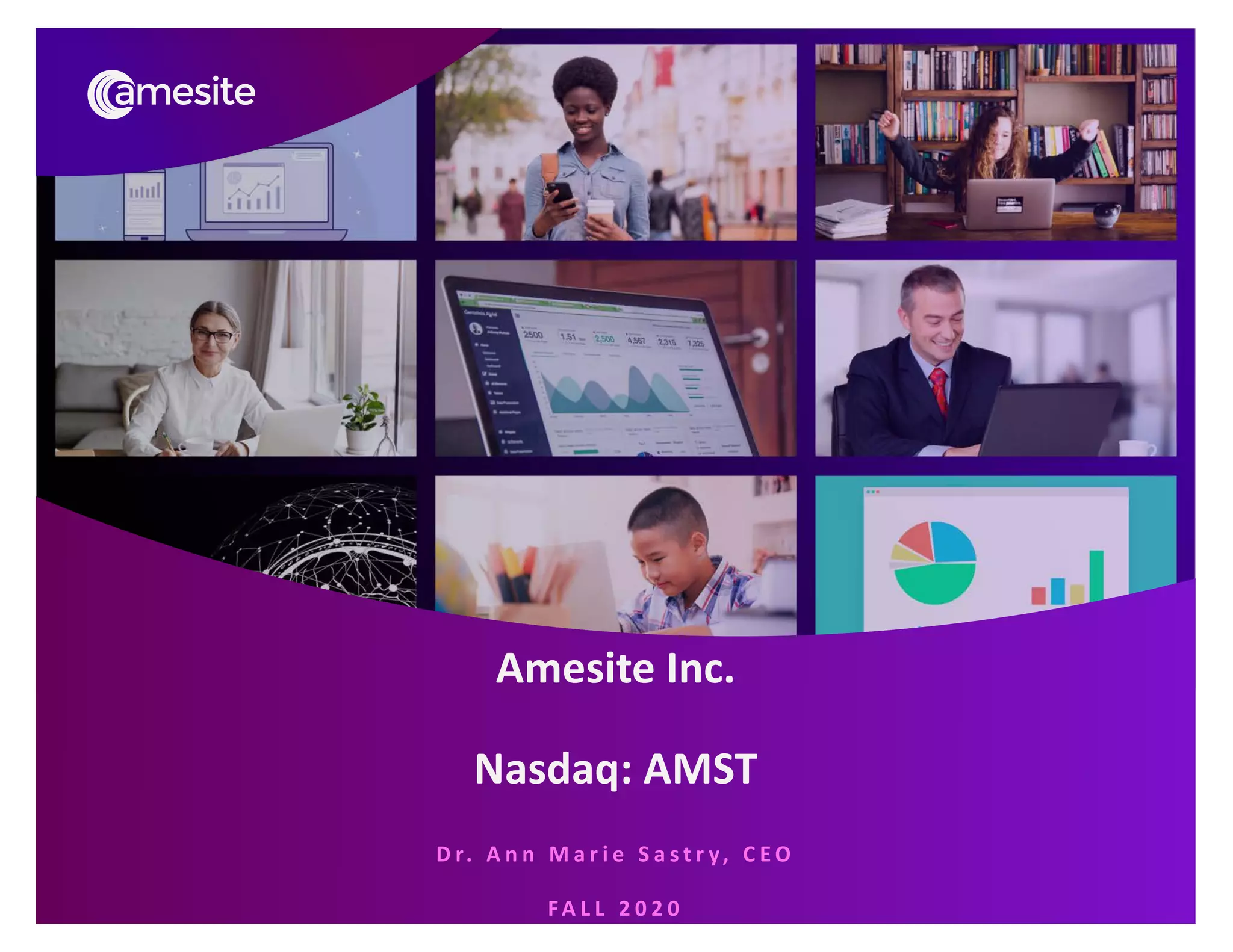
The cover slide immediately establishes the company's status. It features the logo, the company name 'Amesite Inc.', and the Nasdaq ticker 'AMST'. It identifies Dr. Ann Marie Sastry as the CEO and dates the presentation to Fall 2020. The imagery is a collage of diverse learners and data dashboards, signaling a broad application of their technology across different demographics.
Slide 3: The AI Mission
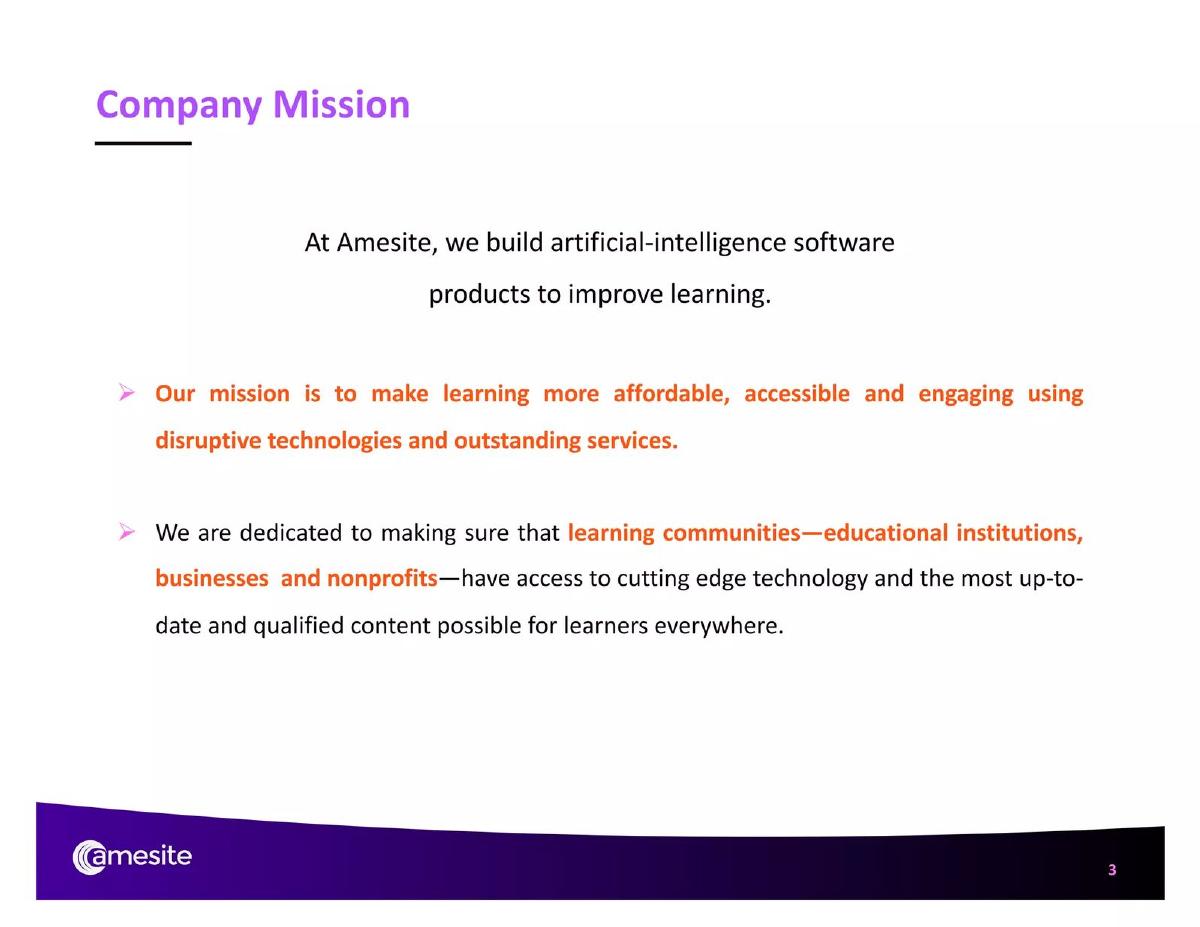
The mission statement is explicit: Amesite builds artificial-intelligence software products to improve learning. The slide breaks this down into three goals: making learning more affordable, accessible, and engaging. Notably, it defines its target 'learning communities' as educational institutions, businesses, and nonprofits. This broad definition sets the stage for the total addressable market (TAM) discussion later in the deck.
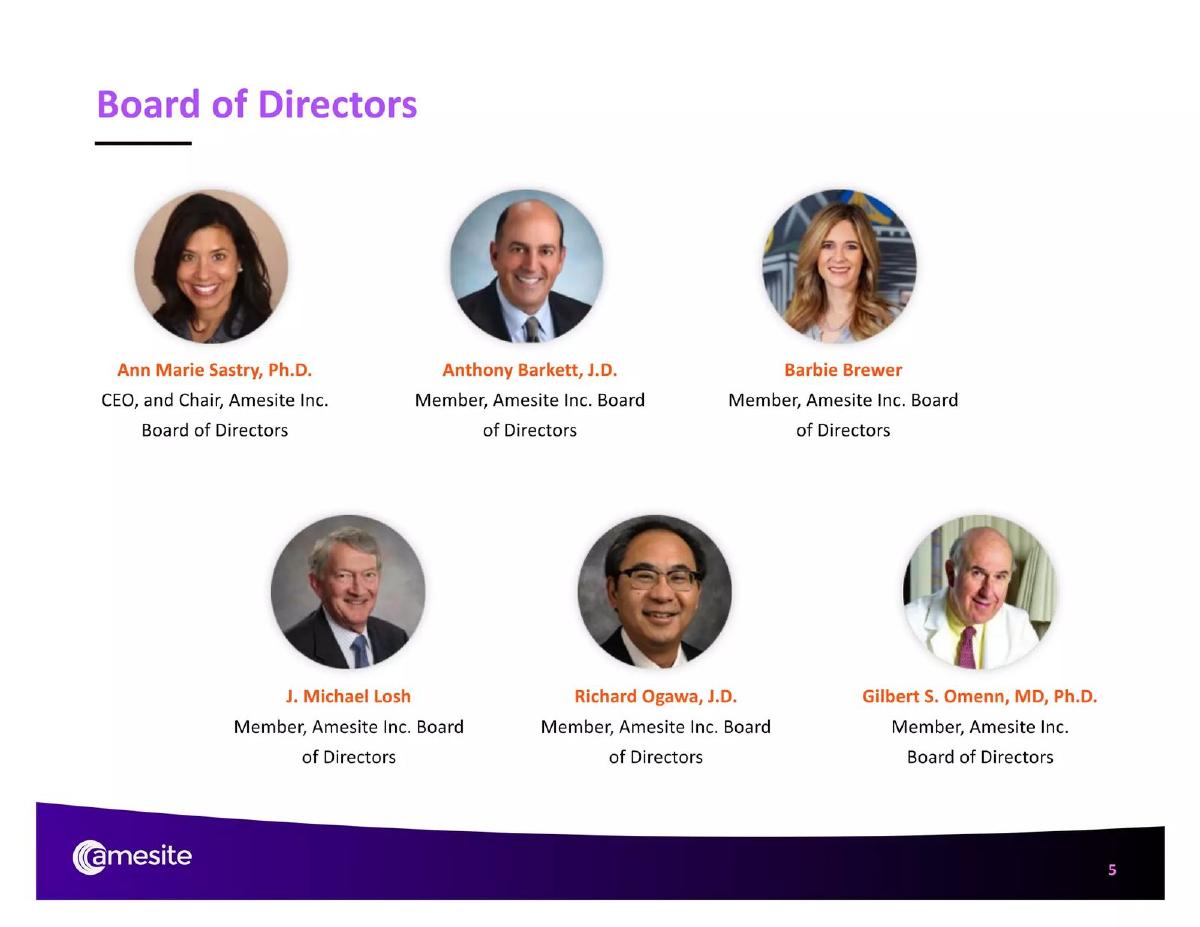
Slide 5: Board of Directors
Instead of a traditional 'Team' slide featuring department heads (CTO, CMO, etc.), Amesite leads with its Board of Directors. This is a common tactic for public or late-stage companies to demonstrate institutional stability. The board includes:
Ann Marie Sastry, Ph.D.: CEO and Chair. · Anthony Barkett, J.D. · Barbie Brewer · J. Michael Losh · Richard Ogawa, J.D. · Gilbert S. Omenn, MD, Ph.D.
The presence of two J.D.s and an MD/Ph.D. suggests a board geared toward regulatory compliance, intellectual property, and high-level institutional partnerships.
Slide 7: The Five-Pillar Business Model
This is arguably the most important slide for an investor. It outlines how the company actually makes money. The model is designed for 'High Margin + ARR' and includes:
Setup Fee: For custom enterprise work (citing The Henry Ford Museum and Wayne State University). · Annual License Fee: To cover infrastructure. · Course Creation Fee: For building content (citing Michigan State University and Humphreys University). · Maintenance Fee: To keep content current. · User Fee: For scaling infrastructure and customer service.
The slide also lists addressable markets: 56.6M K-12 learners, 16.6M Higher Ed learners, and a ~$169B North American employee L&D market.
Slide 9: Value Proposition for Institutions
This slide focuses on the 'How.' It positions Amesite as a 'fully-managed' solution. The key takeaway here is that universities and schools can launch products 'without expanding or taxing your infrastructure.' It highlights an AI-backed platform that matches content to student needs and provides a 'Learner Profile' showing skill progression. The promise to colleges is a 'pay as you go' model that is branded to the institution, not Amesite.
Slide 11: Technology Progress and Capital Efficiency
Amesite uses a timeline to show rapid development. Development began in May 2018. By January 2020, they had launched 'Gen 3.' The Gen 3 technology includes AI algorithms for content refresh, streaming video, and integration with social media and calendars. The most significant figure on this slide is the '~$28M Invested to Date,' which gives investors a sense of the capital required to reach this stage of product maturity.
Slide 13: Technical Infrastructure
This slide targets the 'technical due diligence' aspect of a pitch. It describes the platform as a cloud-based, single-page application. Key technical features include:
Integration with 'thousands of available integrations.' · SSO support for SAML and OpenID. · Auto-scaling infrastructure with end-to-end security. · A 'single-threaded' architecture (though usually, 'single-page application' is the more relevant term for UX, the deck emphasizes the tools used by Netflix and PayPal).
Slide 15: K-12 Scaleup Case Study
To prove the model works in the public sector, Amesite highlights a partnership in New York. It shows the relationship between Peru Central School District and BOCES (Boards of Cooperative Educational Services). The goal is to reach multiple school districts across New York State. The slide lists specific courses being provided, including Intro to Computer Programming (Java), AP Computer Programming, Cybersecurity, and Coding for Gaming (C++).
Slide 17: Conclusion
The final slide is a standard 'Thank You' featuring the Amesite logo and the iconic 'Charging Bull' statue from Wall Street, further reinforcing the company's identity as a public, market-driven entity.
What Works in the Amesite Deck
Clear Revenue Streams: The breakdown on Slide 7 is excellent. It moves away from the vague 'SaaS' label and explains exactly which activities trigger a billable event. This gives investors a clear picture of how the company captures value at every stage of the customer lifecycle.
Market Specificity: By citing specific partners like The Henry Ford Museum and Wayne State University, the deck moves from theoretical to practical. It proves that major institutions have already vetted and paid for the service.
Speed of Execution: The timeline on Slide 11 is a strong visual indicator of a high-velocity team. Moving from initial development to a third-generation product in under two years is a compelling narrative for growth-oriented investors.
What is Missing from the Amesite Deck
Management Team: While the Board of Directors is impressive, the deck lacks a slide for the executive leadership team. Investors want to know who is running the day-to-day operations (CTO, Head of Sales, etc.), especially in a technology-heavy company.
Financial Performance: For a company that is already public (or heading there), the lack of historical revenue charts, gross margins, or user growth metrics is a significant omission. The deck mentions 'High Margin,' but does not provide the percentages to back it up.
Competitive Landscape: The deck operates as if Amesite is in a vacuum. There is no mention of competitors like Coursera, 2U, or Canvas. A slide explaining why Amesite's AI is superior to existing Learning Management Systems (LMS) would have strengthened the 'disruptive' claim on Slide 3.
Unit Economics: While the revenue model is clear, the cost to acquire a customer (CAC) and the lifetime value (LTV) are absent. In the crowded EdTech space, these metrics are vital for understanding long-term viability.
What You Should Copy for Your Own Deck
The 'Fully-Managed' Angle: If your product requires significant integration, copy Amesite's approach on Slide 9. They emphasize that the customer doesn't need to 'tax their infrastructure.' This removes a major friction point in the B2B sales process.
The Multi-Tiered Revenue Slide: Slide 7 is a masterclass in showing how to monetize a platform beyond a simple monthly subscription. If your business has setup, maintenance, or per-user components, use this layout to show the 'stackability' of your revenue.
The Technology Progress Timeline: Slide 11 is a great way to show 'Gen' progression. It tells a story of continuous improvement and suggests that the company is always looking toward the next iteration, rather than sitting on a static product.
Frequently asked questions
- What is Amesite's core product offering?
- Amesite provides a fully-managed enterprise learning platform and customized courses. According to Slide 9, the platform is AI-backed and designed to help universities and K-12 schools launch scalable online learning products quickly. The service includes progress tracking, notifications, and strategic consultation to help institutions create impactful certifications without needing to expand their own internal IT infrastructure.
- How does Amesite generate revenue?
- The company employs a diversified business model detailed on Slide 7. Revenue is generated through initial setup fees for custom work, recurring annual license fees for infrastructure, course creation fees for content development, maintenance fees to keep courses updated, and per-user fees to cover monitoring and customer service. This structure aims for high margins and consistent Annual Recurring Revenue (ARR).
- What is the current scale of Amesite's target market?
- Amesite identifies three massive segments on Slide 7. In 2019, the K-12 market consisted of 56.6 million learners, while the 2018 Higher Education market included 16.6 million learners. Most significantly, the North American employee learning and development market was valued at approximately $169 billion in 2019, representing a major growth vertical for their AI software.
- What technical advantages does the Amesite platform claim?
- Slide 13 highlights that the platform is a cloud-based, single-threaded, single-page application. It features auto-scaling infrastructure, end-to-end security, and SSO support for SAML and OpenID. The company emphasizes that their tech stack is built on tools similar to those used by Netflix and PayPal, offering 'thousands of available integrations' to fit into existing institutional ecosystems.
- Who governs the company according to the deck?
- The governance is led by Dr. Ann Marie Sastry, who serves as CEO and Chair. The Board of Directors, shown on Slide 5, includes Anthony Barkett (J.D.), Barbie Brewer, J. Michael Losh, Richard Ogawa (J.D.), and Gilbert S. Omenn (MD, Ph.D.). This board composition suggests a heavy emphasis on legal, medical, and corporate governance expertise.