AMG Advanced Metallurgical Group N.V. presented a comprehensive 40-slide investor deck in May 2016 that prioritized operational discipline over speculative growth. Facing a period of depressed metal prices, the company highlighted its ability to improve gross margins (from 16.8% to 18.7% YoY) and drastically reduce working capital days from 79 in Q3 2010 to just 26 in Q1 2016. The deck serves as a defensive yet optimistic roadmap, showcasing a diversified portfolio across aerospace, automotive, and infrastructure sectors. By emphasizing safety improvements and debt reduction (down 80% YoY), A…
Key takeaways
- AMG achieved a 67% reduction in working capital days, dropping from 79 days in Q3 2010 to 26 days by Q1 2016 (Slide 21).
- The company successfully increased its gross margin to 18.7% in Q1 2016, up from 16.8% in Q1 2015, despite falling metals prices (Slide 17).
- Net debt was reduced by $69.6 million, representing an 80% decrease compared to the end of Q1 2015 (Slide 17).
- Safety metrics showed significant improvement, with incident severity rates down 37% and lost time incidents down 35% year-over-year (Slide 13).
- The 'Critical Materials Prices' chart reveals that most of AMG's portfolio, including Nb and Sb, were near 10-year price lows in March 2016 (Slide 9).
- AMG Engineering reported a revenue increase of 11% in Q1 2016, reaching $60.8 million, driven by aerospace furnace sales (Slide 25).
- The company maintains a diversified customer base including blue-chip names like GE, Safran, Rio Tinto, and Alcoa (Slide 33).
- Total assets were reported at $736.9 million as of March 31, 2016, with a cash position of $111.6 million (Slide 37).
Introduction
The AMG Advanced Metallurgical Group N.V. Investor Presentation from May 4, 2016, is a detailed 40-slide document (of which we are analyzing the core 10 slides) that provides a snapshot of a mature industrial company navigating a cyclical downturn. Unlike a startup pitch deck that sells a future vision, this deck sells operational excellence and fiscal discipline. The narrative is built around the concept of 'Critical Materials' and the company's role in the 'CO2 Reduction' revolution.
Slide 1: Title Slide
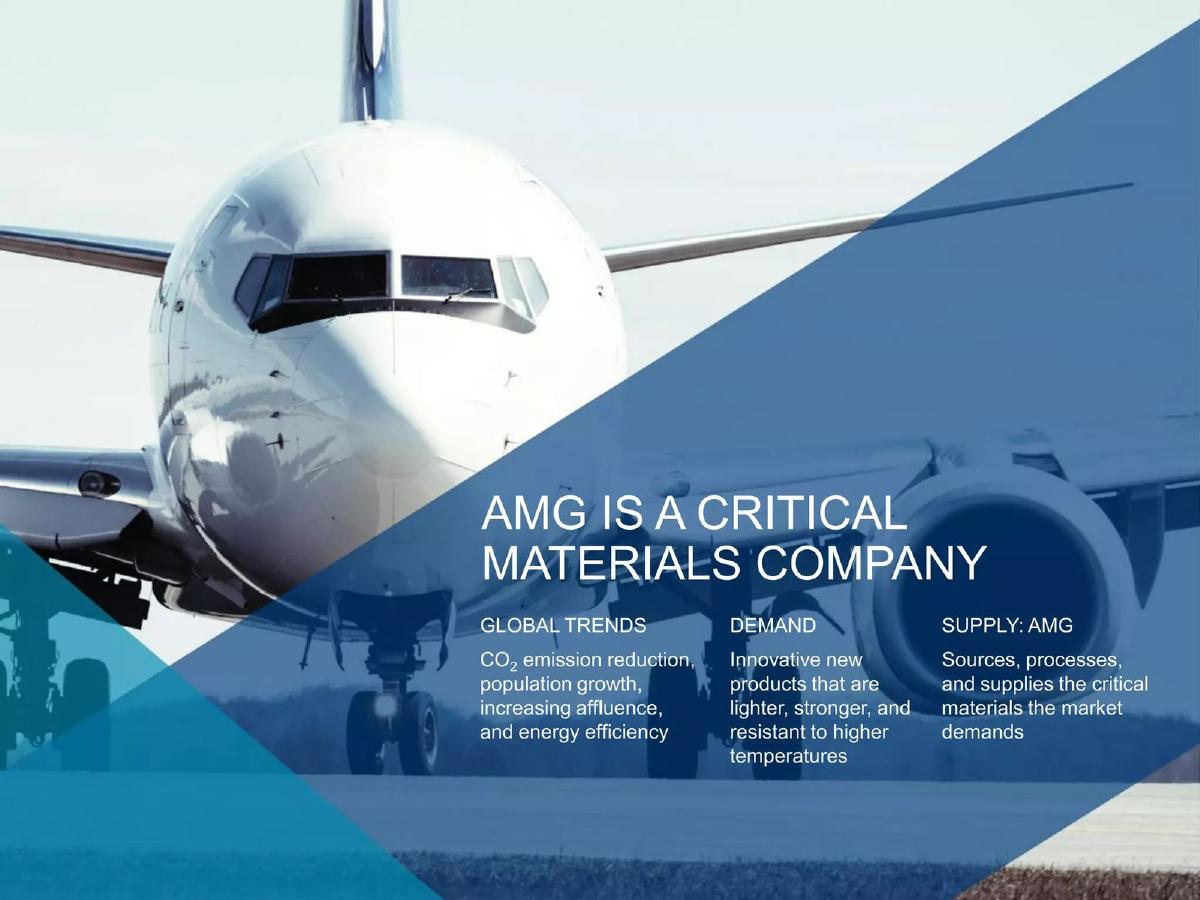
The deck opens with a high-resolution image of a city skyline viewed through an airplane window, immediately signaling the company's focus on the aerospace and transportation sectors. The tagline, "LEADING THE CRITICAL MATERIALS REVOLUTION," positions AMG not just as a supplier, but as a pioneer in a shifting industrial landscape. The slide clearly identifies the entity as AMG Advanced Metallurgical Group N.V. and dates the presentation to May 4, 2016.
Slide 2: CO2 Reduction Strategy
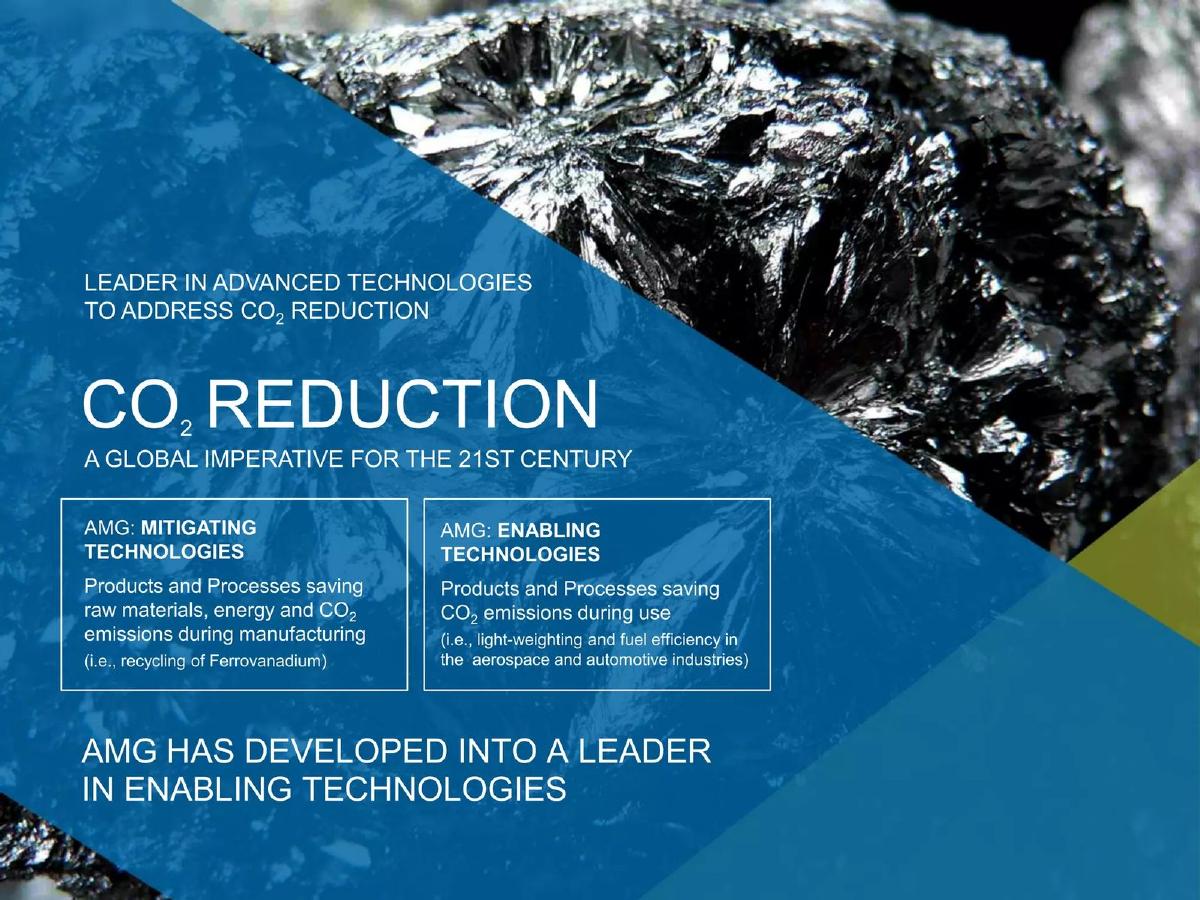
This slide serves as the 'Why' for the company. It frames CO2 reduction as a "global imperative for the 21st century." AMG categorizes its business into two technological pillars: Mitigating Technologies , which focus on saving raw materials and energy during manufacturing (e.g., recycling of Ferrovanadium), and Enabling Technologies , which save emissions during the end-use phase (e.g., light-weighting in aerospace and automotive). This is a strategic move to align a heavy industrial business with environmental sustainability trends.
Slide 9: Critical Materials Prices: 10 Year Perspective
This is perhaps the most honest slide in the deck. It uses a 0-to-10 scale to show where current metal prices sit relative to their 10-year highs and lows. The data for March 2016 shows that almost every material AMG deals in—Chromium (Cr), Molybdenum (Mo), Nickel (Ni), Ferrovanadium (FeV), and Niobium (Nb)—was at or near a 10-year price floor. For example, Nb is at a 0.1 and FeV is at a 0.4. The slide concludes that "AMG has significant potential upside" based on these historical ranges, turning a market weakness into a potential investment opportunity.
Slide 13: Health and Safety Focus
For an industrial company, safety is a proxy for operational quality. AMG reports that the number of safety improvement items increased by 13%, while the incident severity rate dropped by 37% and days away from work dropped by 35% for the period ending March 2016. The table shows a reduction in Lost Time Incidents from 32 in 2015 to 29 in 2016. This slide is intended to build trust with institutional investors by showing that the company is managed with a "rigorous commitment to safety."
Slide 17: 2016 Financial Objectives
This slide outlines four key objectives and provides a progress update for each. The most striking figure is the 80% reduction in net debt ($69.6 million) compared to Q1 2015. Additionally, the company highlights a Gross Margin increase to 18.7% in Q1 2016 from 16.8% in Q1 2015, specifically noting that this was achieved "despite falling metals prices." This reinforces the theme of operational efficiency over market reliance.
Slide 21: Working Capital Reduction
This slide features a line graph showing a consistent downward trend in working capital days. Starting at 79 days in Q3 2010, the company managed to drive this down to 26 days by Q1 2016 . A large orange hexagon highlights this as a "53 DAYS, OR 67% REDUCTION." For investors, this is a clear indicator of improved cash flow management and reduced operational risk.
Slide 25: AMG Engineering Performance
Focusing on one of their specific business units, this slide shows that Q1 2016 revenue reached $60.8 million , an 11% increase over Q1 2015. EBITDA also saw an improvement, rising to $4.6 million. However, the slide also notes a Book to Bill ratio of 0.83x in Q1 2016, with an order intake of $50.5 million. This indicates that while current revenue is strong, new orders are lagging slightly behind current billings, a crucial detail for future forecasting.
Slide 29: 2016 Outlook
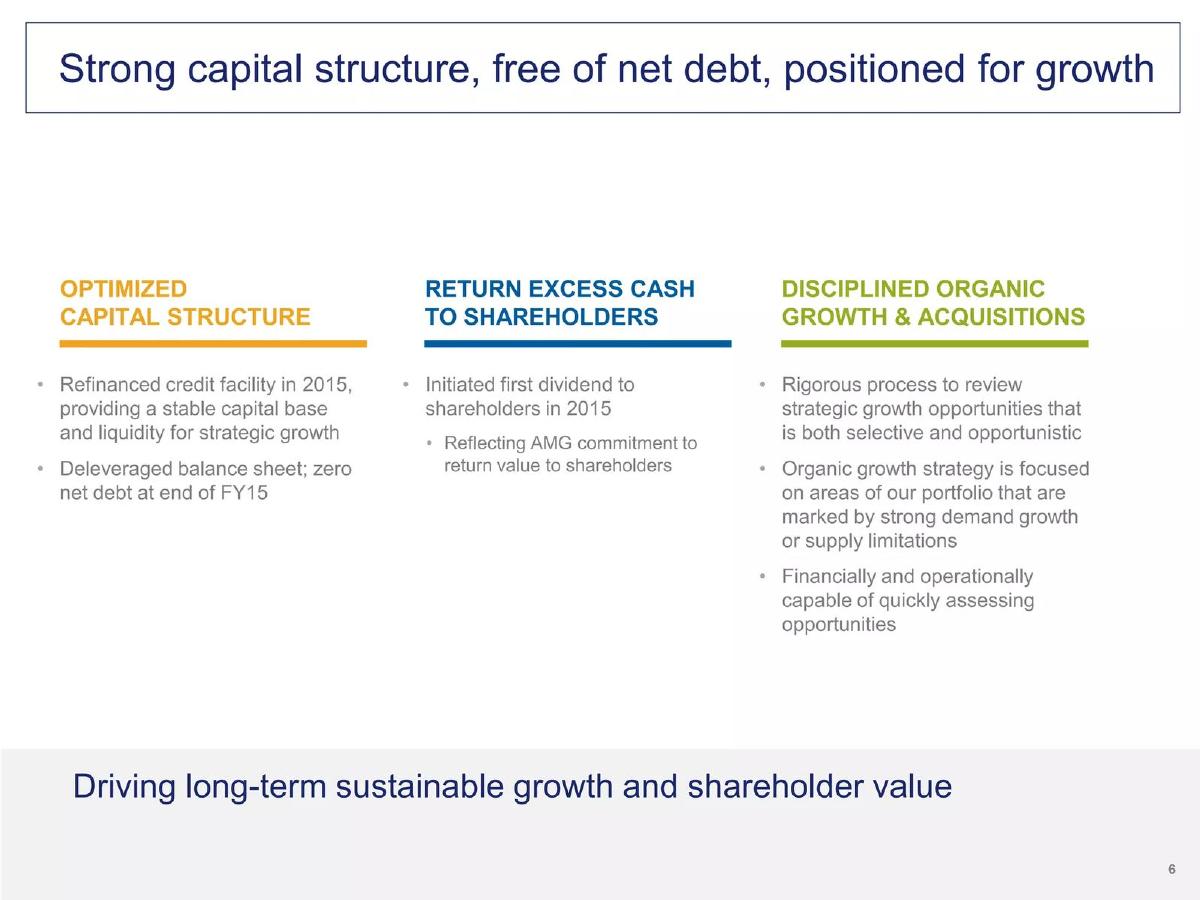
The outlook slide is cautious. It states that management's target is to "maintain 2015 levels of profitability in 2016." It mentions a change in dividend policy, reflecting a "commitment to return value to shareholders" due to the improved balance sheet. The summary at the bottom reiterates the strategy: reduce cost, optimize the product portfolio, and maintain a conservative balance sheet.
Slide 33: Critical Materials – Market Trends
This slide maps AMG’s four business units (Aluminum, Vanadium, Titanium Alloys, and Superalloys) to their major end markets and customers. It lists high-profile customers such as Constellium, Rio Tinto, Alcoa, Nucor, Gerdau, Safran, GE, PCC, and ATI . The market trends identified are almost entirely focused on "Fuel Efficiency," "Infrastructure Growth," and "Energy Saving," showing a unified demand driver across their diverse product lines.
Slide 37: Consolidated Balance Sheet
The final slide in the set is a formal balance sheet as of March 31, 2016. It shows Total Assets of $736.9 million and Total Liabilities of $564.8 million . Key figures include a cash balance of $111.6 million and inventory valued at $125.8 million. The equity position improved from $153.6 million in December 2015 to $172.1 million in March 2016, providing a solid financial foundation for the company’s claims of stability.
What Works Well
Operational Transparency: The inclusion of specific metrics like working capital days and incident severity rates shows a management team that is focused on the details of the business. · Honest Market Assessment: Slide 9 does not hide the fact that metal prices are at a decade-long low; instead, it uses that data to argue for future upside. · Clear Customer Validation: Listing major global corporations like GE and Rio Tinto on Slide 33 provides immediate credibility to their market position.
What is Missing
Competitive Landscape: The deck does not mention specific competitors in the metallurgical or engineering space, making it difficult to assess AMG's market share. · Unit Economics: While gross margins are mentioned, the deck lacks a breakdown of the cost of goods sold (COGS) or specific margin profiles for different materials. · Detailed Risk Factors: Beyond the price volatility of metals, the deck does not address geopolitical risks or supply chain vulnerabilities, which are critical in the materials sector.
Founder Takeaways
Use Efficiency as a Shield: If your market is volatile or down, focus your pitch on what you can control—working capital, margins, and debt. AMG’s slide 21 is a perfect example of this. · Align with Macro Trends: AMG successfully framed a traditional industrial business as a "CO2 Reduction" play. Founders should always look for the broader global trend their company supports. · Visualizing Data: The use of the 0-10 scale for metal prices (Slide 9) is an excellent way to make complex commodity data instantly understandable for a generalist investor.
Frequently asked questions
- How did AMG handle the decline in critical material prices?
- AMG focused on 'enabling technologies' that provide value regardless of raw material costs, such as light-weighting for aerospace. According to slide 17, they also improved productivity and product mix optimization, which allowed them to increase gross margins to 18.7% even as the market prices for their core materials hit historical lows.
- What was the primary driver of AMG's financial stability in 2016?
- The primary driver was aggressive balance sheet management. Slide 17 notes an 80% reduction in net debt, and slide 21 illustrates a massive 67% reduction in working capital days. By freeing up cash tied up in operations, the company maintained liquidity during a challenging price environment for commodities.
- Which industries are the main consumers of AMG's products?
- As detailed on slide 33, AMG's primary end markets are Aerospace, Automotive, and Infrastructure. Their customer list includes major industrial players like Boeing (via PCC/ATI), GE, and steel manufacturers like Nucor and Gerdau, showing a heavy reliance on global transportation and construction trends.
- What is the significance of the 'Working Capital Reduction' slide?
- Slide 21 is a critical proof point of management's execution. In industrial metallurgy, working capital (inventory and receivables) often drains cash. Reducing this from 79 days to 26 days over six years demonstrates a fundamental shift in operational efficiency, making the company much more resilient to market shocks.
- Does the deck mention environmental or sustainability goals?
- Yes, slide 2 positions CO2 reduction as a 'global imperative.' AMG divides its contribution into 'Mitigating Technologies' (recycling Ferrovanadium) and 'Enabling Technologies' (fuel efficiency in aerospace). This framing aligns their industrial output with the broader ESG (Environmental, Social, and Governance) trends emerging in 2016.