Amberscript’s Series A deck is a masterclass in narrative simplicity, focusing on a clear market gap: the trade-off between speed and accuracy in transcription. By positioning their 'Assisted Intelligence' as a bridge between low-accuracy automated tools and slow manual services, they carve out a high-value B2B niche. The deck effectively uses macro trends—specifically European accessibility legislation and the shift toward usage-based pricing—to justify its growth trajectory. While the 11-slide presentation is remarkably light on hard financial data and team bios, it successfully communicate…
Key takeaways
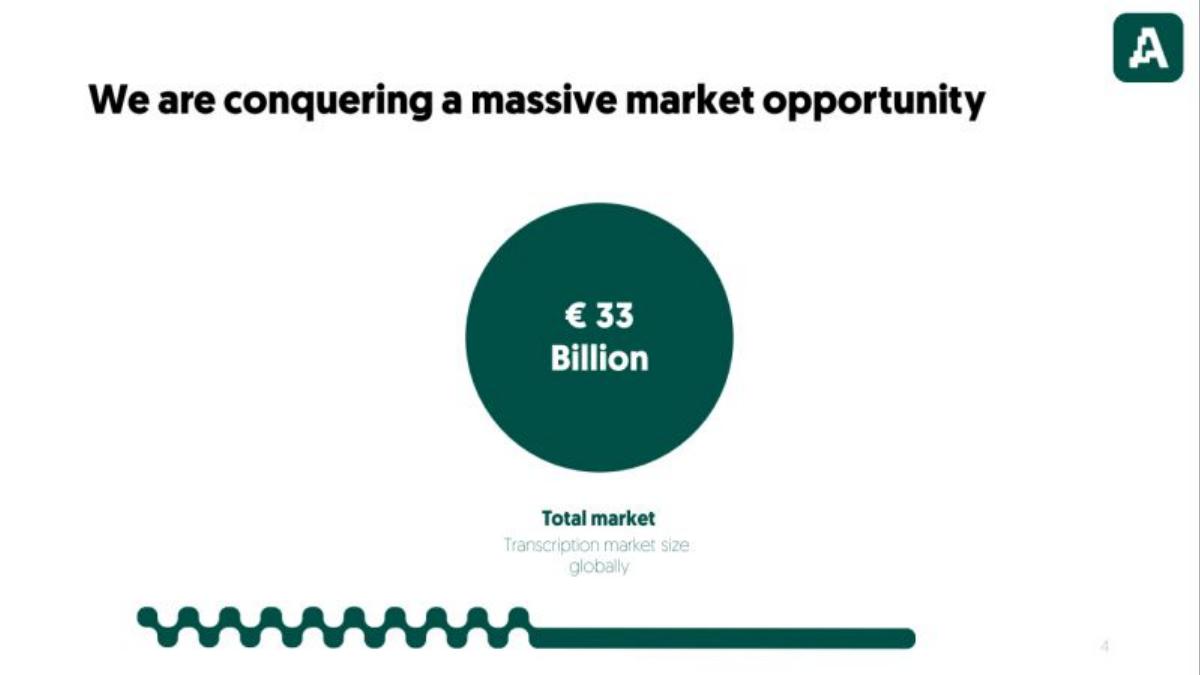
- The total global transcription market size is valued at €33 Billion (Slide 4).
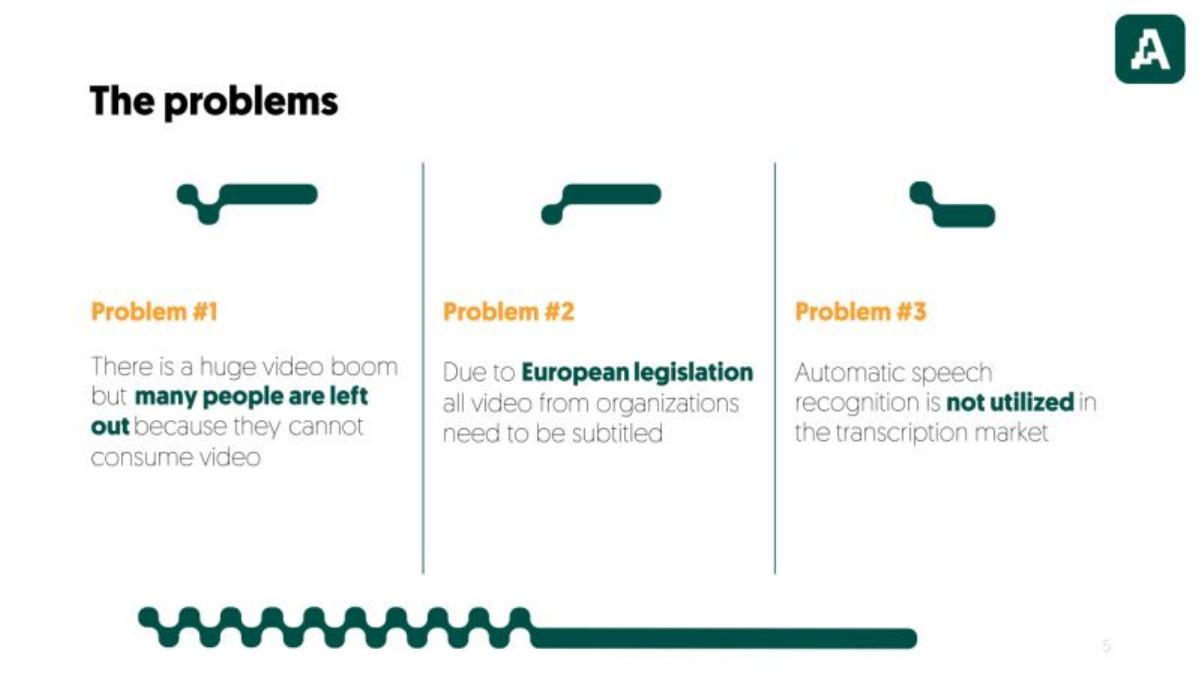
- Amberscript identifies a regulatory tailwind in European legislation requiring all organizational videos to be subtitled (Slide 5).
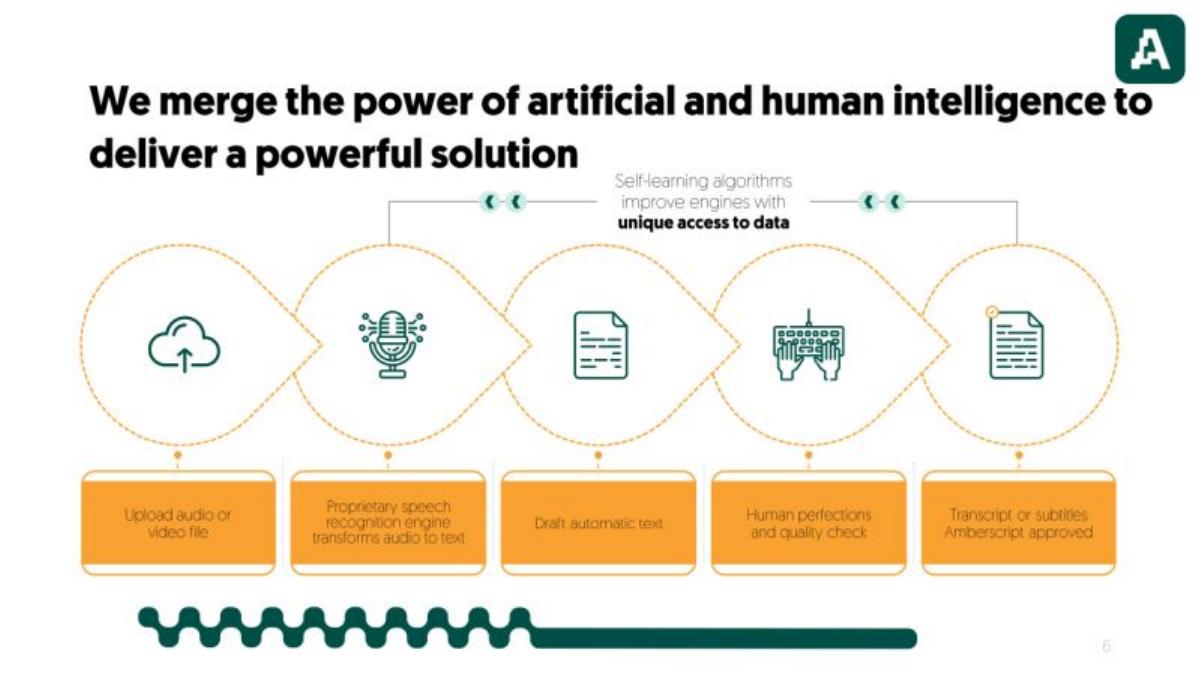
- The 'Assisted Intelligence' model claims to deliver 100% accuracy by merging AI with human perfection and quality checks (Slide 7).
- The company differentiates from traditional manual transcription, which takes 8 hours to transcribe 1 hour of audio (Slide 8).
- Amberscript positions itself in the high-speed, high-accuracy quadrant of the B2B market (Slide 8).
- The business model shifts away from seat-based pricing toward usage-based monetization, citing peers like Snowflake and Datadog (Slide 9).
- The growth roadmap defines 2018-2019 as Product-Market Fit, 2020-2023 as Scaling, and 2024+ as Hyper-scaling (Slide 10).
- The deck omits a dedicated team slide, specific revenue figures, and a detailed breakdown of the $10M funding ask.
The Narrative of Efficiency: Amberscript’s Series A Teardown
Amberscript’s 2021 pitch deck is a lean, 11-slide presentation that focuses heavily on the "Why Now" and the "How." At the Series A stage, investors are typically looking for proof of a repeatable sales motion and a clear path to market leadership. Amberscript addresses this by framing the transcription problem not just as a technical challenge, but as a regulatory and economic one. By raising $10M with this deck, the company proved that a clear, high-level strategic narrative can be just as impactful as a data-heavy appendix.
Slides 1-3: Vision and Mission
The deck opens with a minimalist title slide featuring Peter-Paul de Leeuw, Founder & CEO. The branding is consistent, using a deep green and orange palette that persists throughout the presentation. Slide 2 introduces the vision: "All videos will be subtitled." This is a bold, binary statement that sets the stage for a massive market shift. Slide 3 follows with the mission: "We make audio accessible." This framing is clever; it moves the product from a 'nice-to-have' productivity tool to a 'must-have' accessibility solution, which has significant legal implications in the EU.
Slide 4: The €33 Billion Opportunity
Amberscript doesn't waste time with complex market breakdowns. Slide 4 presents a single, large circle representing a €33 Billion total market size for transcription globally. While the slide lacks a bottom-up calculation or a distinction between TAM, SAM, and SOM, the sheer scale of the figure is intended to signal that the ceiling for growth is nowhere in sight.
Slide 5: The Triple Threat Problem
Slide 5 breaks down the market friction into three distinct problems. First, the "video boom" is leaving people out who cannot consume audio. Second, and perhaps most importantly for their Series A, they cite European legislation as a catalyst, noting that all video from organizations now needs to be subtitled. Third, they point out that automatic speech recognition (ASR) is currently underutilized in the professional market due to accuracy issues. This slide effectively creates a sense of urgency for investors.
Slide 6: The Hybrid Solution
The core of Amberscript’s value proposition is detailed on Slide 6 . They describe a five-step workflow: 1. Upload, 2. Proprietary ASR engine transforms audio to text, 3. Draft automatic text, 4. Human perfections and quality check, and 5. Approved transcript/subtitles. The slide highlights "Self-learning algorithms" that improve the engine through "unique access to data." This is the classic 'human-in-the-loop' AI model, which was a highly attractive narrative in 2021 as it promised 100% accuracy that pure ASR could not yet achieve.
Slide 7: Assisted Intelligence in Practice
Slide 7 reinforces the solution with a product screenshot and three pillars: Accuracy (100%), Speed (automated workflow), and Ease (integration with software suites). Notably, they include a small Trustpilot badge citing 377 reviews . In a deck largely devoid of hard metrics, this social proof serves as a proxy for customer satisfaction and product-market fit.
Slide 8: Competitive Positioning
The 2x2 matrix on Slide 8 is a standard but effective tool. They plot Speed against Accuracy. They claim automatic transcription is fast but only 75% accurate , while manual transcription takes 8 hours to transcribe 1 hour of audio . Amberscript places itself in the top-right quadrant, claiming "record breaking speed" with high accuracy. This slide is the 'moat' argument: their hybrid model allows them to compete on two fronts where others can only choose one.
Slide 9: The Monetization Shift
One of the most sophisticated slides in the deck is Slide 9 , which discusses software trends. Amberscript argues that Automation, AI, and APIs mandate a move toward usage-based monetization . They explicitly name-drop high-performing tech companies like Snowflake, Datadog, Zapier, and HubSpot to align themselves with the 'modern' SaaS cohort. This is a strategic move to justify their business model to VCs who might otherwise be looking for traditional seat-based ARR.
Slide 10: The Success Formula
The final content slide, Slide 10 , provides a high-level roadmap. It categorizes 2018-2019 as the period of "Product market fit," 2020-2023 as "Scaling," and 2024+ as "Hyper scaling." This is a standard growth chart, though it lacks the specific milestones (e.g., revenue targets, headcount, or geographic expansion) that usually accompany such a slide.
What Amberscript Does Well
The Amberscript deck excels at contextualizing the product . Instead of just saying "we transcribe audio," they explain that they are an accessibility company solving a legal compliance problem in a €33B market. This elevates the pitch from a utility tool to an infrastructure play. The use of the "Assisted Intelligence" terminology is also a strong branding choice, as it differentiates their tech stack from the hundreds of 'pure' AI startups that often struggle with the 'last mile' of accuracy required by enterprise clients.
Furthermore, the usage-based pricing argument is very well-handled. By showing that they understand the evolution of SaaS—where automation actually reduces the need for user seats—they proactively answer an investor's concern about how the company will scale revenue if the product becomes too efficient.
What is Missing from the Deck
For a Series A deck, there are several glaring omissions that would typically be considered red flags if not for the successful $10M outcome. First, there is no Team Slide. Investors at this stage usually want to see the pedigree of the engineering team and the experience of the sales leadership. Second, there is a total lack of financial data. There are no charts showing growth in ARR, no mention of Burn Rate, and no Unit Economics (LTV/CAC). Third, the 'Ask' is missing. The deck does not state how much they are raising or what the specific use of funds will be (e.g., hiring 20 engineers, expanding to the US market).
It is highly likely that these details were provided in a separate data room or a more detailed secondary deck, but as a standalone narrative, this presentation relies almost entirely on the strength of the market opportunity and the logic of the product's workflow.
What Other Founders Should Copy
Founders should emulate Amberscript’s clarity of the 'Problem' slide . By breaking the problem into three distinct buckets (Social/Video boom, Regulatory/Legislation, and Technical/ASR limitations), they provide a multi-faceted justification for their existence. This makes the business seem resilient; even if the video boom slows down, the legislation still exists.
Another takeaway is the visual simplicity . The deck is not cluttered. Each slide has one main point, usually supported by a single graphic or three bullet points. This ensures that the investor stays focused on the founder’s spoken narrative rather than reading dense text on the screen. Finally, the alignment with industry leaders (Slide 9) is a great way to borrow credibility. If you are using an unconventional business model, show that the most successful companies in the world are doing the same thing.
Frequently asked questions
- What is Amberscript's core product offering?
- Amberscript provides SaaS solutions that transcribe audio and video into text and subtitles. Their primary differentiator is a hybrid workflow where a proprietary speech recognition engine creates a draft, which is then refined by human editors to reach 100% accuracy, a process they call 'Assisted Intelligence'.
- How does Amberscript justify its market opportunity?
- The company points to a €33 billion global transcription market. They highlight three specific drivers: the massive boom in video content, new European legislation mandating subtitles for accessibility, and the fact that current automatic speech recognition is underutilized in professional B2B contexts.
- What is the company's pricing strategy?
- Amberscript advocates for a usage-based monetization model rather than traditional per-seat SaaS pricing. They argue that as AI and automation make products more efficient, customers need fewer seats, making seat-based pricing counter-productive to the value delivered by the software.
- How does Amberscript compare to competitors?
- The deck uses a 2x2 matrix to show that automatic transcription is fast but only 75% accurate, while manual transcription is accurate but extremely slow. Amberscript claims to occupy the top-right quadrant, offering both high speed and high accuracy through its hybrid model.
- What is missing from the Amberscript pitch deck?
- This deck is notably missing several standard venture components: there is no team slide highlighting founder expertise, no financial slide showing MRR or ARR growth, no customer logos (though Trustpilot reviews are mentioned), and no specific 'Ask' slide detailing how the $10M will be spent.