Advanced Medical Isotope Corporation (AMI) utilizes a 20-slide deck to pitch RadioGel, a proprietary brachytherapy technology that combines a hydrogel delivery vehicle with Yttrium-90 phosphate particles. The company’s core value proposition lies in its dual-market approach: targeting the $40M annual revenue potential of the U.S. veterinary cancer market to establish immediate cash flow, while simultaneously developing a pipeline for human skin, lymph node, and liver/pancreas cancers. By positioning their product as a medical device rather than a drug, AMI argues for a lower-cost and shorter…
Key takeaways
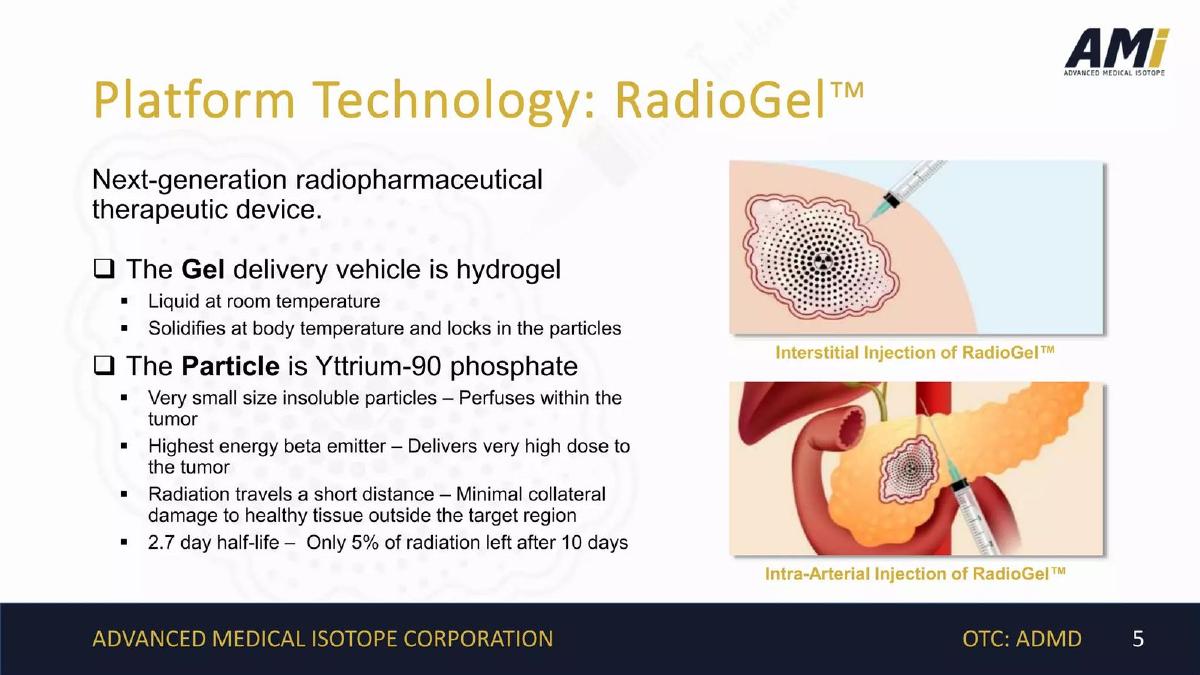
- The company is developing RadioGel, which uses Yttrium-90 phosphate particles with a 2.7-day half-life to deliver high-dose radiation with minimal collateral damage (Slide 5).
- AMI identifies the veterinary market as a near-term revenue driver, projecting $40M in annual revenue by treating 10% of eligible pet cancers at $5,000 per therapy (Slide 9).
- The human market strategy focuses initially on skin cancer, where they project a $1.5B annual revenue opportunity based on a 10% market share of 3.3 million patients (Slide 11).
- Regulatory positioning is key; the company claims the economics of a drug with the lower cost and shorter approval path of a device (Slide 3).
- Intellectual property is anchored by eight patents sublicensed from Battelle and trademark protection in 17 countries (Slide 15).
- The growth strategy follows a sequential expansion from skin cancer to lymph nodes, and finally to liver and pancreas indications (Slide 13).
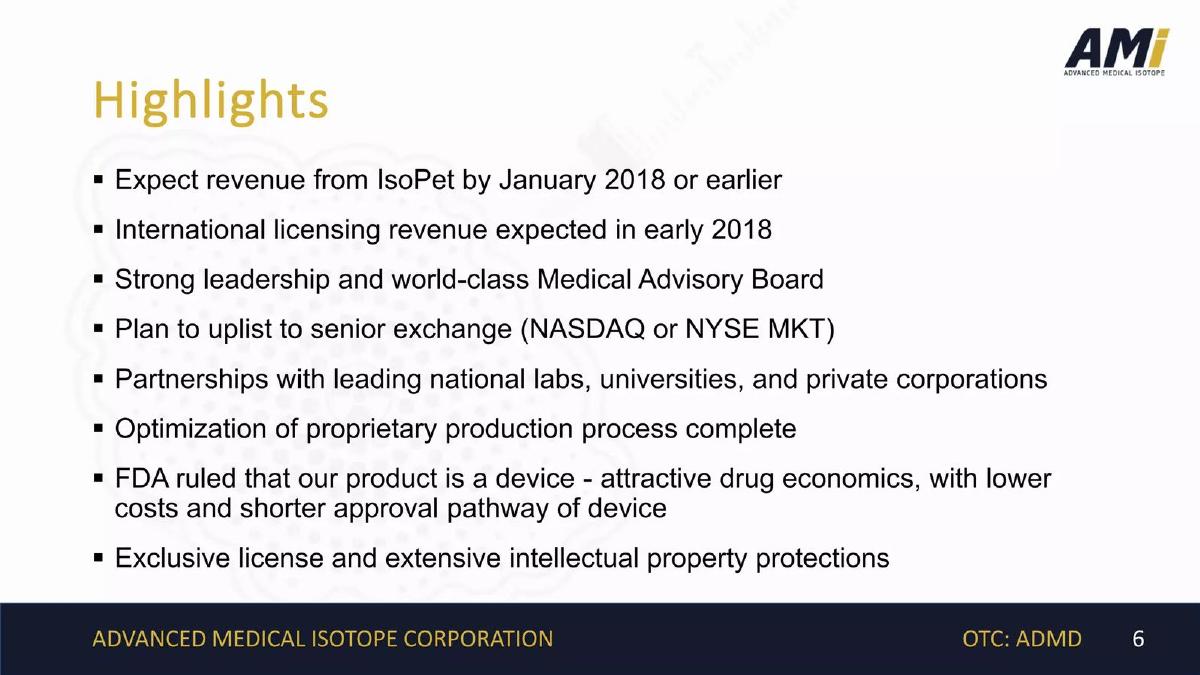
- The company is publicly traded on the OTC market under the symbol ADMD and expresses intent to uplist to a senior exchange like NASDAQ or NYSE MKT (Slide 19).
- Revenue from the veterinary product, IsoPet, was projected to begin by January 2018 or earlier (Slide 19).
Introduction and Corporate Status
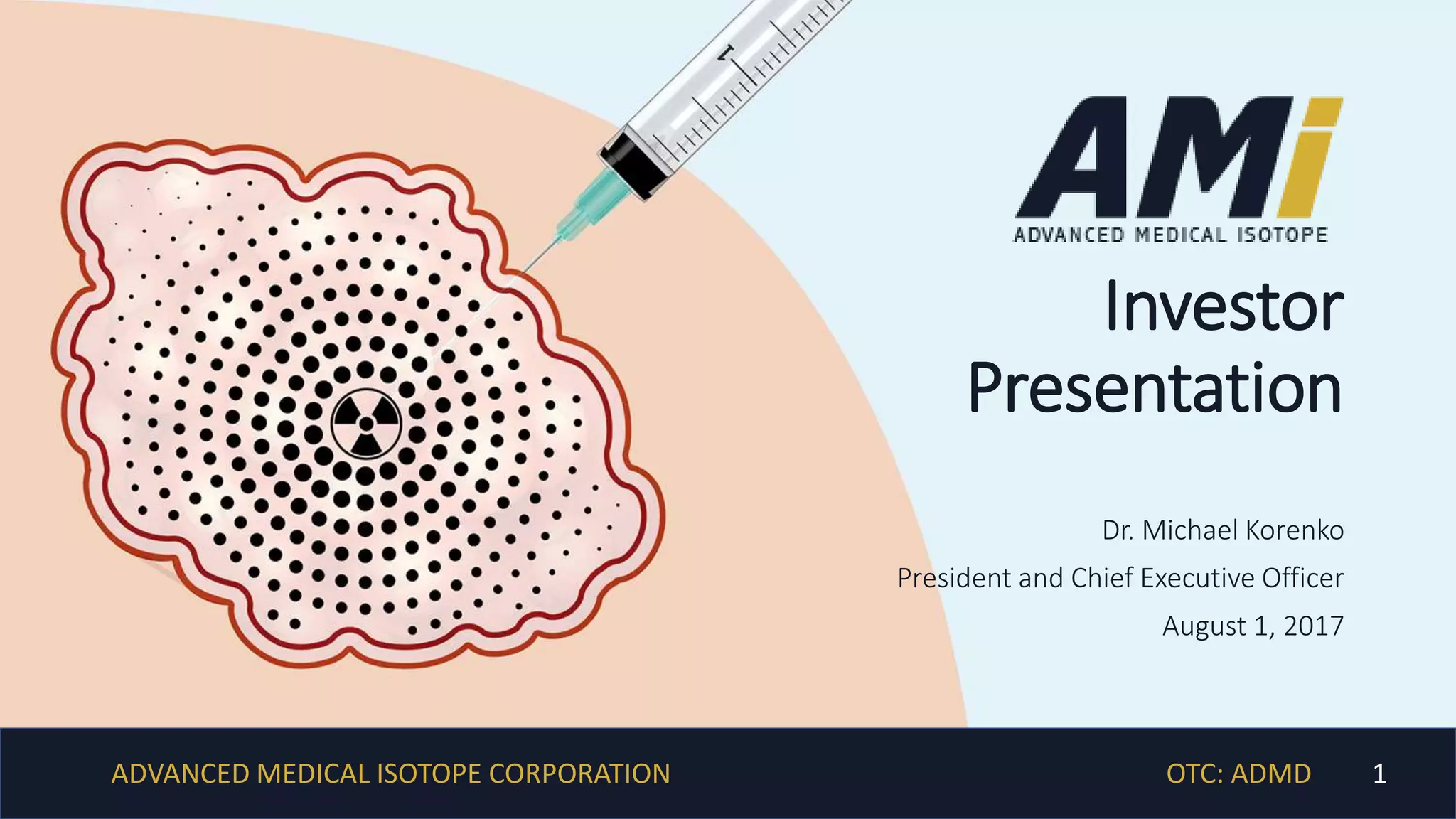
The Advanced Medical Isotope Corporation (AMI) investor presentation, dated August 1, 2017, introduces a company positioned at the intersection of biotechnology and medical devices. The cover slide (Slide 1) establishes the company's leadership under Dr. Michael Korenko and notes its status as a publicly traded entity on the OTC market under the ticker ADMD. The visual metaphor of a syringe injecting a localized tumor immediately communicates the company's focus on targeted, injectable cancer therapy.
Slide 3: The Strategic Overview
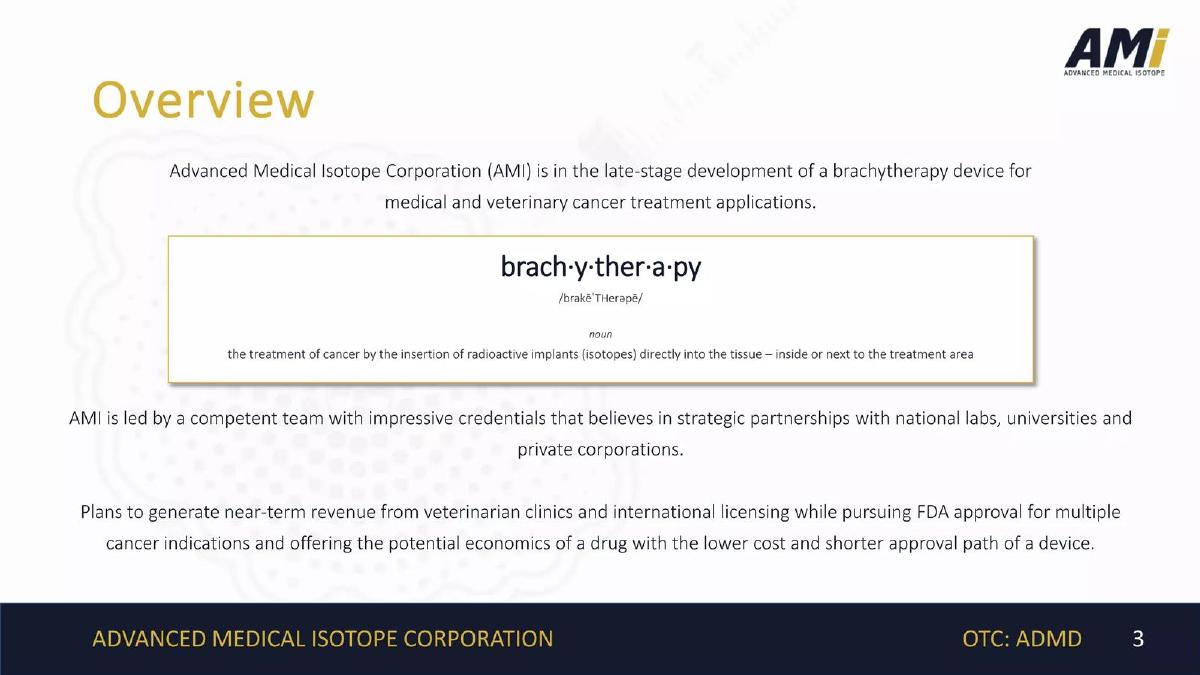
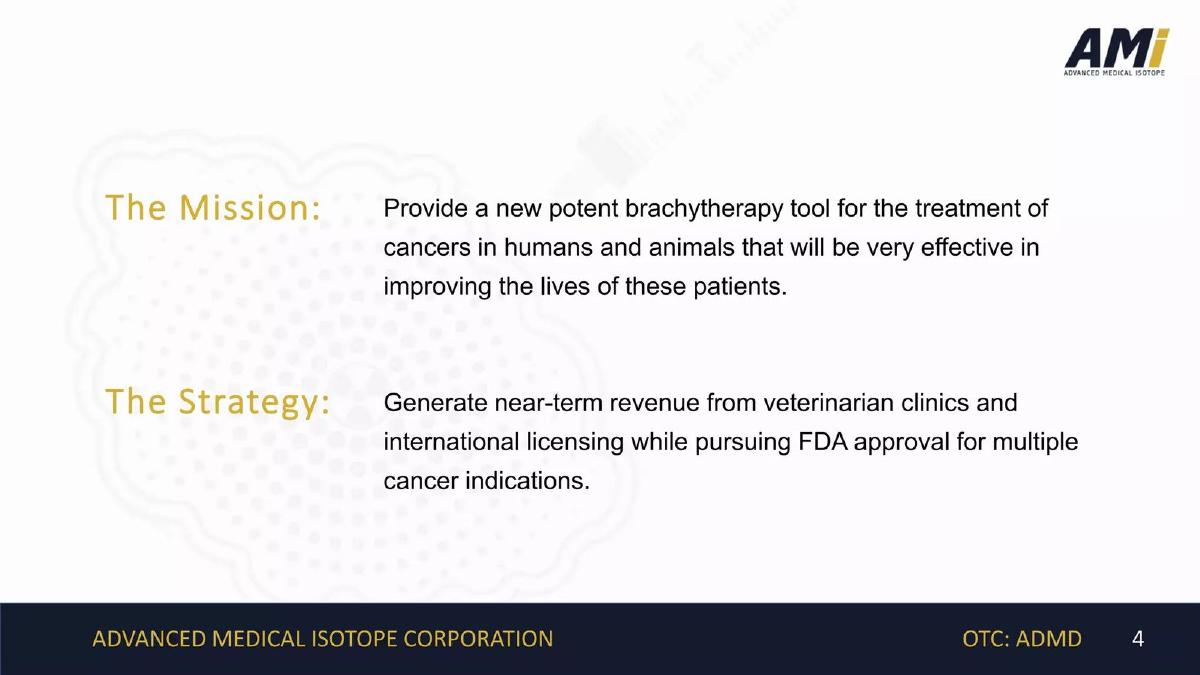
Slide 3 serves as the executive summary. It defines brachytherapy as the treatment of cancer through radioactive implants placed directly into or next to the treatment area. The core value proposition is clearly stated: AMI is pursuing a "device" regulatory path, which typically offers a shorter and less expensive route to market than traditional drug development, while aiming for the high-margin economics associated with pharmaceuticals. The slide also introduces the dual-track strategy of generating near-term revenue from veterinary clinics and international licensing while simultaneously working toward FDA approval for human applications.
Slide 5: RadioGel Technology Platform
This slide provides the technical specifications of the flagship product, RadioGel. It is described as a "next-generation radiopharmaceutical therapeutic device." The technology relies on two components: a hydrogel that remains liquid at room temperature for easy injection but solidifies at body temperature to lock particles in place, and Yttrium-90 phosphate particles. The choice of Yttrium-90 is strategic; as a high-energy beta emitter with a 2.7-day half-life, it delivers a potent dose that dissipates quickly (95% gone after 10 days), minimizing long-term radiation exposure for the patient and surrounding tissue.
Slide 7: The Veterinary Market Entry
Slide 7 outlines a three-step go-to-market strategy for the veterinary sector. The process begins with obtaining approval to test, followed by demonstrating therapies at leading research universities to build clinical credibility, and finally commencing sales to private clinics. This sequence is a standard "low-hanging fruit" strategy in medical tech, where the veterinary market serves as both a revenue source and a real-world proof of concept for human applications.
Slide 9: Veterinary Market Opportunity
The financial justification for the veterinary focus is detailed on Slide 9. Citing a population of 78 million dogs and 86 million cats in the U.S., the slide notes that cancer is the leading cause of death for 50% of dogs over age 10. The revenue model is straightforward: treating 10% of these cancers at a $5,000 price point results in a $40M annual revenue opportunity. Crucially, the slide sets a near-term milestone, stating that revenue streams could begin by January 2018.
Slide 11: Human Skin Cancer Projections
Moving to human applications, Slide 11 focuses on Basal Cell and Squamous Cell carcinomas. The market size is substantial, with 5.4 million cases annually in the U.S. The company applies a similar 10% market penetration assumption as the veterinary slide, which, at a $5,000 price point, yields a projected $1.5 billion in annual revenue. This slide bridges the gap between the smaller veterinary "starter" market and the massive human clinical opportunity.
Slide 13: Medical Sector Growth Strategy
Slide 13 illustrates the roadmap for human clinical indications. The company plans to move through "quantum growth steps" by expanding the use of RadioGel from skin cancer to lymph nodes, and eventually to complex internal organs like the liver and pancreas. This phased approach suggests a strategy of starting with the most accessible (topical/surface) tumors before moving to deeper, more complex internal oncology challenges.
Slide 15: Intellectual Property Protection
For a medical device company, IP is the primary defensive moat. Slide 15 lists the company's assets: eight patents sublicensed from Battelle, trademark protection in 17 countries, and proprietary knowledge regarding production procedures and test data. The mention of a retained IP attorney signals to investors that the company is actively defending and expanding its legal protections.
Slide 17: Medical and Scientific Advisory Boards
Slide 17 focuses on human capital and institutional credibility. By showcasing chairs for Medical, Scientific, and Veterinary advisory boards—including MDs and DVMs with impressive credentials (FACR, FNAP, FASTRO)—AMI attempts to validate its technology through the endorsement of industry experts. This is a critical slide for de-risking the technical claims made earlier in the deck.
Slide 19: Investment Highlights
The final slide in this selection summarizes the pitch. It reiterates the timeline for revenue (January 2018), the strength of the leadership and partnerships, and the strategic goal of uplisting to a senior exchange like the NASDAQ. It reinforces the "drug economics with device pathway" narrative, which is the central pillar of the company's financial appeal.
What Works in This Deck
Clear Technical Differentiation: The explanation of the hydrogel's phase-change properties (liquid to solid) and the specific benefits of Yttrium-90 (short half-life, localized dose) is clear and compelling. It explains how the product works without getting bogged down in impenetrable jargon.
Dual-Market De-risking: The decision to lead with the veterinary market is a strong strategic move. It shows investors a path to cash flow that doesn't rely solely on the multi-year, high-risk FDA human trial process. This "revenue-first" approach is often more attractive to mid-stage investors than a pure-play clinical trial bet.
Regulatory Arbitrage: Positioning the product as a "device" while claiming "drug economics" is a classic medical fundraising tactic. If the company can successfully maintain this classification, it significantly reduces the capital requirements and time-to-market compared to a New Drug Application (NDA).
What Is Missing from This Deck
Competitive Landscape: The deck completely omits a competitor analysis. There is no mention of existing brachytherapy providers, traditional radiation therapy, or emerging immunotherapy treatments that might compete for the same patient pool. Investors need to know why RadioGel is better than the current standard of care.
Unit Economics and Margins: While the deck mentions a $5,000 price point, it does not disclose the Cost of Goods Sold (COGS). Without knowing the manufacturing cost of the isotopes and the hydrogel, it is impossible to verify if the "drug-like economics" claim holds water.
Detailed Use of Proceeds: The deck lacks a specific "Ask" slide in this selection. It does not state how much capital is being raised or exactly how those funds will be allocated between veterinary commercialization and human clinical trials.
Clinical Data: While the deck mentions "all test data" as proprietary IP, it does not show any actual results from animal or human studies. Even preliminary data or case studies from the "leading research universities" mentioned would significantly strengthen the pitch.
What a Founder Should Copy
The Sequential Growth Visual: Slide 13 is an excellent way to show a long-term vision. By starting with a simpler indication (skin cancer) and moving to complex ones (liver/pancreas), the founder demonstrates a logical, risk-adjusted expansion plan.
Market Sizing by Specific Indication: Rather than just citing a "$100 billion cancer market," AMI breaks it down by specific case counts and realistic penetration rates (10%). This makes the $1.5 billion revenue projection feel calculated rather than imagined.
Advisory Board Structure: Segmenting the advisory board into Medical, Scientific, and Veterinary categories shows that the company understands the distinct hurdles in each of those domains and has recruited specific expertise to address them.
Frequently asked questions
- What is the primary technology being pitched?
- The primary technology is RadioGel, a radiopharmaceutical therapeutic device. It consists of two main components: a hydrogel delivery vehicle that is liquid at room temperature but solidifies at body temperature, and Yttrium-90 phosphate particles. These particles are high-energy beta emitters designed to deliver localized radiation to tumors with minimal impact on surrounding healthy tissue due to a short travel distance and a 2.7-day half-life.
- How does AMI plan to generate revenue before FDA human approval?
- AMI plans to generate near-term revenue through two channels: the veterinary market and international licensing. The veterinary application, branded as IsoPet, targets the 78 million dogs and 86 million cats in the U.S. By treating pet cancers at a price point of $5,000, the company aims for $40M in annual revenue, with sales beginning in private clinics after demonstrating therapies at research universities.
- What are the projected economics for the human skin cancer market?
- AMI projects a significant opportunity in basal cell and squamous cell skin cancers. With 5.4 million cases annually in the U.S. affecting 3.3 million people, the company estimates that capturing 10% of this market at a $5,000 price point per therapy would generate $1.5 billion in annual revenue. They also expected international licensing revenue for this indication to begin in early 2018.
- What is the status of AMI's intellectual property?
- AMI has a multi-layered IP strategy. They have retained an intellectual property attorney and secured rights to eight patents through a sublicensing agreement with Battelle. Additionally, they hold trademark protection in 17 countries and claim proprietary IP over their production procedures, test data, and advanced product development metrics such as resorption time and imaging capabilities.
- Who is leading the company and its advisory boards?
- The company is led by Dr. Michael Korenko, who serves as President and CEO. The deck emphasizes a strong clinical and scientific foundation through its advisory boards, featuring Dr. Barry D. Pressman (Chairman, Medical Advisory Board), Dr. Alan E. Waltar (Chairman, Scientific Advisory Board), and Dr. Alice Villalobos (Chair, Veterinary Medicine Advisory Board), along with several other MDs and specialists.