Amplify’s Series B deck is a concise 10-slide narrative that successfully repositioned a legacy financial product—permanent life insurance—as a tech-enabled wealth-building tool. By focusing on the 'Rich Man’s Roth' concept, the company addressed a massive $11B annual new premium market while highlighting a significant shift in consumer behavior toward online financial shopping. The deck leans heavily on the company's proprietary data model and '3x YoY growth' to justify its Series B valuation. While it lacks a traditional team slide or a detailed breakdown of unit economics, the clarity of t…
Key takeaways
- The deck positions permanent life insurance as a 'new asset class' rather than just protection (Slide 1).
- Amplify identifies a massive $11B annual market for new permanent life insurance premiums (Slide 3).
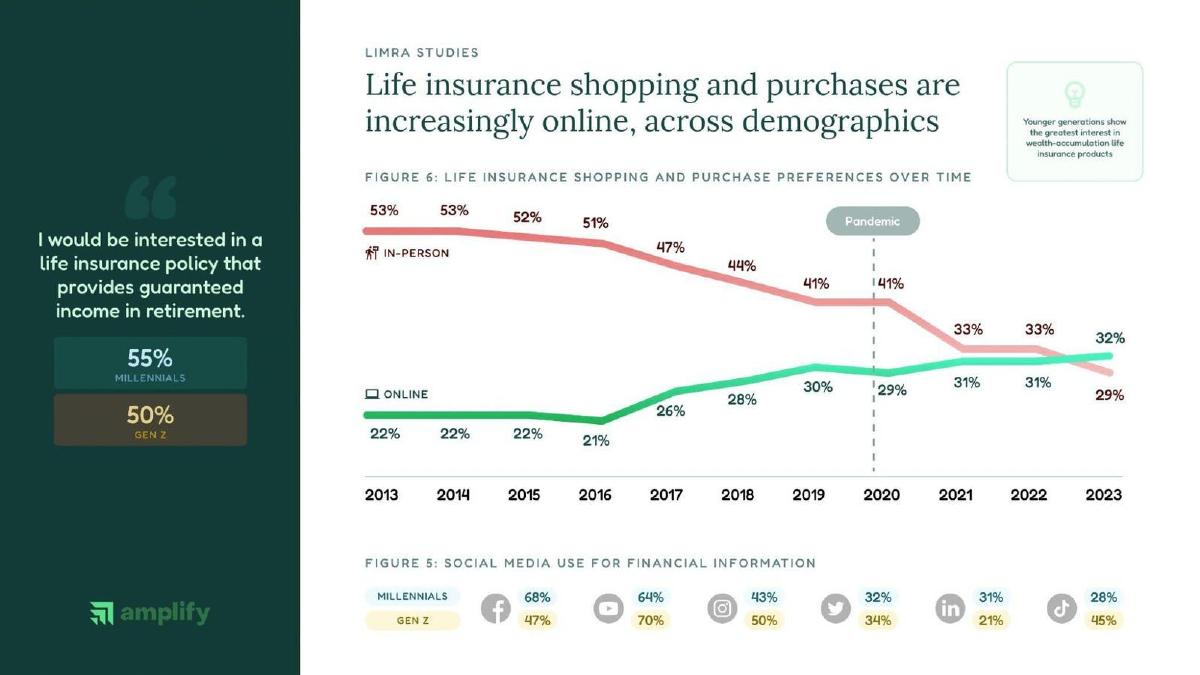
- Consumer behavior is shifting rapidly, with online life insurance shopping surpassing in-person for the first time in 2023 at 32% (Slide 4).
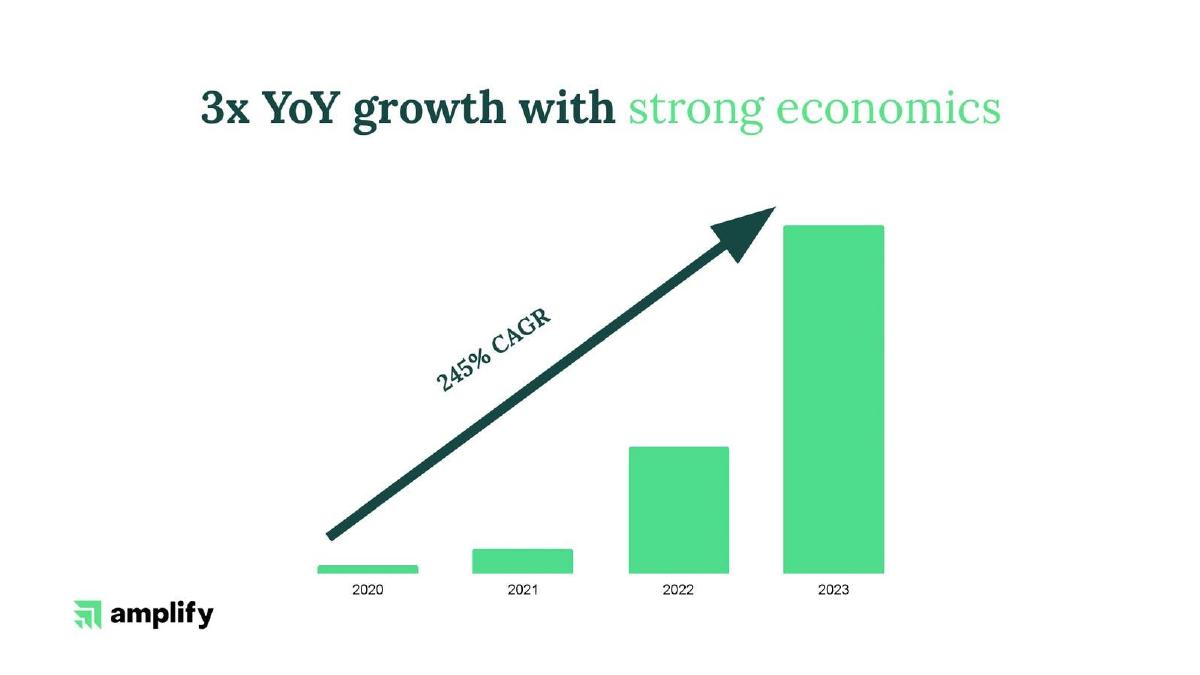
- The company demonstrates significant traction with a reported 245% CAGR from 2020 to 2023 (Slide 6).
- Amplify utilizes a proprietary data model to optimize customer Lifetime Value (LTV) across the entire sales funnel (Slide 7).
- The business model supports both B2C and B2B2C distribution channels through a proprietary tech stack (Slide 9).
- The deck omits a traditional team slide, specific use of funds, and detailed unit economics like CAC or LTV ratios.
- Reported by Business Insider, this deck supported a $20M Series B raise in 2024.
Repositioning a Legacy Industry for the Modern Investor
Amplify’s 10-slide deck is a study in narrative focus. In the fintech and insurtech space, founders often get bogged down in regulatory hurdles or complex actuarial tables. Amplify avoids this by focusing on a single, powerful idea: life insurance is an underutilized asset class for the masses. By raising $20M in a Series B in 2024, as reported by Business Insider, Amplify proved that investors are still hungry for 'boring' industries that are being successfully digitized.
Slide 1: The Vision Statement
The cover slide sets the tone immediately. The tagline, "Creating a new asset class with life insurance," is a bold claim. It signals to investors that this is not just another brokerage or lead-gen site; it is a fundamental shift in how consumers should view their balance sheets. The imagery of a diverse, happy family reinforces the 'protection' aspect of insurance while the text focuses on 'wealth.'
Slide 2: The 'Rich Man’s Roth' Hook
Slide 2 introduces the core concept: "Permanent life insurance has been known as the Rich Man’s Roth." This is a brilliant piece of framing. It takes a complex financial product (Perm Life) and anchors it to a well-understood, high-value concept (Roth IRA). The slide contrasts Term Life (temporary, low cost) with Perm Life (permanent, cash value growth). By highlighting that cash value can grow in "high interest savings or public equities," Amplify positions itself as a wealth-management platform rather than just an insurance agency.
Slide 3: Market Sizing and Global Context
To prove the scale, Slide 3 notes that "Perm life makes up the majority of the life insurance industry today." It cites an "$11B new premium per year" market for permanent life insurance, which represents 80% of the total market volume shown in the pie chart. To add credibility to the 'retirement pillar' argument, the slide lists massive international players: Ping An ($119B in China), Aviva ($10B in Europe), and Policybazaar ($6B in India). This suggests that the U.S. market has significant room to evolve toward these global norms.
Slide 4: The Digital Tipping Point
Slide 4 is the 'Why Now' slide. It uses LIMRA studies to show a massive shift in consumer behavior. For the first time, "Online" shopping and purchase preferences (32%) have surpassed "In-Person" (29%) as of 2023. The slide also notes that "55% of Millennials" and "50% of Gen Z" are interested in life insurance that provides guaranteed retirement income. This data justifies Amplify’s digital-first approach, showing that the legacy 'agent-at-the-kitchen-table' model is dying.
Slide 5: Customer Personas
Slide 5 uses two personas, Sarah and Leslie, to illustrate the product's versatility. Sarah is a "real estate investor" using an IUL (Indexed Universal Life) to protect her portfolio. Leslie is "self employed" and lacks a 401k, using the product for retirement planning and business cash flow. These examples move the product away from 'death benefit' and toward 'living benefit,' which is crucial for the Series B narrative.
Slide 6: Traction and Growth
Traction is the heart of any Series B deck. Slide 6 claims "3x YoY growth with strong economics." The chart shows a "245% CAGR" from 2020 to 2023. While the Y-axis lacks specific dollar amounts, the steepness of the bars from 2022 to 2023 suggests the company has found product-market fit and is ready to scale. The phrase 'strong economics' is used, though no specific LTV/CAC ratios are provided on this slide.
Slide 7: The Proprietary Data Model
Slide 7 explains the 'how.' Amplify claims to have built a "proprietary data model that optimizes customer LTV." The flow chart moves from Marketing Data to Customer Behavior, Sales Funnel Data, Underwriting & Decision, and finally Chargeback & Inforce. This slide is designed to convince investors that Amplify has a technical moat—that they are using data to pick better customers and keep them longer than a traditional carrier or broker could.
Slide 8: The Digital Experience
Slide 8 focuses on the user interface and internal efficiency. It contrasts the "face-to-face, paper-driven sales process" with Amplify's "simple, streamlined, and personalized digital experience." Key components include a "flexible recommendation engine" and "data-driven customer lifecycle management." This slide reinforces the 'InsurTech' identity of the company.
Slide 9: The Distribution Stack
Slide 9 presents a pyramid representing the "proprietary stack that powers B2C and B2B2C distribution channels." At the base is the "Core Digital Agent," moving up through Proprietary Products, Back-end Platform, and API Connectivity. This indicates that Amplify isn't just selling to consumers directly; they have the infrastructure to partner with other institutions (B2B2C), which is a major valuation driver in fintech.
Slide 10: Closing
The deck ends simply with the Amplify logo on a dark green background. There is no 'Ask' slide, no 'Use of Funds,' and no 'Team' slide included in this 10-slide sequence.
What Amplify Does Well
Amplify excels at market repositioning . They take a product that is often viewed as a commodity (life insurance) and rebrand it as a sophisticated investment vehicle. By using the 'Rich Man’s Roth' analogy, they immediately communicate value to a high-intent audience. The use of third-party data (LIMRA) to show the decline of in-person sales is a powerful way to validate their digital-first business model. Furthermore, the focus on 'Proprietary Data Models' and 'API Connectivity' helps them escape the 'agency' label and earn a 'tech' multiple.
What is Missing from the Deck
The most glaring omission is the Team Slide . For a $20M Series B, investors usually want to see the pedigree of the leadership team, especially in a highly regulated industry like insurance. Also missing is a Competitor Analysis . While they mention global giants like Ping An, they don't address domestic competitors or other InsurTech startups. Finally, the lack of an Ask Slide is unusual; typically, a deck should specify how much capital is being raised and the specific milestones that capital will unlock (e.g., geographic expansion, new product lines, or headcount growth).
What Founders Should Copy
Founders should emulate Amplify’s clarity of narrative . The deck doesn't try to do too much. It identifies a massive, outdated market, shows a shift in consumer behavior, and presents a growth curve that proves they are capturing that shift. The visual consistency —using a limited color palette of greens and creams—makes the deck feel professional and 'financial.' Most importantly, the persona slide (Slide 5) is a great way to make a complex financial product feel relatable and solve specific problems for different types of users.
Frequently asked questions
- What is the core value proposition of Amplify?
- Amplify positions permanent life insurance as a wealth-building tool, often referred to as a 'Rich Man’s Roth.' Unlike term life insurance, which provides temporary coverage, Amplify’s products allow users to grow cash value in high-interest savings or public equities, providing tax-free wealth access during their lifetime.
- How does Amplify justify the market opportunity?
- The deck highlights that permanent life insurance already makes up the majority of the industry, with $11B in new premiums per year. It also points to international markets like China (Ping An at $119B) to show that life insurance can be a fundamental pillar of retirement planning.
- What traction metrics are included in the deck?
- Amplify shows a bar chart indicating '3x YoY growth' and a '245% CAGR' from 2020 through 2023. While specific revenue or policy count numbers are not labeled on the Y-axis, the visual representation shows consistent and accelerating growth over a four-year period.
- What is missing from the Amplify pitch deck?
- The deck is notably missing a team slide, a competition slide, and a specific 'Ask' slide detailing how the $20M will be spent. It also lacks granular unit economics, such as Customer Acquisition Cost (CAC) or specific Lifetime Value (LTV) dollar amounts.
- How does Amplify differentiate its technology?
- Amplify emphasizes a 'proprietary stack' that powers its digital agent and distribution channels. This includes a data-driven recommendation engine, a seamless customer portal, and a data model that tracks everything from marketing data to chargebacks to optimize LTV.